Management Infrastructure (MI) — the five elements of the Lean management system
≈ 19 min read · 3,843 words
Management Infrastructure (MI) is the formal structures, processes and systems that direct and optimize human and organizational resources towards shared goals. This is the “how we lead” perspective of Lean’s three lenses, and it is made up of five elements: (1) the performance management process, (2) organization structure, (3) capability building, (4) the continuous improvement infrastructure and (5) functional support. Performance management is the engine that aligns the other four; a Lean result can only be sustained if all five elements develop together.
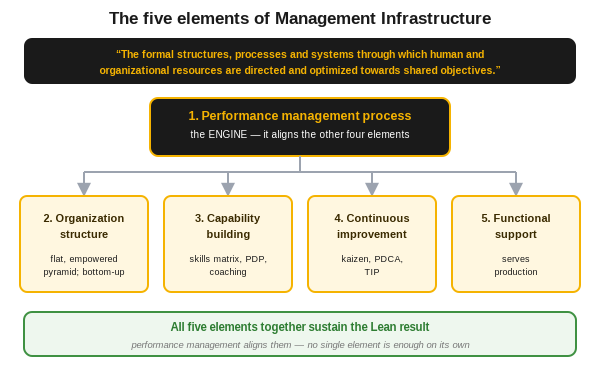
Figure 1 — the five elements of MI, following the “MI in lean transformation” logic: the performance management process is the engine that binds organization structure, capability building, continuous improvement and functional support into a single system.
Who is this for?
Section titled “Who is this for?”This article is for people who are not only rolling out Lean tools but want to build an operation that lasts: plant and production manager · shift supervisor · process engineer · Lean/CI specialist · HR and training · heads of support functions (maintenance, procurement, laboratory) · reliability engineer.
Learning objectives
Section titled “Learning objectives”After reading this article you will be able to:
- place MI within the system of the three Lean lenses (“how we lead”);
- list and tell apart the five elements of MI, and explain why performance management is the engine;
- recognize why a Lean improvement slips back without a management infrastructure;
- run a simple five-element self-assessment on your own plant and find the weakest link;
- draw the boundary: where the MI management system complements certified process-safety systems, and where it does not replace them.
In brief
Section titled “In brief”- MI is one of the three Lean lenses. In the Operating System (OS) / Management Infrastructure (MI) / Mindset & Behaviours (M&B) trio, MI covers the management systems and routines (the “how we lead”), as opposed to the OS (“what we do”) and M&B (“how we think”).
- Five concrete elements, not an abstract notion. The method breaks MI down into five tangible building blocks (see Figure 1), each of which can be measured and improved separately.
- Performance management is the engine. Element 1, the closed loop of measure → dialogue → action, is what aligns the rest; if it is weak, the other four will not hold the improvement either.
- It only works as a whole. No single element is enough on its own: a performance board without organizational empowerment, or capability building without a continuous improvement routine, slips back.
- Many Lean failures come from missing MI. Programs typically improve only the OS (the technical process) and skip the management infrastructure, which is why the improvement is not sustainable.
- It exists to serve the front line. The whole logic of MI is bottom-up: the structure, the support functions and the measurement are there to serve the value-creating process, production, not the other way round.
Why does only one of two identical plants stay Lean? (the stakes)
Section titled “Why does only one of two identical plants stay Lean? (the stakes)”Picture two plants that receive the same Lean training: both introduce 5S, standard work and a performance board. Six months later, in one of them the boards are up to date, the team solves problems on its own and the improvement holds; in the other the boards are dusty ornaments, every decision piles up towards the top, and the results have fallen back to where they started. The difference is not in the tools but in the management infrastructure that was built around the tools (or was not).
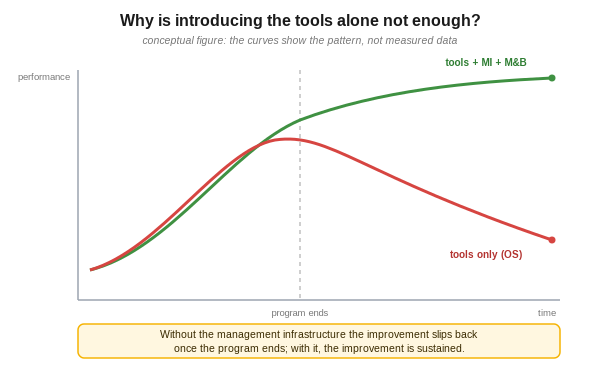
Figure 2 — the tools do improve things on their own, but the gains slip back once the program ends; it is the management infrastructure (MI) and the mindset (M&B) that sustain the improvement. The curves show the pattern, not measured data.
So what is at stake is sustainability. A Lean campaign almost always shows results in the short term, because fresh attention improves things by itself. The question is whether the improvement stays once the attention moves elsewhere. Only one thing answers that: whether there is measurement, accountability, capability, a CI routine and support that turn the improvement into a daily routine. That is MI.
What is MI, and where does it come from? The system of the three lenses
Section titled “What is MI, and where does it come from? The system of the three lenses”MI is the management layer of a Lean transformation: the system that makes day-to-day operation leadable and sustainable. A Lean transformation is developed through three simultaneous perspectives, three “lenses”, and Management Infrastructure is the one that holds the management systems together. The precise definition:
“The formal structures, processes and systems through which human and organizational resources are directed and optimized towards shared objectives.”
That single sentence makes the difference between the three lenses visible:
| Lens | Question | What it holds together |
|---|---|---|
| Operating System (OS) | “what we do” | configuring the process for value creation and waste minimization (standard work, 5S, JIT) |
| Management Infrastructure (MI) | “how we lead” | the formal structures, processes and systems through which we lead |
| Mindset & Behaviours (M&B) | “how we think” | how people think, feel and behave at work, individually and together |
MI is therefore the link through which daily operation becomes measurable, accountable and sustainable: the measurement, the review routine, the organizational setup, the training and the support.
Why five elements? MI is not a single tool but five mutually reinforcing systems. The practical logic is simple: a good performance board (measurement) is worth nothing if the organization gives the front line no accountability (structure); the accountability is worth nothing if people lack the skills to solve problems (capability building); and all of it is worth nothing without a routine that turns improvement ideas into action (continuous improvement), or if the support functions do not serve production (functional support).
What are the five elements of Management Infrastructure?
Section titled “What are the five elements of Management Infrastructure?”The five elements of MI are the performance management process, organization structure, capability building, the continuous improvement infrastructure and functional support. The first is the engine, the other four are the driven system; each can be measured and improved separately, but only together do they hold a result.
1. Performance management process — the engine
Section titled “1. Performance management process — the engine”This is the element that breaks business goals down into human and business performance indicators, and reviews them regularly as well. It is the closed loop of measure → dialogue → action that drives PDCA at every level of the organization, and that aligns the other four elements. The source uses an apt image: performance management is like a car’s dashboard, showing the current value against the target, and giving the basis for corrective interventions. It breaks down into five sub-elements of its own: metrics/targets → plans → tracking → dialogue → rewards/actions.
The five key messages of the method from the source:
-
The dialogue is what counts. The value comes not from the board but from the conversation that forms around it and the action that follows from it.
-
KPIs should measure both performance and health, from the top down.
-
Visual management draws attention to every KPI and shows how important each of them is.
-
Never more than 5–6 KPIs at any one level, with well-defined targets.
-
KPIs are reviewed in a cascade, at every level of the organization, nested into one another.
-
Details: the full cycle, the car-dashboard analogy and the failure patterns are in the performance management article.
-
Tools: performance board · performance dialogue · visual management · KPI · KPI cascade (OGSM) · feedback · gemba walk.
2. Organization structure
Section titled “2. Organization structure”The second element is how the organization is built: the span of control, the decision rules, the clarity of roles and responsibilities. A Lean organization is flatter and empowered: compared with the traditional pyramid, more responsibility sits with the front line. According to the four points in the source, the organization exists to serve the operating system, not the other way round (bottom-up); the “step down” model covers absences; more problem-solving responsibility moves to the line; and the leader coaches rather than fights fires.
- Details: The Lean organization and the empowered workforce (inverted pyramid, step-down model, coaching vs. firefighting).
3. Capability building
Section titled “3. Capability building”The third element is about how well skill development fits the company’s needs and the individual roles. The goal is a capable and flexible workforce. The source gives a four-step logic: understand what skills are needed to run the operating system → assess the skills you have → draw up a development plan (PDP) to close the gap → build talent for the future. Adult learning is effective when it is experiential (learn by doing) and tied to real work; the key tools are the skills matrix and daily coaching, not the classroom.
- Details: Capability building in the Lean organization (skills matrix, PDP, Influence Model, navigator coaching). Related: training and onboarding, Lean navigator.
4. Continuous improvement infrastructure
Section titled “4. Continuous improvement infrastructure”The fourth element measures how effective the CI processes and tools are, and how they turn improvement ideas into action. This is the structured routine: current state → identifying losses → future state → closing the gaps → TIP (implementation plan) with an owner and a deadline → roll out → measurement → review. The source explicitly maps PDCA onto it: the current-state analysis is the Plan, closing the gaps and the roll-out are the Do & Check, the review is the Act. The aim is always kaizen (kai = change, zen = good, “change for better”) moving towards True North (the ideal state).
5. Functional support
Section titled “5. Functional support”The fifth element measures how effectively the other functions and departments (maintenance, procurement, HR, engineering, IT) serve production, because that is where value is created. Good functional support breaks down the silos, adopts a customer perspective (production is the internal customer), and rests on effective communication.
Why does it only work as a whole? The system logic
Section titled “Why does it only work as a whole? The system logic”The five elements are not a menu to pick from but a system in which the weakest link determines the result. A strong board fails alongside a weak structure just as surely as an empowered team fails without skills.
| If this is missing… | …then the symptom is |
|---|---|
| performance management | we measure, but there is no dialogue and no action, and the numbers become “ornaments” |
| organization structure | the front line gets no responsibility, every decision piles up towards the top |
| capability building | the board is there, but the skills for good questions and problem solving are not |
| continuous improvement | good ideas come up, but they never become closed actions |
| functional support | the support functions chase their own goals, silos form, production is left on its own |
Performance management is the engine, because it is the only element that makes the other four measurable and accountable: the responsibilities of the structure, the capability development plans, the CI actions and the support services all come together in the performance dialogue.
What does MI look like in the process industries?
Section titled “What does MI look like in the process industries?”In a process-industry plant (chemicals, oil refining) the five elements of MI take a tangible form. Performance management sets the focus KPIs (energy consumption, availability, unplanned shutdowns) top-down and breaks them down to equipment level. The organization structure gives the shift team and the shift supervisor greater decision-making authority over the stability of the operation. Capability building develops the operators’ technological and problem-solving skills (skills matrix, simulator practice). Continuous improvement is the kaizen and A3 routine. And functional support means that maintenance, the laboratory service and procurement serve production as their internal customer.
How do you diagnose your MI tomorrow? (hands-on)
Section titled “How do you diagnose your MI tomorrow? (hands-on)”One concrete exercise is built around performance management: the team helps a plant manager develop a performance board, then prepare and run a daily review meeting (with assigned roles: one team leader chairs the meeting, one person observes as plant manager and gives feedback and challenge, the rest take part as members of the shift). It is worth running this role-play for real as well, because chairing the dialogue is what needs practising.
Beyond that, a shift supervisor can run a simple five-element self-assessment tomorrow to find the weakest link:
- Performance management: are there a few (max. 5–6) KPIs with targets, on a visible board, with a regular review and action?
- Structure: does the front line solve problems itself, or does everything pile up towards the top?
- Capability building: is there a skills matrix, and a development plan (PDP) for every person?
- Continuous improvement: do the ideas that come up become closed actions with an owner and a deadline (TIP)?
- Functional support: do maintenance, procurement and the laboratory serve production, or chase their own goals?
Give each element a maturity level from 0 to 4 (0 = absent, 4 = mature routine), and start with the weakest element, because that is what drags the whole system down.
Measurement / audit — how to put numbers on it?
Section titled “Measurement / audit — how to put numbers on it?”You can make MI measurable with a simple maturity self-assessment: assign a level from 0 to 4 to each element, and track whether the level of the weakest element is rising. The scale follows the skills-matrix logic established in Lean practice (the cells denote levels 0–4); here you apply it not to a person but to the five MI elements.
| Level | What it means (in general) |
|---|---|
| 0 | not present (no board / no accountability / no skills assessment) |
| 1 | ad hoc, occasional, not regular |
| 2 | defined, but not consistent |
| 3 | a regular routine, works at most levels |
| 4 | mature, self-sustaining, continuously improving |
The point is not the absolute score but two things: (1) identifying the weakest element, and (2) tracking the rise of the level over time. The KPI side of performance management is covered in more depth in the performance board and KPI definitions articles.
Common mistakes — anti-pattern ↔ correction
Section titled “Common mistakes — anti-pattern ↔ correction”- “We just roll out the tools” (OS focus). Why it hurts: without MI the technical improvement is not sustainable and slips back (see Figure 2). Instead: develop all three lenses (OS + MI + M&B) in parallel.
- “The performance board is the goal itself.” Why it hurts: the board is a single sub-element of a single MI element, it is not a management system on its own, and the dialogue is what counts, not the board. Instead: surround the board with dialogue, action, accountability and capability.
- Empowerment without capability building. Why it hurts: the front line is given responsibility but lacks the skills to use it, so it makes mistakes. Instead: develop elements 2 and 3 together (empower + enable).
- Support functions working in silos. Why it hurts: maintenance or procurement chases its own KPI and production is left on its own. Instead: the customer of the support function is production — a shared goal and a shared language.
- CI ideas without action. Why it hurts: kaizen enthusiasm evaporates into unclosed tasks. Instead: every idea into a TIP, with an owner and a deadline, tracked at the review; escalate an unresolved action after a week.
When NOT to rely on MI? (the limits)
Section titled “When NOT to rely on MI? (the limits)”MI is the management system of a sustainable operation, but it is not the answer to every problem. Sometimes another tool or another layer is the right one:
| Situation | Why MI is not (primarily) the answer | The right answer | |||
|---|---|---|---|---|---|
| Safety-critical protection is needed | MI makes HSE performance visible, but it is not a certified protection layer | design per [[lopa-sil.en | SIL/LOPA]], [[hazop.en | HAZOP]], [[moc.en | MOC]] |
| No stable operating base (OS) | you cannot plant a management system on a chaotic process | stabilize the OS first (5S, standard work, [[vsm.en | VSM]]) | ||
| A one-off, non-recurring problem | there is nothing to build into a lasting routine for a single case | one-off root-cause analysis ([[5-miert.en | 5 Whys]], [[a3-riport.en | A3 report]]) | |
| An acute crisis / immediate shutdown | the daily review cadence is too slow for a decision needed within minutes | incident-management / emergency protocol, then the MI lesson afterwards |
Rule of thumb: MI is strongest at sustaining regular operation. It does not replace certified safety, a stable operating base or acute crisis management — it surrounds them and makes them sustainable.
Take it home (keys)
Section titled “Take it home (keys)”- MI is five concrete elements, not a slogan: performance management, structure, capability building, continuous improvement, functional support, each measurable and improvable separately.
- Performance management is the engine. If you start with a single element, make it this one, because it is what makes the rest accountable.
- The weakest element decides. Run the five-element self-assessment and start with the lowest level.
- The whole thing is bottom-up. The structure and the support exist to serve the value-creating front line, not the other way round.
- Without MI, Lean stays a campaign. Sustainability does not depend on the tools but on the management infrastructure.
Self-test
Section titled “Self-test”- Why is introducing a performance board not enough on its own for a Lean transformation? Which other four MI elements does it need in order to be sustainable?
- MI has five elements, and element 1 (performance management) also has five elements. Can you list both fives and say how they are nested into each other?
- In one plant the skills matrix and the training are excellent, but the improvement ideas are never implemented. Which MI element is weak, and how would you fix it?
How does this show up in digital practice?
Section titled “How does this show up in digital practice?”The principle of a management infrastructure does not stop at the paper performance board and the face-to-face review: the same measure → dialogue → action logic is realized in software too. The mechanism differs (database, workflow, dashboard instead of a whiteboard and an in-person meeting), but the principle is the same: daily management routines only hold a result if they are locked into a system.
| MI element / principle | Digital implementation | What it adds |
|---|---|---|
| Performance management (measure → dialogue → action) | KPI dashboard with automatic data collection, logged performance dialogue | the number is visible in real time, the action is not lost |
| Organization structure / accountability | action assignment with an owner and a deadline, escalation rule | the decision stays where it belongs, it does not pile up towards the top |
| Capability building | digital skills matrix, individual development plan (PDP) tracked | the gap and the progress become visible and maintainable |
| Continuous improvement | idea and action register (TIP) with closure tracking | every idea turns into a closed, auditable action |
| Functional support | cross-functional request/ticket from production, with SLA tracking | the customer of the support function is visibly production |
| Shift boundary | structured, searchable digital shift handover | open actions and decisions survive the shift change |
Connection to OPEREX (shift log)
Section titled “Connection to OPEREX (shift log)”The most fragile point of MI is getting the daily management routines to survive from shift to shift: the actions from the performance dialogue, the front-line decisions, the open CI tasks and the requests raised towards the support functions must not be lost at the shift boundary. The OPEREX shift log digitizes exactly this MI layer: it gives a uniform, searchable, time-stamped record of decisions and handovers, which forms an auditable trail (ISO 45001 §10.3) and can be linked to the performance indicators. The connection between the five elements (measure → accountability → action → closure) thus becomes a machine-closed loop.
Terminology (HU / EN / JP)
Section titled “Terminology (HU / EN / JP)”| Hungarian | English | JP / note |
|---|---|---|
| menedzsment-infrastruktúra | Management Infrastructure (MI) | the “how we lead” lens |
| teljesítménymenedzsment-folyamat | performance management process | element 1, the engine |
| szervezeti struktúra | organization structure | element 2 |
| képességépítés | capability building | element 3 |
| folyamatos fejlesztés infrastruktúrája | continuous improvement infrastructure | element 4, 改善 (kaizen) |
| funkcionális támogatás | functional support (system) | element 5 |
| felhatalmazott munkaerő | empowered workforce | flat organization, bottom-up |
| érettségi önértékelés | maturity self-assessment (L0–L4) | for identifying the weakest element |
What is Management Infrastructure (MI) in Lean?
The set of formal structures, processes and systems through which human and organizational resources are directed and optimized towards shared objectives. It is the “how we lead” perspective of Lean’s three lenses, the layer of management systems and routines.
What are the five elements of Management Infrastructure?
(1) The performance management process, (2) organization structure, (3) capability building, (4) the continuous improvement infrastructure and (5) functional support. Performance management is the engine that aligns the other four.
Which MI element is the most important?
The performance management process, because it is the only element that makes the other four measurable and accountable. At the same time, no single element is enough on its own: a Lean result can only be sustained if all five develop together.
Why do so many Lean programs fail because MI is missing?
Because programs typically improve only the Operating System (the technical process) and skip the management infrastructure and the mindset. Without management systems (measurement, accountability, capability, a CI routine, support), the technical improvement is not sustainable and slips back once the program ends.
What is the difference between the five elements of MI and the five elements of performance management?
The five elements of MI are the five building blocks of the management system (PM process, structure, capability building, CI, functional support). The first of these, performance management, itself breaks down into five steps of its own (metrics/targets → plans → tracking → dialogue → rewards/actions). The two “fives” are nested, not the same thing.
Related concepts
Section titled “Related concepts”the three lenses · performance management · organizational empowerment · capability building · functional-support · kaizen · pdca · performance board · performance dialogue · ogsm · mos · lean-navigator · shift handover
Next step
Section titled “Next step”If you have understood MI as a whole, from here it is worth going on — in this order:
- performance management — element 1, the engine, in detail: the measure → dialogue → action cycle, the car-dashboard analogy and the failure patterns. Start with this, because it is what aligns the rest.
- organizational empowerment — element 2: how the pyramid becomes a flat, empowered organization that serves the operating system.
- capability building — element 3: skills matrix, PDP and coaching, so that the empowered front line also has the skills to use that responsibility.
References / further reading
Section titled “References / further reading”- James P. Womack – Daniel T. Jones: Lean Thinking. Free Press, 2003 — the systems view of the Lean transformation, which underpins the role of management infrastructure in sustainability.
- Mike Rother: Toyota Kata: Managing People for Improvement, Adaptability and Superior Results. McGraw-Hill, 2009 — the daily management routine (coaching kata, improvement kata) as the engine of sustainable development.
- ISO 45001:2018 — occupational health and safety management system; §10.3 (continual improvement) provides a frame for the auditable routines of MI.