Six Sigma
≈ 23 min read · 4,515 words
You order a package with “2–4 business days” delivery. Sometimes it is there the next day, sometimes a week later. The average is fine, but you can never plan around it, because the spread is large. This unpredictability is exactly what Six Sigma attacks: it does not polish the average, it squeezes the process’s variation together so that the output reliably stays within the tolerance limits. Let’s look at what the meaning of Six Sigma is, what the notorious 3.4 defects per million means, and how it can be introduced into a process.
Six Sigma is a data-driven process-improvement methodology that improves quality by eliminating the causes of defects and reducing process variation. It attacks variance (spread): the more predictable a process is, the fewer defective outputs it produces. Motorola developed it in the 1980s out of Total Quality Management, and it combines statistical tools, belt-grade expert roles, and quantified, financially measurable targets. A “six sigma” level process produces at most 3.4 defects per million opportunities (DPMO) over the long term, that is, it operates virtually defect-free.
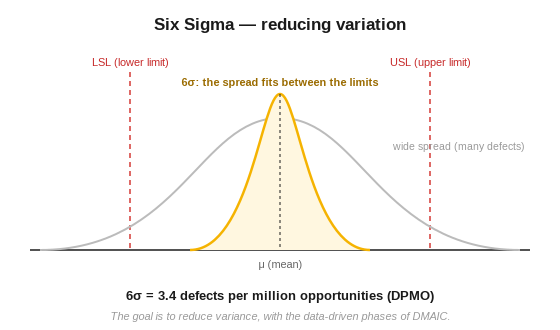 Figure 1 — by narrowing the spread, the bell curve fits between the tolerance limits (LSL, USL); this is quantified by the sigma level and the DPMO.
Who is this for?
Section titled “Who is this for?”This article is for those responsible for the predictability and quality of their processes: process technologist · process and quality engineer · plant and production manager · shift supervisor · CI/Lean specialist · reliability engineer · HSE.
Learning objectives
Section titled “Learning objectives”After reading this article you will be able to:
- explain why variance (not the average) is Six Sigma’s main target;
- interpret the sigma level and the 3.4 DPMO, and justify why it is actually 4.5σ over the long term;
- distinguish DMAIC (improving an existing process) from DMADV/DFSS (designing a new one);
- place the actors in the belt-grade hierarchy (Champion, Master Black Belt, Black/Green/Yellow Belt);
- decide when Six Sigma is the right tool, and when a Lean redesign or another method must come first.
The essence
Section titled “The essence”- Six Sigma attacks variance (spread): the more predictable a process is, the fewer defective outputs it produces. “Doing things right (defect free),” as opposed to lean, which focuses on flow and waste (“doing things quickly”).
- The workflow is the dmaic framework: Define → Measure → Analyze → Improve → Control (improving an existing process), or DMADV / DFSS for a new design.
- The yardstick is DPMO (Defects Per Million Opportunities): the six sigma target over the long term is ≤ 3.4 DPMO, but this is not a mandatory target for every process; the organization decides the appropriate sigma level process by process.
- The belt-grade hierarchy (Champion, Master Black Belt, Black Belt, Green Belt, Yellow/White Belt) professionalizes quality work; success requires top-management commitment.
- The decision is always based on verifiable data and statistics, not on assumption, and every project has a quantified financial target.
- The 3.4 DPMO actually corresponds to 4.5 sigma because of the built-in 1.5 sigma “shift” (long-term shift); understanding this is important so as not to underestimate the real defect level.
- On its own it often “sub-optimizes” (improves processes in isolation), which is why it is merged with Lean into lean-six-sigma.
Why does it matter? (the stakes)
Section titled “Why does it matter? (the stakes)”Variance is not abstract statistics: in a process-industry plant an unpredictable process burns money and safety. A wide spread means the critical parameter (temperature, pressure, sulfur content, cut point) sometimes falls within tolerance and sometimes not. This chain is familiar: a fluctuating process → off-spec product → re-run, re-blending, quality complaint → deviation, an unstable transient state → at the worse end a safety event.
The stake of Six Sigma is thus not the “6σ trophy” but predictability: less scrap, fewer re-runs, fewer deviations, and process fluctuation caught earlier, before it has escalated. The most expensive defect is the one that surfaces at the customer or in an incident.
What is Six Sigma, and where does it come from?
Section titled “What is Six Sigma, and where does it come from?”Six Sigma is a set of strategies, techniques and tools for process improvement, which Motorola developed in the 1980s to reduce defects; its aim is virtually defect-free performance, corresponding to 3.4 defects per million opportunities (DPMO). The methodology grew out of Total Quality Management (TQM), one of the core pillars of industrial engineering.
The roots of “Six Sigma” as a measurement standard reach further back:
- Carl Friedrich Gauss (1777–1855) introduced the concept of the normal curve;
- Walter Shewhart showed in the 1920s that three sigma from the average is the point at which a process requires correction (control chart);
- the term “Six Sigma” was coined by Bill Smith, a Motorola engineer.
The method became globally known when Jack Welch made it a central element of business strategy at General Electric in 1995. GE’s **1 billion) gave a strong boost to its spread; Motorola reported savings of over $17 billion by 2006. By the late 1990s about two-thirds of Fortune 500 companies had launched a Six Sigma initiative. The method is also defined by the ISO 13053:2011 standard.
The three fundamental tenets of the doctrine:
- A stable, predictable process outcome (reducing variance) is vital to business success.
- Processes have measurable, analyzable, controllable and improvable characteristics.
- Sustained quality improvement requires the commitment of the whole organization, especially of senior management.
Where Six Sigma differs from earlier quality initiatives: a clear focus on measurable financial return, strong leadership support, the belt-grade infrastructure, and decisions based on verifiable data instead of guesswork.
How does Six Sigma work?
Section titled “How does Six Sigma work?”Six Sigma attacks the cause of the defect, with a data-driven methodology: in a five-phase framework (DMAIC) it measures the process, uses statistics to uncover the root cause of variance, fixes it, and then controls it so the improvement is sustained. It has two project methodologies, built on a shared statistical core.
The two project methodologies
Section titled “The two project methodologies”Six Sigma projects follow a five-phase methodology inspired by Deming’s PDCA (Plan-Do-Check-Act) cycle:
- dmaic — to improve an existing business process (Define → Measure → Analyze → Improve → Control).
- DMADV / DFSS (Design For Six Sigma) — to design a new product or process.
The five phases of DMAIC in summary (the detailed toolkit and the phase gates are laid out in the dmaic article):
| Phase | What you do | Guiding question |
|---|---|---|
| Define | precise definition of the system, the voice of the customer (VOC) and the project goals, project charter | What matters? |
| Measure | measuring the key characteristics, collecting baseline data | Where do we stand now? |
| Analyze | verifying the cause-and-effect relationship, uncovering the root cause of the defect | What is the real cause? |
| Improve | optimizing the process based on data, a pilot run to prove capability | What must be done? |
| Control | sustaining the future state, correcting the deviation before it becomes a defect | How do we sustain it? |
Some organizations put a Recognize step in front of DMAIC (selecting the right problem) → RDMAIC.
The five phases of DMADV / DFSS: Define (design goals consistent with the customer need and the strategy) → Measure (identifying the CTQ = Critical To Quality characteristics, risks, capability) → Analyze (developing design alternatives) → Design (designing the best alternative) → Verify (validating the design, pilot, handover to the process owner). The choice is simple: is there already an existing process (→ DMAIC), or are we designing from scratch (→ DMADV)?
What does the sigma level mean?
Section titled “What does the sigma level mean?”The “six sigma process” comes from the idea that if there is a distance of six standard deviations (6σ) between the process average and the nearest specification limit, then virtually no item falls outside the limit. Capability studies measure how many standard deviations (σ) fit into this gap. If the spread grows, or the average moves away from the center of the tolerance range, fewer σ fit in, so the sigma number falls and the probability of out-of-specification items rises.
The 1.5 sigma shift (the key to understanding the 3.4 DPMO). Processes perform worse over the long term than over the short term: the average drifts, and/or the spread grows. This is accounted for with an empirical 1.5 sigma shift. So a process that fits 6 sigma in the short term fits only 4.5 sigma over the long term, and it is precisely this 4.5 sigma that gives 3.4 DPMO (a one-sided capability study). “Six sigma = 3.4 DPMO” is therefore actually 6σ minus the 1.5σ shift.
Long-term DPMO values (assuming a 1.5σ shift):
| Sigma level | DPMO | Defective % | Yield | Long-term Cpk |
|---|---|---|---|---|
| 1 | 691,462 | 69% | 31% | –0.17 |
| 2 | 308,538 | 31% | 69% | 0.17 |
| 3 | 66,807 | 6.7% | 93.3% | 0.5 |
| 4 | 6,210 | 0.62% | 99.38% | 0.83 |
| 5 | 233 | 0.023% | 99.977% | 1.17 |
| 6 | 3.4 | 0.00034% | 99.99966% | 1.5 |
The toolbox (within the phases)
Section titled “The toolbox (within the phases)”Six Sigma uses many established quality-management tools: 5 Whys, fishbone (Ishikawa) diagram, check sheet, control chart, correlation, cost-benefit analysis, CTQ tree, DOE, histogram, Pareto analysis and chart, process capability, QFD (Quality Function Deployment), rolled throughput yield, root-cause analysis, run chart, scatter diagram, SIPOC (Suppliers-Inputs-Process-Outputs-Customers), stratification, Taguchi methods. Software frequently used for statistical work: Minitab, JMP, R (SixSigma/qcc packages), SigmaXL, Statgraphics, STATISTICA, MATLAB/Octave, Microsoft Visio.
Who are the Six Sigma “belt grades”?
Section titled “Who are the Six Sigma “belt grades”?”Six Sigma arranges quality-management roles into a hierarchy resembling the martial-arts belt grades, thereby professionalizing quality work. At the top stand a few dedicated leaders; lower down more and more people work on the projects, with ever less dedicated time.
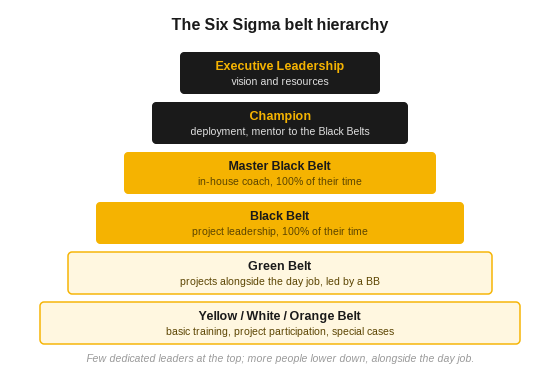 Figure 2 — the belt hierarchy: leadership provides the vision and the resources, the Master/Black Belt is a full-time expert, and the Green and Yellow/White Belts run projects alongside their day job.
| Grade | Role |
|---|---|
| Executive Leadership | forming the Six Sigma vision, resources and empowerment |
| Champion | organization-wide deployment; mentor to the Black Belts, assigner of projects |
| Master Black Belt | in-house coach, 100% of their time; helps Champions, leads Belts, ensures the consistent application of the method |
| Black Belt | executing specific DMAIC projects, 100% of their time |
| Green Belt | works on projects alongside their own job, under the guidance of a Black Belt |
| Yellow / White / Orange Belt | basic training, project participation, special cases |
Process-industry context and safety
Section titled “Process-industry context and safety”In a continuous-operation (petroleum-refining, petrochemical) environment, sigma thinking measures the reliability of the critical quality parameters (product specification, on-spec yield). Low sigma = a lot of off-spec product, recurring deviations, frequent re-runs (re-run, re-blending). The capability study (Cpk) measures whether the critical parameters (temperature, pressure, sulfur content, cut point) stay within the tolerance limits.
Reducing variance is a direct safety and quality benefit: a more stable, more predictable operation means less out-of-specification product, fewer unstable transient states and lower deviation risk. The Control phase’s SPC control chart signals special-cause fluctuation early, before the deviation drives the process out of specification or into a dangerous range. Six Sigma thus fits the existing operational-safety systems (moc, deviation management): the numerical, data-driven approach crowds out anecdotal “I feel it got better” decisions.
How do you introduce Six Sigma?
Section titled “How do you introduce Six Sigma?”You start not with the methodology but with the strategic goal: you select a well-delimited process with real variance, build the roles, run DMAIC through it, and with the Control phase ensure the improvement is sustained before you roll it out further. The recommended introduction arc:
- Start with a strategic goal, not with the methodology. The desired outcome determines the approach, not the other way around. Never “brand” the initiative with the method (the “Six Sigma company” goal is not achievable); the method should work behind the goal, in the background.
- Executive sponsorship (Executive Leadership / Champion). The CEO and senior management set the vision and give resources and freedom to the other roles. Without active, visible participation the initiative dies.
- Pilot on a well-delimited process. Choose a project with a quantifiable financial goal, where there is real variance (this is where Six Sigma works best). Prepare with a Project Charter, VOC, and baseline measurement.
- Building the roles and training. Per the belt hierarchy: a Black Belt leads (100%), a Master Black Belt coaches (100%, in-house trainer), Green Belts work alongside their own jobs, Yellow/White Belts support with basic knowledge, and the Champion mentors and integrates (see the hierarchy table above).
- Running DMAIC through the pilot process, with a pilot run to prove capability in Improve.
- Setting up Control (SPC, visual control, check sheets): this is where it is decided whether the result is sustained.
- Deployment. After the proven pilot, nominating new projects and replicating the results to other processes. Following the “20% of tools → 80% of benefit” principle, focus on the vital few tools.
- Metrics to shape behavior. A regularly reviewed indicator (e.g. Balanced Scorecard) keeps attention on, and sustains, the result achieved.
Measurement / audit
Section titled “Measurement / audit”- Sigma level / DPMO.
DPMO = (number of defects ÷ (number of units × number of defect opportunities per unit)) × 1,000,000. The sigma level is then read from a capability table (see the table above). The goal is not necessarily 3.4 DPMO, but the value assigned to the process according to customer expectation. - Process capability (Cp, Cpk). Measures the process’s “fit” relative to the tolerance. By the logic of the table, the short-term Cpk is 2.0 at ~6σ, the long-term (after the 1.5σ shift) is 1.5. The deterioration of Cpk (short → long term) is exactly the built-in shift.
- Baseline measurement as decision support. The healthcare example is instructive: the clinical processes’ average baseline sigma score was 2.0 (median 1.9), meaning the processes were defective more than 30% of the time; the worst was 0.4 (86% defective). The lesson: if the baseline is too low, a redesign is needed first (Lean), and only afterward is it worth pulling out the variance (Six Sigma). A fundamentally bad process cannot be polished “defect-free.”
- Control chart (SPC) audit. In the Control phase, the control chart signals when intervention is needed to find and eliminate the special-cause variance. A control-limit exceedance is an early sign of the maintenance sliding back.
Hands-on / example
Section titled “Hands-on / example”The integrated Lean Six Sigma workflow, broken into four phases, shows well which tool enters when:
- Understand and Reframe — go to where the work happens (Gemba), interview the workers and management about the current state, look at the “as-is” process. Tools: interview, Pareto, Project Charter, VOC, fishbone, SPC, 5 Whys, measurements, value stream mapping.
- Develop Concepts — unlike traditional Six Sigma, collect every idea, not only the one-dimensional proposals; the aim is to involve the workers and identify quick wins. Tools: brainstorming, affinity diagram, Six Thinking Hats, Pugh matrix.
- Test and Learn — this is where merging Lean and Six Sigma is most useful. Tools: process redesign, 5s, visual control, trystorming, DOE, fmea, kaizen, kanban, poka-yoke, rapid prototyping.
- Design the Delivery — sustaining the result: standards, Balanced Scorecard, standardization, a communication and training plan. Regular metric review embeds the sustainment.
The “20/80” experience: about 20% of the tools deliver about 80% of the benefit. By focusing on the vital few, you save the most time and achieve the greatest impact.
Common mistakes
Section titled “Common mistakes”- You reduce variance in a fundamentally bad process. If the process is badly designed to begin with (baseline sigma too low), polishing refines an unworkable process. Instead: first redesign (Lean, VSM), and only pull out the variance on the stable base process.
- Isolated, uncoordinated projects. Six Sigma improves processes independently of one another, without accounting for system interactions, so it sub-optimizes. Instead: a systems view, which Lean provides (lean-six-sigma).
- The 3.4 DPMO as a rigidly followed dogma. The absolute nature of the target is a trap: it does not suit every process. Instead: set the appropriate sigma level per process, based on customer expectation.
- Misunderstanding the 1.5σ shift. Anyone who does not know that the “6 sigma” process actually gives a 4.5 sigma long-term defect level will underestimate the real defect rate. Instead: communicate the short- and long-term levels transparently.
- Over-statisticizing, rigid tool dependence. An overweight of significance tests can lead to P-value fallacies, and more attention goes to reducing variance than to building in robustness. Instead: the “vital few” tools, plus experience and data together; Six Sigma is not only statistics.
- Stifling creativity in R&D. Six Sigma is strong in incremental innovation; in pure/basic research it can suppress the free nature of discovery. Instead: in exploratory research, cautiously, with a different tool.
- Underestimating the human factor and the infrastructure. The method demands a significant infrastructure investment, and a criticism of it is that it does not take the human factor sufficiently into account. Instead: executive sponsorship + genuine worker involvement; without this the initiative dies.
- “Branding” with the methodology. The “Six Sigma organization” label is an end in itself. Instead: the goal is a better result, the method serves in the background.
When NOT to use it? (limits of the method)
Section titled “When NOT to use it? (limits of the method)”Six Sigma is powerful, but not universal. Knowing when another tool is the right answer is just as important as the method itself:
| Situation | Why (primarily) not Six Sigma | The right answer | ||
|---|---|---|---|---|
| The process is badly designed from the start (very low baseline) | variance reduction polishes an unworkable process | first redesign ([[vsm.en | VSM]], [[kaizen.en | kaizen]]), then Six Sigma |
| The main problem is slowness / waste, not spread | Six Sigma is honed for variance, not for lead time | [[lean-alapok.en | Lean]] (flow, [[muda.en | muda]] removal) |
| A one-off, non-recurring problem, with little data | there is not enough data for statistical root-cause proof | ad-hoc root-cause analysis ([[5-miert.en | 5 Whys]], [[a3-riport.en | A3 report]]) |
| A certified safety function is needed | the sigma level is not a certified protection layer | [[lopa-sil.en | SIL/LOPA]], design per IEC 61511 | |
| Exploratory R&D, creative development | the incremental, variance-narrowing logic stifles discovery | exploratory/experimental methodology |
Rule of thumb: Six Sigma is strongest for recurring, data-rich, variance-driven problems. Where the main issue is speed, design or certified safety, it does not replace the appropriate tool, but at most complements it.
Take it home (keys)
Section titled “Take it home (keys)”- Spread is the enemy, not the average. A predictable process scraps less, re-runs less, deviates less.
- The 3.4 DPMO is actually 4.5σ over the long term (1.5σ shift). Do not underestimate the real defect level, and do not make it a mandatory goal for every process.
- Data decides, not anecdote. Every project has a quantified, financial target; the Control phase guards the improvement with SPC.
- DMAIC improves, DMADV designs. DMAIC for an existing process, DMADV/DFSS for a design starting from scratch.
- The roles professionalize, the size determines. The belt hierarchy provides the frame; the necessary infrastructure stems from the size of the organization, not from the method.
- Lean first, then Six Sigma. Redesign a bad base process first, and only then pull the variance out of it.
Self-test
Section titled “Self-test”- Why is variance the target of Six Sigma, and not the average? Give a process-industry example where a good average still causes trouble because of a large spread.
- A process fits 6σ in the short term. How many sigma and how many DPMO do you expect from it over the long term, and why is there a difference?
- In a recurring off-spec problem the baseline sigma is very low (the process is often defective). Do you deploy Six Sigma, or something else first? Justify it.
How does it appear in digital practice?
Section titled “How does it appear in digital practice?”The Six Sigma principle does not stop at the statistical software: the logic of measuring variance, uncovering the root cause and sustaining the result appears in any well-designed digital operation. The mechanism differs, the principle is the same: work from data, not from feeling.
| Six Sigma principle | Digital implementation | What it delivers |
|---|---|---|
| Baseline measurement | automatic data collection (parameter trend, deviation and off-spec log) | fact data on the starting state, without manual calculation |
| Making variance visible | trend and control chart (SPC) in the interface | the special-cause fluctuation shows up in time |
| Control sustainment | an alert on a control-limit exceedance, an assigned correction (what/who/by when) | the improvement does not slide back between shifts |
| Root-cause trail | structured deviation recording, a retrievable cause-and-effect field | the Analyze phase’s data is not lost |
| Quantified target | automatic reporting of the baseline → follow-up-measurement delta | the financial/performance target is verifiable |
Connection to OPEREX (shift diary)
Section titled “Connection to OPEREX (shift diary)”The Control phase of DMAIC lives or dies on whether the improved process is sustained across shifts. In the OPEREX shift diary, the control-chart exceedances, the special-cause deviations uncovered, and the assigned corrective actions (what / who / by when) can be logged per shift, retrievably and auditably. This way Control is not a one-off document but a continuous observation trail: exactly what the “continuously monitor the process” expectation requires, and what prevents the achieved result from sliding back.
Terminology (HU / EN / JP)
Section titled “Terminology (HU / EN / JP)”| HU | EN | Note |
|---|---|---|
| folyamatszórás / variancia | variation / variance | the main target of Six Sigma |
| hiba / selejt | defect | the numerator of DPMO |
| hibák millió lehetőségenként | DPMO (Defects Per Million Opportunities) | six sigma target ≤ 3.4 |
| folyamatkapabilitás | process capability (Cp, Cpk) | “fit” relative to the tolerance |
| vevő hangja | Voice of the Customer (VOC) | input of the Define phase |
| kritikus minőségi jellemző | CTQ (Critical To Quality) | DMADV Measure phase |
| statisztikai folyamatszabályozás | SPC (Statistical Process Control) | Control phase, control chart |
| kísérlettervezés | Design of Experiments (DOE) | Improve phase |
| hibabiztosítás | poka-yoke / mistake proofing | 日本語: ポカヨケ |
| övfokozatok | belts (Champion / MBB / BB / GB / YB) | expert hierarchy |
The technical terms are validated from the source material (NHS Institute — Lean Six Sigma) and the established Six Sigma canon.
What does 3.4 DPMO mean, and is it really "6 sigma"?
3.4 defects per million opportunities is the classic six sigma target. Because of the built-in 1.5 sigma shift, this actually corresponds to 4.5 sigma long-term performance: a process that performs at 6σ in the short term fits only 4.5σ over the long term. The “6 sigma” name reflects the short-term state.
What is the difference between DMAIC and DMADV?
DMAIC (Define-Measure-Analyze-Improve-Control) is for improving an existing process. DMADV / DFSS (Define-Measure-Analyze-Design-Verify) is for designing a new product or process, when there is nothing yet to improve.
Who developed Six Sigma, and where does the name come from?
Motorola developed it in the 1980s out of TQM; the term “Six Sigma” was coined by Motorola engineer Bill Smith. The statistical foundations were laid by Gauss (the normal curve) and Shewhart (the 3 sigma control point). Jack Welch made it globally known at GE in 1995.
Does every process have to reach 3.4 DPMO?
No. The 3.4 DPMO is not the goal for every process: the organization must determine the appropriate sigma level per process, based on customer expectation, and give priority to improvement. The sigma value is mainly a comparative measure (improving / deteriorating / stagnating).
What is the difference between a Green Belt and a Black Belt?
A Green Belt participates in projects part-time, alongside their own job, under the guidance of a Black Belt; a Black Belt leads Six Sigma projects full-time, dedicatedly. Above them are the Master Black Belt (in-house coach, 100%) and the Champion (organizational deployment, mentor).
Do you need an official certificate for it?
There is no single certifying body; the criteria differ from company to company. The ASQ, for example, requires for the Black Belt a written exam and proven, completed projects. The necessary infrastructure is determined by the size of the company, not by Six Sigma itself.
How is Six Sigma different from Lean?
Lean attacks flow and waste (“doing things quickly”), and asks: “why does this process exist at all?”. Six Sigma reduces defects and variance (“doing things right”), and asks: “how do we improve this process?”. The two are complementary, not competing, together lean-six-sigma.
Related concepts
Section titled “Related concepts”dmaic | lean-six-sigma | fmea | poka-yoke | lean | vsm | 5s | kaizen | muda | mura
Next step
Section titled “Next step”If you have understood this, from here it is worth going on, in this order:
- dmaic — the five-phase improvement engine in detail (tools per phase, phase gates). Start with this: here you see how a Six Sigma project runs in practice.
- lean-six-sigma — how the speed of Lean and the stability of Six Sigma can be merged into a single improvement system.
- fmea — the risk and failure-mode analysis, one of the most powerful tools of the Analyze and Improve phases.
References / Further reading
Section titled “References / Further reading”- ISO 13053:2011 — Quantitative methods in process improvement — Six Sigma (Part 1: DMAIC methodology; Part 2: Tools and techniques). The international standard of the methodology.
- Mikel Harry, Richard Schroeder: Six Sigma: The Breakthrough Management Strategy Revolutionizing the World’s Top Corporations. Doubleday, 2000.
- Peter S. Pande, Robert P. Neuman, Roland R. Cavanagh: The Six Sigma Way: How GE, Motorola, and Other Top Companies Are Honing Their Performance. McGraw-Hill, 2000.
- Helen Bevan, Neil Westwood, Richard Crowe, Michael O’Connor: Lean Six Sigma: some basic concepts. NHS Institute for Innovation and Improvement — a public, practical summary of the integration of Lean and Six Sigma.