Self-awareness and the Johari Window
≈ 18 min read · 3,602 words
Everyone knows someone who cannot sense that their voice drowns out everybody else in a meeting. The team knows it. The neighbouring shift knows it. They alone do not. And that is exactly why they cannot change it: what is missing is not the intention but the information about themselves. This is the blind spot, and it is the most important question of self-awareness: what do others see in you that you do not?
Self-awareness is the conscious knowledge of how we think, feel and behave, and how that affects others. Its classic model is the Johari Window.
The Johari Window divides the self into four panes according to what we ourselves know about us and what others see of it: the Open pane (both know), the Hidden pane (only I know), the Blind spot (only others see) and the Unknown (nobody knows yet). Developed self-awareness means growing the Open pane: by asking for other people’s feedback (this shrinks the blind spot) and through self-disclosure (this shrinks the hidden pane). Self-awareness is the foundation of effective self-management and of good relationships.
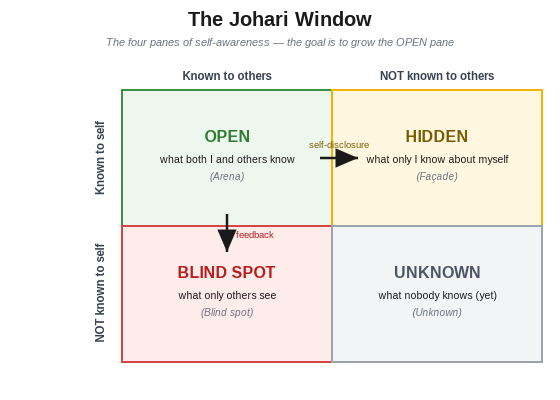
Figure 1 — the Johari Window. The axes: what I know about myself, and what others know of it. The goal is to grow the Open pane: feedback pushes the boundary downwards (at the expense of the blind spot), self-disclosure pushes it to the right (at the expense of the hidden pane).
Who is this for?
Section titled “Who is this for?”This article is for those who work in a team or lead people, and who want to see their own impact more clearly: shift supervisor · plant manager · group and team leader · process engineer · operator and maintenance technician · HSE lead · project manager · mentor and coach · HR partner.
Learning objectives
Section titled “Learning objectives”After reading this article you will be able to:
- name the four panes of the Johari Window, and give a real example for each;
- distinguish the two directions of growth (feedback vs. self-disclosure), and say which pane each of them shrinks;
- place your own dominant colour energy, and name its strength and its limit;
- apply the platinum rule to one specific colleague;
- draw the line: when an instrument of self-awareness is not the right answer.
In brief
Section titled “In brief”- Self-awareness is the first step. First get to know yourself (your style, your strengths, your impact on others), and only then can you manage yourself and your relationships effectively.
- Johari Window, four panes: Open (Arena), Hidden (“Façade”), Blind spot, Unknown (“Dark”), along the two axes of “I know / others know”.
- The direction of development is growing the Open pane: ask for feedback (it shrinks the blind spot) and take on self-disclosure (it shrinks the hidden pane).
- You can only get feedback on what others already know (Arena and Blind spot), which is why the focus of development is the Blind spot.
- Everyone has a style. Four colour energies describe it: Fiery Red (results), Sunshine Yellow (people, enthusiasm), Cool Blue (objectivity), Earth Green (values, harmony), and all four are present in everyone, in different proportions.
- Instead of the golden rule, the platinum rule: treat others the way THEY would like to be treated, not the way you would.
- The best leaders are flexible: they adapt their dominant style to the situation and to the people, they act from choice, not from habit.
Why self-awareness matters (the stakes)
Section titled “Why self-awareness matters (the stakes)”Self-awareness matters because the impact of your behaviour is not measured by you but by your environment: what you do not perceive in yourself, you cannot change, yet everyone else bears its consequences. The stake is therefore not abstract self-improvement but a very practical chain: an unrecognized style effect turns into misunderstanding, the misunderstanding into an unvoiced opinion, the unvoiced opinion into a bad decision, and finally into declining performance or a missed safety signal.
The order of learning follows from this: first get to know yourself and how you affect others, then learn to manage yourself effectively. Self-awareness is not an end in itself but a means. It has three direct benefits:
- you understand your own type, personality and its impact on others better;
- your self-management develops (managing your own time, energy and stress, see time management and energy management);
- your professional relationship building gets stronger.
Two specific personal competences build directly on it: establishing trust (establish trust) and adaptability (adaptability). Someone who does not see their own patterns can hardly adapt consciously, and can hardly build predictable trust (see trust). Self-awareness is thus the shared precondition of feedback, assertive communication and coaching.
What are the four panes of the Johari Window?
Section titled “What are the four panes of the Johari Window?”The four panes of the Johari Window are the Open (Arena), the Hidden (“Façade”), the Blind spot and the Unknown (“Dark”). The model is a 2×2 matrix that divides the self along two questions: do I know it in myself? and do others know it in me? It took its name from its two creators, Joseph Luft and Harrington Ingham (from the two first names: “Joe + Harry”).
- Open pane (Arena) — what both I and others know about me. This includes, for example, my name, my physical appearance, my family, company or other open affiliations, and all the behaviour I openly display. This is where effective cooperation happens.
- Blind spot — what others see in me but I do not notice. Someone can be boastful, conceited or mannered without noticing it at all, and when it is said to their face they receive it with surprise and disbelief, because they are not aware of this side of their personality. This pane can be learned about exclusively from other people’s feedback.
- Hidden pane (“Façade”, the hidden self) — what I know about myself but do not reveal to others. A classic example is the subordinate who is bothered that their boss does not offer them a seat, but who does not say it and accepts the situation instead. A significant share of the “Façade” area consists precisely of things left unsaid in order to preserve the good relationship.
- Unknown (“Dark”) — what is accessible neither to the “self” nor to the “others” in contact with them. According to some psychologists this is a very large area, which surfaces only under special circumstances (an accident, an emergency, a particular stage of life).
How can conscious self-awareness be grown?
Section titled “How can conscious self-awareness be grown?”Growing conscious self-awareness is nothing other than widening the Open pane at the expense of the other three, from two directions:
- Asking for feedback → the blind spot shrinks. If others share how they see me, I “get a view” of what I do not perceive in myself.
- Self-disclosure → the hidden pane shrinks. If I take on my opinions, feelings and intentions, less remains concealed.
A larger Open pane means greater trust, predictability and more effective cooperation, closely linked to building trust. It is no accident that structured feedback trainings typically start with the Johari Window: it explains why it is worth asking for and receiving feedback. In one sentence: you get valuable knowledge about your own behaviour and about how you are seen, and with it you can improve your effectiveness. The continuation, namely how to give and receive feedback well, is in the feedback article.
Personal style: the four Insights colour energies
Section titled “Personal style: the four Insights colour energies”Style is the other layer of self-awareness: how I gain my energy, how I decide, how I have an impact. The Insights model (built on Jung’s theory of types, just like the MBTI) describes style with four “colour energies”, along two axes: task vs. people focus and extraverted vs. introverted pace.
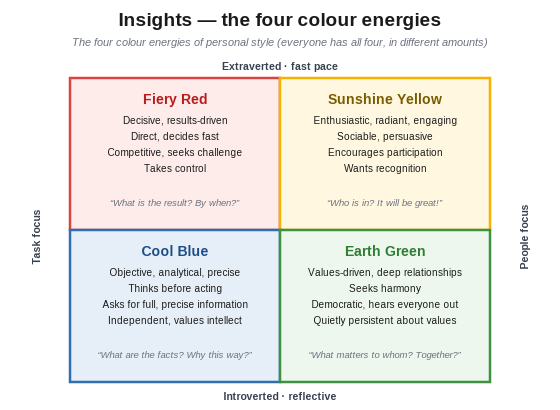
Figure 2 — the four Insights colour energies. All four are present in everyone, in different proportions; the “highest” energy gives the dominant style.
The four colours in brief: Fiery Red (active, holds a firm direction, direct approach, looks for a concrete and tangible result), Sunshine Yellow (radiates enthusiasm, encourages participation, seeks the company of others, wants to be involved and to receive recognition), Cool Blue (wants to understand the world around them, stays objective and reserved, thinks things through before acting, asks for exact and complete information) and Earth Green (looks at the world through their values, seeks harmony and depth in relationships, prefers a democratic approach, defends what matters to them with quiet persistence). The detailed description of the four colour energies, the communication “flex” and the DISC mapping (red≈D, yellow≈I, green≈S, blue≈C) are in a separate article: Insights colour energies.
From the golden rule to the platinum rule: style flexibility
Section titled “From the golden rule to the platinum rule: style flexibility”The style model is not for pigeonholing but for flexing: for consciously adjusting your own default setting to the other person. The key message goes like this: the best leaders, even if they have a clear dominant style, are able to adapt it to the situation and to the people. They develop themselves beyond their instinctive reactions, and act from choice, not from habit.
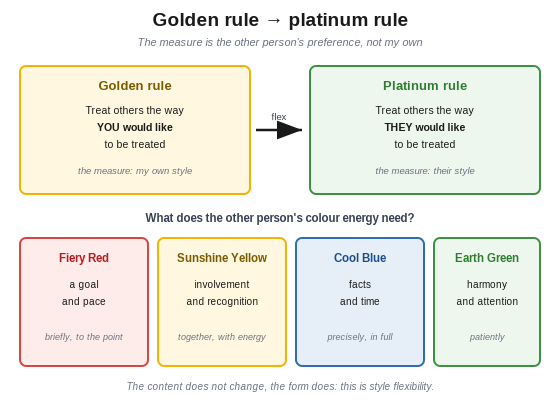
Figure 3 — from the golden rule to the platinum rule. The classic golden rule starts from your own preference; the platinum rule starts from the other person’s. Below, the differing needs of the four colour energies, that is, what you have to “flex”.
This thought can be condensed into a single sentence: do not treat others the way YOU would like to be treated, but the way THEY would like to be. The first is the well-known golden rule, the second is its established further development, the platinum rule (in Tony Alessandra’s formulation). Its logic is simple: the other person’s style differs from yours, so the well-meant “I treat you the way I would like it” often gives exactly not what the other person needs. Give a Cool Blue colleague the facts and the thinking time; a Sunshine Yellow, involvement and recognition; an Earth Green, harmony and personal attention; a Fiery Red, the goal and the pace.
Five situations that test style flexibility
Section titled “Five situations that test style flexibility”The classic exercise for style flexibility is five leadership situations, in which everyone has to ask themselves the same three questions: what is the strength of my style in this situation, what is its limit, and what do I have to flex in order to cope with it?
| # | Situation | What it puts to the test |
|---|---|---|
| 1 | Taking over an underperforming, oversized team, where it is not clear whether the people cannot or will not do the work | the diagnosis: is capability or intention missing |
| 2 | A crisis: an accident has happened on site, the press is banging on the door, and the team does not know what to do | decision and control under pressure, with incomplete information |
| 3 | Taking over a group of experts who work independently of one another | getting the leadership role accepted alongside professional autonomy |
| 4 | A team member’s performance declines because of a personal problem, and the others are impatient because they are working in their place too | the balance between fairness to the individual and the load on the team |
| 5 | A team rigidly attached to procedures, which is unwilling to try anything new, even though there is an innovation expectation from above | handling resistance to change |
The lesson of the exercise is not which is the “best” style. The model deliberately gives no answer to that: the best leader adapts their own to the situation and to the people, from choice, not from habit. In my own experience, situation 2 is the most instructive: in a crisis the quick, directive mode is typically worth more than clarifying the details or seeking consensus, but this is exactly the moment when the dominant style does not switch over by itself. That is why it is worth thinking this through in advance, in a calm situation.
Leadership and team context
Section titled “Leadership and team context”In a shift-based, team-working plant environment the direct benefit of self-awareness is: fewer misunderstandings in the shift handover, more targeted feedback, and more conscious conflict handling. If a shift supervisor knows that they are strongly “Fiery Red” (results focus, fast pace), they understand why an “Earth Green” subordinate may find them impatient, and can flex to them.
Reducing the blind spot is, moreover, also a safety question. A leader who does not sense that their style suppresses questions loses the weak signals (the near-miss report, the uncertain “I don’t think this is right” half-sentence), that is, exactly what safety prevention depends on.
How do you widen your own window? (practice)
Section titled “How do you widen your own window? (practice)”The five exercises below come from the material of classic self-awareness trainings, and can be done alone or in a team. The first has the fastest return: it opens the Blind spot directly.
- Ask your leader how they see your personal style, and what effect it has on your work with them, with your peers, with your subordinates and with customers. A single conversation from which you get blind-spot information immediately.
- Choose someone with whom you would like a better relationship: it can be your boss, a subordinate, a peer or an external partner. Practice is always measured on one specific relationship.
- Look back at two days of a “normal” working week, and break down where the time went. This is the entry point to self-management (managing time and energy), see time management.
- Lay out your own colour tower: rank the four colour energies on yourself, from the highest to the lowest, and write down when you switch to each.
- Form a style-kindred team (by your highest colour energy), collect the characteristics of the “dominant” style together, and depict them in one picture. Then look at the other groups’ pictures: the difference is the lesson itself.
To close, take the five situations from the table above through the three questions (strength, limit, what I flex). This “style training” gives the bridge between self-awareness and everyday leadership practice.
Common mistakes
Section titled “Common mistakes”- Treating the acquisition of self-awareness as a one-off test. The blind spot only shrinks from continuous, requested feedback.
- Using the style model as a pigeonhole (“I am Blue, I am not interested in people”). The model is for self-reflection, not for excuses.
- The golden rule instead of the platinum one: assuming that everyone wants it the way I do.
- Only self-disclosure, without feedback (or the other way round): the Open pane grows from both directions, either one on its own is lopsided.
- Asking for feedback but not receiving it. If you react with defensiveness, next time you will not get an honest mirror.
- Opening the Hidden pane uncritically. Self-disclosure is not unlimited baring of the soul: in a workplace context what counts is what helps the shared work.
When NOT to use it (the limits of the method)
Section titled “When NOT to use it (the limits of the method)”The Johari Window is a thinking frame, not a measuring instrument. It has no score, no validated questionnaire, it gives no type, and it does not predict performance. So avoid it in the following situations:
- For selection, appraisal or rating. Neither the Johari Window nor the colour energies are suitable for judging suitability. That calls for a structured assessment tied to the job.
- In an environment without trust. The model works on people honestly sharing what they see. Where speaking openly has consequences, the “feedback round” produces pseudo-feedback: trust has to be built first.
- At therapeutic depth. The psychological content of the “Dark” pane is not a training topic and not a leadership task; if the problem really is there, that belongs to a professional.
- Instead of a concrete performance or safety deviation. If a procedure is not followed, that is not a question of self-awareness: there you need data, structured feedback and consequences, not style analysis.
- As a label, to name others. The blind spot is a concept that applies to your own. Pronouncing other people’s “blind spot” on their behalf is a fast route to defensiveness.
Take it home (keys)
Section titled “Take it home (keys)”- Ask someone what they see in you that you do not. A single conversation with your leader moves your blind spot more than any test.
- Aim at the Blind spot. You can only get feedback on what others know, so that is where the biggest return is.
- Grow the Open pane from both directions: ask for feedback and take on self-disclosure; either one without the other is lopsided.
- Know your own colour order, and know when you switch automatically to the first one. Awareness begins where you notice the switch.
- Flex to the other person’s style, not to your own: in practice the platinum rule means that you adjust the form to the other’s need, not the content.
- Practise in peacetime. In difficult situations (crisis, conflict) nobody starts a new habit; that has to be built up in advance.
Self-test
Section titled “Self-test”- On which two panes of the Johari Window can you get feedback at all, and why exactly those? Which one is worth concentrating on?
- A colleague says: “this is my style, it has to be put up with”. Which two statements of this article contradict that? Formulate each in one sentence.
- Take a real colleague with whom you are making little progress. Which colour energy is dominant in them based on their behaviour, what does this require from you, and what is it from your own default setting that you must not force on them?
Terminology (HU / EN / JP)
Section titled “Terminology (HU / EN / JP)”| Hungarian | English | Japanese | Note |
|---|---|---|---|
| önismeret | self-awareness | 自己認識 | the conscious knowledge of one’s own patterns |
| Johari-ablak | Johari Window | ジョハリの窓 | Luft & Ingham, 1955 |
| Nyílt mező (Aréna) | Open area / Arena | 開放の窓 | I + others know it |
| Rejtett mező („Zárt”) | Hidden area / Façade | 秘密の窓 | only I know it |
| Vak folt (Vakfolt) | Blind spot | 盲点の窓 | only others see it |
| Ismeretlen („Sötét”) | Unknown area | 未知の窓 | nobody knows it (yet) |
| önfeltárás | self-disclosure | 自己開示 | shrinks the hidden pane |
| visszajelzés | feedback | フィードバック | shrinks the blind spot |
| szín-energia | colour energy | カラーエネルギー | the description of personal style |
| platina-szabály | platinum rule | プラチナルール | the way THEY would like it |
What are the four panes of the Johari Window?
Open or Arena (what both I and others know about me), Hidden or “Façade” (what only I know about myself), Blind spot (what only others see in me) and Unknown or “Dark” (what nobody knows yet). The two axes: do I know it in myself, and do others know it.
How can conscious self-awareness be developed?
By growing the Open pane, from two directions: by asking for feedback (this shrinks the blind spot, because I can get a view of what I do not perceive in myself) and through self-disclosure (this shrinks the hidden pane, because I conceal less). A larger Open pane gives more trust and better cooperation.
Which Johari pane is worth concentrating on?
The Blind spot. You can only get feedback on those areas that are known to others, that is, on the Arena and the Blind spot. But the content of the Arena is already known to both of you, so the real new information comes from the Blind spot.
What do the Insights colour energies mean?
Four styles, along two axes (task/people and extraverted/introverted): Fiery Red (decisive, results-driven), Sunshine Yellow (enthusiastic, engaging, people-centred), Cool Blue (objective, analytical, precise) and Earth Green (values-driven, striving for harmony). All four are present in everyone, in different proportions.
What is the platinum rule?
“Treat others the way THEY would like to be treated”, as opposed to the golden rule (“the way you would like it”). Since the other person’s style differs from yours, an effective relationship depends on adjusting to their preference.
Related concepts
Section titled “Related concepts”MBTI · MBTI self-assessment · Insights colour energies · DISC · self-awareness models · feedback · assertive communication · circle of influence · the trust model · Lean leadership and coaching · time management · energy management
Next step
Section titled “Next step”If you have understood this, from here it is worth going on — in this order:
- Insights colour energies — the detailed description of the four colour energies and the communication flex: here you learn how to adjust to the other person’s style in practice.
- feedback — the operating instrument of the Johari Window: how to ask for, give and receive feedback so that your blind spot really shrinks.
- time management — the counterpart of self-awareness on the self-management side: once you know what characterizes you, the next question is where your time and energy go (energy management).
References / further reading
Section titled “References / further reading”- Joseph Luft – Harrington Ingham: The Johari window, a graphic model of interpersonal awareness. Proceedings of the Western Training Laboratory in Group Development, University of California, Los Angeles, 1955 — the original publication of the model.
- Joseph Luft: Of Human Interaction. National Press Books, 1969 — the detailed exposition of the Johari Window by its author.
- Tony Alessandra – Michael J. O’Connor: The Platinum Rule. Warner Books, 1996 — the further development of the golden rule towards the other party’s preference.
- The Insights Group Ltd. — the owner and canonical source of the Insights Discovery colour energy model (built on Jung’s theory of types).
- Stephen R. Covey: The 7 Habits of Highly Effective People. Free Press, 1989 — the foundational work on proactivity and widening the circle of influence, see circle of influence.