The House of Lean (TPS House)
≈ 16 min read · 3,254 words
Imagine building a house — but you start with the roof. Nobody puts the tiles on before the foundation and the walls are standing; if you tried anyway, the whole thing would collapse. Lean uses exactly this everyday truth: it draws the Toyota Production System as a house, where the stable foundation carries the pillars, and those carry the roof — the ultimate goals. The message of the model is not a list of elements but the order: what is built on what, and why it cannot be the other way round. Let’s look at what it is, why it is a house, and how to use it as a map for your own improvement.
The House of Lean is the visual model of the Toyota Production System: a house whose foundation is stability, whose two pillars are Just-in-Time and Jidoka, and whose roof is the goals. The roof carries the goal system (safety, best quality, lowest cost, shortest leadtime); the two load-bearing pillars are Just-in-Time (flow) and jidoka (built-in quality); the foundation is provided by standardised work, stabilised production, 5s and continuous improvement; and in the middle the flexible, engaged workforce and kaizen move the whole. The message of the metaphor is structural: without a stable foundation the pillars do not hold, and the roof’s goals cannot be reached — so the model is not a checklist but a ranking (foundation → pillars → roof).
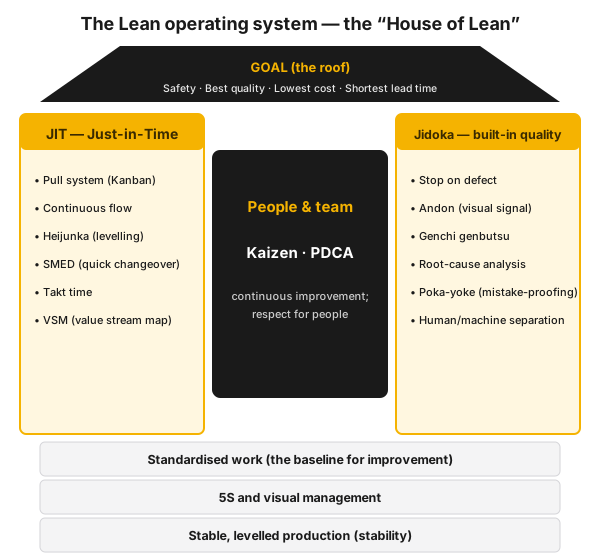 Figure 1 — the House of Lean: on the roof the goals, the JIT and Jidoka pillars, in the middle the people and Kaizen, in the foundation standardised work, 5S and stable production.
Who is this for?
Section titled “Who is this for?”This article is for those who want to understand and introduce Lean not tool by tool but as a system: operator · production and plant manager · shift supervisor · process engineer · Lean/CI specialist · transformation-leading manager · process technologist · HSE.
Learning objectives
Section titled “Learning objectives”After reading this article you will be able to:
- list the four levels of the House of Lean (foundation, two pillars, roof) and the main tools that belong to each;
- explain which pillar delivers what — JIT delivers flow, Jidoka delivers built-in quality;
- say why the model is a house, and what the structure teaches about the order of the rollout;
- recognize the most common mistake: starting with the flashy tools, without a stable foundation;
- use the model as a diagnostic map to assess the Lean maturity of your own area.
The essence
Section titled “The essence”- Roof (goals): safety · best quality · lowest cost · shortest leadtime.
- Pillar 1 — Just-in-Time: pull, kanban, flow, heijunka, SMED, takt time, VSM — the flow.
- Pillar 2 — Jidoka: andon, built-in quality, genchi genbutsu, problem-solving (5 Why, Ishikawa), poka-yoke — the quality.
- Foundation: standardised work, stable, levelled production, 5s and visual management.
- People at the centre: flexible, engaged workforce (flexible manpower) and kaizen — the driver of the two pillars.
- The point is the order: the house ranks — first the foundation, then the pillars, finally the roof. This is not decoration but a dependency map.
Why it matters (the stakes)
Section titled “Why it matters (the stakes)”The House of Lean is not a theoretical ornament: its structure tells you what to build first — and most Lean rollouts fail exactly on this. Whoever starts with the flashy tools (kanban board, andon lamp) while the process is fundamentally unstable is like someone starting the house with the roof: for a while there seems to be progress, then the whole thing slides back.
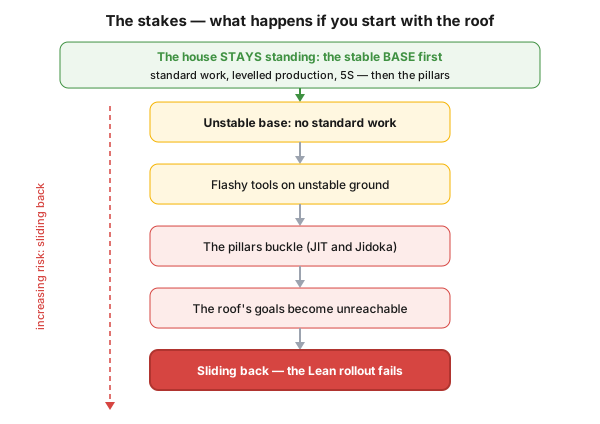 Figure 2 — the stakes: if you skip the foundation, the pillars buckle, the roof’s goals become unreachable, and the Lean rollout slides back. The correct order starts with the stable foundation.
The lesson is simple: the fastest Lean rollout is the one that does not start with the roof. The model is worth the few minutes of learning, because afterwards, at every improvement decision, you can ask: “is this level already standing under me?”
What is the House of Lean, and where does it come from?
Section titled “What is the House of Lean, and where does it come from?”The House of Lean is the best-known visual summary of the Toyota Production System (TPS): a house diagram that shows in a single picture how the elements of Lean fit together. It is not a stand-alone tool but a map — it arranges the whole of the Lean operating system into a foundation–pillars–roof structure.
The house reflects the thinking that crystallized at Toyota: the two pillars — Just-in-Time and Jidoka — were built on one another over decades. The JIT principle was formulated by Kiichiro Toyoda in the late 1930s, while the root of Jidoka reaches back even earlier, to Sakichi Toyoda’s automatic loom. Taiichi Ohno organized these two pillars and the tools around them into a system; and the characteristic “house” shape was made into a teaching device by Ohno’s student, Fujio Cho.
In the model of the three lenses (VOC – Operating System – Management Infrastructure & Mindset), the house depicts precisely the middle one, the operating system (Operating System) lens: the technical core that turns customer demand (VOC) into a stable, high-quality, fast flow. The principles of Lean become concrete tools in this house.
How is the house built?
Section titled “How is the house built?”The house consists of four levels, and the structure also signals the logic: the foundation carries the pillars, the pillars carry the roof, and in the middle the people move the whole.
The foundation — stability
Section titled “The foundation — stability”The foundation is the ground on which everything else stands: standardised work, stabilised and levelled production, 5s and visual management. Neither JIT nor Jidoka can be built on an unstable process — because an “abnormality” can only be detected at all against an existing standard. The foundation gives the reference point against which improvement is measured.
Pillar 1 — Just-in-Time (flow)
Section titled “Pillar 1 — Just-in-Time (flow)”The JIT pillar ensures the flow: the right part at the right time in the right quantity. Its tools: pull system (pull / kanban), continuous flow, load levelling (heijunka), quick changeover (SMED), takt time and the value stream map (VSM). The goal: a radical reduction of inventory and steering production by “pull” signals — the customer pulls the system, the plan does not push it.
Pillar 2 — Jidoka (built-in quality)
Section titled “Pillar 2 — Jidoka (built-in quality)”The Jidoka pillar delivers built-in quality: the process stops when a defect arises, so the scrap does not move on. Its tools: andon (visual signal), genchi genbutsu (go and see it on the spot), root-cause analysis (5 Why, Ishikawa diagram), poka-yoke (error-proofing) and the separation of human and machine work. The logic: the defect must be stopped and solved where it arises, not at the end of the line.
The roof — the goal system
Section titled “The roof — the goal system”The two pillars together carry the roof, that is, the goals: safety → best quality → lowest cost → shortest leadtime. These are not separate projects but the natural results of well-working pillars standing on a stable foundation.
At the centre — people
Section titled “At the centre — people”The house does not stand by itself: at the centre the flexible, engaged workforce (flexible manpower) and continuous improvement (kaizen, pdca) move it. Without respect for people and their involvement in improvement, the pillars remain lifeless tools.
| Level | What it delivers | Main tools | ||
|---|---|---|---|---|
| Roof | goal system | safety, quality, cost, leadtime | ||
| Pillar 1 — JIT | flow | pull/[[kanban.en | kanban]], flow, heijunka, SMED, takt, VSM | |
| Pillar 2 — Jidoka | built-in quality | andon, genchi genbutsu, 5 Why, poka-yoke | ||
| Centre — people | driving force | flexible manpower, [[kaizen.en | kaizen]], [[pdca.en | pdca]] |
| Foundation | stability | [[standard-munka.en | standard-munka]], stable production, [[5s.en | 5s]], visual management |
Why a “house”?
Section titled “Why a “house”?”The house metaphor is strong because it ranks: the structure itself is the teaching. On a house you cannot start with the roof (the result) before the foundation (the stability) — and this is exactly the correct order of a Lean rollout too.
Many Lean rollouts run aground because they start straight with the flashy tools (kanban boards, andon signals) while the process is fundamentally unstable. The house reminds us that first the standardised work and the stability, only then the pillars — otherwise the improvement slides back down the chain shown in Figure 2.
The metaphor carries a second message too: the two pillars must stand together. Only JIT (fast flow) without Jidoka (quality) means you are flowing the scrap on faster; only Jidoka without JIT is slow and expensive. The roof is held by both at once.
Process-industry context
Section titled “Process-industry context”In the process industry (crude-oil processing, chemical plant) the foundation is especially critical: the stability of the continuous operation is the precondition of safety and yield. The logic of the house transfers almost one to one:
- Foundation = stable, controlled operation. Standardised operation, the standard shift handover and the orderly, visually managed operating area (5s) are the ground on which every improvement stands. Disciplined flow or quality cannot be built on an unstable, “hectic” operation.
- Jidoka pillar = alarm and shutdown principles. The logic of Jidoka is akin to the alarm (Andon-like) and safety-shutdown principles used in the process industry (trip, ESD): the system stops or signals on an abnormal state, before the fault escalates. Important boundary: Jidoka is a management and quality principle that culturally reinforces the “stop and signal” reaction — but it does not replace certified functional safety systems (SIL/LOPA, IEC 61511).
- JIT pillar = intermediate storage and campaign changes. The process-industry equivalent of JIT is reducing intermediate storage and speeding up campaign/product changes (changeover, see SMED and muri) — less intermediate inventory, shorter leadtime.
How to use the model? (hands-on)
Section titled “How to use the model? (hands-on)”The most practical benefit of the House of Lean is that it can be used as a diagnostic map: you go through the levels and check which one is already standing under you. A shift supervisor can start like this tomorrow:
- Draw the house for your own area — the four levels and the people in the middle.
- Start with the foundation, not the roof. Ask honestly: is there stable, standardised work? Is the area orderly (5s)? Is production levelled? If the answer is weak here, start here, not with the kanban.
- Look at the pillars. Is there a working flow (pull, low intermediate inventory)? Does the process stop when there is a fault (Jidoka), or does the scrap move on?
- Check the roof. Is the measurement of the goals (safety, quality, cost, leadtime) in line with what the lower levels allow?
- The weakest level is your next improvement. The house tells you the one thing that gains you the most now — typically the lowest weak level.
Common mistakes
Section titled “Common mistakes”The pitfalls of the house almost all stem from the same thing: the model is taken as a checklist instead of a ranking. In anti-pattern ↔ correction pairs:
- Starting with the roof. You install flashy tools (kanban, andon) on an unstable foundation. Why it’s bad: the improvement slides back down the chain in Figure 2. Instead: first the stable foundation (standard work, 5s, levelled production), then the pillars.
- Leaving out the people. You treat the house as a tool, without the engaged workforce and kaizen. Why it’s bad: the pillars remain lifeless tools, nobody keeps them alive. Instead: involve those who run the process in the improvement.
- Overweighting one pillar. Only JIT (flow) without Jidoka (quality). Why it’s bad: you flow the scrap on faster; the other way round the system becomes slow and expensive. Instead: build the two pillars together.
- Treating the house as the goal. You regard the house diagram itself as the result. Why it’s bad: the model is only a map, not a goal — the logic (stability → pillars → goal) is what must be understood and applied. Instead: use it as a diagnostic tool, not as a poster on the wall.
When NOT to use it (the limits of the model)
Section titled “When NOT to use it (the limits of the model)”The House of Lean is an excellent map, but it is not the right tool for every question. Knowing where it ends is just as important as the model itself:
| Situation | Why (primarily) not the house | The right answer | |||
|---|---|---|---|---|---|
| Detailed rollout of a specific tool is needed | the house is the map of the system, not a step-by-step guide | the tool’s own article ([[vsm.en | vsm]], [[smed.en | smed]], [[kanban.en | kanban]]…) |
| A non-manufacturing/production process (e.g. knowledge work) | the classic pillar tools cannot all be transferred 1:1 | take over the principles ([[lean-alapok.en | lean-alapok]]), adapt the toolkit | ||
| A certified safety function is needed | the Jidoka principle is not a certified protection layer | design per [[lopa-sil.en | SIL/LOPA]], IEC 61511 | ||
| The goal is developing culture/leadership | the house describes the technical core (Operating System) | the other two lenses: [[lean-harom-lencse.en | VOC and Management Infrastructure]] |
Rule of thumb: the House of Lean is strongest for understanding the operating system and marking out the order of the rollout. For the deep rollout of a single tool, for the leadership/cultural layer, or for certified safety, call the appropriate, dedicated tool — and use the house as their map.
Take it home (keys)
Section titled “Take it home (keys)”- The house is a ranking, not a list — the point is which level is built on which (foundation → pillars → roof).
- The foundation first: an abnormality can only be measured against a stable, standardised process (standard-munka, 5s).
- Two pillars, together: JIT delivers flow, jidoka delivers quality — one without the other is one-legged.
- People are the driving force: without an engaged workforce and kaizen the pillars are not alive.
- Diagnostic map: your weakest house level is your next improvement — the model tells you where to start.
- Don’t start with the roof: most Lean failures come from starting with the flashy tools on an unstable foundation.
Self-test
Section titled “Self-test”- List the four levels of the House of Lean (from bottom to top), and say what each level gives the system.
- A plant introduces a kanban board and andon lamp right away, but the process is unstable. According to the logic of the house, what will be the consequence, and what should have been done first?
- What does the JIT pillar deliver, and what does the Jidoka pillar — and why is it not enough if only one of them is standing?
How does this show up in digital practice?
Section titled “How does this show up in digital practice?”The logic of the House of Lean layers the same way not only on the production line but also in a digital operating system: the software too only holds if the pillar functions (flow and quality signals) are built on the stable, standardised foundation, above which the roof — the measurement of the goals — is visible. The mechanism is different, the structure is the same.
| House level | Digital implementation | What it delivers |
|---|---|---|
| Foundation (standard work, stability) | digital standard work, templated shift handover, reliable, uniform data | the stable ground against which the deviation is measured |
| Pillar 1 — flow (JIT) | pull/inventory signals, process status in real time, change- and leadtime tracking | the flow becomes visible and steerable |
| Pillar 2 — quality (Jidoka) | automatic anomaly detection, enforced stopping in a faulty state, deviation log | the fault does not move on unnoticed |
| Centre — people | engaging improvement/idea tracking, task and action tracking | the trail and momentum of continuous improvement |
| Roof — goals | dashboard of the goal metrics (safety, quality, cost, leadtime) | the goals derived from the lower levels, measured for real |
Connection to OPEREX (shift log)
Section titled “Connection to OPEREX (shift log)”The foundation of the House of Lean is stable, standardised production — its daily layer is the shift log (OPEREX): the standard shift handover, the visual status and the recording of deviations keep the foundation stable, on which the JIT and Jidoka pillars stand. The log makes the lower level of the house auditable and repeatable: the deviation measured against the standard, the Jidoka-type deviation management and the continuity between shifts all live in a retrievable log layer (audit trail per ISO 45001). Stable foundation = auditable, repeatable daily operation — this is exactly where the house begins to be built.
Terminology (HU / EN / JP)
Section titled “Terminology (HU / EN / JP)”| Hungarian | English | 日本語 | Note |
|---|---|---|---|
| Lean Templom | Lean Temple / House of Lean | — | the visual model of the TPS |
| Éppen időben | Just-in-Time (JIT) | ジャストインタイム | flow pillar |
| Beépített minőség | Jidoka / built-in quality | 自働化 | quality pillar |
| Szabványosított munka | Standardised work | 標準作業 | the reference point of the foundation |
| Stabilizált termelés | Stabilising production | — | the stability of the foundation |
| Rugalmas munkaerő | Flexible manpower | — | the central, driving element |
| Folyamatos fejlesztés | Continuous improvement / Kaizen | 改善 | the force that keeps the house alive |
| Kiegyenlítés | Levelling / Heijunka | 平準化 | the load levelling of the JIT pillar |
| Működési rendszer | Operating System | — | the middle one of the three lenses — this is what the house depicts |
What are the two main pillars of the House of Lean?
Just-in-Time (pull, kanban, flow, heijunka — the flow) and Jidoka (built-in quality, andon, problem-solving — the quality). The two together carry the roof’s goals; one without the other is one-legged.
Why is the Lean model a house?
Because the structure ranks: without a stable foundation (standard work, stable production) the pillars do not hold, and the roof’s goals (safety, quality, cost, leadtime) cannot be reached either. So the house is not a tool list but a dependency map.
What is in the foundation of the House of Lean?
Standardised work, stabilised, levelled production, 5S/visual management and continuous improvement — these provide the stability on which JIT and Jidoka are built.
What does the house depict out of the whole of Lean?
Out of the three lenses (VOC – Operating System – Management Infrastructure & Mindset), the operating system (Operating System): the technical core that turns customer demand into a stable, high-quality, fast flow. The leadership and cultural layer is described by the other two lenses.
Where should I start the Lean rollout according to the house?
At the foundation, not the roof. First the stable, standardised work and the orderly area (5S), only then the pillar tools (kanban, andon). Your weakest house level is your next improvement.
Related concepts
Section titled “Related concepts”just-in-time · jidoka · standard-munka · 5s · kanban · heijunka · smed · vsm · kaizen · pdca · lean-alapok · lean-harom-lencse
Next step
Section titled “Next step”Once you have understood the logic of the house, from here it is worth going on — in this order:
- standard-munka — the reference point of the foundation; without it there is nothing against which to detect an “abnormality.” Start with this: the lowest, load-bearing level of the house.
- jidoka — the pillar of built-in quality: how the process stops at the fault, so the scrap does not move on.
- lean-harom-lencse — the wider picture: the house is only the middle lens; here you see how it fits the customer demand (VOC) and the management system.
References / further reading
Section titled “References / further reading”- Taiichi Ohno: Toyota Production System: Beyond Large-Scale Production. Productivity Press, 1988. — the canonical foundational work on the two pillars of the TPS (JIT + Jidoka).
- James P. Womack – Daniel T. Jones: Lean Thinking. Free Press, 1996. — the Western systematization of the principles of Lean, the context of the operating system.
- Jeffrey K. Liker: The Toyota Way. McGraw-Hill, 2004. — a practical presentation of the TPS house and the 14 principles behind it.