Lean basics — what is Lean, and what are its principles?
≈ 15 min read · 3,075 words
Think of the last time you waited for a package, stood in line at an office, or a simple piece of paperwork was two weeks late. If you added it up, for most of that time nothing was happening that you would pay for — you were just waiting. Most processes look exactly like this: often only a few percent of the total lead time creates real value, the rest is hidden waste. Lean is nothing other than the methodical, relentless elimination of this waste — so that the customer gets exactly what they need, faster and cheaper. Let’s look at what it is, where it comes from, and how it thinks.
Lean is a system-level management philosophy that gives the customer exactly what they need while methodically eliminating waste (muda). Its essence in a single sentence: “we shorten the time from the customer order to the receipt of the money by removing the non-value-adding waste” (Taiichi Ohno). Lean is not a toolset but a mindset and culture: a customer-focused approach based on continuous improvement (Kaizen) — the generalized version of the Toyota Production System (TPS).
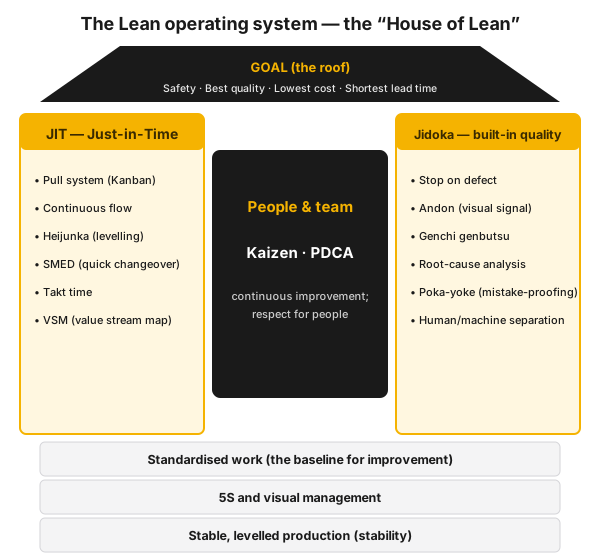 Figure 1 — the Lean operating system (the “House of Lean”): the goal on the roof, JIT and Jidoka as the two pillars, people + Kaizen at the centre, standard work / 5S / stability as the foundation.
Who is this for?
Section titled “Who is this for?”This entry-level overview is for those just getting to know Lean, or who want to organize the picture: operator · maintenance technician · technologist · process and project engineer · shift and plant manager · HSE · Lean/CI specialist · senior executive.
Learning objectives
Section titled “Learning objectives”After reading this article you will be able to:
- say in one sentence what Lean is, and distinguish the “toolset” view from the “culture” view;
- list Lean’s five principles and the three barriers to flow (muda / mura / muri);
- place the main concepts in the big picture, and know which article to go deeper in;
- explain why the success of Lean hinges on leadership behaviour (and why ~70% of programs fail);
- draw the line: when Lean is NOT (on its own) the right answer.
In brief (TL;DR)
Section titled “In brief (TL;DR)”- Lean is the generalized version of the Toyota Production System (TPS); the name “lean” was made famous by The Machine That Changed the World (Womack, Jones, Roos, 1990).
- Definition: to give the customer exactly what they want — by fully eliminating waste (muda). The goal is to shorten the lead time.
- Five principles: value → value stream → flow → pull → perfection — in a loop, again and again.
- The three barriers to flow: waste (muda), variability (mura), inflexibility (muri); the mnemonic for the 8 waste types is TIM WOODI.
- Lean is not a tool program but a cultural transformation: it stands on three “lenses” — operating system, management infrastructure, mindset & behaviours — and its success is decisively determined by leadership behaviour (~70% of transformations fail because of mindset/behaviour).
- It works in the process industry too, typically without significant capital investment: shorter lead time, less inventory, better yield and energy efficiency.
Why it matters (the stakes)
Section titled “Why it matters (the stakes)”A single hidden waste is cheap on its own — the trouble is the chain reaction it sets off if nothing eliminates it. In a typical process, surprisingly few steps create real value: measured end to end, often only a fraction of the steps is what the customer would actually pay for — often only a small share of the total lead time creates real value. The remaining waste breeds long lead times, tied-up capital and slow service — ultimately lost competitiveness.
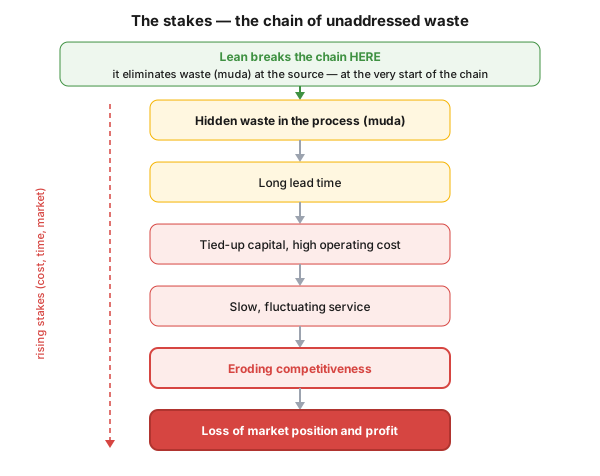 Figure 2 — the escalation of unaddressed waste: the further down the chain you handle it, the more expensive and the harder to reverse. Lean eliminates the waste at the very start of the chain — at the source.
The lesson is simple: the cheapest waste is the waste never accumulated. That is why it pays to invest attention at the start of the chain — in system-level process improvement — rather than firefighting expensively at the end.
What is Lean, and where does it come from?
Section titled “What is Lean, and where does it come from?”Lean is the generalized version of the Toyota Production System (TPS): the goal of the TPS is to reduce manufacturing cost by fully eliminating waste, and it “produces an excellent product from a fraction of the resources” — with less human effort, space, investment, inventory and operating cost. The story did not begin in the 1990s, but that is when it got its name:
| Time | Milestone | |
|---|---|---|
| ~1900–1920s | Henry Ford’s mass production: the Model T was assembled in 93 minutes — but the system tolerated no variety (“any color, so long as it is black”), and there was no quick changeover between products. | |
| 1930s – 1950s | At the post-war, near-bankrupt Toyota, Taiichi Ohno radically reshapes manufacturing (in those post-war, near-bankrupt years ~11,000 vehicles a year against GM’s 3.6 million, at a fraction of American productivity) — thus the TPS is born, building on the work of Frederick Taylor and W. Edwards Deming. | |
| 1990 | Womack, Jones and Roos’ book The Machine That Changed the World spreads the name “lean”; the TPS steps out of the automotive industry and spreads to other industries too. | |
| 2000s | Lean and Six Sigma converge (see [[lean-six-sigma.en | lean-six-sigma]]); the focus shifts from the workstation toward the whole value stream and value system. |
An important starting point: Lean is a strategic approach, not just an operational toolset. If someone applies only the tools at the operational level and merely cuts cost, Lean is degraded into a “cost-cutting practice” — the full benefit is realized only when it is applied at both the strategic and operational level. And Lean is not copying: every organization must solve its own challenges based on its own process, place and people — there is no universal benchmark to lift off the shelf.
What are Lean’s principles and core concepts? (the big picture)
Section titled “What are Lean’s principles and core concepts? (the big picture)”Lean can be broken down into a few simple, interlocking concepts: the five principles give the logical frame, the three sources of waste the target, and the three lenses the realization that beyond technique, culture is also needed. This section is the overview map — each row points to its own, deep article.
| Building block | In one sentence | Deeper | |
|---|---|---|---|
| The 5 principles | value → value stream → flow → pull → perfection, repeated in a loop | [[lean-5-alapelv.en | the five principles]] |
| The 3 types of activity | value-adding (flow it) · necessary (reduce it) · pure waste (eliminate it) | [[tevekenyseg-harom-tipusa.en | the three types of activity]] |
| The 3 barriers to flow | muda (waste) · mura (variability) · muri (inflexibility) | [[muda-mura-muri.en | muda-mura-muri]] |
| The 8 wastes | the TIM WOODI mnemonic: transport, inventory, motion, waiting, overproduction, overprocessing, defects, unused knowledge | [[muda.en | muda]] |
| Flow and lead time | shortening the time from order to the receipt of money (the Ohno time view) | [[flow.en | flow]] |
| The 3 lenses | operating system (what we do) · management infrastructure (how we steer it) · mindset & behaviours (how we think) | [[lean-harom-lencse.en | the three lenses]] |
Two ideas tie the whole together. One is the logic of flow: we sort the process steps into three groups and intervene accordingly — the abnormal, superfluous steps we eliminate, the necessary but non-value-adding ones we reduce, and the value-adding ones we flow. The reference base is always standard work, against which the deviation (abnormality) can be filtered out.
The other is that Lean is not a technical project. The most common source of failure is precisely the isolated introduction of the technical operating system (OS), leaving out the human and system side.
How is Lean introduced? (the transformation)
Section titled “How is Lean introduced? (the transformation)”Introducing Lean is not a one-off project but a multi-lens transformation that proceeds in waves. In short: diagnosis → design → pilot → scale-up → continuous improvement — with dedicated change agents (Lean navigators) who gradually hand over the wheel to the front line (the “cyclist” handover model: at first the navigator steers and pedals, in the end the business team rides on its own). Success hinges decisively on leadership commitment.
For the details, go deeper from here:
- The wave-based journey and the roles: the transformation journey · lean-navigator
- The diagnosis along all three lenses (OS / MI / M&B): the diagnose phase
- The process-industry, 8-step implementation recipe (Implementation Prescription): the 8-step Lean rollout
- The change equation — dissatisfaction × vision × first steps > resistance (D × V × F > R): the change formula
Where does Lean matter in the process industry?
Section titled “Where does Lean matter in the process industry?”Lean works in the process industry too, typically without significant capital investment: shorter lead time, less inventory, better yield and energy efficiency — all with operational levers. Yet the method spread slowly here for a long time: in the 1980s the metrics of continuous-operation plants (inventory turns, scrap) were often already better than the early Lean model, the capital-intensive environment is prone to seeking a “silver bullet” (a technological miracle cure) instead of disciplined, system-level improvement, and the culture is strong at the short-term management of the bottleneck — which can divert attention from optimizing the whole value stream.
Today, because of competition, tightening performance expectations and the pressure of alternative energy, Lean is a relevant strategic choice here too. The typical, early improvements are achievable without investment and quickly — illustrative (not plant-specific) examples from petroleum refining: reducing machine start-up failures after maintenance, improving cooling-tower control, cutting product giveaway (the “free” quality delivered above the specification requirement) and drawing down the middle-distillate inventory.
When NOT to use it (the limits)
Section titled “When NOT to use it (the limits)”Lean is not a miracle cure, and knowing where it is not (on its own) the right answer is just as important as the method itself:
| Situation | Why (primarily) not Lean | The right answer | |
|---|---|---|---|
| The main problem is statistical variation / defect rate | Lean targets flow and waste, not the deep, statistical analysis of variation | [[lean-six-sigma.en | Six Sigma / DMAIC]] alongside Lean |
| No leadership commitment or intent to change the culture | tools without culture change are not durable — this is how ~70% of programs fail | first leadership commitment and vision ([[valtozas-formula.en | D × V × F > R]]) |
| The goal is “let’s copy a Lean company’s solution” | there is no universal benchmark; every organization is different | own diagnosis: current → future state | |
| The goal is a one-off, capital-intensive technological leap | Lean builds on investment-free, operational levers | a targeted investment/project decision (Lean complements, does not replace it) |
Rule of thumb: Lean is strongest for system-level, continuous waste and lead-time reduction. For statistical variability, capital-intensive technology change, or missing leadership will, it does not replace the right tool — it complements it.
Common mistakes
Section titled “Common mistakes”- The “Lean = tool program” misconception. Applying the tools in isolation, only operationally (and mere cost-cutting) does not deliver the full benefit. Instead: treat it as a cultural transformation — technique + management system + mindset together.
- “Copying best practice.” The misconception that it is enough to find a similar “Lean” company and copy it. Instead: identify and solve your own challenges based on your own process, place and people.
- Underestimating mindset and behaviour. ~70% of transformations fail on the human factor (resistance, unsupportive leadership), not on tool knowledge. Instead: invest in leading by example and in trust (the mindset is the decisive, underwater part of the iceberg).
- No strategic direction and project sequence. Lean initiatives are often killed by a lack of foresight from senior management (without policy deployment). Instead: tie Lean to a clear strategy and milestones.
- The “silver bullet” mentality (in the process industry). Seeking a technological miracle cure instead of disciplined kaizen. Instead: system-level, repeated improvement — technology complements this, it does not replace it.
- Sub-process optimization at the expense of the system. Short-term management of the bottleneck can undermine optimizing the whole value stream. Instead: optimize for the whole flow (flow, lead time).
- “Branding” the initiative on the methodology. The “Lean Six Sigma plant” as a goal misses the point. Instead: let the method stay in the background, and put the goal (better performance, safety, the customer) up front.
Key takeaways
Section titled “Key takeaways”- Lean is a game of time: you shorten the time from order to money by eliminating waste — the cheapest waste is the one never accumulated.
- Five principles, in a loop: value → value stream → flow → pull → perfection; flow / reduce / eliminate the process steps.
- Three barriers, one goal: muda (waste), mura (variability), muri (inflexibility) — durable improvement starts on the cause side (mura, muri).
- Not technique but culture: all three lenses (OS + MI + M&B) are needed; Lean stands or falls on leadership behaviour.
- Start small, spread in waves: pilot → prove and “sell” → scale, with dedicated navigators who hand over the wheel.
- Safety first: in the process industry, improvement may happen only within the HSE and quality constraints.
Self-check
Section titled “Self-check”- Say what Lean is in one sentence, and explain the difference between the “Lean as toolset” and the “Lean as culture” views — why is it not enough just to introduce the tools?
- List Lean’s five principles and the three barriers to flow (muda / mura / muri). Which action goes with each of the three activity types (flow / reduce / eliminate)?
- ~70% of Lean transformations fail. What is the most common reason, and which two of the three lenses, if omitted, cause it — how does the change formula (D × V × F > R) relate to this?
How does this show up in digital practice?
Section titled “How does this show up in digital practice?”Lean’s principle does not end on the production line: the same logic is realized in software too, in any well-designed digital operation. Instead of the physical KPI board, andon lamp or paper checklist, here structured data capture, an enforced workflow and automatic alerts carry the principles on — the mechanism differs, the principle is the same.
| Lean element | Digital implementation | What it delivers |
|---|---|---|
| Visual performance management (daily KPI board, morning meeting) | digital KPI dashboard, daily deviation view | everyone sees their own metric and the deviation |
| Standard work | digital work instruction / workflow template | uniform, traceable, non-person-dependent execution |
| Deviation capture (andon, abnormality vs. the standard) | structured deviation log, automatic alert | waste and variability become measurable |
| Continuous improvement (Kaizen, PDCA) | action tracking: owner, deadline, status | improvement is not lost, stays auditable |
| Pull flow | real-time inventory and status signal | less overproduction and tied-up inventory |
Connection to OPEREX (shift log)
Section titled “Connection to OPEREX (shift log)”Lean’s management infrastructure layer — the daily KPI board, morning meeting, deviation capture, performance review — is exactly the daily rhythm that the shift log (OPEREX) supports digitally. The deviations recorded at the shift handover (sources of variability, stoppages, near-misses, abnormalities from standard work) provide the raw material for continuous improvement (Kaizen): the regular, structured recording of “what we see above the waterline” is what makes waste and variability visible, and ties it back to the milestones of the waves heading toward True North.
Terminology (HU / EN / JP)
Section titled “Terminology (HU / EN / JP)”| Hungarian | English | Japanese / note |
|---|---|---|
| veszteség | waste | muda (無駄) |
| változékonyság | variability | mura (斑) |
| rugalmatlanság / túlterhelés | inflexibility / overburden | muri (無理) |
| folyamatos fejlesztés | continuous improvement | kaizen (改善) |
| menj és nézd meg | go and see | genchi genbutsu / gemba |
| beépített minőség | built-in quality | jidoka + andon (signal) |
| húzó rendszer | pull | kanban |
| szintezés | levelling | heijunka |
| éppen időben | just-in-time | JIT |
| értékfolyam-térkép | value stream map | VSM |
| ideális állapot / valódi észak | ideal state | True North |
| a vevő hangja | voice of the customer | VOC |
What is Lean in one sentence?
Lean means giving the customer exactly what they want — nothing less and nothing more — by methodically eliminating waste (muda); at its core is Kaizen, continuous improvement.
What are Lean's five principles?
Value, value stream, flow, pull and perfection (True North). After perfection you start the cycle over.
What is the difference between Lean and Six Sigma?
Lean improves flow and eliminates waste (“doing things fast”); Six Sigma reduces variability and defects with DMAIC and statistics (“doing things well”). The two complement each other — see lean-six-sigma.
Does Lean only work in manufacturing?
No. Its origin is the automotive industry (Toyota), but it has been applied successfully in services, banking, healthcare, utilities, construction and the process industry (petroleum refining, oil platforms) too — the transformations improve several operational metrics at once, regardless of industry.
How much capital investment does Lean need in a process-industry plant?
Typically little or none — the early gains (machine start-up failures, inventory, giveaway, energy) are achievable with operational levers, without investment. The main “investment” is leadership attention, culture change and training people.
Why do Lean transformations fail?
~70% of programs do not reach their goal, typically because of human mindset and behaviour, a lack of leadership support, and resistance — not from a lack of tool knowledge. This is why leadership, vision (D × V × F > R) and trust are decisive.
Related concepts
Section titled “Related concepts”the five principles | muda-mura-muri | the three types of activity | flow | the three lenses | the transformation journey | tps | vsm | 5s | kaizen | jidoka | lean-six-sigma
Next step
Section titled “Next step”If you have understood this overview, from here it is worth going on — in this order:
- the five principles — Lean’s logical frame: value → value stream → flow → pull → perfection. Start with this, because everything else builds on it.
- muda-mura-muri — what you hunt: the three sources of waste (and why mura/muri is the real cause). This gives the target.
- the three lenses — why technique is not enough: the operating system, the management infrastructure and the mindset & behaviours together make the improvement durable.
References / further reading
Section titled “References / further reading”- Taiichi Ohno: Toyota Production System: Beyond Large-Scale Production. Productivity Press, 1988. — the canonical foundational work on the TPS and waste elimination.
- James P. Womack, Daniel T. Jones, Daniel Roos: The Machine That Changed the World. Rawson Associates, 1990. — this book made the name “lean” famous.
- James P. Womack, Daniel T. Jones: Lean Thinking: Banish Waste and Create Wealth in Your Corporation. Simon & Schuster, 1996. — the systematic exposition of the five Lean principles.