True North (ideal state) and the current–target state gap
≈ 15 min read · 3,068 words
On a long hike you are not trying to reach the North Pole itself — yet the compass needle points to it the whole way. At every step you glance at it and decide: did I get closer or farther? The goal is not the pole, but that the team moves in one direction, and that every decision points to the same place. Lean management calls exactly this compass the True North, in other words the ideal state. It is not a number you “hit,” but a shared direction against which you measure every improvement. Let’s look at what it is, why it works, and how you set it.
The True North (ideal state) is Lean’s long-term, customer-centered compass: the state in which the process never stalls and creates value without waste. It is not a specific, attainable numerical target, but a direction that gives every improvement decision a common frame. The gap between the True North and the current state gives you the improvement tasks; the intermediate, attainable milestones are set with target conditions and KPIs. The True North is never fully reached — we always approach it, and this is what drives continuous improvement (kaizen).
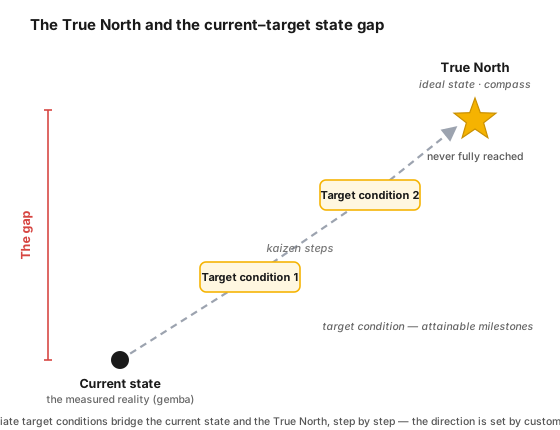 Figure 1 — the gap between the current state and the True North is closed by intermediate target conditions, step by step; the red bracket marks the gap to be improved, the star marks the never-fully-reached ideal.
Who is this for?
Section titled “Who is this for?”This article is for everyone who seeks direction, or gives direction, in a Lean transformation: operator · shift and plant manager · process engineer · technologist · Lean/CI specialist · stream leader · procurement and back-office specialist · leader.
Learning objectives
Section titled “Learning objectives”After reading this article you will be able to:
- distinguish the True North (distant direction) from the target condition (the next attainable milestone);
- state what the current state–True North gap is, and why it is the real subject of improvement;
- derive how you define the True North starting from customer value;
- set a measurable KPI and intermediate target condition to close the gap step by step;
- recognize when the True North is NOT the right tool.
In brief (TL;DR)
Section titled “In brief (TL;DR)”- True North = compass, not an end state — we approach it continuously, but never fully reach it.
- Customer-centered: first clarify who the customer is and what value is (see voc), then set the ideal.
- Its hallmark: the process never stalls anywhere, value creation is the fastest, without waste.
- The gap between the current state and the True North → this is the subject of improvement.
- Three levels: current state (measured reality) → target condition (attainable milestone) → True North (distant ideal).
- Measurement: KPIs and intermediate target conditions show where you are along the way.
Why does it matter? (the stakes)
Section titled “Why does it matter? (the stakes)”Without a shared True North, improvements diverge: every team chases its own local optimum, and the many small gains do not add up into a single shared advance. The compass prevents exactly this — it provides the reference point against which every decision can be measured.
Look at what you risk if there is no set ideal:
- Optimums pulling against each other. Procurement speeds up, but quality suffers; you accelerate one operation, and congestion builds up before another. What is a local improvement may even be a regression for the whole process.
- Effort that does not accumulate. Without direction, kaizen steps lead to random points — there is no cumulative advance toward a shared goal.
- Immeasurable progress. Without a compass there is nothing against which to say “did we get closer” — improvement runs on feeling, not fact.
The lesson: the most expensive improvement is the one that is good but simply leads in the wrong direction. That is why it pays to set the direction first, and only then to move.
What is the True North, and why is it a compass?
Section titled “What is the True North, and why is it a compass?”The True North is the Lean organization’s shared, long-term guidance — not a finally attainable state, but a compass against which we measure every improvement. The hallmark of the ideal state is simple: the process never stalls anywhere, and value creation happens as fast as possible, without waste. This is the tangible formulation of Lean’s fifth principle, the pursuit of perfection (Perfection): not an attainable endpoint, but the direction of continuous approach.
That is precisely why the True North and kaizen are inseparable: continuous improvement is often informally referred to as “seeking the ideal state” (seeking True North) — not as a synonym, but to emphasize the shared direction. The compass metaphor is exact here: you do not watch the needle in order to one day stand on the North Pole, but so that every decision of yours leads in one direction.
The True North is customer-centered — it starts not from internal preference but from the customer’s definition of value. Hence the next question is always: how do you even set the ideal?
How do we define the True North?
Section titled “How do we define the True North?”Defining the True North starts at the customer and at value, not at the internal process. The logic is a short, question-by-question checklist:
- Who is the customer? Internal (the next operation, another organization) or external — but always specific (see voc).
- What counts as value for them? What they are willing to “pay” for (with time, money, trust) — everything else is waste.
- Examine the whole process. What steps does a request pass through before it becomes a result (e.g. from the procurement request to the finished order)?
- Ask for each step: is it needed at all, and does it move the process toward the goal?
- Formulate the ideal: the state in which the process never stalls and creates value for the customer as fast as possible, without waste.
This approach is not plant-specific: with the logic of the value stream map, it applies in exactly the same way to any process — manufacturing, maintenance, procurement, back-office.
Current state, target condition, True North — what is the gap?
Section titled “Current state, target condition, True North — what is the gap?”Improvement has three levels, and the point is the distance between them:
| Level | Meaning | Character |
|---|---|---|
| Current state | the measured reality — from actual data, not from assumption (gemba) | where you are now |
| Target condition | the next, attainable milestone toward the True North | specific · measurable · time-bound |
| True North (ideal state) | the distant ideal that gives direction but is not an end state | compass |
The gap between the current state and the target condition is the subject of the next kaizen leap; the distance between the target condition and the True North marks the long-term direction. kaizen closes these gaps step by step, and standardization holds the level reached — there is no sliding back.
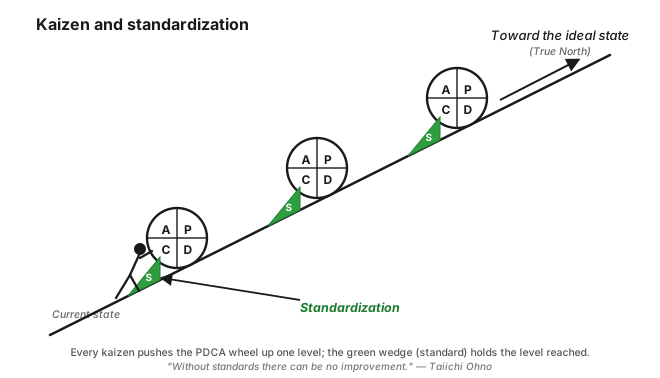 Figure 2 — every kaizen step is a higher target condition toward the True North; standardization (the green wedge) prevents sliding back.
Putting it into practice
Section titled “Putting it into practice”Setting the True North is not a one-off declaration, but a repeatable cycle. Suggested order — each step is an action to perform:
- Define the customer and the value (internal or external — voc).
- Map the whole process (VSM), and ask for each step: is it needed, and does it move toward the goal?
- Formulate the ideal state — obstacle-free, fastest, waste-free value creation.
- Record the current state with actual data, and measure the gap against the True North.
- Set an attainable target condition (specific, measurable, time-bound) and the KPI that goes with it.
- Close the gap with a kaizen step, then standardize the level reached (standard work) so it does not slide back.
- Repeat — from the new current state, set a next target condition toward the True North.
Process-industry context
Section titled “Process-industry context”The logic of the True North can be transferred to any organization operating in the process industry — the example does not even come from a production line, but from a procurement process.
Process-industry example (procurement): the True North is the obstacle-free, fastest run of the process from the procurement request to the order. The current state is given by the actual lead time and the waits at each step; the gap is caused by unnecessary approval cycles, rework and waiting. Here, too, the True North is not a number but a direction: every process improvement moves toward faster, obstacle-free service for the customer (the internal requester). The intermediate target conditions are marked here too by measurable KPIs (e.g. lead time, number of approval steps), and progress is shown by their trend.
The same frame holds for production, maintenance and shift operations too: there is always a customer, a value, a measured current state and a distant ideal, toward which the intermediate target conditions lead.
Measurement / audit
Section titled “Measurement / audit”On the way toward the True North you do not measure the ideal (that is not even possible), but the progress in closing the gap. The question is always: how do we know where we are?
- KPI / PI / I — the indicators of progress. You assign a specific, measurable indicator to the intermediate target condition (e.g. lead time, number of approval steps, defect rate), and follow its trend.
- The size of the gap from actual data. Always record the current state with measured data (gemba), otherwise both the gap and the progress remain invisible.
- Fulfillment of the target condition. Did we reach the set, time-bound milestone? If so, did we standardize it so it does not slide back?
Common mistakes
Section titled “Common mistakes”- Treating the True North as a specific target. We handle it as a number to be “achieved.” Why it’s a problem: the directional character is lost, and reaching the endpoint stops improvement. Instead: the True North is a direction; set the measurable, attainable goals with intermediate target conditions.
- An ideal defined without a customer. We say what is “ideal” from internal preference. Why it’s a problem: you optimize something that is not value for the customer. Instead: the True North starts from customer value — first the customer, then the ideal.
- A gap without measurement. We do not record the current state with actual data. Why it’s a problem: if there is no measured starting point, neither the gap nor the progress is visible. Instead: measure the current state at the gemba, from actual data.
- Sliding back without standardization. We reach a level, but do not lock it in. Why it’s a problem: the improvement falls back, the gap reopens. Instead: lock in every target condition reached with a standard (the green wedge in the figure).
- A jump to the True North in a single step. We want to reach the distant ideal at once. Why it’s a problem: too big a jump ends in failure, it demotivates. Instead: advance with a chain of small, attainable target conditions — this is the essence of kaizen.
When NOT to use it? (the limits of the method)
Section titled “When NOT to use it? (the limits of the method)”The True North is a strategic compass, not an operational tool. There are times when a different answer is the right one:
| Situation | Why (primarily) not the True North | The right answer | ||
|---|---|---|---|---|
| An immediate, concrete problem must be solved (a stoppage, a fault) | the True North is a direction, not a troubleshooting tool | one-off root-cause analysis ([[5-miert.en | 5 Whys]]), [[jidoka.en | jidoka]] reaction chain |
| The customer and the value are unclear | an ideal cannot be set without customer value | first [[voc.en | customer value]] discovery, then the True North | |
| A numerical, binding target is needed (standard, contract) | the True North is intentionally not a number | a specific, time-bound target condition + KPI | ||
| The team has no stable base (no standard, no measurement) | there is nothing against which to define a “gap” | first [[5s.en | 5s]], [[standard-munka.en | standard work]], measurement — then direction |
Rule of thumb: the True North is strongest for setting the long-term direction. It does not replace immediate problem-solving and the numerical, binding target — leave those to target conditions and to the appropriate tool.
Key takeaways
Section titled “Key takeaways”- You set a compass, not a destination — the True North is never fully reached, and that is as it should be.
- First the customer, then the ideal — the True North starts from customer value, not from internal preference.
- The gap is the work — the distance between the current state and the True North gives the improvement tasks.
- Step up with target conditions — the path to the distant ideal leads through small, attainable, measurable milestones.
- Measure the current state and standardize — without actual data there is no gap, without a standard there is sliding back.
Self-check
Section titled “Self-check”- What is the difference between the target condition and the True North, and which one can be quantified?
- A team starts to “improve” without having set the True North. What three risks threaten its improvements?
- How would you derive the True North of a back-office process? Walk through the steps from the customer to formulating the ideal.
How does this show up in digital practice?
Section titled “How does this show up in digital practice?”The principle of the True North does not stop at the strategy board: the same logic is realized in software too. Instead of the physical compass, here goal cascading, KPI trend and gap tracking make visible where the organization stands relative to the ideal — the mechanism differs, the principle is the same.
| True North principle | Digital implementation | What it delivers |
|---|---|---|
| The ideal as direction | a recorded long-term goal / vision on the strategy dashboard | every improvement points in a shared direction |
| Current state (measured reality) | automatic actual-data collection, live KPI trend | the starting point from fact, not assumption |
| Target condition (milestone) | a specific, time-bound, measurable goal on the KPI board | the next attainable step is unambiguous |
| The gap | visualization of the plan–actual deviation, a gap report | the improvement task is quantified and visible |
| Kaizen chain + standard | action tracking, the proven solution locked in as a digital standard | progress accumulates, does not slide back |
Connection to OPEREX (shift log)
Section titled “Connection to OPEREX (shift log)”On the way toward the True North, daily progress is measured by KPIs; the shift log (OPEREX) is the source of the daily actuals from which the closing of the gap between the current state and the target condition can be tracked and audited. The daily review thus links the long-term compass to shift-level action: every shift records where the indicator stood, and this trend shows whether we are approaching the ideal (MOS).
Terminology (HU / EN)
Section titled “Terminology (HU / EN)”| Hungarian | English | Note |
|---|---|---|
| Ideális állapot / iránytű | True North / ideal state | long-term direction, not an endpoint |
| Jelenállapot | current state | the measured reality |
| Célállapot | target condition | the next, attainable milestone |
| Rés | gap | the distance between the current state and the goal — the subject of improvement |
| Lean út | Lean journey | the gradual closing of the gap |
| Az ideális állapot keresése | seeking True North | the informal name for advancing toward the True North |
Is the True North an attainable goal?
No. The True North gives direction, it is not an end state — we approach it continuously, but never fully reach it. The specific, attainable milestones are set with KPIs and intermediate target conditions.
How does the True North relate to the customer?
Defining the True North starts from the customer’s definition of value (VOC): first you must clarify who the customer is and what counts as value for them, because the ideal state always means fast, obstacle-free value creation for the customer.
What is the difference between the target condition and the True North?
The target condition is the next, specific and attainable milestone; the True North is the distant ideal that gives direction. The target conditions lead as steps toward the True North, and — unlike the True North — can be quantified.
What does the current state–True North gap mean?
The gap is the distance between the measured current state and the set ideal. This gives the improvement tasks: kaizen closes it step by step, through intermediate target conditions, and standardization holds the level reached.
Related concepts
Section titled “Related concepts”voc · kaizen · vsm · standard work · the five principles · jidoka · mos · Lean basics
Next step
Section titled “Next step”If you have understood this, from here it is worth going on — in this order:
- voc — the customer value from which the True North can be set at all. Start with this: without it there is nothing to give direction to.
- kaizen — the engine that closes the gap between the current state and the True North step by step.
- standard work — the standard that holds the target condition reached, so that progress accumulates and does not slide back.
References / further reading
Section titled “References / further reading”- Mike Rother: Toyota Kata: Managing People for Improvement, Adaptiveness, and Superior Results. McGraw-Hill, 2009. — the canonical exposition of the gap-based logic of the target condition and advancing toward the challenge/ideal.
- Mike Rother – John Shook: Learning to See: Value Stream Mapping to Add Value and Eliminate Muda. Lean Enterprise Institute, 1999. — the foundational work on mapping the current state and the future state.
- James P. Womack – Daniel T. Jones: Lean Thinking. Free Press, 1996. — the pursuit of perfection (Perfection) as Lean’s fifth principle — the conceptual root of the True North.