The Three Lenses of Lean: Operating System, Management Infrastructure, Mindsets & Behaviours
≈ 14 min read · 2,871 words
At the start of the year many people buy running shoes and sign up for a gym membership. They have the equipment — yet by February most are back on the couch. Why? Because the shoes and the membership are not enough on their own: you also need a daily routine that holds you to account (when, how much, who is watching), and a decision made in your head that this really matters. Developing an organization is exactly like this. If you introduce only the “tools” — 5S, standard work, a new process — but the management routine and the mindset do not change, the improvement slides back just like a New Year’s resolution. Lean answers this with the three lenses: look at the organization at the same time through what it does, how it governs itself, and how it thinks. Let’s look at what it is, why it works, and how it is used.
The three lenses of Lean are the three simultaneous perspectives through which an organization must be developed to achieve a lasting result. The operating system (Operating System, OS) is how we configure the process for value creation and to minimize waste; the mindsets and behaviours (Mindsets & Behaviours, M&B) are how people think, feel and behave; and the management infrastructure (Management Infrastructure, MI) is the formal structures, processes and systems through which resources are governed. The whole thing starts from the Voice of the Customer (VOC), and a lasting result can only be achieved by developing all three lenses together.
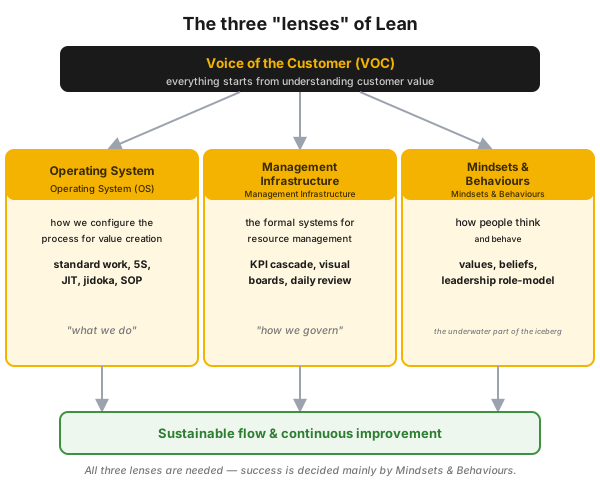
Figure 1 — the Voice of the Customer (VOC) starts from the top; below it, the three lenses (OS, MI, M&B) together lead to sustainable flow.
Who is this for?
Section titled “Who is this for?”This article is for those responsible for developing an organization or plant, who want more than to introduce a single tool: plant and factory manager · shift supervisor · Lean/CI program lead (PMO) · change leader · process engineer · HR and training specialist · senior executive.
Learning objectives
Section titled “Learning objectives”After reading this article you will be able to:
- name the three lenses (OS / MI / M&B), and say which is the “what,” the “how we govern,” and the “how we think”;
- explain why everything starts from the Voice of the Customer (VOC);
- justify why improvement slides back if you develop only one lens;
- recognize where the three lenses end as a diagnostic framework, and where a different tool is needed;
- work out for one of your own areas how you would start an improvement on all three lenses at once.
In brief
Section titled “In brief”- OS — Operating System: “what we do” — the technical configuration of the process (standard work, 5S, JIT, jidoka, layout).
- MI — Management Infrastructure: “how we govern” — its five elements: performance management, organizational structure, capability building, continuous improvement, functional support (KPI cascade, visual boards, daily review, shift handover).
- M&B — Mindsets & Behaviours: “how we think” — values, beliefs, leadership role-modelling (the underwater part of the iceberg).
- VOC starts it: everything begins from understanding customer value.
- It only works together: no single lens is enough on its own — the improvement slides back if the other two do not hold it.
Why it matters (the stakes)
Section titled “Why it matters (the stakes)”Most Lean programs fail not because they choose the wrong tool, but because they develop only one lens. They introduce 5S, standard work, the new process — the OS — but the management routine (MI) and the mindset (M&B) remain untouched. The improvement shows for a while, then quietly slides back into the old rut: there is nothing to hold it.
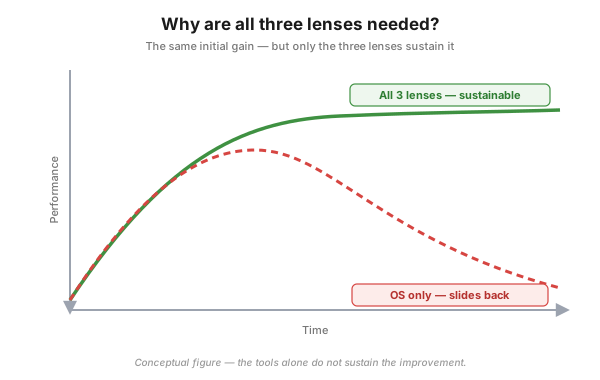
Figure 2 — the same initial improvement on both paths, but only the three lenses sustain it. If the routine and the mindset do not change, the tools slide back on their own. (Conceptual figure.)
The lesson is simple: sustainability does not depend on the tools, but on whether the management system and the culture evolve along with them. That is why it pays to start the improvement on all three lenses from day one — not in sequence, but in parallel.
What are the three lenses of Lean, and where do they come from?
Section titled “What are the three lenses of Lean, and where do they come from?”The three lenses are three simultaneous perspectives through which an organization must be developed: the operating system (OS), the management infrastructure (MI) and the mindsets and behaviours (M&B) — each starting from the Voice of the Customer (VOC). The framework makes visible that a lasting Lean transformation is not a set of tools, but the moving-together of three layers.
The metaphor lives in the word “lens”: you look at the same organization through three different “glasses,” and each shows you something different. The surface, clearly visible layer of the process is the OS; this is surrounded by the management system (MI); and deep down, below the surface, are the mindsets and behaviours (M&B) — the underwater, hidden, yet decisive part of the iceberg. If you only poke at the surface, the underwater part pulls it back to the old state.
The classic, citable definitions of the framework:
| Lens | Definition | “Motto” |
|---|---|---|
| Operating System (OS) | how we configure and optimize the process for value creation and to minimize waste | “what we do” |
| Management Infrastructure (MI) | the formal structures, processes and systems through which human and organizational resources are governed and optimized for common goals | “how we govern” |
| Mindsets & Behaviours (M&B) | how people think, feel and behave at work, individually and collectively | “how we think” |
What does each lens mean?
Section titled “What does each lens mean?”The three lenses answer three different questions — what we do, how we govern, how we think — and the VOC ties them to customer value.
- Operating System (OS) — “what we do”: the technical configuration of the process to maximize value and minimize waste. Its elements: standard work, 5S, JIT, jidoka, layout, SOP; stable production and a flexible workforce are framed by built-in quality and continuous improvement, toward the “Safety – Best Quality – Lowest Cost – Shortest Lead Time” goal system. Its measurement: e.g. observing shift activities, value-creating ratio.
- Mindsets & Behaviours (M&B) — “how we think”: how people think, feel and behave individually and collectively. This is the underwater, hidden, yet decisive layer of the iceberg — commitment, the “I can do it” attitude, what someone sees in a problem. Its exploration: interviews, surveys, employee feedback.
- Management Infrastructure (MI) — “how we govern”: the formal structures, processes and systems through which resources are governed. Its five elements: (1) the performance management process, (2) organizational structure, (3) capability building, (4) the continuous improvement infrastructure, (5) functional support — the full framework is in the MI hub article.
The framework places the VOC (Voice of the Customer) input at the top: development starts from the customer need, not from internal logic (see voc). This way the three lenses are not an end in themselves, but always point toward the value created for the customer.
How do you develop all three lenses together?
Section titled “How do you develop all three lenses together?”The three lenses must be developed in parallel, not one after another — this is the essence of transformation. The practical sequence is in the diagnosis, not in the rollout:
- OS: map and optimize the process (measuring the value-creating ratio, VSM).
- M&B: through interviews and surveys, uncover the behavioural patterns, the hidden beliefs — what the team sees in a deviation.
- MI: build the supporting systems — shared shift handover, training, performance visualization, daily review.
- Launch initiatives on all three lenses at once, and link them to the goal hierarchy (MOS, OGSM).
The cause of most failures is that programs develop only the OS (the technical process), and leave out the M&B and the MI — which is why the improvement is not sustainable (see Figure 2).
What do the three lenses look like in a process-industry plant?
Section titled “What do the three lenses look like in a process-industry plant?”In a process-industry plant the three lenses translate into concrete, tangible things. In an improvement aimed at energy efficiency, for example, all three layers move at once:
- OS — the configuration of the process. Optimizing the column and furnace operation: switching on and tuning advanced control (APC, soft sensor) well, standardizing good practice. Here “what we do” is the measurable, technical layer.
- M&B — the mindset. The panel operators’ energy awareness and problem-solving attitude: they should understand that with their parameters they too influence the plant’s energy consumption, and see how they can help reach the targets.
- MI — the management routine. The system of operator training (OTS training) and the tracking of the performance metric (MTMR KPI). Without intensifying the OTS training — more effective and more frequent training — and without the visible support of management, the technical improvement (APC usage) does not survive.
The lesson is the same as everywhere: switching on the APC (OS) is not enough on its own if the operators do not understand why it matters (M&B), and there is no routine that measures and holds the usage to account (MI).
When NOT to use it (the limits of the framework)
Section titled “When NOT to use it (the limits of the framework)”The three lenses are a diagnostic and transformation framework — not the right tool for every problem. Knowing where it is not is just as important as the framework itself:
| Situation | Why (primarily) not the three lenses | The right answer | ||
|---|---|---|---|---|
| A single, concrete technical fault (e.g. a valve leaks) | there is nothing to transform “in three layers” for a single failure | ad-hoc troubleshooting, [[5-miert.en | root-cause analysis]] | |
| A certified safety function is needed | the lens framework is a management and culture model, not a certified protection layer | design per [[lopa-sil.en | SIL/LOPA]], IEC 61511 | |
| A quick, one-off fix is enough | a full three-lens transformation would overshoot the goal | a targeted [[kaizen.en | kaizen]] event or [[pdca.en | pdca]] cycle |
| The framework would be used for labelling instead of real improvement | the model does not replace the actual intervention | concrete OS/MI/M&B actions with an owner and a deadline |
Rule of thumb: the three lenses are strongest for lasting, system-level transformation. For a single point fault, a quick fix or certified safety, it does not replace the appropriate tool — it is for drawing the big picture and ensuring sustainability.
Common mistakes
Section titled “Common mistakes”- Technique only (OS focus). The human (M&B) and system (MI) lenses are left out. Why it’s a problem: the improvement slides back, there is nothing to hold it. Instead: develop all three lenses in parallel.
- Mindset preaching without structure. We ask for M&B change, but there is no MI behind it. Why it’s a problem: without measurement, routine and accountability, “think differently” remains an empty request. Instead: behaviour is shaped by visibility and the daily routine (MI), not by a sermon.
- VOC blindness. The improvement starts from internal logic. Why it’s a problem: instead of customer value, the organization optimizes its own comfort. Instead: start every lens from the Voice of the Customer.
- Sequential rollout. “First the tools, then the culture someday.” Why it’s a problem: by the time you reach the culture, the tools have already slid back. Instead: develop the three lenses at once, not one after another.
Key takeaways
Section titled “Key takeaways”- Three glasses, one organization. Look at every improvement from the OS (“what”), the MI (“how we govern”) and the M&B (“how we think”) — the symptom often has its root in another lens.
- The tool slides back on its own. Sustainability comes from the management routine (MI) and the culture (M&B), not from the OS tool.
- In parallel, not in sequence. Develop the three lenses at once — “the culture will come later” is the most common failure pattern.
- Always start from the customer. The VOC is the top of the framework: development starts from customer value, not from internal logic.
- It is good for diagnosis too. For a stalled improvement, ask: which lens is missing?
Self-check
Section titled “Self-check”- Name the three lenses, and for each say which question it answers (“what we do” / “how we govern” / “how we think”). Which is the underwater part of the iceberg?
- A plant introduced 5S and standard work, yet six months later everything is back to the old ways. Which two lenses were left out, and which specific gap of theirs causes the slide back?
- Why is the VOC at the top of the framework, and what happens if an improvement does not start from customer value?
How does this show up in digital practice?
Section titled “How does this show up in digital practice?”The three lenses do not stop at the organizational chart: the same logic is realized in software too in a well-designed digital operation. Instead of the paper board and the verbal handover, here digital standard work, a KPI dashboard and searchable records carry the three layers — the mechanism differs, the principle is the same.
| Lens / principle | Digital implementation | What it delivers |
|---|---|---|
| OS — standard process | digital standard work, enforced workflow order | uniform, repeatable execution |
| MI — measurement → dialogue → action | KPI dashboard, digital performance board, action log with owner and deadline | the management routine is not lost between days |
| MI — shift handover | structured, searchable digital shift log | the decision and the open action carry across the shift boundary |
| M&B — transparency, accountability | a record visible to everyone, time-stamped | behaviour is shaped by visibility and traceability |
| VOC — customer feedback | digital feedback channel, need and complaint log | the improvement provably starts from the customer need |
Connection to OPEREX (shift log)
Section titled “Connection to OPEREX (shift log)”One of the most fragile, tangible elements of the management infrastructure (MI) is the structured, shared shift handover. The OPEREX shift log digitizes exactly this MI element: it provides a uniform, searchable shift-handover record that forms an auditable trail (ISO 45001 §10.2) and can be linked to the performance metrics — so the MI lens becomes measurable and sustainable, and the daily management routine is not lost at the shift boundary.
Terminology (HU / EN / JP)
Section titled “Terminology (HU / EN / JP)”The framework’s concepts come from English-origin, modern OpEx terminology; they have no established Japanese equivalent (the “Motto” column is an explanatory note).
| Hungarian | English | 日本語 / “Motto” |
|---|---|---|
| Működési rendszer | Operating System (OS) | — (English origin) · “what we do” |
| Menedzsment-infrastruktúra | Management Infrastructure (MI) | — (English origin) · “how we govern” |
| Gondolkodás és viselkedés | Mindsets & Behaviours (M&B) | — (English origin) · “how we think” |
| A vevő hangja | Voice of the Customer (VOC) | — (English origin) · the starting input |
What are the three lenses of a Lean transformation?
The Operating System (the technical configuration of the process), the Management Infrastructure (the management systems and structures) and the Mindsets & Behaviours (how people think and behave) — all three start from the Voice of the Customer (VOC), and only together do they deliver a sustainable result.
Why isn't it enough to optimize only the technical process in Lean?
Because developing the operating system is not sustainable without human behaviour (M&B) and a supporting management infrastructure (MI): the improvement slides back if the people and the systems do not sustain it.
What is Management Infrastructure?
The set of formal structures, processes and systems — shift handover, training, performance measurement, reviews — through which resources are governed and the Lean result is sustained.
Which lens is the most important?
None on its own — that is exactly the point. The framework teaches that only the combined development of the three lenses delivers a lasting result; leaving out any one leads to a slide back. In practice, the hidden M&B layer (the underwater part of the iceberg) is the one most easily neglected.
What is the role of the VOC in the three lenses?
The VOC (the Voice of the Customer) is the top of the framework: every improvement starts from understanding customer value, not from internal logic. The three lenses translate the customer need into operation, management and mindset.
Related concepts
Section titled “Related concepts”management infrastructure · the iceberg model · voc · standard work · performance board · mos · ogsm · shift handover · Lean basics · jidoka
Next step
Section titled “Next step”If you have understood this, from here it is worth going on — in this order:
- management infrastructure — the five elements of the most frequently neglected lens in detail: how the management system sustains the improvement.
- voc — the top of the framework: how to start the improvement from customer value, not from internal logic.
- the iceberg model — the underwater M&B layer: why mindsets and behaviours are the deepest, yet decisive lens.
References / further reading
Section titled “References / further reading”- James P. Womack – Daniel T. Jones: Lean Thinking. Simon & Schuster, 1996. — value creation starts from defining customer value (VOC); the foundational work of Lean thinking.
- David Mann: Creating a Lean Culture: Tools to Sustain Lean Conversions. Productivity Press, 2005. — the “lean management system” (leader standard work, visual management, daily accountability, discipline): precisely the sustaining layer of the MI and M&B lenses.
- Jeffrey K. Liker: The Toyota Way. McGraw-Hill, 2004. — Lean as culture and mindset (M&B), with practical examples.