Toyota Production System (TPS) — the origin of Lean and its adaptability
≈ 16 min read · 3,271 words
Imagine taking the neighboring team’s training plan, or another plant’s operating manual, and copying it word for word onto your own. The same exercises, in the same order — and yet it doesn’t work, because your people, your machines and your constraints are different. This is exactly the lesson of the Toyota Production System (TPS): Toyota built a brilliant system on its own post-war constraints, and out of it later grew Lean — but whoever copies it one-to-one reaps only frustration. The TPS is not a recipe but a way of thinking, which you have to fit to your own environment through reflection and tailoring. Let’s look at what it is, where it comes from, and why it cannot be copied blindly.
Lean — originally the Toyota Production System (TPS) — was born in post-war Japan, and can only be transferred to another industry through reflection and tailoring. The system arose out of necessity: Toyota had to cut its costs and improve its quality with little space, little raw material, and under fierce competition. Putting the concept together was the achievement of Taiichi Ohno, and it drew heavily on the quality teachings of W. Edwards Deming. Because Toyota developed it for itself, to its own needs, the literal copying of the system at another organization produces only frustration — Lean is not a copyable recipe but a way of thinking to be adapted to the local culture.
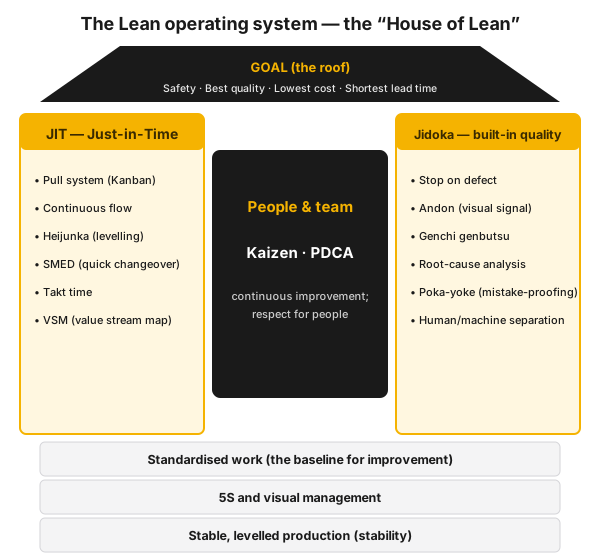 Figure 1 — the visual model of the TPS, the House of Lean: on the stable foundation the JIT and Jidoka pillars carry the “best quality – lowest cost” goal system, with people and Kaizen at the center.
Who is this for?
Section titled “Who is this for?”This article is for those who would start or lead a Lean or process-improvement transformation in their own organization: plant and production manager · shift supervisor · process engineer · Lean/CI specialist · project and change manager · senior executive / sponsor · process technologist.
Learning objectives
Section titled “Learning objectives”After reading this article you will be able to:
- say where and why the TPS was born, and what it has to do with Lean;
- name who put the system together, and what intellectual foundation it was built on;
- justify why the TPS cannot be transferred to another industry without change;
- outline the main steps of a tailored introduction (learning → reflection → strategic plan → breaking down barriers);
- recognize when the mere copying of the TPS is the wrong answer, and what is the right one instead.
In brief (TL;DR)
Section titled “In brief (TL;DR)”- The TPS was made for Toyota’s own circumstances (little space, little raw material, fierce competition, post-war scarcity).
- Taiichi Ohno put it together as a business approach, building heavily on W. Edwards Deming’s quality and process thinking.
- The name “lean” was made famous by The Machine That Changed the World (Womack, Jones, Roos, 1990) — the generalized, industry-independent version of the TPS.
- Don’t copy it literally: at another company it works only through reflection and tailoring, adapted to the local culture.
- Literal copying frustrates and alienates people from the concept — Lean is not a recipe but a way of thinking.
- ~95% of the loss is the cultural barrier to change: introducing tools without a cultural shift cannot be sustained.
- In training avoid purely Toyota / manufacturing examples — use industry-specific (e.g. process-industry) cases.
Why it matters (the stakes)
Section titled “Why it matters (the stakes)”Poorly transplanting a good system costs more than never starting at all. Blind copying is not neutral: it sets off a chain that in the end consumes not only money but people’s trust. Whoever forces the Toyota model one-to-one onto an organization with a different culture and a different industry typically gets rejection — “this isn’t about us” — and afterwards the name Lean becomes a “burned” concept in the organization for years.
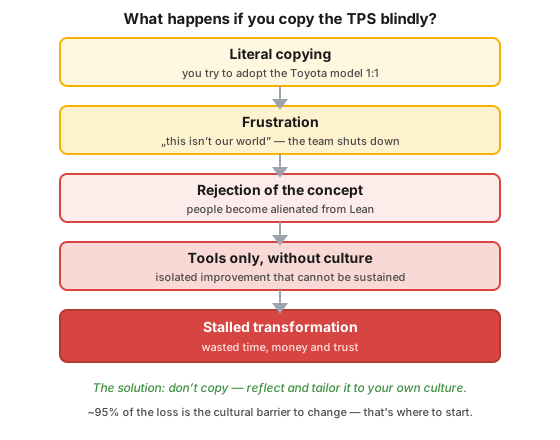 Figure 2 — the escalation of blind copying: literal adoption → frustration → rejection of the concept → tool introduction without culture → stalled transformation. The solution is at the very start of the chain: reflection and tailoring.
The lesson is simple: the value of Lean is not in its tools but in the thinking that leads to it. About 95% of an organization’s loss is tied to the cultural barriers to change — which is why isolated tool fixes (a kanban here, a 5S action there) do not survive without the underlying cultural shift. So the stakes are not “do we introduce a few tools,” but whether the organization truly transforms, or merely plays at Lean.
Where does the TPS come from, and what does it have to do with Lean?
Section titled “Where does the TPS come from, and what does it have to do with Lean?”The TPS grew out of the scarcity of post-war Japan, and Lean is the generalized version of it. Toyota had to produce cheaply and with good quality using little space, little raw material, under fierce competition — around 1950 Toyota’s annual volume was a fraction of that of the large American manufacturers, and its productivity lagged far behind too. Out of this necessity was born a series of simple but revolutionary innovations.
The arc of the story is worth following:
| Era | Milestone | What it gave to Lean | |
|---|---|---|---|
| 18th c. | Benjamin Franklin — “time is money” | the conscious management of value-creating time | |
| ~1903–1927 | Henry Ford’s mass production (Model T) | flow and standardization (but: “any color, as long as it’s black”) — zero variation | |
| from ~1936 | Toyota Production System — Kiichiro Toyoda, Taiichi Ohno | self-checking machines (Jidoka), quick changeover, [[pull-rendszer.en | pull]] process, built-in quality |
| 1990 | The Machine That Changed the World (Womack–Jones–Roos) | the name “lean” — the industry-independent generalization of the TPS |
Putting the system together was Taiichi Ohno’s doing: although many took part in the development, it was he who forged it into a single, working business approach — with Kiichiro Toyoda and others at Toyota. The intellectual foundation was heavily the quality and process thinking of W. Edwards Deming (and others) — hence the PDCA / Deming cycle too. Toyota also rethought Ford’s original ideas: it sized the machines to actual volume, ensured quality with self-checking machines, enabled small batches with quick changeovers, and every step signaled its current material need to the previous one. The result: low cost, high variety, high quality and very fast lead time.
The key sentence to remember from this: Toyota created the system for itself. It fit precisely their needs, constraints and culture — which is why it made them so successful, and why it cannot be pulled onto anyone else without change. The full operating model (with the pillars and the foundation) is summarized by the House of Lean; the five principles of Lean and the waste types are set out in the Lean basics and the five Lean principles articles — this article deliberately concentrates on origin and adaptability.
Can it be transferred to another industry without change?
Section titled “Can it be transferred to another industry without change?”No: the TPS was made for Toyota’s own needs, and so at another organization it works only through reflection and tailoring. The most important lesson is not a tool but an attitude — adopting the thinking instead of the copying. The steps of transplanting it into another industry:
- Don’t copy the Toyota model literally — the system is not portable “as is.”
- Reflect on your own circumstances: what your processes, your workforce, your culture, your constraints are like.
- Tailor the system to the organization’s culture and workforce composition — you shape the way of introduction, you don’t dilute the principles.
- In training use examples characteristic of the given industry instead of Toyota / manufacturing references.
Literal copying leads to frustration and alienates people from the concept. Lean is not a recipe but a way of thinking: the same 5S or VSM is worth something entirely different in a culture that understands and wants continuous improvement than in one where it was imposed from above.
How would you introduce it elsewhere? (roadmap)
Section titled “How would you introduce it elsewhere? (roadmap)”Introduction is not tool installation but a cultural shift — which is why the order runs top-down, from understanding to breaking down barriers. A source-faithful, generalizable outline:
- Learn and reflect. The leadership team and the key advisors should understand what Lean would mean for the organization — deciding, through much debate and honest self-examination, whether it is even a good answer for you at all.
- Build it into the strategic plan. If the decision is yes, Lean should go into the company’s high-level plan — so that everyone takes it seriously, and top management commits as well. The process-level work can be delegated, the responsibility for the cultural shift cannot.
- Identify and break down the barriers to change. Assess how large the organizational barriers are (silos, embedded culture, traditional leadership), weight them, and attack the most critical ones first. You never fully eliminate the barriers — decide when progress is “enough” to move on.
- Tailor it to the organization. Adapt the way of introduction to the culture and workforce composition, continuously reassessing, so the old habits don’t creep back.
- Start value-stream-based improvement. Move from the big picture (value stream map) toward the details, and execute the surfaced problems quickly, prioritized by criticality — so the momentum is kept.
Mini-scenario (how you would start tomorrow). Don’t “introduce Lean” all at once. Choose a single, painful and measurable problem in one value stream, draw its current state with the team on site, and launch a small, quick kaizen action on the largest item of waste. The goal is not the spectacle, but that the team experiences on their own example: Lean is about them, not about Toyota.
Homework. Write down your own organization’s three biggest cultural barriers to change (e.g. silos, “we’ve always done it this way,” a punitive error culture), weight them from 0 to 5, and mark which one you could meaningfully reduce over the next quarter.
How is the TPS different from a toolset?
Section titled “How is the TPS different from a toolset?”The TPS is a system and a way of thinking, not a collection of tools — and this difference decides the fate of the introduction. Whoever takes it as a tool list (kanban, andon, 5S…) adopts the most spectacular parts without the invisible foundation — the culture and the leadership behavior — and precisely what would make it work is left out.
| Viewpoint | TPS as a toolset | TPS as a system / way of thinking |
|---|---|---|
| What you adopt | concrete tools (kanban, andon, 5S) | principles + the thinking that leads to them |
| Where it starts | “let’s install this one too” | “let’s understand what our problem is” |
| Sustainability | isolated, wears off quickly | embedded in the culture, durable |
| Transferability | copyable — but doesn’t fit | to be tailored — which is why it fits |
jidoka, JIT, kaizen and 5s are all tools of the TPS — but on their own, without the underlying system, they deliver only a fraction of the value. So it is worth treating the TPS separately as a concept (the system) and as an implementation (the local tools).
Process-industry context
Section titled “Process-industry context”Process-industry players often feel they are different from discrete manufacturing: different problems, processes and workforce composition (continuous operation, control room, Seveso risk). This is partly true — and precisely for this reason the way of introducing Lean must be tailored to the industry, and in the trainings the purely manufacturing (Toyota) examples must be avoided, otherwise the specialists rightly feel that “this isn’t about us.”
But the essence is the same: Lean focuses on reducing waste — and there is waste in every organization. In the process industry Lean does not optimize serial production, but reliability, lead time and safety; waste is present there too, whether the product price is high or low — and it must be managed continuously, so that the organization stays successful year after year. The details of continuous-operation application are discussed in Lean basics.
When NOT to use it? (the limits of the method)
Section titled “When NOT to use it? (the limits of the method)”The TPS is strong, but not in every situation is the bare “let’s introduce the Toyota system” the right answer. Knowing where the boundary is matters just as much as the method itself:
| Situation | Why (primarily) not TPS copying | The right answer |
|---|---|---|
| No leadership commitment to the cultural shift | Lean is 95% a cultural matter; without it, a tool-theater | first sort out the leadership and the sponsorship, only then introduce it |
| A one-off, isolated fix is needed, not a transformation | the whole system is too heavy for a single point | use the tools in a targeted way — but know that on its own it isn’t sustainable |
| Blind copying with Toyota examples, in another industry | breeds frustration and rejection | reflection + tailoring + industry-specific examples |
| The problem is really technological / design-related | Lean targets process and cultural waste | an engineering / technological solution, alongside Lean |
Rule of thumb: the TPS is the right answer when you are ready to transform the culture too and to tailor the system to your own. If you only want quick, isolated gains without a cultural shift, you may use the tools — but don’t call it a Lean transformation.
Common mistakes
Section titled “Common mistakes”- Copying without reflection. Transplanting the Toyota model one-to-one → frustration and rejection. Instead: reflect on your own circumstances, and tailor the way of introduction to your culture.
- Tool fetish. Introducing kanban/andon without the underlying thinking (and the three lenses). Instead: first understand the system and the culture; the tool only comes after that.
- Foreign examples. Only manufacturing (Toyota) cases for a process-industry audience → “this isn’t about us.” Instead: industry-specific examples taken from the audience’s own world.
- A culture-free “quick fix.” Isolated tool actions bypassing the deeper change. Instead: attack the cultural barriers to change — this is ~95% of the gain.
- “We’re already doing this” complacency. Satisfaction with progress kills the hunger for further improvement. Instead: institutionalized humility — “how much improvement is still possible” (the core of the Toyota culture).
Key takeaways
Section titled “Key takeaways”- The TPS was Toyota’s own — your job is not to copy it, but to adopt the thinking behind it and tailor it to your own.
- Reflection > copying: first understand your own problem and culture, only then reach for a tool.
- Culture is the 95%: introducing tools without a cultural shift does not survive.
- Teach in your own language: industry-specific examples, not Toyota anecdotes.
- Lean is a way of thinking, not a recipe — and it is never “finished”: continuous dissatisfaction with progress is the engine of the system.
Self-check
Section titled “Self-check”- Why was Toyota’s own circumstance (space, raw material, competition) crucial in the TPS turning out exactly the way it did — and why does it follow that it cannot be copied blindly?
- A leader says: “let’s introduce the Toyota system one-to-one, since it works for them.” List what chain this sets off (Figure 2), and where it could have been broken.
- What is the difference between adopting the TPS as a toolset and as a way of thinking — and which one survives durably, and why?
How does this show up in digital practice?
Section titled “How does this show up in digital practice?”The most important message of the TPS — “don’t copy, tailor it to your own reality” — translates directly into digital operation. A good digital operating system does not force a foreign template onto you, but can be configured to your processes; the mechanism differs, the principle is the same.
| TPS principle | Digital implementation | What it delivers | |
|---|---|---|---|
| Adaptability (don’t copy) | configurable workflow / template for your own plant’s reality | the system fits, it doesn’t break the people | |
| Built-in quality ([[jidoka.en | jidoka]]) | automatic anomaly signaling, a step that can’t be closed in a faulty state | the defect surfaces where it arises |
| Pull process ([[pull-rendszer.en | JIT]]) | demand-based signal to the previous step, real-time inventory feedback | only as much and only when it is needed |
| Continuous improvement ([[kaizen.en | kaizen]]) | recorded deviations → prioritized improvement items, action tracking | the daily reality supplies the raw material for improvement |
| Standard work | a digital template records the proven routine, but can be changed with versioning | a uniform yet improvable practice |
Connection to OPEREX (shift log)
Section titled “Connection to OPEREX (shift log)”The TPS’s principle of adaptability shows up directly in a digital shift log. The OPEREX shift log does not transplant Toyota’s assembly line, but digitizes the shift-level reality of continuous operation: the shift handover, the deviation recording and the tracking of open items, configured to your plant. This way the daily engine of Lean — recording deviations and the continuous improvement that starts from them — lives on in a tool tailored to the local culture, not as the imposition of a foreign template.
Terminology (HU / EN / JP)
Section titled “Terminology (HU / EN / JP)”| Hungarian | English | 日本語 / note |
|---|---|---|
| Toyota Termelési Rendszer | Toyota Production System (TPS) | トヨタ生産方式 — the original name of Lean |
| Lean (karcsú) gyártás | Lean manufacturing | the generalized version of the TPS (Womack–Jones, 1990) |
| Lean Templom | House of Lean / TPS House | the visual model of the TPS |
| Testreszabás | tailoring / adaptation | adapting to the local culture |
| Autonomáció (beépített minőség) | jidoka / autonomation | 自働化 — the self-checking machine |
| Éppen időben | just-in-time (JIT) | a pull, demand-driven process |
Can Toyota's system be copied one-to-one?
It’s not worth it: the TPS was made for Toyota’s own needs. Copying it literally only causes frustration and alienates people from the concept; reflection and adaptation to the local culture are needed.
Who are the "fathers" of the TPS?
Putting the concept together is Taiichi Ohno’s achievement (with Kiichiro Toyoda and others at Toyota), and it built heavily on W. Edwards Deming’s quality and process thinking.
What is the difference between the TPS and Lean?
The TPS is Toyota’s specific production system; “lean” is its industry-independent, generalized name, made famous by The Machine That Changed the World (Womack, Jones, Roos, 1990).
Why avoid Toyota examples in a process-industry training?
Because process-industry specialists feel their own environment is different; industry-specific examples are more credible, and don’t distract attention from the principle itself.
Why isn't it enough to adopt just the tools (kanban, 5S)?
Because the value of Lean is in the underlying culture and thinking. Isolated tool fixes do not survive without a cultural shift — ~95% of an organization’s loss is tied to the cultural barrier to change.
Related concepts
Section titled “Related concepts”Lean basics · the five principles · the House of Lean · jidoka · just-in-time · pdca · kaizen · the three lenses · Lean leadership
Next step
Section titled “Next step”If you have understood this, from here it is worth going on — in this order:
- Lean basics — the five principles of Lean, the waste types and the three lenses: here you get the content of the system that the TPS only illuminates in its origin and adaptability.
- the House of Lean — the visual model of the TPS: why a house, what the two pillars (JIT + Jidoka) carry, and what the foundation is.
- Lean leadership — the leadership side of tailoring and cultural change: how you break down the barriers to change in practice.
References / further reading
Section titled “References / further reading”- Taiichi Ohno: Toyota Production System: Beyond Large-Scale Production. Productivity Press, 1988. — the canonical foundational work of the TPS from the very creator of the system; its thesis is the complete elimination of waste, with cost reduction as the goal.
- James P. Womack — Daniel T. Jones — Daniel Roos: The Machine That Changed the World. Rawson Associates, 1990. — the work that coined and popularized the concept of “lean.”
- Jeffrey K. Liker — Gary L. Convis: The Toyota Way to Lean Leadership. McGraw-Hill, 2012. — the leadership and cultural side of the TPS, with the perspective of tailoring and continuous improvement.