Flow and lead time — Ohno's view of time
≈ 17 min read · 3,365 words
You order something online — making it and boxing it takes minutes, yet you wait a whole week for it. Between the factory and the warehouse the box “rests” for days, waits for a truck, waits at customs, waits for delivery. If you laid out the full journey of your order on a strip, the picture would be sobering: the useful, value-adding work is a thin green line, and the rest is pure waiting. This is exactly the picture Lean looks at for every process. Flow is the state in which the product moves without interruption along the value stream; lead time measures how much time passes from the start of the process to the end. The two are two sides of the same coin: the better the flow, the shorter the lead time. Let’s look at what it is, why lead time is its main metric, and what Taiichi Ohno said about time.
Flow is the uninterrupted movement of products along the value stream. In Lean, flow produces a shorter lead time, builds in quality and reduces cost; variation (Mura), by contrast, obstructs flow. The most important performance metric of flow is the lead time. According to Taiichi Ohno, the essence of Lean is watching and shortening the time that passes from the arrival of the customer order to the arrival of the payment for the completed order — by eliminating the processes that create no value.
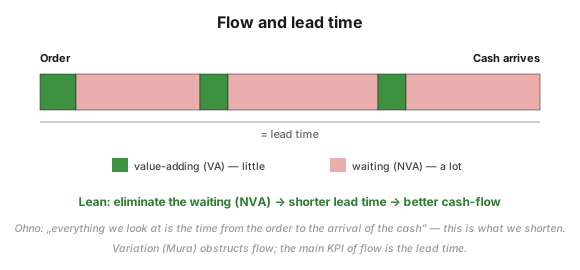 Figure 1 — the lead time from order to the arrival of the cash; there is little value-adding (green) time and much waiting (NVA). Lean eliminates the waiting.
Who is this for?
Section titled “Who is this for?”This article is for those who deal in practice with the question of flow and lead time: operator · shift and plant manager · process engineer · logistics and supply-chain specialist · buyer · planner · finance/controlling specialist · Lean/CI specialist.
Learning objectives
Section titled “Learning objectives”After reading this article you will be able to:
- say what flow is, and why lead time is its most important metric;
- explain Ohno’s view of time — that lead time is at once a customer-service and a financial question;
- classify the steps of a process using the Eliminate → Reduce → Flow logic, and say where the greatest potential lies;
- recognize why variation (Mura) blocks flow;
- draw the line: when chasing flow is not the right answer.
In brief (TL;DR)
Section titled “In brief (TL;DR)”- Flow = uninterrupted movement along the value stream: the right material, at the right time, in the right quantity, moving on.
- The main KPI of flow is the lead time: the shorter it is, the better the flow.
- Flow creates a shorter lead time, builds in quality and reduces cost — variation (Mura), by contrast, blocks flow.
- Ohno: “everything we look at is the time from the order to the arrival of the cash” — this is the time we shorten.
- The lead time is dominated by the waits (NVA), not the value-adding steps — that is where the potential is.
- Financial stake: a long lead time finances tied-up capital; a shorter one improves cash-flow.
Everyday flow examples (you have definitely met them)
Section titled “Everyday flow examples (you have definitely met them)”Flow and lead time are not abstract factory concepts — you live them day in, day out, you just don’t call them that. The common thread: the useful work is short, the waiting is long — and the lead time is dominated by the latter.
| Everyday situation | Value-adding time | What inflates the lead time |
|---|---|---|
| Receiving an online order | minutes (picking) | days of warehouse and shipping waiting |
| Medical referral → result | minutes of examination | weeks in the queue, waiting for an appointment |
| Morning queue at the bakery | seconds of service | minutes standing in line |
| Administrative case handling | minutes of the actual decision | days/weeks of approval loops |
| Car repair at the shop | hours of actual work | days waiting for the part |
The lesson of each is the same: it is not the work that needs speeding up — it is the waiting that needs eliminating. This is exactly what we take into industry too.
Why does it matter? (the stakes)
Section titled “Why does it matter? (the stakes)”A long lead time on its own seems like “just slowness” — the trouble is the chain reaction it sets off. Every day the product waits, you finance tied-up capital, you pile up work-in-process, and you serve the customer more slowly and less reliably. In the end you are not simply slow: you are more expensive and more vulnerable than the competitor who works with a short lead time.
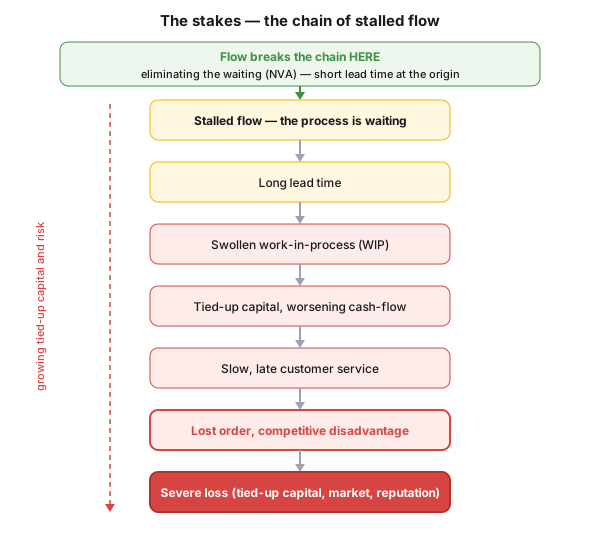 Figure 2 — the escalation of stalled flow: waiting breeds long lead time, swollen inventory, tied-up capital and worsening cash-flow. Flow breaks the chain at its very start — at the origin, by eliminating the waiting.
The lesson is simple: the cheapest wait is the wait that never happened. That is why it pays to build flow into the start of the chain — into the process — rather than compensating expensively at the end with more inventory and expedited shipping.
What is flow, and why is lead time its main metric?
Section titled “What is flow, and why is lead time its main metric?”Flow is the uninterrupted movement of products: the right part at the right time, in the right quantity, moving all the way along the value stream. When this succeeds, you get three things at once: a shorter lead time, built-in quality and lower cost. The enemy of flow is variation (Mura): dispersion stalls the process — which is why stable, predictable operation is the precondition of flow (see mura and the muda waste types).
The main KPI of flow is the lead time, because it is the only metric that measures the whole process, not one step at a time. The material and information flow covers the entire order-to-payment process: forecast, order, raw material, preparation, processing, delivery — from the supplier through the company to the customer. If you speed up just one machine but the intermediate waiting stays, the lead time does not move. So the lead time is the honest mirror of the system: it does not let local optimization hide the system’s real slowness.
Ohno’s view of time — time and cash flow
Section titled “Ohno’s view of time — time and cash flow”According to Taiichi Ohno, the father of the Toyota Production System (TPS), time is the only truly important measure. His classic line: “All we are doing is looking at the time line — from the moment the customer gives us an order to the point when we collect the cash.” Lean shortens this time — not by driving people to work faster, but by taking the non-value-adding waits out of the process.
Ohno’s time line is also a cash-flow time line. The company first pays out cash (Cash Out): it buys the raw material. Only much later, after the product is delivered and the customer pays, does it receive cash (Cash In). The gap between the two is the financed period: the longer the lead time, the longer the company must finance the work-in-process from its own money — this is the tied-up capital (working capital). This is why shortening the lead time kills two birds with one stone: better customer service and better cash-flow.
| Ohno’s time line | Financial meaning |
|---|---|
| Procuring raw material | Cash Out — the company pays |
| Processing, waiting, storage | financing the tied-up capital |
| Delivery, customer payment | Cash In — the cash arrives |
This view is what makes clear why lead time is not merely a technical question: a long lead time weighs directly on the balance sheet.
How do we create flow? (Eliminate → Reduce → Flow)
Section titled “How do we create flow? (Eliminate → Reduce → Flow)”Creating flow is not a single move but a classification and intervention. You sort every process step into three categories (see the three types of activity), and you intervene accordingly:
- Eliminate — get rid of the non-value-adding (NVA) steps: abnormal operation and pure waste (the customer does not pay for it).
- Reduce — reduce the necessary but non-value-adding steps (handling, inspection, setup — needed, but adds no value).
- Flow — make the remaining, value-adding (VA) steps continuous.
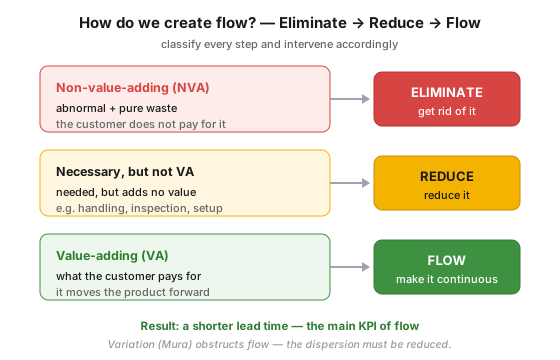 Figure 3 — Eliminate → Reduce → Flow: first eliminate the waste, then reduce the necessary evil, and finally let the value-adding core flow. The result is a shorter lead time.
The ranking matters: elimination always comes first, because even the fastest step is superfluous if it should not exist in the first place. The value stream map (VSM) makes visible where and how much time is spent — the time strip is longest at the waits, so that is where the greatest saving potential lies. The guiding motif is the same throughout: eliminate → reduce → flow.
How is flow different from “speeding up” or maximizing utilization?
Section titled “How is flow different from “speeding up” or maximizing utilization?”Flow is not the same as “let’s work faster” or “let’s run every machine at maximum.” On the contrary: local speed-ups and full utilization often worsen flow, because they breed intermediate inventory and waiting. Flow looks at the whole system, not the individual steps:
| Approach | What it optimizes | Its weakness vs. flow |
|---|---|---|
| Flow | the whole lead time | — |
| Local speed-up | the speed of a single step | the intermediate waiting stays; the lead time does not move |
| Utilization maximization | the busyness of machines/people | causes overproduction and accumulating WIP — the worst muda |
| Large batches (“all at once”) | saving on setups | swells inventory and waiting |
So flow does not strengthen the weakest link alone, but attacks the time between steps — where the lead time is actually lost.
Process-industry context
Section titled “Process-industry context”In process industries the value stream runs from the raw material (feed) through semi-finished and finished products to the customer; the intermediate storage (semi-finished/finished goods) and the variation stall the flow, increasing the lead time and the tied-up inventory. Flow here does not mean a conveyor belt but a stable, predictable material flow free of bottlenecks — and it is hard precisely because in continuous operation the storage and buffer tanks can easily hide the real waiting.
The deterioration of flow does not apply only to the physical material. In a documented procurement / administrative Lean project, streamlining the approval process — fewer approval steps and fewer administrative documents — measurably reduced the lead time. This shows well that lead time is just as much at stake in office / support processes (procurement, permitting, maintenance planning) as in physical production: a long administrative lead time ties up capital and slows down troubleshooting.
Putting it into practice (roadmap)
Section titled “Putting it into practice (roadmap)”Improving flow is not a “big transformation” but a well-followable, repeatable loop. Suggested order:
- Choose the value stream — the path of one specific product or service family from order to payment.
- Map the current state (VSM): draw up the material and information flow, and measure the time at every step and every wait.
- Classify every step (Eliminate / Reduce / Flow) — mark what is value-adding, what is a necessary evil, and what is pure waste.
- Attack the longest wait first — the longest NVA stretch of the time strip, not the most spectacular machine.
- Stabilize against dispersion (reducing mura): level the load, standard work — there is no flow without a stable process.
- Re-measure the lead time and repeat (pdca): flow is not a one-off project but a continuous state.
Mini-scenario (how you would introduce it tomorrow). Take a painful, slow process — say the journey of a maintenance work order from request to closure. On an A3 sheet of paper draw up the steps, and next to every arrow write how much time passes there (not the work, but the waiting). Almost certainly the “rest” between the steps will be 80–90% of the total time. Pick the longest one and ask: why does it wait here? In most cases for an approval, a part or a decision — and that is exactly the NVA to eliminate.
Measurement / audit
Section titled “Measurement / audit”The “hard” metric of flow is the lead time, but it is worth putting two nuancing metrics beside it:
| Metric | What it measures | Why it matters |
|---|---|---|
| Lead time | the total elapsed time from start to finish | the main KPI of flow; the honest mirror of the system |
| Value-adding time (VA time) | how much of it is actual value creation | usually a fraction of the lead time |
| Flow efficiency (PCE = VA / lead time) | the ratio of VA time to the total lead time | shows how much is “pure waiting” |
The logic is simple: if the flow efficiency is low, most of the lead time is made up of waiting — so you should not speed up but eliminate the waiting. The goal is not a “nice number” but that the total lead time decreases while quality and stability do not deteriorate.
Common mistakes
Section titled “Common mistakes”The pitfalls of flow almost all stem from the same thing: we look at the individual steps instead of the whole flow. In anti-pattern ↔ correction pairs:
- Blocking flow with variation. We try to build flow on a fluctuating, unpredictable process. Instead: first stabilize (Mura reduction, standard work), then flow — there is no flow without a stable base.
- Looking only at the VA steps. We try to speed up the actual work. Instead: the lead time is dominated by the waits (NVA) — the real potential is there, not in the VA steps.
- Local optimization. We speed up a single machine/step. Instead: look at the whole value stream — speeding up one step does not help if the intermediate waiting stays.
- Chasing utilization. “Let everything run at maximum.” Instead: 100% utilization breeds overproduction and accumulating WIP — flow matters more than busyness.
- Ignoring the financial stake. We see the long lead time only as “slowness.” Instead: a long lead time is tied-up capital — connect the process to the cash-flow.
When NOT to use it? (the limits of the method)
Section titled “When NOT to use it? (the limits of the method)”Flow is one of the strongest principles of Lean, but chasing flow is not the right answer in every situation. Knowing where the boundary is is just as important as the method itself:
| Situation | Why (primarily) not flow | The right answer | ||
|---|---|---|---|---|
| Unstable, unpredictable process | flow cannot be built on a fluctuating base | first stabilize: Mura reduction, [[standard-munka.en | standard work]] | |
| Safety-critical, mandatory waiting (e.g. reaction time, curing, quarantine) | these are not “wastes” but necessary, prescribed times | do not shorten these — design the flow around them | ||
| Very low, sporadic demand | there is not enough repetition for one-piece flow | batch production + inventory can be the rational answer | ||
| The root problem is quality, not flow | fast flow multiplies the defect just as fast | first [[jidoka.en | jidoka]] / [[poka-yoke.en | poka-yoke]] for built-in quality |
Rule of thumb: flow is strongest on stable, recurring value streams. It does not replace the safety and quality preconditions — it builds on them.
Key takeaways
Section titled “Key takeaways”- The lead time is the honest mirror of the system — the only metric that measures the whole process, not one step.
- Attack the waiting, not the work: the lead time is dominated by the time between steps, that is where the greatest, often free, potential is.
- Eliminate → Reduce → Flow, in that order — even the fastest step is superfluous if it should not exist at all.
- Stability first, then flow: variation (Mura) blocks flow.
- Lead time is also a financial question: a long lead time is tied-up capital — shortening it improves cash-flow.
Self-check
Section titled “Self-check”- Why is lead time the main metric of flow, and why is it not enough to measure the speed-up of a single step?
- Where on Ohno’s time line are the “Cash Out” and the “Cash In,” and what does the company finance between the two?
- Classify three steps from a process you know into the Eliminate / Reduce / Flow categories — and say which one you would start with and why.
How does this show up in digital practice?
Section titled “How does this show up in digital practice?”The principle of flow does not end on the production line: the same logic is realized in software too, in any well-designed digital workflow. Instead of the physical material flow, here the work, the task and the information flow — and the system makes visible where it stalls. The mechanism differs, the principle is the same.
| Flow principle | Digital implementation | What it delivers |
|---|---|---|
| Measuring lead time | an automatic timestamp at every status change (from start to finish) | the whole lead time becomes visible, not just felt |
| Detecting waiting | automatic detection of the idle time between steps (where the task “sits”) | the largest NVA stretch can be targeted at once |
| Eliminate / Reduce | cutting superfluous approval and administrative steps out of the workflow | a shorter lead time by reshaping the process |
| Visualizing flow | a digital board / status tracking of the real position of the work | the stalled item is visible at a glance |
| Monitoring variation | the trend of the lead time’s dispersion, flagging outliers | Mura becomes measurable and manageable |
Connection to OPEREX (shift log)
Section titled “Connection to OPEREX (shift log)”The lead time and the events that block flow (downtime, waiting, quality deviation) can be logged up to date in the shift log (OPEREX), so a deterioration in flow becomes visible early to the shift supervisor and management — the intervention starts not from a monthly report but at shift level. The log connects the flow-blocking event to the owner and the deadline, so recurring bottlenecks (repeated waiting at a given step) can be filtered out, and at the handover between shifts a pending matter is not lost.
Terminology (HU / EN)
Section titled “Terminology (HU / EN)”| Hungarian | English | Note |
|---|---|---|
| Áramlás | Flow | the uninterrupted movement of products |
| Átfutási idő | Lead time | the main KPI of flow |
| Rendelés–fizetés folyamat | Order-to-payment | the frame of Ohno’s view of time |
| Értékteremtő idő | Value-adding (VA) time | what the customer pays for |
| Nem értékteremtő | Non-value-adding (NVA) | waiting, waste |
| Áramlási hatékonyság | Process cycle efficiency (PCE) | VA time / lead time |
| Lekötött tőke | Working capital | the cost of a long lead time |
| Változékonyság | Variation (Mura) | blocks flow |
What is the main performance metric of Flow in Lean?
The lead time: a shorter lead time signals better flow. The lead time is the only metric that measures the whole process — and variation (Mura) blocks flow.
What did Taiichi Ohno say about lead time?
According to Ohno, the company watches how much time passes from the arrival of the customer order to the arrival of the cash, and it shortens this time by eliminating the processes that create no value.
Why is lead time also a financial question?
Because the company finances the gap between its own cash outflow (raw material) and the customer’s cash inflow; a long lead time means tied-up capital (working capital), and shortening it improves cash-flow.
What does Eliminate → Reduce → Flow mean?
You classify every process step: you eliminate the non-value-adding (NVA), reduce the necessary but non-value-adding, and make the remaining value-adding one continuous. The order matters — elimination always comes first.
Why is it not enough to speed up a single machine or step?
Because the lead time is dominated by the waiting between the steps, not the work within the steps. If the intermediate waiting stays, a faster machine does not shorten the lead time — that is local optimization.
Related concepts
Section titled “Related concepts”vsm · the three types of activity · mura · muri · muda · pull system · the five principles · standard work · jidoka
Next step
Section titled “Next step”If you have understood this, from here it is worth going on — in this order:
- vsm — the value stream map: this is what makes the lead time and the waits discussed here measurable and visible. Start with this.
- mura — variation (Mura), which blocks flow: how to stabilize so that flow can be sustained at all.
- pull system — the pull system, which ties flow to real customer demand and prevents overproduction.
References / further reading
Section titled “References / further reading”- Taiichi Ohno: Toyota Production System: Beyond Large-Scale Production. Productivity Press, 1988. — the time- and cash-flow-centered view, the lead time as the measure of the TPS.
- James P. Womack – Daniel T. Jones: Lean Thinking. Simon & Schuster, 1996. — the five principles of Lean, including flow and pull; the canonical work of value-stream thinking.
- Mike Rother – John Shook: Learning to See: Value Stream Mapping. Lean Enterprise Institute, 1999. — the foundational work on the value stream map and the practical measurement of lead time / VA time.