The five Lean principles: Value, Value Stream, Flow, Pull, Perfection
≈ 20 min read · 3,994 words
You order a coffee at your usual spot. You get exactly what you asked for — that is value. Behind the counter every motion (grinding, brewing, frothing) happens for that one cup — that is the value stream. There is no queue, the cup moves without interruption — that is flow. They don’t brew a hundred servings in advance; they make it when you order — that is pull. And tomorrow the barista will be one motion faster — that is a small step toward perfection. Five everyday moments, and that is exactly what the five Lean principles are: the logic by which waste can be driven out of any process. Let’s look at what it is, why it works, and how it is introduced.
The five Lean principles — Value, Value Stream, Flow, Pull, Perfection — are the sequence by which waste can be led out of any process step by step. The framework was formulated by James P. Womack and Daniel T. Jones, translating the Toyota Production System (Taiichi Ohno) into generalizable principles: define what is value to the customer; map the entire value stream; bring the material into uninterrupted flow; pull only on customer demand (don’t push inventory into the process); then start over, toward perfection. Lean is not a one-off project but a continuous loop: Lean = continuous improvement = continuous change.
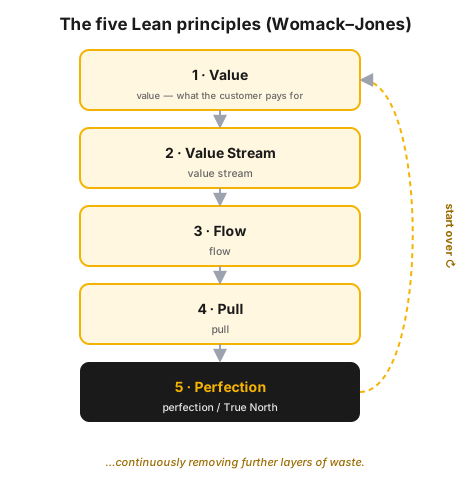 Figure 1 — the five Lean principles as a single cycle: Value → Value Stream → Flow → Pull → Perfection, then start over, removing further layers of waste.
Who is this for?
Section titled “Who is this for?”This article is for those who improve or operate a process in practice: operator · shift and plant manager · process engineer · process and maintenance engineer · logistics specialist · Lean/CI navigator · production and business-unit manager.
Learning objectives
Section titled “Learning objectives”After reading this article you will be able to:
- list the five Lean principles in the correct order, and justify why exactly this order;
- explain why lead time is Lean’s main metric;
- sort the steps of a process into three categories (value-adding / necessary-but-non-VA / pure waste), and know what to do with them;
- distinguish pull from push;
- justify why perfection (True North) is not an end state.
In brief (TL;DR)
Section titled “In brief (TL;DR)”- The five Lean principles are a sequence and a cycle: Value → Value Stream → Flow → Pull → Perfection, then start over.
- The starting point is always the Voice of the Customer: value is what the customer is willing to pay for; everything else is waste.
- The shared goal is reducing lead time — the shorter the path of material/information from “cash out” to “cash in,” the leaner the operation.
- Flow has three obstacles: waste (Muda), inflexibility (Muri) and variability (Mura) — see muda-mura-muri.
- Pull means we produce only when and only as much as the next step (ultimately the customer) actually asks for — we don’t push inventory into the process.
- Perfection (True North / ideal state) can never be fully reached — which is exactly why it drives the endless loop of continuous improvement.
Why it matters (the stakes)
Section titled “Why it matters (the stakes)”Lean’s main metric is lead time: the time that elapses between spending money on raw material (cash out) and the customer finally paying (cash in). The longer this time, the longer the money is tied up — and the more problems stay hidden.
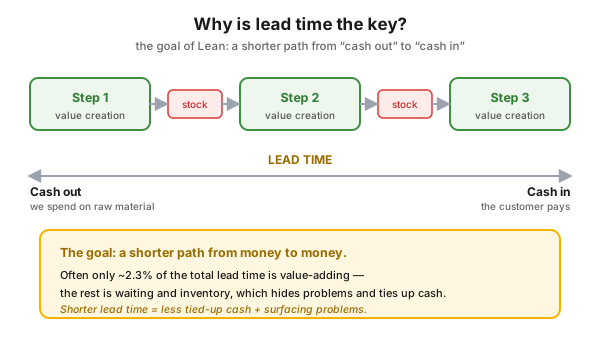 Figure 2 — the material passes through steps and intermediate inventories between cash out and cash in; typically only ~2.3% of the total lead time is value-adding, the rest is waiting and inventory.
What happens to the material in the meantime? It passes through the successive steps of a process-industry production line (e.g. distillation → desulphurization → blending-storage), with inventory everywhere between the steps. If something halts the flow, the process stalls — and the classic “solution” then is to pile up inventory. But inventory hides all the problems while tying up money and energy. That is why it is expensive to skip the five principles: the stake is not a single spectacular defect but the continuously tied-up capital, the problems made invisible, and the exposure to fluctuations in customer demand. Lean’s stake is thus competitiveness itself.
What are the five Lean principles, and in what order should we introduce them?
Section titled “What are the five Lean principles, and in what order should we introduce them?”The five Lean principles must be worked through in this order: (1) Value — define what is valuable to the customer; (2) Value Stream — map the entire process; (3) Flow — bring the value-adding steps into uninterrupted motion; (4) Pull — produce only on customer demand; (5) Perfection — start over, and improve again and again. The order is not arbitrary: you can’t bring into flow something whose value and process you don’t know, and there is no point going to pull until it flows.
1. Value — Who is the customer? What is value?
Section titled “1. Value — Who is the customer? What is value?”The starting point. First you have to clarify who the customer is — it can be external or internal (in a process plant one unit is the internal supplier of another, so one unit is the customer of the other). Value is the Voice of the Customer: what the customer is willing to pay for. The goal is 100% fulfilled customer demand.
2. Value Stream — Observe it!
Section titled “2. Value Stream — Observe it!”Mapping the entire process. A value-adding step is one that changes the product or service so that it becomes a finished product and fulfills the customer demand. The main tool is the VSM (value stream map). The experience is startling: the typical value-added ratio can be as little as 2.3% — that is, only a fraction of the total lead time creates real value, the rest is waste.
3. Flow — Bring it into flow!
Section titled “3. Flow — Bring it into flow!”The value-adding steps must be brought into undisturbed, uninterrupted flow, without intermediate inventory build-up. Flow is the movement of the material through each and every step of the value-creating process. This is made possible by eliminating the three obstacles (waste, inflexibility, variability).
4. Pull — Pull instead of Push.
Section titled “4. Pull — Pull instead of Push.”In the traditional push model every step produces whenever it can and pushes its output onto the next step — this causes overproduction and inventory. In the pull model the process produces only when and only as much as the next step (ultimately the customer) actually calls off. The typical tool of pull is Kanban.
5. Perfection — True North = ideal state.
Section titled “5. Perfection — True North = ideal state.”The classic formulation: “As you define value, identify the value streams, remove the wasteful steps, and introduce flow and pull, start the process again, and continue until you reach a perfect state in which perfect value is created with no waste.” Perfection is the ideal state = True North — a guiding goal that is never fully reached, which is exactly why it drives the endless loop of continuous improvement.
Where do the five Lean principles come from?
Section titled “Where do the five Lean principles come from?”The five principles are associated with the work of James P. Womack and Daniel T. Jones, who shaped the principles of the Toyota Production System (associated with Taiichi Ohno) into a generalizable framework. The historical line of Lean in a few key dates:
- 18th century — Benjamin Franklin: time as the resource of added value (“time for value added activities”).
- ~1903–1922 — Henry Ford: mass production, standardization.
- From 1936 — Toyota / Taiichi Ohno: Kaizen, value stream, the pull principle, built-in quality.
- 1990 — Womack & Jones: The Machine That Changed the World — the spread of the concept of “lean production”; the author pair laid out the five principles in Lean Thinking (1996).
The essence of Lean in a single sentence: Lean = continuous improvement = continuous change. The inevitability of change is the core of the philosophy, underlined on Lean trainings by three classic quotes — Charles Darwin (it is not the strongest species that survives, but the one most adaptable to change), Barack Obama (“we are the change that we have been waiting for”) and W. Edwards Deming (“it is not necessary to change — survival is not mandatory”). The saying often attributed to Winston Churchill fits here too: “To improve is to change; to be perfect is to change often.”
How does it reduce lead time? — the three types of work
Section titled “How does it reduce lead time? — the three types of work”The first step of bringing into flow is to classify every process step by whether it adds value. This is a simple, three-tier logic — flow it → reduce it → eliminate it:
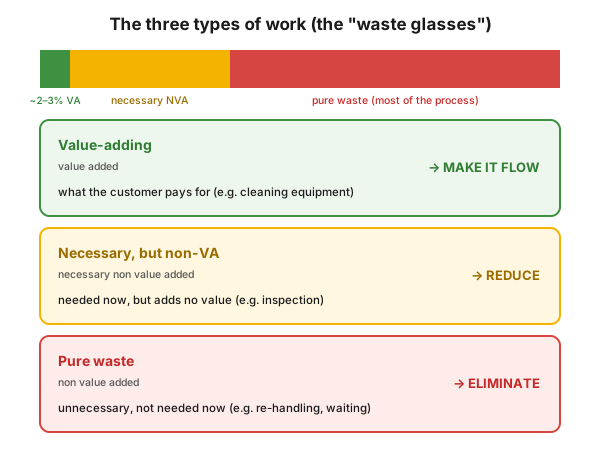 Figure 3 — the three types of work: the value-adding step must flow, the necessary-but-non-value-adding must be reduced, pure waste must be eliminated. Most of a process’s time is typically pure waste.
- Abnormal steps (non value-adding) → ELIMINATE. They create no value, arising only from defects and disruptions.
- Normal but unnecessary steps → REDUCE. Necessary evils (e.g. transport, inspection) that can’t be zeroed out entirely but can be minimized.
- Normal and necessary (value-adding) steps → FLOW. This is the actual value creation, which must be brought into undisturbed flow.
What are the three obstacles to flow?
Section titled “What are the three obstacles to flow?”Flow is obstructed by three factors: waste (Muda), inflexibility (Muri) and variability (Mura). All three add cost to the system without adding value — for durable improvement all three must be attacked at once. This framework builds on the input–transformation–output model: the inputs (people, machine, method, material, information) are transformed through the value-creating process into output (“the best-quality goods, in the right quantity, delivered on time”). Detailed treatment of the three obstacles: muda-mura-muri.
- Waste (Muda) — every process step that adds no value: it consumes resources, money and time. The eight waste types are captured by the acronym TIMWOODI (transport, inventory, motion, waiting, overprocessing, overproduction, defects, unused talent) — full list and process-industry examples: 8 wastes.
- Inflexibility (Muri) — a capacity problem: the inability to change production volume (or quality, resource) to match customer demand.
- Variability (Mura) — fluctuation of processes causes wasted capacity.
Where do the principles fit? — the three lenses
Section titled “Where do the principles fit? — the three lenses”A Lean system is best examined through four viewpoints — this gives the frame in which the five principles live. Detailed treatment: lean-harom-lencse.
- Voice of the Customer (VOC) — what does the customer expect? Everything starts here (think about what you expect in a restaurant).
- Operating System (OS) — the way the process is configured and optimized to create value and minimize waste. This is the home of the concrete Lean toolkit (JIT, Kanban, Jidoka, 5S, standard work, etc.) — in detail: lean-harom-lencse.
- Management Infrastructure (MI) — the formal structures, processes and systems through which human and organizational resources are directed (KPI cascade, performance boards, audit routines).
- Mindset & Behaviours (M&B) — how people think, feel and behave at work. The right mindset and behavior is decisive for a successful Lean transformation.
Process-industry context + safety
Section titled “Process-industry context + safety”The principles are not abstract in a process-industry environment:
- The model of flow: the successive steps of a production line (distillation → desulphurization → blending-storage), the continuous movement of material with minimized intermediate inventory.
- Internal customer–supplier chains: the output of one unit is the input of the next — so the concepts of “value” and “customer” apply to internal customers too, not only the final consumer.
- Safety comes first. The first message of a Lean introduction is SAFETY itself — “there is no alternative to safety.” The precondition of the goal triad (Best Quality – Lowest Cost – Shortest Lead time) is safety: no optimization of flow, inventory or scheduling may come at the expense of safety. At continuous-operation units, stable flow and lower variability are themselves a safety factor — unpredictable operation carries risk.
Putting it into practice
Section titled “Putting it into practice”The five principles as a sequence of action
Section titled “The five principles as a sequence of action”- Define value from the perspective of the customer (external or internal): why are they willing to pay?
- Map the value stream with VSM, and calculate the value-added ratio (VA ratio).
- Bring into flow the value-adding steps: eliminate the three obstacles, reduce intermediate inventory.
- Introduce pull (Kanban): produce only on the next step’s call-off, don’t push inventory.
- Strive for perfection: start over, and improve again and again with the PDCA loop.
How does this scale in an organization?
Section titled “How does this scale in an organization?”The principles are realized not all at once but in organized transformation waves, working on all three lenses (Operating System, Management Infrastructure, Mindset & Behaviours) in parallel. The introduction is led by an internal change agent, the navigator, who then gradually hands responsibility over to the organization — like on a tandem bicycle where the navigator first steers and pedals, and finally the team stands alone at the handlebars. Detailed treatment of the waves, roles and success factors: lean-transzformacios-ut, diagnosztikai-fazis, lean-navigator.
Hands-on / example
Section titled “Hands-on / example”A simple Kaizen (layout improvement). A targeted workstation rearrangement significantly reduces motion waste and lead time, without a big investment:
| Metric | Before Kaizen | After Kaizen | Improvement |
|---|---|---|---|
| Lead time | 1:25 | 0:38 | 0:47 |
| Distance walked per day | 18 m | 1.8 m | 16.2 m |
| Distance walked per year | 6,552 m | 655.2 m | 5,896.8 m |
The lesson: big impact does not always come from big investment — eliminating motion waste with a single well-designed rearrangement yields enormous annual savings.
Maintenance workshop — value-stream analysis. The VSM of a rotating-equipment maintenance workshop revealed that the total lead time was 55 days with material procurement and 34.8 days without it — yet of this the actual physical assembly is only a fraction. The breakdown of the net assembly time: 45% actual assembly time, 36% to be eliminated, 19% unavoidable but minimizable. The improvements (splitting the process into fault-finding and repair, a standardized tool wall, SOPs, a performance board, 5S) brought significant annual hour savings — well illustrating that the VA ratio is typically low, and there is plenty to eliminate and reduce.
Lean in everyday life. Lean principles are everywhere — even at a ski resort: tracking rented roof racks (visual management / whiteboard), distinguishing ski poles (visual management), the small adjustments skiers can make themselves (autonomous maintenance), cleanliness (so that no unnecessary extra activity arises) and the tool wall in the boiler room (easy access + visual management) all embody the same principles. The lesson: look around — Lean principles can be discovered anywhere.
Measurement / audit
Section titled “Measurement / audit”The progress of the five principles can be measured. The main metrics:
| Metric | What it measures | Target logic |
|---|---|---|
| VA ratio (value-adding time / total lead time) | how “lean” the process is | increase the typical ~2.3% step by step by phasing out wasteful steps |
| Lead time (cash out → cash in) | the time capital is tied up | minimize |
| Variability (min / max / average) | the stability of the process | narrow the min–max band (less buffer needed) |
| 8-waste audit (TIMWOODI) | the location and extent of waste | quantify and eliminate (e.g. motion in meters, inventory in tied-up money) |
The guiding principle in auditing: “Speak with Data” — decisions are based on facts, not gossip or feelings. In case of a problem, root-cause analysis follows (5 Why, fishbone/Ishikawa diagram, RCPS – Root Cause Problem Solving). Deviations (gaps) from True North are made visible by the performance board (Performance Management Board) as part of Gemba presence.
Common mistakes
Section titled “Common mistakes”- “Give me the benchmark of a company similar to us, and we’ll copy it.” This is the traditional, mistaken assumption — Lean is not copying. Instead: every organization solves its own challenges based on its own process, place and people.
- Piling up inventory to “solve” problems. Inventory hides the problems while tying up money and energy. Instead: don’t buffer — eliminate the root of the problem.
- Keeping push thinking. If “the most important thing is that volume flows through the unit,” overproduction and inventory arise. Instead: pull — produce on customer demand.
- Lean as an “extra task.” “I’m so busy with my normal work and all the lean stuff.” Instead: “Lean is my normal work!”
- Leading from the meeting room. “Let’s sit down in a meeting room and discuss it…” Instead: “Let’s see it with our own eyes on the shop floor!” (Genchi Genbutsu / Gemba).
- Blame-seeking. “Who is responsible for this defect?” Instead: “Where can we improve the process?” — we fix the system, we don’t blame the person.
- Treating perfection as an end state. Whoever thinks they are “done” stops, and the loop of continuous improvement breaks. Instead: True North is a direction, not a finish line — there is always a next step.
When NOT to use it (the limits)
Section titled “When NOT to use it (the limits)”The five Lean principles are strongest for repetitive, well-definable value streams. Knowing where it is not the first tool is just as important as the framework itself:
| Situation | Why (primarily) not the 5 principles | The right answer |
|---|---|---|
| A one-off, non-repetitive job or genuine R&D / prototype | there is no stable, repetitive process to bring into flow | a flexibility-oriented approach, ad-hoc capture of the lesson |
| A fundamental technological / design constraint causes the bottleneck | eliminating waste doesn’t help, redesign does | process/equipment redesign, engineering intervention |
| Blindly adopting another company’s solution | Lean is not copying — different process, place, people | own current state → future state analysis |
| A safety-critical decision | optimizing flow/inventory can never precede safety | design according to risk analysis and the relevant standards |
Rule of thumb: the 5 principles make the process lean — but they don’t override safety, technological limits, or the uniqueness of the organization.
Key takeaways
Section titled “Key takeaways”- Follow the order: Value → Value Stream → Flow → Pull → Perfection — and start over.
- The customer decides what value is — everything else is waste to be led out.
- Lead time is the measure: a shorter path from money to money = less tied-up capital and surfacing problems.
- Pull, don’t push: produce only on the next step’s call-off.
- Perfection is a direction, not a goal — True North never ends, so improvement stays continuous.
- Don’t copy, solve your own — and never sacrifice safety for flow.
Self-check
Section titled “Self-check”- List the five Lean principles in order, and justify why the 4th (pull) can’t come before the 3rd (flow).
- Only ~2.3% of a process’s lead time is value-adding. What does this mean for the remaining ~97.7%, and which principle targets it directly?
- What is the difference between push and pull, and which causes overproduction — why?
How does this show up in digital practice?
Section titled “How does this show up in digital practice?”The five Lean principles do not end on the production line: the same logic is realized in software too, in any well-designed digital operation. Instead of physical inventory and a paper schedule, here real-time data, a pull-based workflow and visual status tracking reduce lead time — the mechanism differs, the principle is the same.
| Principle | Digital implementation | What it delivers |
|---|---|---|
| Value | explicit recording of customer demand and KPIs | it is always visible what the “valuable” output is |
| Value Stream | digital process/lead-time tracking, revealing bottlenecks | the location of waste becomes visible |
| Flow | automatic status and inventory tracking, an alert on a stall | a stall is revealed immediately, not after the fact |
| Pull | a demand-driven work queue (the next step calls off the work) | no unnecessarily “pushed” inventory or task |
| Perfection | logged deviation → root cause → action (PDCA loop), trend tracking | continuous improvement becomes measurable and traceable |
Connection to OPEREX (shift log)
Section titled “Connection to OPEREX (shift log)”The five Lean principles connect directly to what a shift log measures. The stability of pull-based flow and the reduction of variability can only be managed if the actual performance, the stoppages and the deviations from True North are visible shift by shift. The OPEREX shift-log SaaS provides exactly this daily data recording and visual tracking: as the digital equivalent of the Management Infrastructure’s performance board (Performance Management Board), it supports the KPI cascade and daily gap identification. This way the “Speak with Data” principle is fed by shift-level reality — which is the precondition of the loop of continuous improvement.
Terminology (HU / EN / JP)
Section titled “Terminology (HU / EN / JP)”| Hungarian | English | Japanese / note |
|---|---|---|
| Érték | Value | per the Voice of the Customer (VOC) |
| Értékfolyam | Value Stream | — |
| Áramlás | Flow | — |
| Húzás | Pull | ↔ Push |
| Tökéletesség / ideális állapot | Perfection / Ideal State | True North |
| Folyamatos fejlesztés | Continuous Improvement (CI) | Kaizen (改善) |
| Értékfolyam-térkép | Value Stream Map | VSM |
| Éppen időben | Just-in-Time | JIT |
| Beépített minőség / autonomáció | Built-in Quality / Autonomation | Jidoka (自働化) |
| Kiegyenlített termelés | Levelling | Heijunka (平準化) |
| Húzórendszer-kártya | Pull card / signal | Kanban (看板) |
| Veszteség | Waste | Muda (無駄) |
| Változékonyság | Variability | Mura (斑) |
| Rugalmatlanság / túlterhelés | Inflexibility / overburden | Muri (無理) |
What are the five Lean principles and in what order should they be introduced?
The five Lean principles are: (1) Value, (2) Value Stream, (3) Flow, (4) Pull and (5) Perfection. They must be worked through in exactly this order — first define value for the customer, map the value stream, bring it into flow, pull only on customer demand, then start over, toward perfection.
What is the difference between pull and push?
In the push model every process step produces whenever it can and pushes its output onto the next step — this causes overproduction and inventory. In the pull model a step produces only when and only as much as the next step (ultimately the customer) actually calls off, typically based on a Kanban signal.
Can perfection ever be reached in Lean?
No, and that is exactly the point. Perfection is True North (the ideal state) — a guiding goal we approach but never fully reach. As the formulation goes: after introducing value, flow and pull, “start the process again, and continue until you reach a perfect state in which perfect value is created with no waste.” This endless loop drives continuous improvement.
What are the three main obstacles to flow?
Waste (Muda), inflexibility (Muri — the incapacity of capacity to adapt to customer demand) and variability (Mura — the fluctuation of the process, which causes wasted capacity).
Can another company's Lean solution be copied?
No. In the Lean view every organization must identify and solve its own challenges based on its own process, place, people and unique factors. There is no universal benchmark — leaders must walk their own organization’s path from the current state to the future state.
Related concepts
Section titled “Related concepts”vsm | 8 wastes | muda-mura-muri | lean-harom-lencse | kaizen | 5s | just-in-time | kanban | heijunka | jidoka | smed | gemba | true-north | pdca | lean-transzformacios-ut
Next step
Section titled “Next step”If you have understood this, from here it is worth going on — in this order:
- vsm — the value stream map: the practical tool of the 2nd principle, with which you make waste and the ~2.3% VA ratio visible.
- muda-mura-muri — the three obstacles to flow in more depth: what you eliminate when you “bring into flow.”
- lean-harom-lencse — how the principles fit into the whole Lean system (OS / MI / M&B), and how the transformation becomes sustainable.
References / further reading
Section titled “References / further reading”- James P. Womack & Daniel T. Jones: Lean Thinking: Banish Waste and Create Wealth in Your Corporation. Simon & Schuster, 1996. — the canonical formulation of the five principles (value, value stream, flow, pull, perfection).
- James P. Womack, Daniel T. Jones & Daniel Roos: The Machine That Changed the World. Rawson Associates, 1990. — coining the concept of “lean production” after the Toyota Production System.
- Taiichi Ohno: Toyota Production System: Beyond Large-Scale Production. Productivity Press, 1988. — the original source of pull and built-in quality.
- Mike Rother & John Shook: Learning to See. Lean Enterprise Institute, 1999. — the practical foundational work on value-stream mapping (VSM).