Voice of the Customer (VOC) — customer value as a compass
≈ 15 min read · 2,986 words
When you order at the café — “a large cappuccino, with oat milk, no sugar, extra hot” — you are voicing your own customer’s voice. You don’t ask for less (a lukewarm coffee), and you don’t pay more for something you don’t want (whipped cream, syrup). You expect exactly what you pay for — and if you get it, you are satisfied. The same logic drives Lean: improvement does not start from “what can we do better,” but from what the customer values. This is the Voice of the Customer (VOC). Let’s look at what it is, why it is the compass of value, and how to use it.
The Voice of the Customer (VOC) is the set of needs and expectations of internal and external customers that they are willing to pay for. Lean starts from the VOC: you must deliver exactly those expectations the customer really wants — no more and no less. The VOC gives the reference point for what is value and what is waste, and it links the current state to the desired future state: Lean closes the gap between the two, step by step.
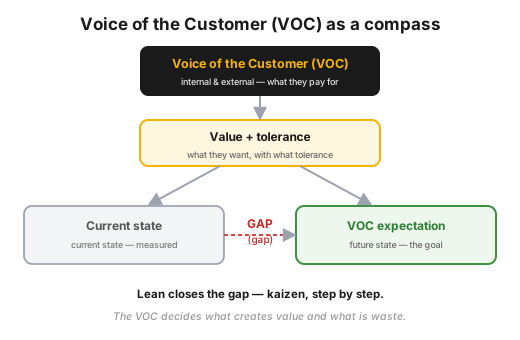 Figure 1 — the VOC defines value and the tolerance band; Lean (kaizen) closes the gap between the current state and the VOC expectation toward the future state.
Who is this for?
Section titled “Who is this for?”This article is for those whose everyday work touches value creation and serving the customer: operator · shift supervisor · production and plant manager · process engineer / technologist · quality engineer · sales / customer relations · Lean/CI specialist · HSE.
Learning objectives
Section titled “Learning objectives”After reading this article you will be able to:
- say who the customer is in Lean (internal and external), and what counts as “value” through their eyes;
- explain why both over-delivery and under-delivery are waste relative to the VOC;
- walk through the VOC → current state → gap → future state logic on one of your own processes;
- recognize where the VOC is NOT the right starting point (legal, safety requirements);
- define the customer of your own area and what value means for them.
In brief
Section titled “In brief”- VOC = the needs of the internal/external customer they pay for — “what the customer pays for.”
- Lean’s goal: deliver exactly this much — not more (over-delivery = waste), not less (under-delivery = insufficient quality).
- The VOC decides what creates value and what is waste (see the three types of activity) — value can only be defined from the customer’s viewpoint.
- A compass: the gap between the current state and the VOC expectation gives the improvement to-do list.
- The internal customer counts too: the next process step / shift is also a “customer” who must be handed value.
- The goal: to serve the customer’s need at the greatest safety and with the least possible use of resources.
Why it matters (the stakes)
Section titled “Why it matters (the stakes)”Without the VOC there is nothing to measure the work against: you cannot decide whether an activity creates value or produces waste. If you do not start from the voice of the customer, “internal logic” (habit, the department’s own convenience) takes over the decision — and from there a slowly swelling chain of waste begins.
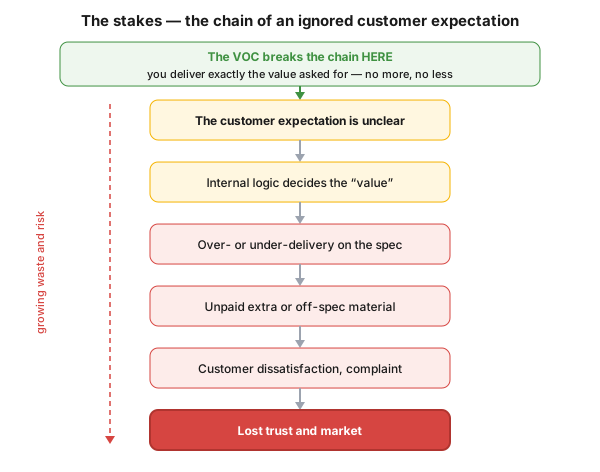 Figure 2 — what happens if you do not clarify the customer expectation: internal logic decides on “value,” the process over- or under-shoots the spec, and the unpaid extra or the off-spec material turns into waste, and finally into lost trust. The VOC breaks the chain at its very start.
The definition of waste comes exactly from this: work or use of resources that, seen through the customer’s eyes, adds no value to the product. Over-production and over-processing are among the eight waste types precisely because they produce an “extra” the customer did not ask for and does not pay for. The lesson is simple: the most expensive improvement is the one that does not target the customer’s value — it pours a lot of energy into what is indifferent to the customer.
What is the VOC, and why is it the compass of value?
Section titled “What is the VOC, and why is it the compass of value?”The VOC is the need and expectation of the internal and external customer that they “pay for” — and at the same time the compass of the whole Lean transformation: every improvement decision is referenced to it. It is not only a starting point but a reference base: once the VOC is known, it is measurable whether an activity is value-creating or waste.
Lean’s goal is to deliver exactly the VOC — neither more nor less:
- More (an extra the customer does not value) → over-production / over-processing, i.e. waste.
- Less (insufficient quality, incomplete delivery) → the customer’s expectation is not met.
In the three lenses framework, too, the VOC is the starting input: the Lean approach is built up from the voice of the customer (VOC → operating system / management infrastructure / mindset and behaviour). This is why the compass role is literal: if the VOC shifts, the improvement direction shifts too.
Who is the customer, and what do they expect?
Section titled “Who is the customer, and what do they expect?”The customer is whoever is willing to pay for the product or service — and can be external (the end user, the buyer) or internal (the next process step, another department, the next shift). The needs of both matter, insofar as they expect value.
The customer’s basic need is the combination of three things:
| What the customer expects | In plain terms |
|---|---|
| The right quality | the product/service to the required specification |
| The right quantity | in the quantity ordered |
| The right time | at the right time (on deadline) |
From this the company’s goal can also be derived: to serve the customer’s need at the greatest safety and with the least possible use of resources. An important element of the VOC is the tolerance band: you must know not only what the customer wants, but also within what tolerance — because the goal is meeting the spec exactly, not needlessly surpassing it.
How do you get from the VOC to the future state?
Section titled “How do you get from the VOC to the future state?”The VOC on its own is not action — it becomes a compass when you measure the current state against it and close the difference step by step. The path has five steps:
- Collect and clarify the customer expectations: what do they want, within what tolerance?
- Identify the core activities needed to meet the expectations.
- Assess the current state, and compare it with the VOC: are the expectations met?
- Identify the gap to the future state that meets the VOC.
- Close the gap step by step, through kaizen and PDCA.
This logic is what makes the value/waste classification interpretable: only from the customer’s viewpoint can it be decided whether an activity is value-creating or waste. And the gap is not abstract — it is the concrete, prioritizable improvement list.
How does the VOC show up in the process industry?
Section titled “How does the VOC show up in the process industry?”In the process industry the VOC is just as two-layered as in discrete manufacturing — only here the “spec” means a product property. The external customer expects the product’s quality specification (on-spec), quantity and delivery deadline; the internal customer may be the next process unit or the next shift, which expects a certain quality of an intermediate stream.
The “tolerance band” element of the VOC here is the product specification: the goal is to meet the spec exactly. Unjustified over-delivery — for example, a purer product than needed — is energy and yield loss: you pay with resources for a quality the customer did not ask for and does not reward. This is why, in the process industry, the VOC directly links the quality goal to operating cost.
Putting it into practice / mini-scenario
Section titled “Putting it into practice / mini-scenario”The best entry point for introducing the VOC is a short, two-question exercise that even a shift supervisor can run with their team:
Task — “Who is my customer?”
- Who is my customer? Write down the direct customer of your own area — external and internal alike (e.g. the next process section, the lab, the next shift, the end user).
- What means value to them? List what exactly they expect (quality, quantity, time), and within what tolerance.
- Where is the gap? Compare what you hand over today with what the customer expects. Where there is a difference, that is the improvement to-do.
Homework. Pick a single output of your own process (a report, an intermediate stream, a piece of work done). Name its customer, write its VOC in one sentence, and mark where you give more or less than needed today. That gap is the starting point for the next kaizen.
Measurement / audit
Section titled “Measurement / audit”The “hard” metric of the VOC is always the gap — the difference between the current state and the expectation. Auditable, VOC-based signals (practical logic, not a source-specific target number):
- Spec accuracy: is the output within the customer’s tolerance band — and not with a needless margin (over-delivery is also a deviation from the VOC).
- Signs of over-delivery: where do we give an “extra” the customer did not ask for (energy, margin, administration) — this is hidden waste.
- Customer feedback: complaints, satisfaction, the internal customer’s grievances — direct signs of the VOC not being met.
Target logic: the goal is not maximum quality, but the exact delivery of the VOC — reducing the gap from both directions (neither too much, nor too little).
When NOT to use it (the limits of the method)
Section titled “When NOT to use it (the limits of the method)”The VOC is the compass of Lean, but not every decision can be derived from it. Knowing where the voice of the customer is not the right starting point is just as important as the method itself:
| Situation | Why the VOC is not (primarily) the decider | The right answer |
|---|---|---|
| Legal / safety requirement | these are mandatory, not expectations “negotiated” with the customer | comply in any case; the VOC optimizes on top of this, not underneath it |
| The customer expectation is unknown / assumed | optimizing for an assumed VOC gives the wrong direction | first assess the real expectation (ask the customer) |
| There is no real customer for the step | if an activity has neither an external nor an internal customer, it is likely waste | first ask: is this step needed at all? |
| Short-term customer wish ↔ long-term value conflict | the momentary request is not always the sustainable value | balance: weigh the VOC together with safety and sustainability |
Rule of thumb: the VOC tells you what is worth doing. The safety and legal minimum must always be met — the VOC steers improvement on top of that, not in its place.
Key takeaways
Section titled “Key takeaways”- Start with the customer, not the process: the improvement question is not “what can we do better?” but “what does the customer value?”.
- Deliver exactly the VOC: over-delivery is just as much waste as under-delivery.
- The internal customer is a customer too: the need of the next step / shift is also VOC — an exact handover, no more, no less.
- The gap is the to-do: the difference between the current state and the VOC expectation is the concrete, prioritizable improvement list.
- Know the tolerance band: not only what the customer wants, but within what tolerance — the goal is meeting the spec exactly, not maximally.
- The VOC is a compass, not a command: it orders improvement above the safety and legal minimum, not below it.
Self-check
Section titled “Self-check”- Who can be a “customer” in the Lean VOC, and why does the internal customer matter too? Give an internal-customer example from your own area.
- Why is over-delivery waste? Give a process-industry example where “better than needed” quality is actually waste.
- Draw the VOC → current state → gap → future state logic: from which step does the concrete improvement list come, and what closes the gap?
How does this show up in digital practice?
Section titled “How does this show up in digital practice?”The VOC principle does not stop at a specification written on paper: the same logic is realized in software too, in any well-designed digital workflow. Instead of the physical spec sheet, here structured requirement fields, validation tolerance limits and gap-monitoring views keep the process on the customer expectation — the mechanism differs, the principle is the same.
| VOC principle | Digital implementation | What it delivers |
|---|---|---|
| Recording the customer expectation | structured requirement fields (quality, quantity, time) in one place | the VOC is not lost in people’s heads; it is measurable and retrievable |
| Tolerance band | validation lower/upper limit; the system signals if the output falls outside | meeting the spec exactly, neither over- nor undershoot |
| Current state vs. expectation | gap-monitoring view / dashboard: actual vs. target | the gap is immediately visible, prioritizable |
| Serving the internal customer | structured handover: the next step receives exactly the requested data | no information missing and none superfluous at the handover |
| Over-delivery signal | deviation alert also for margin above the target | the hidden (unpaid extra) waste becomes visible |
Connection to OPEREX (shift log)
Section titled “Connection to OPEREX (shift log)”Whether the needs of the internal customer (the next shift, the next process step) are met can be documented in the shift log (OPEREX): a structured shift handover is exactly the serving of the internal VOC — the next shift receives precisely what it needs (plant status, open work, deviations), no more and no less. This way the handover between shifts is not random, but an exact, retrievable handover aligned to the internal customer’s expectation.
Terminology (HU / EN)
Section titled “Terminology (HU / EN)”| Hungarian | English | Japanese | Note |
|---|---|---|---|
| A vevő hangja | Voice of the Customer (VOC) | — | needs they pay for (no established Japanese Lean equivalent) |
| Vevői érték | Customer value | — | derived from the VOC |
| Belső / külső vevő | internal / external customer | — | the needs of both count |
| Jelenállapot | Current state | — | the measured reality |
| Jövőállapot | Future state | — | the goal that meets the VOC |
| Rés | Gap | — | the subject of improvement |
| Tűréshatár | Tolerance | — | how much the spec may deviate |
Who is the customer in the Lean VOC?
It can be an external customer or an internal customer (e.g. the next process step, another department, the next shift) — the needs of both count, insofar as they expect value they “pay” for. By definition, the customer is whoever is willing to pay for the product or service.
Why is the VOC important for identifying waste?
Because the definition of value is the customer’s viewpoint: only knowing the VOC can it be decided whether an activity is value-creating or waste. Without the VOC, “internal logic” takes over the decision, and the real improvement direction is lost.
Why is over-delivery waste?
Because the extra the customer did not ask for and does not pay for (e.g. quality better than the spec) consumes resources without adding value — this is over-production/over-processing, i.e. muda. In the process industry this is typically energy and yield loss.
What exactly does the customer expect?
Basically three things together: the right-quality product/service, in the ordered quantity, at the right time — all within a given tolerance band. The goal is to deliver this exactly, safely and with minimal resources.
Does the VOC mean you must always do what the customer says?
No. The VOC is a compass for improvement, but the safety and legal requirements must be met in any case — the VOC optimizes above these. And for an unknown expectation, do not design from assumption: first assess the real customer need.
Common mistakes
Section titled “Common mistakes”- Internal logic instead of the VOC. “Value” defined on a “we’ve always done it this way” basis. This reflects one’s own convenience, not the customer’s. Instead: ask (or assess) what the customer really values — internal and external alike.
- Over-delivery as “quality.” We take an extra the customer does not pay for to be quality, when it is waste. Instead: the goal is meeting the spec exactly; going above the tolerance band is waste (energy, yield, time).
- Ignoring the internal customer. We treat the need of the next step/shift as “not a real customer.” Instead: the internal customer’s need is VOC too — an exact, complete and non-superfluous handover.
- VOC without measurement. The current state is not compared with the VOC, so the gap is invisible and improvement proceeds blindly. Instead: always measure the current state against the expectation — the difference is the to-do.
- Confusing the VOC with the legal minimum. We think the customer’s wish overrides safety. Instead: the safety/legal minimum is always met; the VOC steers on top of it.
Next step
Section titled “Next step”If you have understood this, from here it is worth going on — in this order:
- the three types of activity — how the VOC splits work into value-creating, necessary, and waste activity. Start with this: here “value through the customer’s eyes” becomes practical.
- muda — the eight waste types: in concrete form, which you recognize and eliminate by measuring against the VOC.
- vsm — the value stream map: starting from the VOC, it draws up the whole process backward from the customer, and shows where the gap is.
References / further reading
Section titled “References / further reading”- James P. Womack – Daniel T. Jones: Lean Thinking: Banish Waste and Create Wealth in Your Corporation. Simon & Schuster, 1996. — the five Lean principles, the first of which is: “specify value from the standpoint of the end customer.”
- James P. Womack – Daniel T. Jones – Daniel Roos: The Machine That Changed the World. Rawson Associates, 1990. — the presentation of Lean/TPS as a customer-value-driven system.
- Taiichi Ohno: Toyota Production System: Beyond Large-Scale Production. Productivity Press, 1988. — the concept of waste (muda) from the viewpoint of customer value.
Related concepts
Section titled “Related concepts”the three types of activity · muda · the three lenses · vsm · true-north · lean basics · shift handover