OGSM strategy deployment
≈ 29 min read · 5,862 words
“This year, efficiency is the number-one priority.” Somewhere, that sentence is said every January — and by March it turns out nobody knows what they personally should be doing differently on Monday morning. Management knows what it wants; the shift knows what it has to do today; but between the two there is no passage. OGSM builds exactly this passage: with a disciplined, four-letter structure it translates the corporate vision downward until, at the lowest level, it becomes a concrete, measurable daily action. Let’s look at what it is, why it works, and how it can be introduced.
OGSM is a strategy-deployment framework: it breaks a company goal into Objectives, Goals, Strategies, Measures, cascaded tier by tier to daily action.
In plain terms: broad goals in words, concrete goals in numbers, strategies in words, measures in numbers. The framework is cascaded through organizational levels (tiers) from the company, through the area and the unit, down to the individual. The core of the method is a single rule: the Strategy/Measure pair of a higher level becomes the Objective/Goal pair of the level below, so that shift-level daily action traces back to the corporate goals. OGSM is the practical, templated version of the Japanese Hoshin Kanri philosophy.
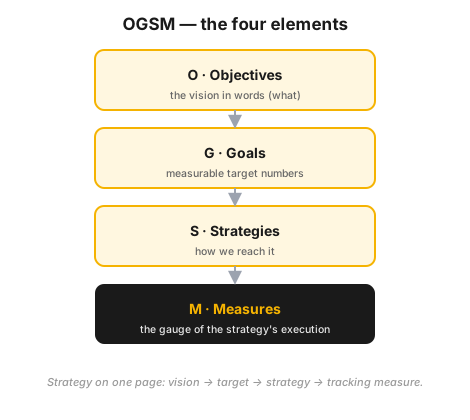 Figure 1 — the four elements of OGSM: the vision in words (O), a measurable target number (G), the chosen route in words (S), and the gauge of the chosen route’s execution (M).
Who is this for?
Section titled “Who is this for?”This article is for those who, at some level, take part in setting, deploying or delivering goals: plant manager · shift supervisor · technologist · production and maintenance manager · HSE manager · Lean/CI specialist · controller · senior executive · project and team leader.
Learning objectives
Section titled “Learning objectives”After reading this article you will be able to:
- distinguish the four elements of OGSM, and apply the
O = words, G = numbers, S = words, M = numbersbasic rule; - explain the single key mechanism of the cascade (the “how” of the level above becomes the “what” of the level below);
- justify why the Objectives are given, and why the Strategies need local creativity;
- outline the step sequence of an introduction from the vision to the individual charter, with its accompanying review rhythm;
- recognize when OGSM is not the right tool.
In brief
Section titled “In brief”- OGSM has four elements: Objectives (what, in words), Goals (how much, in numbers), Strategies (how, in words), Measures (the metric of the how, in numbers). Basic rule:
O = words, G = numbers, S = words, M = numbers. - The method is the practical version of the Japanese Hoshin Kanri philosophy; in the 1990s Procter & Gamble applied it, and today leading companies use it in the United States, Japan and at American-owned European firms.
- Deployment happens tier by tier: the Strategy + Measure pair of the higher tier becomes, by “cut and paste,” the Objective + Goal pair of the tier below. This way everyone sees how their own work connects to the corporate goals.
- Key principle: the Objectives are givens, but the Strategies and Measures require creativity. The higher level dictates the goal, the lower level works out the execution, and this is what creates commitment.
- OGSM is not a one-off plan but a continuous system: it is kept alive by visual activity boards, multi-level scheduled reviews (weekly, monthly, quarterly, yearly), a designated system owner and benchmarking.
- The top-tier OGSM ties the target values of the performance board to the strategy: the board’s target numbers equal the OGSM’s numbers.
- The detailed mechanics of breaking metrics down level by level is carried forward by the KPI cascade article.
Why does it matter? (the stakes)
Section titled “Why does it matter? (the stakes)”If goals are not aligned, the organization performs poorly not out of laziness but because the forces cancel each other out. A simple analogy shows the stake most sharply: four people move a one-tonne load from A to B on ropes and rollers.
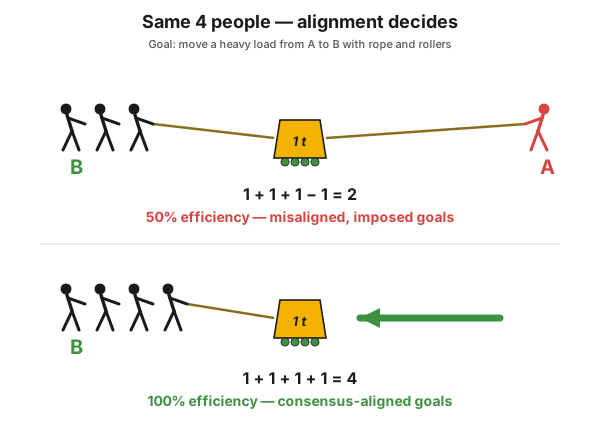 Figure 2 — the rope analogy. If the goals are inconsistent and imposed from above, the resultant force is
 1 + 1 + 1 − 1 = 2, i.e. 50% efficiency. If the goals come together by consensus, 1 + 1 + 1 + 1 = 4, i.e. 100%.
The same four people, the same load, twice the result. The difference is not in diligence but in whether everyone pulls in the same direction. The price of misalignment is familiar in practice: production drives volume, maintenance defends cost, technology optimizes yield, and all three can claim at year-end that they delivered, while the site’s result fell short. OGSM excludes this drift by making every level’s goal physically derive from the very sentence that the level above committed to as its own route of execution.
What is OGSM, and where does it come from?
Section titled “What is OGSM, and where does it come from?”OGSM is a strategy-deployment tool that translates the company’s long-term vision into concrete, measurable actions assigned to the individual organizational levels. Its name is formed from the initials of its four elements.
Its origin is tied to the Japanese Hoshin (Hoshin Kanri) philosophy, a fully integrated approach: it involves the entire workforce in achieving business results, both the “hard” and the “soft” ones. Hoshin draws on many of the management tools and techniques in use today, and it has a twofold intent: to achieve results, and along the way to establish an involving, behavioural-led culture. The four-element OGSM template was applied by Procter & Gamble in the 1990s, and today it is used by leading companies in the United States, Japan and at American-owned European firms; it is regarded as a “World Class” tool.
OGSM is part of the Lean Management Infrastructure layer, that is, the set of formal structures, processes and systems through which the human and organizational resources are managed toward the shared goals (see management infrastructure). In a process-industry Lean transformation, OGSM is the concrete tool with which the “What?” and “How?” parts of performance management are connected across the site, block, unit and equipment levels.
What does a well-working OGSM achieve?
- It creates a long-term vision for the business.
- It makes the intent, the activities and the progress visible.
- It gives greater ownership of the results by involving the key people.
- It separates the objectives, goals, strategies and measures from one another.
- It deploys the actions at every level of the organization.
- It aligns all business activities along shared goals.
- It builds good review and feedback processes, and uses the appraisal systems meaningfully.
- It distinguishes long-, medium- and short-term results, and does away with the traditional “one-year goal-setting” habit.
- It aligns the development and training programs to real need.
How does OGSM work, and how does it connect the vision to daily work?
Section titled “How does OGSM work, and how does it connect the vision to daily work?”OGSM connects the vision to daily action by repeating the same four-element structure at every level, and at the boundary of the levels applying a single disciplined handover rule: the execution route of the higher level becomes the goal of the lower level. Let’s take the elements, the handover rule and the process in turn.
Where does OGSM sit in the communication of strategy?
Section titled “Where does OGSM sit in the communication of strategy?”OGSM does not stand in a vacuum: it is the middle of a longer communication chain that runs from the reason for the organization’s existence to the personal indicators. The rungs of the chain, from top to bottom:
| Rung | What it answers |
|---|---|
| Mission | Why we exist |
| Values | What matters to us |
| Vision | What we want to be (long-range goals) |
| Strategy | How we realize the vision |
| Strategic goals | We shape the strategy into concrete goals |
| Objectives | What we must achieve |
| Deploying goals to units | What our unit, our team has to do |
| Personal goals | What I, personally, have to do |
| Performance indicators | Corporate, department and personal indicators |
OGSM connects the upper half of this ladder (vision, strategy, strategic goals) with the lower half (unit-level and personal goals, indicators). This is the explanation for why it is at once a planning and a communication tool: it can be used both to formulate the strategy and to communicate it.
The basic sequence for building an OGSM sheet has four steps:
- Define the long-range goal. The starting point is understanding the organization’s strategy: what it wants to achieve, and how.
- Select the concrete goals. What kind and how large a quantifiable, measurable result must be achieved for the long-range goal. The goal should be SMART.
- Work out the strategies and actions. How the goals can be reached; the strategies ensure the goals are achieved.
- Define the measures. Do the strategies realize the goals, and can the long-range goal be reached within the expected time? We examine this by measurement and by regular evaluation of the measures.
A compact deployment ratio worth taking as a starting point: a vision, below it a few (typically two-three) broad goals, two-three concrete goals for each, one-two strategies or actions per concrete goal, and a measure for every strategy. In a larger, multi-tier system the top level typically expands to four-five broad goals.
The four elements and the basic rule
Section titled “The four elements and the basic rule”| Element | Meaning | Type | Example |
|---|---|---|---|
| O — Objective | What we want to achieve | text (words) | “Improve our energy use” |
| G — Goal | The numeric target belonging to the objective | number | specific energy-use target (GJ/t) |
| S — Strategy | How we achieve it (the chosen route) | text (words) | “More intensive operator simulator training” |
| M — Measure | How well the strategy is realized | number | the metric of the execution |
The basic rule to keep: O = words, G = numbers, S = words, M = numbers.
The tier system and the logic of the cascade
Section titled “The tier system and the logic of the cascade”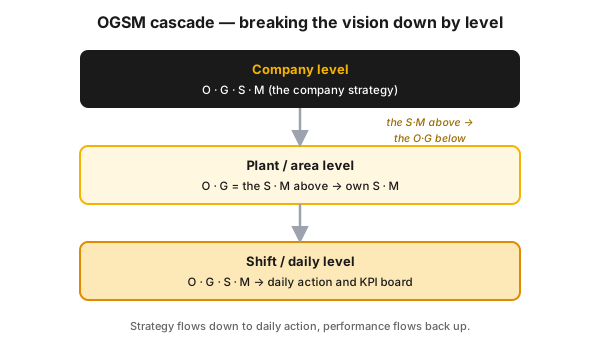 Figure 3 — the OGSM cascade. Strategy breaks down toward daily action, and performance aggregates back up.
The core of the cascade is a single mechanism: the Strategy and Measure element of the higher tier is copied verbatim (cut & paste) into the Objective and Goal element of the tier below. Put differently: at Tier-2 the “What” (Objective and Goal) is precisely the “How” part of Tier-1 (Strategy and Measure). This way the higher level’s how becomes the lower level’s what, and this is what binds the corporate vision into a single chain all the way down to the shift and equipment level.
The practical discipline of deployment rests on a few simple rules: at the deployment the presence of the leaders and experts of the two levels involved is indispensable; we proceed strictly top-down, level by level; we use the same visual structure at every level; and color codes help keep the whole system readable. A question template that works well for creating the S and M elements of a lower level: for the strategy and its measure formulated to reach the concrete goal assigned to the higher level’s broad goal — with what own strategy or action can I support it in my area, and with what own measure can I track its execution?
This “What/How” handover does not stop at the text level: when we translate the measures into concrete, level-by-level aggregable indicators, the continuation is the KPI cascade, which carries the same logic through from selecting the focus KPI to the equipment-level indicator, with top-down targets and bottom-up actuals. OGSM gives the frame, the KPI cascade the mechanics of the metrics.
The step-by-step process
Section titled “The step-by-step process”- Create the vision. The senior leaders work out the vision of the business, that is, a “dream” of what perfect operation could look like. Typically 4-5 paragraphs, without target numbers and time frames, timeless (at least five years ahead), and not a slogan. Inputs: the corporate direction, the customer and business-environment needs. Debate, dialogue and reformulation are part of the process. A good communication tool, but it must not become “wallpaper” (see vision workshop).
- Prepare the Top Tier OGSM. From the vision, extract the key themes; these become the key objectives (what we want to achieve in 3-5 years). At this level, at most 4-5 objectives. Assign hard target numbers (goals) to them, then strategies — the hows — to every objective. An objective may have several strategies, and each strategy has one measure. Rule: the objectives are given, but the strategies are choices.
- Cascade to Tier Two. The senior leaders decide how to split the business (by site, function, location or business line), and every “area” has a responsible senior manager. Copy the top-tier Strategy and Measure elements into the place of the Tier-2 Objective and Goal. The manager then, with their own team, in workshops generates the Tier-2 strategies and measures. Make it clear that the “O” and the “G” are given, but the “S” and the “M” require creativity.
- Cascade to Tier Three. The same principle, split by department, function, process or location. Copy the “S” and “M” elements from above, then, involving the managers, team leaders, department heads and key operators, create the given area’s own “S” and “M” elements. It is at this level that the concrete business tools and techniques appear in the strategies, for example Six Sigma, SMED or TPM.
- Break it down to individuals. In the Tier-3 areas, designate the key people (team leaders, managers, Six Sigma green and yellow belts) who lead projects or teams to realize the strategies. They prepare a charter (mandate), which is essentially a mini OGSM: Purpose, Objectives, Measures. Launch an integrated training and development program with it, which gives a real, meaningful reason for the training.
- Run the system. Designate a system owner, set the review rhythm, and organize benchmarking. OGSM is not a project but a state.
What supporting structure keeps it alive?
Section titled “What supporting structure keeps it alive?”An OGSM lives because there is a visible board, a scheduled review and a responsible owner around it; without these even the best content gradually fades.
- Visual activity boards in clearly visible places (see performance board and visual management).
- Formal, data-driven reviews on a “gap correction” basis, with the following rhythm:
| Participants | Rhythm |
|---|---|
| Key leaders + Tier-3 manager | weekly |
| Tier-3 manager and their team ↔ Tier-2 manager | monthly |
| Senior leaders with their own top tier OGSM | quarterly |
| Board with the senior leaders | yearly |
- Informal 1:1 reviews tied to the appraisal system, which evaluates not only results but also behaviour, that is, the building of organizational capability.
- Designating a system owner who facilitates the process. OGSM “lasts forever,” but it requires interaction, control and monitoring.
- Benchmarking meetings and visits with similar sites or departments, because they have the same objectives.
The essence of the whole chain is a bridge: the team and the individuals see how their work connects back to the company’s objectives.
Process-industry context and safety
Section titled “Process-industry context and safety”In a process-industry environment OGSM is the backbone of performance management: it connects the site, block, unit and equipment levels. Two characteristic applications:
1) Energy OGSM at the site level. The top-level objective is improving the site’s specific energy use, with the specific target value (GJ/t) set by the organization. This breaks down tier by tier onto the technology blocks, for example the distillation block, the motor-fuel production block or the reformer block, each with its own specific consumption target. The “what/how” logic works here too: the site’s measure becomes the block’s goal.
2) Unit- and equipment-level OGSM. Broken down to a specific technology unit:
- Objective: reduce the examined unit’s energy use.
- Goal: the annual saving determined from the potential (GJ/year).
- Strategies: reduce fuel-gas consumption, reduce steam consumption, reduce electricity consumption.
- Measures: the percentage reduction of the three consumption items.
Here an important process-industry discipline point appears: the strategies are always approved by the unit management. Among the concrete tools of the strategies are the introduction of advanced process control and soft-sensor (inferential) estimation, as well as training in the correct use of the control (see APC and soft sensors). Installing a control system is not in itself a strategy; the strategy is that the extent of its use grows step by step, and this is measurable.
Introduction in practice
Section titled “Introduction in practice”The introduction of OGSM starts from the top with the vision, then cascades downward. An indicative schedule for the launch:
| Activity | Meetings / days | Calendar time |
|---|---|---|
| Creating the vision | 2-3 meetings | 3-4 weeks |
| Building the top tier | 2-3 meetings | 2-4 weeks |
| Generating S and M at Tier-2 | 2-3 meetings + reviews, with “incubation” time | 6-8 weeks (in parallel) |
| The same at Tier-3 | as above | 3-4 weeks (in parallel) |
| Implementing early strategies with a development program | 8 days training + 4 days coaching | 12-16 weeks |
Who, what, in what order:
- Hold a senior-leadership workshop on the vision and the general direction.
- Prepare the top tier OGSM with 4-5 objectives, goals, strategies and measures.
- Have the Tier-2 senior managers review the O/G pairs coming from above, and have them generate their own S/M rows in a workshop. The “incubation time” is deliberate: people need time to make the goal their own.
- Involve the Tier-3 managers, team leaders and key operators in creating the S/M elements of the given unit. This is where the Lean and Six Sigma tools come in as strategies.
- Have individuals and project teams write a charter (mini OGSM), and launch integrated training with it.
- Appoint a system owner who facilitates the whole cycle, sets the review rhythm and organizes the benchmarking.
Measurement and audit
Section titled “Measurement and audit”The measurement logic of OGSM can be grasped in two places: in the calibration of the goal and measure numbers (SMART), and in breaking the indicators down level by level.
SMART target-value logic for setting the goal and measure numbers:
- Specific: the level’s owning group genuinely has an effect on it.
- Measurable: measurable, and the method of measurement is agreed and accepted.
- Attainable: it is a challenge, but reachable.
- Realistic: the group considers it realistic together with the actions belonging to it.
- Time-bound: there is a deadline for reaching the goal.
KPI → PI → I breakdown. The measures are not all of equal weight. The hierarchy: KPI (Key Performance Indicator) → PI (Performance Indicator) → I (Indicator). The top, result-level KPI breaks down into block- and unit-level PIs, then into equipment-level Is; a technology unit’s fuel-gas consumption (PI) breaks down further into furnace operating parameters, excess-air and oxygen content, or heat-exchanger condition as indicators. The detailed mechanics are described by KPI / PI / I and the KPI cascade. Each measure has a target value calibrated by the SMART principle, visually as target vs. actual.
Metric rules for the breakdown. The metric should be assessable in its process and SMART. At the lower levels the time horizon shortens: on the first level typically a year, on the second a quarter or a month, lower a week, then a day. Between certain levels a dimension change is needed, for example a financial metric becomes an activity metric at the production or maintenance level. Avoid the date as a metric; if it is nevertheless unavoidable, let it be the final date of a ready schedule, referring to realization according to the schedule. Do not use a yes/no type metric, because it does not allow real continuous control.
Long-term trend. The long-term change of the process is best followed with I-MR (Individual-Moving Range) control charts, on the weekly averages of the most important metrics. The reviews are data-driven and “gap correction” based: the focus is always the gap to the target, and not excuse-making but the root cause (A3 report, 5 Whys) and the corrective action.
Hands-on: a full Tier-1 OGSM
Section titled “Hands-on: a full Tier-1 OGSM”The example below shows the structure of a full Tier-1 site OGSM. The concrete target numbers are deliberately generalized; the structure is the lesson:
| Objective (O) | Goal (G) | Strategy (S) | Measure (M) |
|---|---|---|---|
| Continuously improve our HSE performance | zero accident frequency | Continue the safety focus; effective use of the audit system; legal compliance | number of lost-time accidents; audit-score threshold; compliance rate |
| Improve quality performance | complaint-count target | Reduce complaints by following procedures and tackling the biggest defects; ISO 9001 conformance | complaint target; successful audit |
| Improve delivery performance | OTIF target | Reduce late and early deliveries; reduce under- and over-delivery | % late / % early; % under / % over |
| Generate profit | EBITDA target | Reduce conversion cost; reduce total waste; improve inventory turns | conversion cost %; waste %; inventory days |
| Motivated, trained team | Lean assessment score | Training and motivation; internal communication; coaching | training-matrix %; attendance rate; coaching and appraisals per person/year |
| Reliable capacity | weekly shipment volume | Stabilize capacity | weekly quantity sold |
Two things can be observed. First, every row keeps the O = text, G = number, S = text, M = number rule. Second, an objective may have several strategies: the profit row, for instance, attacks the same goal along three separate routes (conversion cost, waste, inventory), and each route has its own metric.
Applied task. Take the single most important goal of your own area. Write down the O for it in one sentence in words, the G with a number, then think up two strategies for it (two different routes) and a measure for each. Check it against the basic rule: has a number slipped into the O, or a goal into the measure?
Common mistakes
Section titled “Common mistakes”The pitfalls almost all stem from the same thing: the frame is filled in, but the discipline and rhythm behind it are not kept.
- Opening the “O” and the “G” for debate at the lower levels. The objectives and goals are given. Why it’s a problem: if these too are renegotiated, the chain falls apart, and the higher level’s commitment is left without cover. Instead: only the S and the M are open, but there with real local freedom.
- Confusing the Strategy and the Measure. Why it’s a problem: whoever takes the measure to be another goal builds a double goal system, and the organization does not know which to deliver. Instead: the measure is solely the metric of the strategy’s execution.
- Too many objectives at the top level. Why it’s a problem: the focus is diluted, and every level below splits into ten directions. Instead: the top tier has at most 4-5 objectives.
- The vision becomes “wallpaper.” Why it’s a problem: if it only hangs on the wall and there is no review rhythm behind it, the whole system empties out. Instead: scheduled, data-driven review at every level.
- Treating it as a one-off plan. Why it’s a problem: after the annual goal-setting ritual nobody looks at it until the next cycle. Instead: system owner, scheduled reviews, benchmarking. OGSM lasts forever.
- Top-down imposition without consensus. Why it’s a problem: by the lesson of the rope analogy, imposed, inconsistent goals give half the efficiency. Instead: catchball, that is, the back-and-forth alignment of goals along the cascade.
- Separating the board and the OGSM. Why it’s a problem: if the performance board’s target values do not match the OGSM’s numbers, two separate truths arise. Instead: one target number, from one source, at every level (see KPI cascade).
- Strategy without approval at the technology level. Why it’s a problem: changing an operating parameter carries a technical and safety risk. Instead: unit-management approval for every process-affecting strategy, with a management of change procedure if needed.
What does OGSM give, and what does it not?
Section titled “What does OGSM give, and what does it not?”The most common introduction failure stems from using OGSM as something it is not. OGSM is not made for the purpose of a business review, it is not an activity list, and it is not the comprehensive business metric system. Instead, it gives three things:
- a tool for communicating the corporate goals and hierarchically breaking them down to personal goals;
- a systematic method for defining the “thermometer” indicators of progress toward the goals;
- help in defining the continuously in-focus metrics of the adequacy of the daily activities.
When NOT to use it? (the limits of the method)
Section titled “When NOT to use it? (the limits of the method)”OGSM is a strong frame, but not for every task. Knowing where it ends is just as important as the method itself:
| Situation | Why (primarily) not OGSM | The right answer | |||
|---|---|---|---|---|---|
| Acute plant upset, immediate intervention | OGSM is a directing frame on a yearly-to-multi-year cycle, not incident handling | emergency procedure, then a subsequent [[a3-riport.en | root-cause analysis]] | ||
| Solving a single, well-bounded problem | one problem does not need a tier system and a cascade | a [[pdca.en | PDCA]], [[a3-riport.en | A3]] or [[dmaic.en | DMAIC]] project |
| There is no vision, and leadership does not even want one | the whole chain starts from the top level; without a vision the cascade has no source | first a [[vizio-workshop.en | vision workshop]], then OGSM | ||
| The basics of daily operation are unstable | if there is nothing to measure deviation against, the measures measure noise | first stabilize: [[5s.en | 5S]], [[standard-munka.en | standard work]], basic metrics | |
| A very fast-changing, experimental environment | multi-year objectives can make the organization rigid | shorter-cycle goal-setting, keeping the OGSM frame |
Rule of thumb: OGSM is strongest for multi-level directing over a multi-year horizon. For solving a single problem it is too heavy, and for immediate intervention it is unsuitable.
Take it home (keys)
Section titled “Take it home (keys)”- Four letters, one rule:
O = words, G = numbers, S = words, M = numbers. If this slips, the whole deployment slips. - The cascade is a single move: the higher level’s how becomes the lower level’s what. If at some level you cannot say where your objective came from, the chain is broken.
- The goals are given, the routes are free. Commitment comes from the fact that the execution is worked out by whoever will do it.
- One number, one truth: the board’s target value should be identical to the OGSM’s number, otherwise the organization works by two realities.
- The rhythm matters more than the document: without a system owner and scheduled review, even the finest OGSM becomes wallpaper.
- Hold safety at the strategy level, because below-target safety performance cannot be corrected after the fact.
Self-test
Section titled “Self-test”- A Tier-2 manager asks to renegotiate the goal assigned to them. What do you answer, and what do you offer instead?
- A row reads: Objective “Reduce fuel-gas consumption by 5%,” Measure “5% fuel-gas reduction.” What is the error, and how do you fix it?
- The OGSM is done, the boards are up, yet half a year later everyone has forgotten it. Which three supporting elements were missing, and which one would you start the recovery with?
Answer key
- The “O” and the “G” are given, and there is no negotiating them downward in the cascade: the Tier-2 goal is precisely the Tier-1 measure, so renegotiating it would hollow out the commitment of the level above. What you offer is the real room to maneuver over the “S” and the “M”: the manager and their team choose for themselves by what route they reach the goal, and by what they measure the route’s progress. If the goal really seems unrealistic, that is to be disputed not downward but upward, with the Tier-1 owner (catchball), because that is where the target number is decided.
- The error is that the Measure is the same as the Objective quantified, that is, the metric here does not measure the strategy’s execution but repeats the goal. On top of that, a number has slipped into the “O” (
O = words). Fix: the Objective in words is “Reduce fuel-gas consumption,” the Goal is the number belonging to it (the 5 percent), the Strategy is the chosen route (for example optimizing furnace excess air and the consistent use of the control), and the Measure is the gauge of that route (for example the time the excess air spends in the target band, or the rate of the control’s use). - Three elements of the supporting structure were missing: the regular, data-driven, “gap correction” based review rhythm at every level, the designated system owner who facilitates the process, and the benchmarking. Start with the system owner: they are the one who restores and also maintains the review rhythm. Without them the other two elements will wear off again, and the vision and the board become “wallpaper.”
How does it appear in digital practice?
Section titled “How does it appear in digital practice?”The logic of OGSM does not stop at the laminated wall board: the same structure is realized in software too. The mechanism differs, the principle is the same, namely that the goal, the route and the metric remain in a single connected chain, level by level.
| OGSM element | Digital implementation | What it delivers |
|---|---|---|
| Four-element structure (O·G·S·M) | structured strategy record with mandatory fields, type checking (text vs. number) | the basic rule cannot be violated, no number slips into the objective |
| Tier cascade | parent-child reference between the levels; the higher Strategy/Measure automatically becomes the child level’s Objective/Goal field | the chain is machine-closed, there is no “orphan” goal |
| One target number, one truth | the target value propagates from a single source to the boards and the reports | manual re-typing and the two separate truths disappear |
| Review rhythm | scheduled review cadence, with reminder and agenda template | the weekly, monthly, quarterly cycle does not slip |
| Gap correction | automatic deviation signal between target and actual, with a mandatory comment | the gap does not remain without explanation |
| Tracking strategy execution | actions with owner and deadline, with status under the strategy | it is visible whether the how is really progressing |
| Bottom-up actuals | the recorded values of the lowest level aggregate upward | behind the leadership metric there is real, time-stamped data |
Connection to OPEREX (shift diary)
Section titled “Connection to OPEREX (shift diary)”The lowest tier of the OGSM, that is, the unit and equipment level, “lands” where the shift actually works. From the Strategy/Measure pairs, daily, indicator-level tracking arises at this level, for example fuel-gas consumption, unplanned downtime, changeover time or speed. The shift diary (OPEREX) is exactly this layer: here the shift records the actual values, the gaps to target, the mandatory comments attached to them and the actions triggered. This way the OGSM’s measures become visible and auditable shift by shift, and the shift diary closes the last meter of the strategy deployment: from the corporate vision down to the commented daily data point traced to its root cause.
Terminology (HU / EN / JP)
Section titled “Terminology (HU / EN / JP)”| Hungarian | English | Japanese / note |
|---|---|---|
| Stratégia-lebontás | Strategy Deployment | breaking the corporate goal down into levels |
| Átfogó célok (szavakban) | Objectives | the OGSM “O” element, a text goal; sets the direction for three to five years |
| Konkrét célok (számokban) | Goals | the OGSM “G” element, the numeric, objectively measurable target of the broad goal |
| Stratégiák (szavakban) | Strategies | the OGSM “S” element, the chosen route of execution and resource allocation |
| Mutatószámok (számokban) | Measures | the OGSM “M” element, the gauge of the strategy’s execution, not another target value |
| Politika-irányítás (alapfilozófia) | Policy Deployment | Hoshin Kanri (方針管理) |
| „Adottak” | Givens | the O and G received from above, not open to negotiation |
| Konszenzusépítés a kaszkádban | Catchball | the back-and-forth alignment of goals between levels |
| Megbízólevél (mini-OGSM) | Charter | individual or project-level Purpose, Objectives, Measures |
| Rendszergazda | System Owner | the owner facilitating the whole OGSM cycle |
| Érlelési idő | Incubation time | the deliberate pause for a level to take ownership of the goal |
| Eltérés-korrekció | Gap correction | data-driven handling of the gap to target at the review |
What is the difference between the Goal and the Measure?
The Goal is the numeric target value belonging to the Objective, that is, what we want to achieve. The Measure is the metric belonging to the Strategy, which shows how well we execute the given strategy. The measure is therefore not a goal in itself but the gauge of the execution.
How do two tiers connect to each other?
The Strategy and Measure element of the higher tier is copied verbatim into the place of the Objective and Goal of the tier below. The higher level’s “how” becomes the lower level’s “what,” and this is what makes the chain continuous from the vision to the shift.
Why is it said that the objectives are given, but the strategies need creativity?
The higher level dictates the goal (objective and goal) so that the direction stays unified, but the way of execution (strategy and measure) is worked out by the lower level, which knows the process. This ensures both alignment and commitment at the same time.
Is OGSM the same as Hoshin Kanri?
OGSM is the practical, four-element version of the Hoshin Kanri philosophy. Hoshin is the broader, integrated, behaviour-led frame, while OGSM is the concrete, cascadable template that Procter & Gamble applied in the 1990s and that leading companies use today.
How often should an OGSM be reviewed?
With a different rhythm at each level: the key leaders and the Tier-3 manager weekly, the Tier-3 manager with their team and the Tier-2 manager monthly, senior leadership quarterly, the board yearly. The review is always data-driven and focuses on the gap to target.
How many objectives should there be at the top level?
At most four or five. More than that dilutes the focus, and since every objective breaks down further, too broad a top level results in an unmanageable amount of goals at the lower tiers.
What is the difference between OGSM and the KPI cascade?
OGSM gives the frame and the handover rule between the levels, while the KPI cascade is the metric-side mechanics of the same logic: how we choose the focus KPI, how we break it down to equipment level, and how the actuals aggregate back up.
Related concepts
Section titled “Related concepts”KPI cascade | performance board | performance management | Hoshin Kanri | vision workshop | management operating system | KPI / PI / I | KPI definition | management infrastructure | visual management | A3 report | PDCA
Next step
Section titled “Next step”If you have understood this, from here it is worth going on — in this order:
- KPI cascade — the metric-side continuation of the OGSM What/How logic: how the Strategy/Measure pair becomes a KPI chain broken down to equipment level and aggregable. Start with this.
- Hoshin Kanri — the broader philosophy and catchball: how the cascade turns from a one-way drop-down into a consensus alignment.
- management operating system — the operating system that gives the review rhythm and the leadership cadence around OGSM, so it does not fall into oblivion.
References / Further reading
Section titled “References / Further reading”- Yoji Akao (ed.): Hoshin Kanri: Policy Deployment for Successful TQM. Productivity Press, 1991. — the canonical foundational work of Hoshin Kanri; OGSM is the practical, templated version of this philosophy.
- Marc van Eck – Ellen Leenhouts: The One Page Business Strategy. Pearson. — the independent, public treatment of the OGSM framework.
- Pascal Dennis: Getting the Right Things Done. Lean Enterprise Institute, 2006. — the practical presentation of strategy deployment and catchball in a Lean environment.