Production system success factors
≈ 23 min read · 4,500 words
Imagine that closing the plant is being seriously discussed at your site: customer claims are piling up, costs are high, and headquarters no longer sees you as the best choice. Six years later the same site is the group’s Lean competence and training centre, with the best indicators in the group. Not because of one miracle tool, and not because somebody “introduced 5S”. Because of eight success factors acting at once, every one of them tied to the same centre: people. Let’s look at what those eight factors are, in what order the system matures, and what most rollouts fail on.
The success of an own production system rests not on one Lean tool but on eight simultaneous factors, all tied to people: Lean is above all a cultural change.
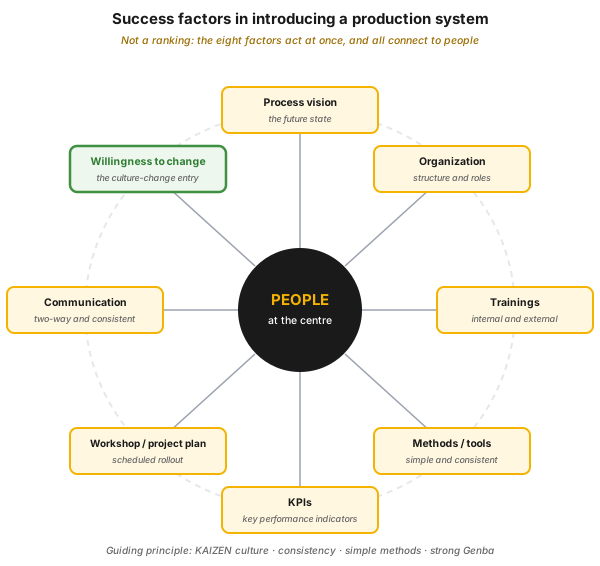
Figure 1 — the radial model of the success factors. PEOPLE stand at the centre, and the eight factors connect to them at once, reinforcing one another. Willingness to change (in green) is the entry point of the culture change: without it the tools will not bite either.
Who is this for?
Section titled “Who is this for?”This article is for those who do not want to introduce a tool but to build a working system in their own area: plant manager · site manager · production manager · shift supervisor · Lean/CI coordinator · process engineer · HR and training lead · senior executive sponsoring a transformation.
Learning objectives
Section titled “Learning objectives”After reading this article you will be able to:
- list the eight success factors of introducing a production system, and explain why people are the centre of the model;
- derive the root-cause chain that leads from the customer claim to poor management;
- distinguish the four maturity stages of the system, and say where your own area stands;
- interpret a before-and-after indicator set, and justify why it is the culture that delivers the hard numbers;
- start a production-system rollout in a way that does not turn into a single tool campaign.
The essence
Section titled “The essence”- People stand at the centre. The eight success factors (willingness to change, communication, process vision, organization, trainings, methods and tools, KPIs, workshop/project plan) all connect to people, and act at once.
- Lean is a human and cultural transformation, not a tool rollout. Methods on their own bring no lasting result without commitment and consistent leadership.
- Willingness to change means culture change: involving every employee in continuous improvement, building the Kaizen culture.
- The root cause is leadership. The five-why chain running from the claim to poor management shows why you must not start with the tools.
- Guiding principle: create a Kaizen culture, work consistently, use simple methods, and have a strong Genba. The lasting result comes from consistency and low-cost solutions, not from complicated tools.
- The maturing path is staged and takes years: functional layout and push planning, then trainings and first workshops, then defining the system and becoming a competence centre, finally full KANBAN, product lines and an audit system.
- Culture shows up in hard numbers: a fourfold turnover in seven years, an 85% drop in the PPM defect rate and a 54% drop in inventory.
- Every waste counts: the small, motion-level Kaizens add up to real money through the sheer number of repetitions.
Why it matters (the stakes)
Section titled “Why it matters (the stakes)”The stake is not that the organization will “not be Lean enough”. The stake is that you look for the cause of the bad indicators in the wrong place, and spend years introducing tools against a problem whose root sits in the management system.
If you follow the five “Why?” questions through, the chain almost always ends up in the same place. Customer claims and high costs exist because the production processes are instable. Those are instable because there is too much waste (Muda) in them. The waste stays in because Genba management is poor. That is poor because there is no Kaizen culture. And that is missing because leadership is poor.
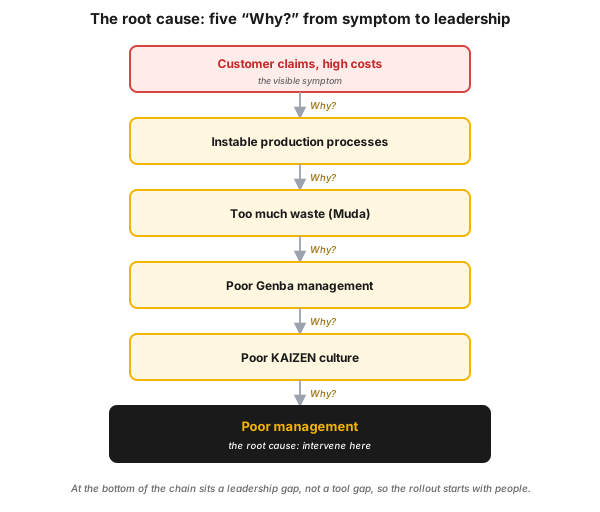
Figure 2 — the root-cause chain. From the visible symptom (through the five “Why?” questions) we reach the leadership root cause. If the intervention stays at the top of the chain, the symptom comes back.
What is an own production system, and what does introducing it mean?
Section titled “What is an own production system, and what does introducing it mean?”An own production system is the named, documented and audited methodological framework by which a company runs its own manufacturing: what principles the material flows by, how we measure, how we improve, and who is accountable for what. It is not a tool list but a system that the organization calls its own, teaches and holds people to.
Introducing it is therefore not a project but a staged transformation lasting several years. The practical pattern this article builds on is the journey of an automotive supplier site: in 2006 it still ran with a job-shop (functional) layout, big batches, individual premiums, a mailbox-based idea system and push production planning. Within a few years it built up its own, named production system (Eissmann Production System, EPS), and became the Lean competence and training centre with the best indicators within the group. This duality matters: the site did not only receive training, it also provided it.
The lesson generalizes. A production system is not a toolset that you “introduce”, but a system-level, people-focused transformation driven forward by aligned success factors.
What are the success factors of introducing an own production system?
Section titled “What are the success factors of introducing an own production system?”There are eight success factors, and they do not form a ranking but a set of factors acting at once around people. The model is deliberately radial: the absence of any one of them breaks the whole, and there is no such thing as “we’ll do that one later”.
- Willingness to change: the entry point of the culture change. Its concrete content: involving every employee in continuous improvement, and building the Kaizen culture.
- Communication: consistent, two-way communication of the vision, the goals and the results.
- Process vision: a clear picture of where the production system is heading, that is, the future state.
- Organization: the structure and the accountabilities, for example dedicated improvement roles and an internal competence centre.
- Trainings: internal and external training, continuous capability building.
- Methods and tools: 5S, KANBAN, the Milkrun/Dandori system, workshops, Pareto walks, audits. The emphasis is on simplicity and consistent use.
- KPIs: measuring progress; a good KPI is actionable, and makes the gap to the target visible.
- Workshop / project plan: a structured, scheduled rollout instead of ad-hoc actions.
What makes a “strong Genba”?
Section titled “What makes a “strong Genba”?”A “strong Genba” is not a mood but eight concrete building blocks that together create the Kaizen culture: Genba time for leaders, simple checklists on the Genba, meetings on the Genba, short, simple audits on the Genba, visualization, standards, involving employees and low-cost solutions.
It is worth noticing what they have in common: each of them takes leadership and the deviation to the actual place instead of packaging it into reports. You put the visual signal and the standard out at the workplace so that the deviation is visible on the spot; you keep the audit short so that it actually happens. The practical implementation (route, questions, behaviour, typical mistakes) is unpacked by the gemba walk article, read on there; the visual layer is given by visual management, and the standard side by standard work.
How does the system mature? Four stages
Section titled “How does the system mature? Four stages”The system does not mature in one leap but in four stages built on one another, roughly two years each. The path below leads from the initial, job-shop state to the full, pull-based, audited system.
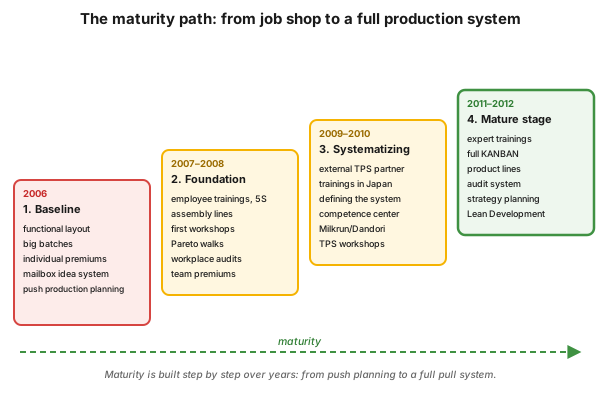
Figure 3 — the four maturity stages as rising steps. The steps cannot be swapped: pull material flow presupposes stable processes, and stable processes presuppose trained and involved people.
The four maturity stages:
- Baseline (2006). Functional layout, big batches, individual premiums, a mailbox-based idea system, push production planning. This is the starting point, not the fault: most plants stand here when they begin.
- Foundation (2007–2008). Employee trainings and 5S, setting up assembly lines, first workshops, Pareto walks, workplace audits, and switching the premium system from individual to team premiums. That last point is often skipped, yet it is what makes improvement a shared interest.
- Systematizing (2009–2010). Defining the own production system and becoming a competence centre. This is when the real TPS knowledge arrived too: cooperation with a supplier from the Toyota group (Toyoda Gosei), trainings in Japan, then joint TPS workshops at home. The Milkrun/Dandori system in material supply also started here.
- Mature stage (2011–2012). Expert trainings in Japan, a full KANBAN system, setting up product lines, an audit system for the own production system, plus strategy planning and “Lean Development”.
Switching from push to pull material flow is the central milestone of stages 3 and 4. This is what makes the system genuinely Lean, not merely “tidy”.
What do the numbers show?
Section titled “What do the numbers show?”Over the seven years every material indicator improved, and improved together: the growth did not come at the expense of quality.
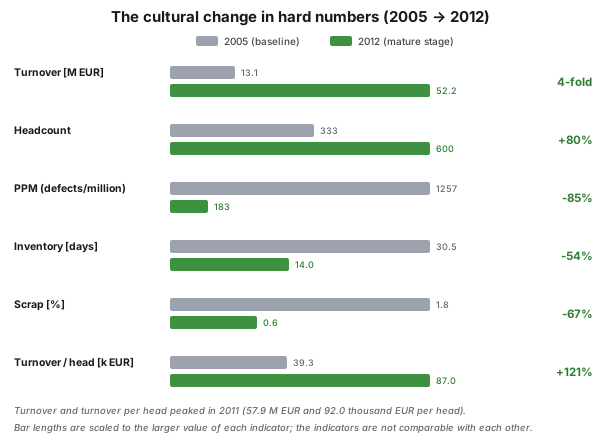
Figure 4 — before-and-after indicators, from 2005 to 2012. The bar lengths are scaled separately per indicator; the indicators are not comparable with each other.
| Indicator | Before (2005) | After (2012) | Improvement |
|---|---|---|---|
| Turnover | 13.1 M EUR | 52.2 M EUR | close to fourfold (peak in 2011: 57.9) |
| Headcount | 333 people | 600 people | +80% |
| PPM (defects / million pcs) | 1257 | 183 | −85% |
| Inventory | 30.5 days | 14.0 days | −54% |
| Scrap | 1.8% | 0.6% | −67% |
| Turnover / head | 39.3 thousand EUR | 87.0 thousand EUR | +121% (peak in 2011: 92.0) |
The lesson in one sentence: the “soft” human factors show up in hard, business indicators, and the two cannot be swapped. They did not optimize for the indicators and get a culture out of it; they built the culture and got indicators out of it.
Every waste counts: motion Kaizen
Section titled “Every waste counts: motion Kaizen”Motion Kaizen is the level of improvement where you do not redesign a process but make a single movement easier or safer. The examples are deliberately small: a sponge at the workplace, feeding by piece instead of in batches, a magnet for positioning the part.
The leverage lies in the number of repetitions. If one movement saves one unit of currency, and the operation repeats a million times a year, that is a million. This is why the guiding sentence runs “endless opportunities in motion Kaizen”, and this is why we call it “the power of small Kaizens”.
This level has a less obvious benefit as well: this is the improvement the operator can carry out on their own. A large process redesign needs an engineer, an investment and a project plan; a magnet or a sponge does not. Involvement is therefore not a slogan: motion Kaizen is the entry point where “involving every employee in continuous improvement” really happens.
How would you start tomorrow? (mini-scenario)
Section titled “How would you start tomorrow? (mini-scenario)”The full system is a matter of years, but you do not have to wait for the big programme to start the first round. A shift supervisor or plant manager can begin like this in their own area:
- Go out to the Genba, and measure your own Genba time. For a week, note down how many hours you actually spent where the value is added. This will be your baseline number.
- Introduce a short, simple checklist for the area (five questions at most), and use it every day at the same time. A good list is one that actually gets filled in.
- Pick one single repetitive operation, and look for a motion Kaizen on it together with the operators. Let the solution be cheap and implementable the same day.
- Make the deviation visible with a simple visual signal (a marked place, a colour code, a board), so that the abnormality does not come to light by asking around.
- Choose two indicators, one on quality and one on flow (for example defect rate and inventory days), and record their baseline values. Not more than two, or attention falls apart.
- Hold a 15-minute weekly meeting on the Genba, where the two indicators and the open actions come up. Every action gets an owner and a deadline.
- After three months take out the baseline numbers, and decide what can be extended to the next area. This is the first step toward the workshop and project plan.
These seven steps cover five of the eight success factors (willingness to change, communication, methods, KPIs, plan), and require neither investment nor a separate programme.
Process-industry context
Section titled “Process-industry context”The pattern is an automotive, discrete-manufacturing case, but the success factors hold for the process industry as well, with a few shifts of emphasis:
- The competence centre here means building up your own Lean/OE organization (navigators, internal experts).
- The direct analogue of KANBAN and the milk run is less the continuously running plant. The pull principle shows up rather in maintenance material supply, in the laboratory and in logistics, while in continuous operation the goal is levelled, stable running.
- The KPIs and audits fit into the system of performance management and the performance board.
- A strong Genba matters especially in a Seveso plant: the physical presence of leadership at the place of production is an improvement tool and a safety tool at the same time.
- The analogue of motion Kaizen is simplifying the operator round and the manual interventions: less bending, less manual sampling, safer access to fittings.
Introducing an own production system in a process plant typically happens through the eight-step implementation and the wave-based transformation. The success factors add the “why it succeeds or fails” frame to it.
Common mistakes
Section titled “Common mistakes”Most rollouts fail not because the wrong tool was chosen, but because the tool was introduced without the culture and the leadership routine. Every one of the seven mistakes below stems from leaving out one of the eight success factors.
- Starting with a tool, without people. Why it’s a problem: a 5S or KANBAN project without culture change and commitment gives an appearance of order that slides back (see Lean anti-patterns). Instead: start with willingness to change and involvement; the tool serves that.
- Taking willingness to change for granted. Why it’s a problem: without communication and involvement, “resistance” is not an obstacle but a symptom that has to be handled. Instead: two-way communication, visible leadership presence, early shared wins.
- Complicated methods. Why it’s a problem: the guiding principle calls for simple methods, because the front line will not sustain an over-complicated tool. Instead: a short checklist, a simple visual signal, a low-cost solution.
- Working without measurement. Why it’s a problem: without KPIs and a project plan the rollout cannot be tracked, and it “runs out of steam”. Instead: two or three actionable indicators, with a baseline value and regular review.
- Treating it as a one-off project. Why it’s a problem: the system matures across four stages over several years; the “we’ve introduced it, done” attitude kills the sustaining. Instead: a staged maturity plan, with an annual re-assessment.
- A weak Genba. Why it’s a problem: if leadership is not present at the place of production, the system stays on paper, and the root-cause chain re-forms. Instead: protected Genba time, meetings held on the Genba and short audits.
- Keeping the individual premium. Why it’s a problem: an individual incentive optimizes for one’s own performance while Lean improves the process as a whole. Instead: team-level incentives, as the second maturity stage does.
When NOT to use it? (the limits of the method)
Section titled “When NOT to use it? (the limits of the method)”This success-factor model is a strong frame for building a production system, but it is not the answer to every situation. Knowing the limits is part of the credibility here too:
| Situation | Why this is not primarily the right frame | The right answer |
|---|---|---|
| There is an acute quality or delivery crisis, a result is needed within weeks | the model is about multi-year culture building, not firefighting | structured problem solving, immediate containment, five whys and root-cause analysis |
| The problem is a single technological bottleneck | the eight factors do not solve an equipment or technology limit | targeted technical intervention, capacity and reliability analysis |
| A safety-critical protective function is missing | the Kaizen culture is not a certified barrier | a designed protection layer based on risk analysis |
| There is no leadership commitment, only a box-ticking programme | the root cause of the model is leadership itself, so it cannot substitute for it | sponsorship and leadership routine first, rollout only afterwards |
| A very small, one- or two-person or strongly project-type operation | the administrative burden of staged system building is disproportionate | a few selected elements (visualization, standard, small Kaizen) without a system |
Rule of thumb: this model tells you what makes a production system durable. It does not tell you what to do this afternoon with a line that has stopped. The two do not replace each other.
Take it home (keys)
Section titled “Take it home (keys)”- Start with people, because that is where the root cause is. The five-why chain runs out at leadership, so a tool answer intervenes at the wrong point of the chain.
- Do not rank the eight factors, go through all of them. Whichever is missing will be the brake on the rollout next year.
- Switch from individual to team-level premiums, otherwise the incentive works against the process.
- Simplicity is a strategy, not a compromise. A short checklist, a simple visual signal, a low-cost solution: these are what survive on the front line.
- Measure few but actionable indicators, and record the baseline value, or you will not be able to defend the result.
- Do not underrate the small Kaizens. Through the number of repetitions, these deliver the involvement and the inexhaustible stock of improvements.
- Plan in years, deliver in months. The four maturity stages span years, but the first measurable step can be there within a quarter.
Self-test
Section titled “Self-test”- Why is it wrong to say that the eight success factors follow one another “in order”, and what does the radial arrangement express instead?
- Derive the five-why chain from the customer claim to the root cause, and say at which point a typical tool rollout intervenes.
- Which of the four maturity stages did the external TPS partnership and the training in Japan fall into, and why could this not have been brought forward into the first stage?
Answer key
- The factors act at once, each of them tied to people; the radial arrangement expresses that there is no factor that can be dealt with “later”. If you nevertheless look for an entry point, it is willingness to change, but this is not a ranking.
- Customer claims and high costs → instable production processes → too much waste (Muda) → poor Genba management → poor Kaizen culture → poor management. The typical tool rollout intervenes at the top of the chain, at the level of the symptom and the instable process, which is why the problem returns.
- Into the third stage (systematizing). A trained, involved team and workshop experience of your own were needed first for the external TPS knowledge to be absorbed; without that the training stays a visit instead of a knowledge transfer.
How does this show up in digital practice?
Section titled “How does this show up in digital practice?”The success factors do not stop at the noticeboard and the paper checklist: the same logic is realized in software too, in any well-organized digital production environment. The mechanism differs, the principle is the same.
| Success factor | Digital implementation | What it delivers |
|---|---|---|
| Communication | structured shift handover, an event log available to everyone | the vision and the daily situation do not depend on hearsay |
| KPIs | automatic data capture (downtime, scrap, inventory), trend view | the indicator does not live off a monthly manual collection |
| Methods, tools | digital checklist, mandatory fields, enforced sequence | the standard cannot be skipped quietly |
| System audits | digital audit register, scoring, recurring scheduling | that the audit happened, and its result, is retrievable |
| Workshop / project plan | action register with owner and deadline, status tracking | the improvement action is not lost between two meetings |
| Willingness to change | low-threshold idea and Kaizen capture from the workplace | the small improvement is documented, and the next shift takes it over |
Connection to OPEREX (shift log)
Section titled “Connection to OPEREX (shift log)”The biggest risk of a multi-year production-system rollout is that the milestones, workshops, audits and indicators live on only in presentations, while the sustaining stays undocumented. The OPEREX shift log makes this auditable: the events of the rollout, the results of the system audits and the movement of the indicators can be recorded with a timestamp, retrievably. This way the progress of the transformation and the hardest part, the sustaining, can be followed on a factual basis, and in the performance dialogue the maturity of the system comes onto the agenda alongside the results. The daily connection point is the shift handover: this is where it becomes visible whether the standard and the state of the area hold up from shift to shift.
Terminology (HU / EN / JP)
Section titled “Terminology (HU / EN / JP)”| Hungarian | English (canonical) | 日本語 (rōmaji) |
|---|---|---|
| termelési rendszer | production system | — |
| sikertényezők | success factors | — |
| változtatási hajlam | willingness to change | — |
| folyamat vízió | process vision | — |
| oktatás, tréningek | trainings | — |
| mutatószámok | KPIs | — |
| workshop- és projektterv | workshop / project plan | — |
| kompetenciaközpont | competence center | — |
| csapatprémium | team premiums | — |
| rendszer-audit | EPS audit system | — |
| anyagellátási körjárat | milk run | — |
| Milkrun/Dandori-rendszer | Milkrun/Dandori | Dandori (段取り) |
| folyamatos fejlesztés | continuous improvement | Kaizen (改善) |
| a hozzáadott érték helye | the real place | Genba (現場) |
| veszteség | waste | Muda (無駄) |
| mozdulat Kaizen | motion Kaizen | — |
What is the most important success factor when introducing a production system?
People and the willingness to change, that is, the culture change: involving employees in continuous improvement and building the Kaizen culture. In the model all eight factors connect to people and act at once, so this is not a ranking.
Does a Lean rollout start with tools?
No. The guiding principle says: create a Kaizen culture, work consistently, use simple methods, and have a strong Genba. The tools serve this, not the other way round. Introducing methods on their own, without commitment, brings no lasting result.
In what steps is it worth introducing an own production system?
In four stages: (1) assessing the initial, push-based operation, (2) foundational trainings, 5S, first workshops, audits and team premiums, (3) formally defining the system, a competence centre and pull material supply, (4) full KANBAN, product lines, an audit system and strategy planning.
How long does building a production system take?
Several years. In the case presented, from 2006 onwards they went from job-shop manufacturing to a full KANBAN system and their own competence centre in roughly two-year steps.
What is motion Kaizen, and why is it worth dealing with such small things?
Motion Kaizen is making a single movement easier or safer, for example with a magnet, a sponge or feeding by piece. It is worth it because the number of repetitions multiplies it: one unit saved at a million repetitions is a million, and on top of that this is the level of improvement the operator can carry out on their own.
What result can be expected from such a transformation?
In the case presented, over seven years turnover grew close to fourfold, the PPM defect rate fell by 85%, inventory by 54%, scrap by 67%, and turnover per head more than doubled. The numbers show that the cultural transformation shows up in hard business indicators.
Related concepts
Section titled “Related concepts”kaizen · gemba walk · muda · the five whys · kanban · pull system · 5S · standard work · visual management · the eight-step implementation · the transformation journey · Lean anti-patterns · performance management · KPI definition · the Lean navigator · training and capability building · shift handover
Next step
Section titled “Next step”If you have understood this, from here it is worth going on — in this order:
- gemba walk — the practical implementation of the eight building blocks of the “strong Genba”: route, questions, behaviour.
- the eight-step implementation — how the eight success factors turn into a scheduled, step-by-step rollout plan.
- the transformation journey — how all this scales from a single area to the whole organization, in waves.
References / further reading
Section titled “References / further reading”- James P. Womack – Daniel T. Jones: Lean Thinking: Banish Waste and Create Wealth in Your Corporation. Simon & Schuster, 1996 — the foundational work on the five Lean principles and on system-level (not tool-level) thinking.
- Jeffrey K. Liker: The Toyota Way: 14 Management Principles from the World’s Greatest Manufacturer. McGraw-Hill, 2004 — TPS as a management and cultural system, whose practical transfer forms are the trainings in Japan and the TPS workshops.
- Masaaki Imai: Gemba Kaizen: A Commonsense Approach to a Continuous Improvement Strategy. McGraw-Hill, 2nd edition, 2012 — the canonical source of the “strong Genba” and of the small, motion-level Kaizens.
- Lean Enterprise Institute Hungary: International Lean Summit, Budapest, 12 June 2013 — the conference frame of the practical case presented (public lecture).
- Automotive Lean Production Award (Agamus Consult / Automobil Produktion) — the independent, public benchmark of automotive Lean maturity; the group of the site presented received it in 2012.