DMAIC
≈ 21 min read · 4,283 words
In a plant the same quality loss has been coming back for weeks, and everyone has their own theory about it. One blames the raw material, another the temperature, a third the afternoon shift. Everyone guesses, no one measures. DMAIC settles exactly this situation: it gives a five-step, data-driven frame in which you get from defining the problem, through measurement and uncovering the true root cause, to a demonstrably working solution, and then you secure the improvement so it does not slip back. The decision is not the loudest opinion’s, but the data’s. Let’s look at what it is, what its phases are, and when it is the right tool.
DMAIC is Six Sigma’s five-phase, data-driven project methodology for improving already existing processes. Its acronym is made up of the initials of the English names of the five phases: Define, Measure, Analyze, Improve and Control. Inspired by Deming’s PDCA cycle, the approach leads from precisely defining the problem, through measurement and root-cause discovery, to improvement and the introduction of process control; its goal is the methodical, evidence-based reduction of defects and variance (variation).
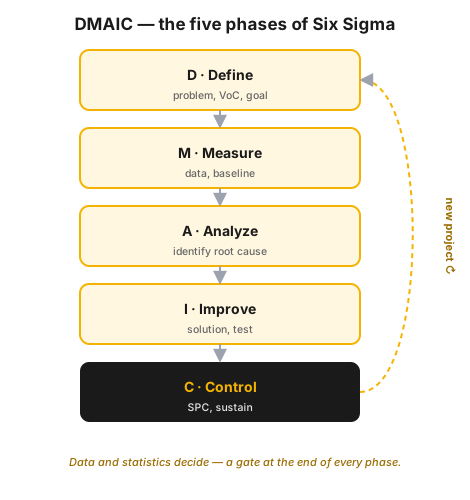 Figure 1 — the five phases of DMAIC in sequence (Define → Measure → Analyze → Improve → Control), with a gate at the end of every phase; a new project can start from Control. The guiding principle: data and statistics decide.
Who is this for?
Section titled “Who is this for?”This article is for those who solve recurring quality, yield or reliability problems in practice: process engineer · process technologist · production and shift manager · quality engineer · reliability engineer · Lean/Six Sigma specialist (Green/Black Belt) · HSE.
Learning objectives
Section titled “Learning objectives”After reading this article you will be able to:
- list the five phases of DMAIC, and say which phase answers which question;
- decide when DMAIC and when DMADV (new design) is the right frame;
- name one or two typical tools of each phase (charter, SIPOC, Gage R&R, Pareto, DoE, SPC);
- justify why 3.4 DPMO is not always the goal;
- recognize when DMAIC is NOT the right tool (a design fault, an unknown root cause, a one-off event).
The essence
Section titled “The essence”- DMAIC is for improving an existing process; for designing a new product or process its counterpart is DMADV (DFSS, Design for Six Sigma).
- Five phases in sequence: Define → Measure → Analyze → Improve → Control; each phase has its own toolset and a gate.
- The heart of the method is that data and statistics decide, not assumption or anecdote: Define starts with the Voice of the Customer, Control closes with SPC.
- Every project has a quantified, financially expressed goal (cycle-time, cost or defect reduction).
- Six Sigma’s target level is 3.4 defects per million opportunities (DPMO), but this is not a mandatory goal for every process: the organization decides on the appropriate sigma level based on customer expectations.
- The methodology is supported by a belt-grade role infrastructure (Champion, Master Black Belt, Black Belt, Green Belt) and senior-management commitment.
- Some organizations extend it with an initial Recognize step (RDMAIC), so that the right problem is chosen.
Why it matters (the stakes)
Section titled “Why it matters (the stakes)”A badly solved process problem does not go away by itself: it reproduces the scrap, the yield loss or the unplanned stoppage on every shift, and the longer it lives, the more expensive it becomes. The stake is not a single faulty batch, but the continuous, predictable loss that keeps producing until someone methodically gets to its root.
The stake of DMAIC is the mirror of this. Without it, the typical response is to suppress the symptom: more inspection, more warnings, temporary patching that reverts by the next shift. DMAIC is worth it because it:
- makes the problem measurable and expressible in money, so management can prioritize;
- finds the true root cause, rather than confirming the loudest opinion;
- builds the improvement into the process with the Control phase, so you don’t have to solve the same thing again half a year later.
What is DMAIC, what are its phases, and when do we use it?
Section titled “What is DMAIC, what are its phases, and when do we use it?”DMAIC is Six Sigma’s five-phase (Define → Measure → Analyze → Improve → Control), data-driven methodology for improving existing processes; it is the right tool when a recurring, data-rich problem with an unknown root cause must be solved methodically, on an evidence base (the details of the phases are further below, the right and wrong applications in the When NOT to use it? section).
DMAIC is Six Sigma’s execution engine: the structured project logic with which you improve, step by step, the measurable quality of an existing process. Six Sigma itself is a set of process-improvement strategies, techniques and tools, developed by Motorola in the 1980s to reduce manufacturing defects, and it became globally known when Jack Welch at General Electric in 1995 made it the central element of the business strategy. The method improves the quality of process outputs by identifying and eliminating the causes of defects, and minimizing variability.
Six Sigma uses two project methodologies, each of five phases, inspired by Deming’s Plan-Do-Check-Act (PDCA) cycle:
| Methodology | What it is for | Pronunciation |
|---|---|---|
| DMAIC | improving an already existing business or manufacturing process | “duh-may-ick” |
| DMADV (DFSS, Design For Six Sigma) | designing a new product or process | “duh-mad-vee” |
The name “Six Sigma” comes from the statistical concept of process-capability studies: there are six standard deviations (6σ) of distance between the process mean and the nearest specification limit, and in such a process practically no batch falls outside tolerance. The roots go further back: the normal distribution is linked to Carl Friedrich Gauss (1777–1855), and statistical process control to Walter Shewhart (1920s), who showed that a distance of three standard deviations from the mean is the point where the process requires correction. Coining the term “Six Sigma” is attributed to Motorola engineer Bill Smith. The broader frame, history and belt-grade system of the methodology are explored in the six-sigma article; here we focus on the execution frame, the five phases of DMAIC.
In a broad sense DMAIC follows the classic quality-improvement step sequence that Lean also shares with it: (1) identify the project, (2) set up the project, (3) diagnose the cause, (4) remedy the cause, (5) hold the result, (6) replicate results and designate new projects.
How do the five phases of DMAIC work?
Section titled “How do the five phases of DMAIC work?”The five phases of DMAIC build on one another in sequence: each answers a well-defined question, and its output is the input of the next phase. At the end of each phase stands a gate: you move on only if the phase’s goal has been demonstrably met. The table below gives the frame, with the details phase by phase underneath.
| Phase | Question | Goal | Typical tools |
|---|---|---|---|
| Define | What matters to the customer? | fixing the problem, scope, goal | project charter, SIPOC, CTQ tree, VoC |
| Measure | Where do we stand now? | measuring the baseline | data-collection sheet, Cp/Cpk, Gage R&R, control chart |
| Analyze | What is the real cause of the problem? | verifying the root cause | 5 Whys, Ishikawa, Pareto, regression, hypothesis testing |
| Improve | What must be done? | solution and testing | DoE, poka-yoke, standard work, FMEA |
| Control | How do we sustain it? | securing the improvement | SPC, control plan, visual control, audit |
Define
Section titled “Define”The precise, concrete definition of the system, the Voice of the Customer and the project goals. Here the project charter is prepared (goal, scope, team, schedule, expected financial benefit), and here the characteristics critical to the customer are identified (CTQ, Critical To Quality). The phase’s question: what matters in the customer’s eyes? Its typical tools: project charter, SIPOC analysis (Suppliers, Inputs, Process, Outputs, Customers), CTQ tree, Voice of the Customer, process map.
Measure
Section titled “Measure”Measuring the key characteristics of the current process and collecting the relevant data — this gives the baseline (the starting performance). The question: where do we stand now? Its typical tools: data-collection sheet (check sheet), process capability (Cp/Cpk), measurement-system analysis (Gage R&R / ANOVA), control chart, histogram, run chart, rolled throughput yield.
Analyze
Section titled “Analyze”Analyzing the data to uncover and verify cause-and-effect relationships. The goal is to find the root cause of the defect examined, and to ensure that every factor has been taken into account. The question: what is the real cause of the problem? Its typical tools: 5 Whys, Ishikawa (fishbone / cause-and-effect) diagram, Pareto analysis and chart, correlation, scatter diagram, regression, analysis of variance (ANOVA), chi-square test, hypothesis testing.
Improve
Section titled “Improve”Optimizing the current process based on the data analysis, so that a new, future state (future state) arises. Its prominent tools are Design of Experiments (DoE), poka-yoke (mistake-proofing) solutions and standard work. Here pilot runs are used to establish the process capability achieved. The question: what must be done? Its typical tools: DoE, poka-yoke, standard work, process redesign, Pick chart, FMEA.
Control
Section titled “Control”Controlling the future state, so that deviations are corrected even before the defect occurs. Control systems are introduced: statistical process control (SPC), production boards, visual workplace, and continuous monitoring of the process. The question: how do we sustain the improvement? Its typical tools: control charts, SPC, visual controls, control plan, standardized work instruction, audit.
What do the sigma scale and 3.4 DPMO mean?
Section titled “What do the sigma scale and 3.4 DPMO mean?”Six Sigma’s target level is 3.4 defects per million opportunities (DPMO), which, because of an empirical 1.5-sigma long-term shift, actually corresponds to 4.5σ long-term performance: this is what, in practice, comes out of the name “6 sigma process.” Important: this is not a mandatory goal for every process. The sigma number is primarily a relative, improvement-tracking comparative indicator (whether the process improves, worsens or stagnates), not an absolute goal; the organization decides on the appropriate level based on customer expectations. The full sigma → DPMO → yield conversion table and the detailed (and disputed) derivation of the 1.5σ shift are found in the six-sigma article.
How does DMAIC fit into Lean?
Section titled “How does DMAIC fit into Lean?”Lean and Six Sigma are complementary, not competing methodologies. Lean concentrates on improving process flow and eliminating waste (muda), that is “doing things fast”; Six Sigma, through the DMAIC frame and statistical tools, on uncovering and reducing the root causes of variance, that is “doing things well, defect-free.” The two map directly onto each other:
| Lean (5 principles) | Six Sigma (DMAIC) | Question |
|---|---|---|
| Specify Value | Define | What matters? |
| Identify Value Stream | Measure | Where do we stand? |
| Flow | Analyze | What is wrong? |
| Pull | Improve | What must be done? |
| Perfection | Control | How do we sustain it? |
The two approaches cover each other’s weaknesses: Lean is weaker in the measure and analyze phases, and this is exactly what Six Sigma’s statistical apparatus strengthens; Six Sigma, on the other hand, tends to optimize sub-processes locally, and Lean’s systems view balances this out. The merged variant of the two is lean-six-sigma.
Process-industry context and safety
Section titled “Process-industry context and safety”In a process-industry and Seveso-classified environment DMAIC is ideal for the systematic solution of recurring, data-rich problems: recurring quality or yield loss, recurring specification deviation (a product property outside the tolerance limit), alarm flood or an equipment-reliability issue (recurring unplanned stoppage).
- The Measure/Analyze phase uses the many measured parameters of the process (temperature, pressure, flow, composition) to verify the root cause statistically; here the data-richness of the process industry is especially strong.
- The SPC control charts of the Control phase signal when a special cause appears, before it turns into a defect, a quality loss or a safety event. This is precisely why the control chart is the tool for sustaining quality.
- Standardized, audited work instructions ensure that the improvement is preserved across shifts too.
How do you introduce it in practice?
Section titled “How do you introduce it in practice?”One of Six Sigma’s main innovations is the professionalization of quality management with a hierarchy of roles and responsibilities (Champion, Master Black Belt, Black Belt, Green Belt); the precise role and training levels of the belt grades are set out in the six-sigma article. The typical arc of introduction:
- Secure senior-management commitment. Leadership provides the vision and the resources; without active senior-management sponsorship no change process works.
- Delegate an owner for the organization-wide rollout, and build internal coaching capacity that ensures the consistent application of the method across functions.
- Run the improvements with dedicated, full-time project leaders, on concrete, well-delimited DMAIC projects.
- Involve the practical participants working alongside their day job too, so that the method takes root across the full breadth of the organization.
A few tried-and-tested principles of the pilot → rollout logic:
- Start with strategic intent, not with the method. The desired result determines the approach, not the other way round. Do not name the initiative after the methodology; the “Lean Six Sigma plant” ambition is not a goal in itself.
- Choose the right problem (Recognize/Define): a measurable, customer-critical, financially relevant, limited-scope pilot.
- Test and focus on the result. A quick, visible success is contagious; a method loses its credibility if it brings no result for too long.
- Involve the staff and the change agents, and use the metrics to shape behavior toward the desired result.
- The 20/80 rule. Roughly 20% of the tools deliver roughly 80% of the benefit; concentrate on the “vital few” tools, do not force the whole toolbox.
- Proportionality. The heavy infrastructure (dedicated Black Belts) stems from the size of the organization, not from the method itself; a smaller organization can also use the tools without a Black Belt.
Hands-on part and example
Section titled “Hands-on part and example”A documented healthcare (NHS) Lean Six Sigma introduction illustrates well the limits and the correct use of the method:
- A national Six Sigma pilot program was launched and measured with external evaluation. Analyzing the projects’ baseline sigma scores, the average baseline sigma level of the clinical processes was 2.0, with a median of 1.9, that is, the processes were defective more than 30% of the time; the worst, 0.4-sigma process meant an 86% defect rate.
- The lesson: if the process is badly designed to begin with, DMAIC alone does not make it defect-free. First (with Lean) the process must be redesigned, then (with Six Sigma) the variance must be taken out of it. According to the early results the teams improved the sigma score by one or two levels, but did not reach the “defect-free” level.
- Another documented application: at the radiology department of Commonwealth Health Corporation, throughput rose by 33%, and cost per procedure fell by 21.5% with Six Sigma. This is an illustration of the measurable, financial benefit of DMAIC.
Applied mini-scenario. Choose a recurring, measurable problem (for example a regular tolerance-limit overshoot of a product parameter). Define: fix the CTQ and the goal (by what percentage the loss should decrease, how big the financial stake is). Measure: collect the parameter’s historian data, establish the baseline and the Cpk. Analyze: with Pareto and regression analysis narrow down the suspect variables, and verify the root cause. Improve: with a small DoE find the right setting, and check it in a pilot. Control: put the key parameter on an SPC control chart, and write into the control plan who does what on a deviation.
Measurement and audit
Section titled “Measurement and audit”DMAIC is itself measurement-centered, so “audit” here can be understood on two levels:
- At the process level the Control phase’s SPC control charts and the control plan continuously audit whether the process stays within the intervention limits; on a deviation a designated correction starts.
- At the project level the project’s success is verified by the baseline → post-measurement delta of the quantified goal fixed in Define (DPMO/sigma level, cycle time, cost, financial savings).
Useful indicators:
| Indicator | What it measures | Note | |
|---|---|---|---|
| DPMO | defects / (units × defect opportunities/unit) × 1,000,000 | the basis of the sigma level | |
| Yield | the ratio of within-specification, defect-free outputs | the counterpart of the sigma level (see the sigma table in [[six-sigma.en | six-sigma]]) |
| Cpk | process-capability index | the long-term Cpk is ~0.5 lower than the short-term (1.5σ shift): 4σ short-term → Cpk(short)=1.33, Cpk(long)≈0.83 |
Target-value logic: 3.4 DPMO is not always the goal. The organization determines the appropriate sigma level for the given process based on customer expectations, and management prioritizes the improvement areas accordingly.
Common mistakes
Section titled “Common mistakes”- You choose the method instead of the problem. Why it’s a problem: the “Six Sigma organization” label becomes the goal, not the better result. Instead: start from the desired result, and choose the appropriate tool for it.
- You apply it to a process that is wrong to begin with. Why it’s a problem: if the base process is faulty (low baseline sigma), DMAIC does not bring defect-freeness. Instead: first redesign the process with Lean, and only on a stable base take out the variance.
- You over-complicate a simple problem. Why it’s a problem: the full statistical apparatus is slow and expensive for a trivial matter. Instead: use the 20% “vital few” tools with which 80% of the benefit is achievable.
- You improve in an uncoordinated way, with a system-level blind spot. Why it’s a problem: the projects optimize locally, independently of one another (Six Sigma sub-optimizes). Instead: connect the value stream with Lean’s systems view (lean-six-sigma).
- You overdo the statistics. Why it’s a problem: excessive significance testing and regression lead to P-value misunderstandings. Instead: Six Sigma is not only statistics, but experience and data together; professional interpretation is also needed.
- You apply it only at the operational, tool level. Why it’s a problem: purely operational use yields only cost reduction. Instead: the full benefit stems from strategic-level application; prioritize it there.
- You misunderstand the 1.5σ shift. Why it’s a problem: the “6 sigma process” is actually 4.5σ long-term performance, and concealing this underestimates the real defect level. Instead: communicate the short- and long-term difference transparently.
When NOT to use it?
Section titled “When NOT to use it?”DMAIC is a powerful tool, but not universal. Knowing its limits is just as important as the method itself:
| Situation | Why (primarily) not DMAIC | The right answer | ||
|---|---|---|---|---|
| Designing a new product or process | DMAIC improves an existing process, there is nothing to measure and improve | DMADV (DFSS, Design for Six Sigma) | ||
| The problem is a design fault, not variance | statistics do not fix a badly designed process | process redesign with Lean ([[vsm.en | VSM]], [[kaizen.en | kaizen]]) |
| A one-off, non-recurring event | for a single case the full project frame is not worth it | ad-hoc root-cause analysis ([[5-miert.en | 5 Whys]]), recording the lesson | |
| An obvious, known cause can be remedied at once | DMAIC is slower than the direct fix | quick fix, then standardization ([[standard-munka.en | standard work]]) | |
| Exploratory R&D / creative development | the incremental, variance-reducing logic can stifle creativity | in pure research use with caution, another methodology | ||
| A certified safety function is needed | DMAIC is not a certified protection layer | design per [[lopa-sil.en | SIL/LOPA]], IEC 61511 |
Rule of thumb: DMAIC is strongest for recurring, data-rich problems with an unknown root cause. For a design fault, a one-off case and certified safety it does not replace the appropriate tool.
Take it home (keys)
Section titled “Take it home (keys)”- Five phases, one logic: Define → Measure → Analyze → Improve → Control, and at the end of each phase stands a gate: you move on only with a verified result.
- Data decides, not opinion: the strength of DMAIC lies in measurement and in the statistical verification of the root cause.
- Control is half the success: the improvement must be built in (SPC, control plan), otherwise it slips back.
- Improving an existing process → DMAIC; new design → DMADV. If the process is bad to begin with, first redesign it with Lean.
- 3.4 DPMO is not always the goal: the appropriate sigma level is set by customer expectations and the financial stake.
- In the process industry it is strong against variance, but the safety constraints take priority, and it does not substitute for the certified SIL/LOPA layers.
Self-test
Section titled “Self-test”- Which DMAIC phase answers which question, and why can the order not be swapped?
- On an existing production line you observe a recurring, out-of-tolerance product property. Is DMAIC or DMADV the right frame, and in which phase would you do what first?
- What does “6 sigma process = 4.5σ long-term” mean, and why is it important to know this when setting the goal?
How does it appear in digital practice?
Section titled “How does it appear in digital practice?”The logic of DMAIC does not stop at the paper charter and the wall-mounted control chart: the same measure-analyze-control principle is also realized in software. Instead of manual data collection, automatic data flow; instead of the wall board, a live dashboard; instead of memory, a recorded audit trail carries the phases; the mechanism differs, the logic is the same.
| DMAIC element | Digital implementation | What it delivers |
|---|---|---|
| Define (goal, scope) | structured project-charter template, with mandatory fields | a uniform, retrievable goal-setting |
| Measure (baseline) | automatic data and parameter collection (historian, e-log) | a baseline free of manual re-entry and distortion |
| Analyze (root cause) | trend and Pareto views, a statistical module on the data | faster, data-driven root-cause discovery |
| Improve (solution) | digital standard work, enforced workflow steps | the proven solution is built into the daily process |
| Control (sustain) | automatic SPC alert on a control-limit overshoot | the deviation surfaces before the defect |
| Control plan | logged check points and corrective actions (what / who / by when) | a continuous, auditable audit trail |
Connection to OPEREX (shift diary)
Section titled “Connection to OPEREX (shift diary)”The controls and audit points of the DMAIC Control phase fit naturally into a digital shift diary. In the OPEREX shift diary the control plan’s check points, the corrective actions launched on SPC signals (what / who / by when) and the sustained state can be logged and retrieved shift by shift. This way DMAIC’s “hold the gains” principle stays not a one-off project closure, but an auditable, continuous routine. Documenting the delta between the baseline and the post-measurement is likewise trackable, which supports the verification of the financial and performance goal fixed in Define.
Terminology (HU / EN / JP)
Section titled “Terminology (HU / EN / JP)”| Hungarian | English (canonical) | Note |
|---|---|---|
| Definiálás | Define | Voice of the Customer (VoC), CTQ, charter |
| Mérés | Measure | baseline, data collection |
| Elemzés | Analyze | root cause, cause-and-effect |
| Fejlesztés | Improve | DoE, poka-yoke (ポカヨケ), standard work |
| Szabályozás / fenntartás | Control | SPC, control plan, audit |
| Defekt / millió lehetőség | DPMO | Defects Per Million Opportunities |
| Folyamatképesség | Process capability | Cp / Cpk |
| Hibavédelem | Poka-yoke / mistake-proofing | 日本語: ポカヨケ |
What do the letters of DMAIC mean?
Define, Measure, Analyze, Improve and Control. This is Six Sigma’s five-phase, data-driven methodology for improving an existing process.
When should we use DMAIC, and when DMADV?
DMAIC for improving an already working business or manufacturing process; for designing a new product or process, DMADV (DFSS, Design For Six Sigma) is used instead.
What does 3.4 defects per million opportunities (DPMO) mean?
This is Six Sigma’s accepted “defect-free” target level, which, because of the 1.5-sigma long-term shift, actually corresponds to 4.5-sigma performance. It is not a mandatory goal for every process; the appropriate level must be determined based on customer expectations.
What is the goal of DMAIC's last, Control phase?
Sustaining the improvement. By introducing controls and metrics (SPC control chart, control plan, visual workplace) it ensures that deviations are corrected even before the defect, and that the result does not slip back.
Where does DMAIC come from, and what does it have to do with PDCA?
It was developed by Motorola in the 1980s, and made famous by Jack Welch at GE (1995). DMAIC is a five-phase methodology inspired by Deming’s Plan-Do-Check-Act (PDCA) cycle.
Do you need a Black Belt to use DMAIC?
Not necessarily. The heavy belt-grade infrastructure stems from the size of a large organization; a smaller organization can also use the DMAIC tools without a dedicated Black Belt, the essence being the data-driven, phased approach.
Related concepts
Section titled “Related concepts”six-sigma | lean-six-sigma | pdca | poka-yoke | standard work | vsm | muda | kaizen | 5 Whys | lopa-sil
Next step
Section titled “Next step”If you have understood this, from here it is worth going on, in this order:
- six-sigma — the broader methodology of which DMAIC is the execution engine: DPMO, sigma level, belt grades, history.
- lean-six-sigma — how DMAIC can be merged with Lean’s flow and waste view, so that the process is fast and defect-free.
- pdca — the Deming cycle from which DMAIC drew its inspiration; comparing the logic of the two deepens the understanding.
References / Further reading
Section titled “References / Further reading”- ISO 13053-1:2011 and ISO 13053-2:2011 — Quantitative methods in process improvement — Six Sigma (the international standard of the DMAIC methodology and its tools).
- W. Edwards Deming: Out of the Crisis. MIT Press, 1986 — the foundational work of the PDCA cycle and the statistical process view from which DMAIC drew its inspiration.
- Peter S. Pande, Robert P. Neuman, Roland R. Cavanagh: The Six Sigma Way. McGraw-Hill, 2000 — a comprehensive handbook of the practical introduction of Six Sigma and DMAIC.
- Mikel Harry, Richard Schroeder: Six Sigma: The Breakthrough Management Strategy. Doubleday, 2000 — the classic description of the methodology and the belt-grade system.
- NHS Institute for Innovation and Improvement: Lean Six Sigma: some basic concepts — a public, case-study-based summary of the integration of Lean and Six Sigma.