Lean Six Sigma (LSS) — uniting speed and quality
≈ 18 min read · 3,541 words
Think of your favourite café, the one you keep going back to because it is fast AND always just as good. If it is fast but every cup tastes different, you are disappointed. If it is perfect but you queue for fifteen minutes, likewise. What pulls you back is the two together: fast and flawless. In the factory and the plant this is exactly the question of Lean Six Sigma. Lean delivers that the process runs fast, without excess. Six Sigma delivers that it runs well, with a predictable, defect-free output. For a long time the two were taught as separate schools, yet together they are worth far more. Let’s look at what it is, why it works, and when to reach for which.
Lean Six Sigma is the unified methodology of lean and Six Sigma: lean drives down speed and waste, Six Sigma drives down variation and defects. Lean approaches from “doing things quickly” (improving flow, eliminating waste), and Six Sigma from “doing things right” (defect-freeness, variation reduction, data-driven root-cause discovery with DMAIC). Lean provides the strategy and the environment for improving flow, Six Sigma quantifies the problems and uncovers the root causes. Together they deliver faster, lower-cost and more durable improvement than either alone. The two are complementary, not competing.
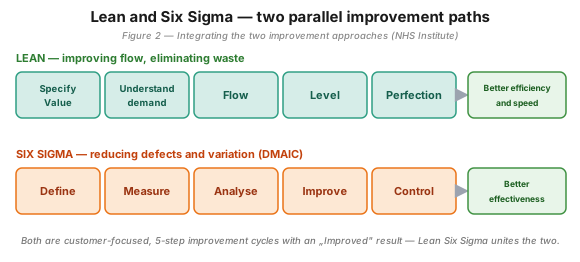 Figure 1 — the parallel, five-step improvement paths of lean (Specify Value → Understand demand → Flow → Level → Perfection) and Six Sigma DMAIC (Define → Measure → Analyse → Improve → Control); both are customer-focused and lead to an “improved” result. Lean Six Sigma unites the two.
Who is this for?
Section titled “Who is this for?”This article is for those who improve processes in practice and have to decide with which tool: process engineer · process technologist · quality engineer · production and plant manager · shift supervisor · Lean/CI specialist · Six Sigma belt (Green/Black Belt) · operational excellence leader · HSE.
Learning objectives
Section titled “Learning objectives”After reading this article you will be able to:
- distinguish in one sentence what lean targets, what Six Sigma targets, and what Lean Six Sigma adds;
- decide for a concrete problem whether speed/waste (lean) or variation/defect (Six Sigma) is the main issue, and in what order to tackle them;
- explain why the two methods need each other (lean’s systems view and Six Sigma’s statistical power);
- recognize when Lean Six Sigma remains mere cost cutting, and what is needed for the full benefit;
- name the most common pitfalls (branding the methodology, isolated projects, wrong order).
The essence (TL;DR)
Section titled “The essence (TL;DR)”- Lean = “doing things quickly” (flow, waste elimination); Six Sigma = “doing things right” (defect-freeness, variation reduction). Lean Six Sigma unites the two.
- Complementary, not competing: lean fixes and speeds up the base process, Six Sigma takes the variation out of it.
- Order matters: first lean provides the stable, excess-free flow, then Six Sigma pulls out the variation. There is no point building fine statistics on a fundamentally bad process.
- 20/80: roughly 20% of the tools deliver 80% of the benefit: focus on the “vital few” tools.
- Strategic + operational together: the full benefit comes at the strategic level; purely operational application remains only cost cutting.
- Don’t brand around the methodology: the goal is the better result, not the “Lean Six Sigma” label itself.
- Pioneers: Six Sigma was developed by Motorola, and General Electric is one of its early adopters, which later moved toward Lean Six Sigma itself.
Why does it matter? (the stakes)
Section titled “Why does it matter? (the stakes)”Each method works on its own too, but both have a characteristic blind spot, and the other covers exactly that. If you use only one, half the improvement is lost.
- Lean only. You speed up the flow, throw out the excess, but the process variation remains. Lean on its own does not recognize the effect of variation, and is weak in the measurement-analysis (the DMAIC Measure–Analyse) phases. The unpredictable, sometimes-good-sometimes-bad output remains.
- Six Sigma only. You pull the variation out of a process you improve in isolation — you do not see the system interaction, the projects are not coordinated, and the process meanwhile stays full of waste and unnecessary steps. Six Sigma “sub-optimizes”: it polishes one process at a time, while the whole value stream stays slow.
- Wrong order. The classic mistake is trying to “statistics” a fundamentally badly designed process into “defect-freeness.” If the starting level is too low, you first have to redesign (lean), and only then pull out the variation (Six Sigma).
The lesson is simple: speed without error only comes together when the two viewpoints work together. That is why it pays to unite them, not to choose between them.
What is Lean Six Sigma, and why is it worth uniting the two methodologies?
Section titled “What is Lean Six Sigma, and why is it worth uniting the two methodologies?”Lean Six Sigma is a comprehensive improvement philosophy that unites lean’s value-maximizing view and Six Sigma’s data-driven toolkit, to deliver fast, low-cost and durable improvement. The integration is win-win: lean provides the strategy and the environment for improving flow and eliminating waste, while Six Sigma quantifies the problems, makes decisions based on factual data (not anecdote), reduces variation, uncovers the root causes, and quantifies the financial benefit.
The two methods grew from different roots, yet converged toward each other. Lean originates from Toyota’s production system (Taiichi Ohno, Just-in-Time), and Toyota developed the approach in the 1950s, building on the work of Frederick Taylor and W. Edwards Deming. Six Sigma grew out of the quality movement: from Deming’s quality-improvement tools and Total Quality Management, then took shape at Motorola in the 1980s. The name refers to the statistics (coined by Bill Smith, an engineer at Motorola), and the goal is the practically defect-free, 3.4 defects per million opportunities level. From the two branches came Lean Six Sigma.
How do lean, Six Sigma and Lean Six Sigma differ?
Section titled “How do lean, Six Sigma and Lean Six Sigma differ?”In short: lean attacks speed and waste, Six Sigma variation and defects, and Lean Six Sigma both at once: it first creates a stable, excess-free flow, then pulls the variation out of it. This section justifies why the three are separate concepts, and when to reach for which.
| Aspect | Lean (Lean basics) | Six Sigma (six-sigma) | Lean Six Sigma | |—|—|—|—| | What it targets | improving flow, eliminating waste | eliminating defects, reducing variation | both: a fast AND defect-free process | | Guiding question | “Why does this process exist at all? What is the value?” | “How do we improve this process?” | “How can it be fast and stable at the same time?” | | Workflow | Specify Value → Value Stream → Flow → Pull → Perfection | DMAIC: Define → Measure → Analyse → Improve → Control | lean gives the direction, DMAIC the depth | | Its strength | systems view, speed, quick action (kaizen) | measurement, analysis, root cause, statistics | the two strengths combined | | Its blind spot alone | does not handle variation; weak at Measure–Analyse | improves in isolation, “sub-optimizes”; leaves much waste | — (this is exactly what it solves) | | When it is the right one | slow, wasteful, but not particularly variable process | stable but unpredictable process scattering many defects | when speed and quality are the problem together |
The interdependence is mutual. Lean needs Six Sigma because the latter gives tools for understanding problems and sources of variation, recognizes the effect of variation, and is strong where lean is weak (Measure, Analyse). Six Sigma needs lean because lean brings a systems view to the otherwise isolated projects, improves the process’s speed and lead time, gives quick action (kaizen), identifies the waste, and removes the non-value-adding steps, so Six Sigma quality is reached faster.
How do lean and Six Sigma work together?
Section titled “How do lean and Six Sigma work together?”Lean Six Sigma is not the parallel running of two methods, but an optimal combination: lean sets the direction, and Six Sigma deepens where variation hurts. The practical logic comes together in two steps:
- First the lean identifies what adds value and what the value stream is (VSM, waste): the focus goes onto what matters to the customer.
- Once the value stream is fixed and stable, the Six Sigma tools (DMAIC, SPC, process capability) take the variation out of it.
The two methods share or complement many established tools. The table below shows where each reaches for something different, while Lean Six Sigma picks from a single common toolkit:
| Area | Typical lean tools | Typical Six Sigma tools | |
|---|---|---|---|
| Analysis | Value Stream Mapping, voice of the customer (VOC), interview | SIPOC, swim-lane, detailed process map, CTQ tree | |
| Root cause / measurement | 5 Why, SPC, takt time, OEE | SPC, process capability, applied statistics, cause-and-effect (Ishikawa) diagram, Pareto | |
| Improvement | process redesign, [[5s.en | 5s]], TPM, poka-yoke, visual control | process redesign, DOE |
Lean Six Sigma reduces not only cost but also improves productivity, quality, speed and safety, from manufacturing through services to administrative processes, in every industry.
Process-industry context
Section titled “Process-industry context”In process industries, lean provides the stable, waste-free base process: the standardization of shift handover, startup and shutdown, the reduction of lead times and unnecessary steps. Six Sigma then drives down the variation of the critical parameters (yield, product quality, energy use), and in the DMAIC Control phase continuously monitors so that the improvement is sustained.
A more stable process is also safer: fewer unpredictable deviations, fewer off-spec batches, and rarer dangerous transient states. Process instability is often a direct precursor of a safety event, so reducing variation is a direct quality and safety benefit (related: mura, robustness and redundancy). An important boundary, however, is that Lean Six Sigma is a management and quality philosophy, not a certified protection layer: safety-critical functions must still be designed according to risk analysis and the relevant standards (SIL/LOPA, IEC 61511).
Putting it into practice (roadmap)
Section titled “Putting it into practice (roadmap)”Lean Six Sigma is not the installation of a tool, but the building of an improvement arc. The proven introduction order (the steps start with an action, so they can be followed directly):
- Start with a strategic goal, not with the methodology. Let the need for a better result decide the approach, not the other way round. Never “brand” the initiative with the method: “becoming a Lean Six Sigma company” is not a goal; the method should work behind the goal, in the background.
- Secure senior-leadership commitment. Without active, visible leadership participation the program dies; leadership provides the resource and the mandate.
- Choose where Lean Six Sigma fits and where it does not. Not every problem is statistical or flow-related — decide which tool is needed (a pragmatic approach).
- Start with lean: fix value and flow. Map the value stream (VSM), identify customer value, and eliminate the non-value-adding steps, so there is a stable base process.
- Bring Six Sigma onto the remaining variation. On the stabilized process run DMAIC: measure the key characteristics, uncover the root cause, improve based on data analysis, and set up the Control phase (SPC, visual control).
- Focus on the vital few tools. Roughly 20% of the tools bring 80% of the benefit: concentrate on what saves the most time and delivers the greatest impact.
- Spread and measure. Replicate the proven pattern onto new processes, and use regularly reviewed metrics (e.g. Balanced Scorecard) to shape behaviour and sustain the gains.
Practical mini-scenario
Section titled “Practical mini-scenario”The problem: a packaging line is fast, but the fill weight varies, and every month several batches slip out of spec. Lean step: value-stream map, eliminating the unnecessary changeovers and intermediate storage — the flow becomes faster and simpler. Six Sigma step: on the stabilized line, DMAIC — the Measure reveals the variation of the fill weight, the Analyse the root cause (e.g. fluctuating feed pressure), the Improve sets and verifies the correction, and the Control monitors it with SPC so it does not slip back. Result: the line is not only fast but predictably on-spec — exactly what neither method would have delivered alone.
Measurement / audit
Section titled “Measurement / audit”You measure the effect of Lean Six Sigma on the shared metrics of the two viewpoints, not separately:
- Speed / flow: lead time, process cycle time, inventory level, the ratio of non-value-adding steps (the metrics of the lean side).
- Quality / variation: DPMO or sigma level, process capability (Cp, Cpk), the ratio of defects caught during the process vs. those that reached the customer (the metrics of the Six Sigma side).
- Financial return: the quantified saving of the project. Six Sigma’s virtue is that every project has a numerical financial target.
Target-value logic: the number should not be an end in itself. The sigma value is primarily a comparative measure (improving, worsening, stagnating), and 3.4 DPMO is not the mandatory target of every process: leadership sets the appropriate level and the priority per process, based on customer expectation.
When NOT to use it? (the limits of the method)
Section titled “When NOT to use it? (the limits of the method)”Lean Six Sigma is strong but not universal. Knowing where it is not the right answer is just as important as the method itself:
| Situation | Why (primarily) not Lean Six Sigma | The right answer | |
|---|---|---|---|
| Purely operational, cost-cutting goal, without strategic intent | the full benefit comes at the strategic level; applied purely operationally it remains only cost cutting | tie the improvement to a strategic goal (policy deployment) | |
| The process is fundamentally badly designed (baseline too low) | there is nothing to “statistics” into defect-freeness on an unworkable process | first redesign (lean/redesign), then Six Sigma | |
| Simple, well-understood task where detailed statistics is overkill | Six Sigma is too detailed and complex for some tasks | a proportionate, simple tool (e.g. a quick [[kaizen.en | kaizen]]) |
| A certified safety function is needed | Lean Six Sigma is a management and quality principle, not a certified protection layer | design per SIL/LOPA, IEC 61511 | |
| A one-off, non-recurring deviation | there is no durably improvable, measurable process | one-off root-cause analysis, recording the lesson |
Rule of thumb: Lean Six Sigma is strongest for recurring, measurable, value-adding processes, with strategic intent. It does not replace certified safety, and for simple, well-understood tasks it is often overkill: in that case it calls for a different, more proportionate tool.
Common mistakes
Section titled “Common mistakes”The pitfalls of Lean Six Sigma almost all stem from taking the method as the goal, or from using only one half of it. In anti-pattern ↔ correction pairs:
- They “brand” with the methodology. “Let’s become a Lean Six Sigma organization!” — the method becomes an end in itself. Instead: the goal is the better result; the method should work in the background, in service of the strategic goal.
- Purely operational, cost-cutting application. The project saves a few pennies, but the system-level benefit is missing. Instead: tie it to a strategic goal — the full benefit comes at the strategic level.
- Wrong order: variation in a fundamentally bad process. They try to polish an unworkable process with Six Sigma. Instead: first lean redesign (stable flow), then pulling out the variation.
- Isolated, uncoordinated projects. Six Sigma improves processes one by one, ignoring the system interaction (“sub-optimizes”). Instead: let lean’s systems view connect the projects.
- Lean only, variation-blind. The flow becomes fast, but the output stays unpredictable. Instead: let Six Sigma measure and pull out the variation.
- All the tools at once. Over-statisticizing, tool fetishism. Instead: the vital few — focus on the ~20% of tools that deliver 80% of the benefit.
Take it home (keys)
Section titled “Take it home (keys)”- Fast AND well: lean gives the speed, Six Sigma the quality; the real benefit is the two together.
- Lean first, then Six Sigma: stabilize and speed up the flow, then pull the variation out of it; the reverse does not work.
- Complementary, not competing: lean’s systems view and Six Sigma’s statistical power cover each other’s blind spot.
- The full benefit is at the strategic level: mere operational application is only cost cutting.
- Don’t brand the method: the goal is the better result, not the “Lean Six Sigma” label.
- Vital few: ~20% of the tools deliver ~80% of the benefit — do not try to do them all at once.
Self-test
Section titled “Self-test”- A process is fast, but its output is sometimes good, sometimes bad — is lean, Six Sigma or Lean Six Sigma the right answer, and why? Which method cures which problem?
- Why is it not worth starting with Six Sigma on a fundamentally badly designed process? What order do you suggest instead?
- Name one blind spot that lean alone does not handle, and one that Six Sigma alone does not — how does Lean Six Sigma cover the two?
How does it appear in digital practice?
Section titled “How does it appear in digital practice?”The principle of Lean Six Sigma does not end on the production line: the same “fast and well” logic is realized in software too, in any well-designed digital workflow. Instead of the physical value-stream map and the manual control chart, here automatic data collection, process monitoring and alerting carry the pairing of speed and stability — the mechanism differs, the principle is the same.
| Lean Six Sigma principle | Digital implementation | What it delivers |
|---|---|---|
| Flow / waste (lean) | a digital workflow that eliminates unnecessary steps and waiting | faster, simpler throughput |
| Variation monitoring (Six Sigma) | automatic trend- and control-limit monitoring, deviation alerting | the variation is visible early, before it becomes a defect |
| Stable sequence / standard | enforced sequence, digital standard work | less ad-hoc, more predictable output |
| Root-cause trail (DMAIC) | recorded deviation → corrective action (owner, deadline) | an audit trail from fix to sustainment |
| Sustainment (Control) | continuous, automatic measurement against slipping back | the improvement does not wear off by the next shift |
Connection to OPEREX (shift log)
Section titled “Connection to OPEREX (shift log)”The daily trace of Lean Six Sigma fits naturally into a digital shift log. On the lean side, the standardized shift handover, startup and shutdown can be recorded as a retrievable, searchable template; on the Six Sigma side, the deviations of the critical parameters, the control-limit breaches and the assigned corrective actions (what / who / by when) can be logged per shift, auditably. This way stability and quality together give a continuous observation trail: the deviation surfaces at the end of the shift, within the system, not at the next shift or at the customer, and the DMAIC Control phase is not a one-off document but a living supervision that can be followed shift by shift.
Terminology (HU / EN)
Section titled “Terminology (HU / EN)”| Hungarian | English | Note |
|---|---|---|
| Lean Six Sigma | Lean Six Sigma (LSS) | the unified methodology of lean and Six Sigma |
| áramlás | flow | lean’s main target: a fast, unobstructed value stream |
| veszteség | waste / muda | the non-value-adding activity |
| variancia / szórás | variation | Six Sigma’s main target |
| defekt / hiba | defect | the numerator of DPMO |
| hibák millió lehetőségenként | DPMO | the measure of the Six Sigma level (target ≤ 3.4) |
| komplementer | complementary | not competing, but complementary |
| „gyorsan tenni” / „jól tenni” | doing things quickly / doing things right | the one-sentence distinction of lean and Six Sigma |
What is the difference between lean and Six Sigma?
Lean targets the process’s speed and the elimination of waste (flow), Six Sigma the reduction of process variation and defects (quality). In short: lean is “doing things quickly,” Six Sigma is “doing things right.” Lean Six Sigma unites the two.
Are they competing or complementary methods?
Complementary. They developed separately, but serve a similar goal, and applied together they deliver a faster, more durable result: lean grounds and speeds up the base process, Six Sigma takes the variation out of it.
In what order should I apply the two?
First lean fixes the value and the stable, excess-free flow; once the value stream is stable, Six Sigma DMAIC pulls out the remaining variation. The reverse is hard: there is no point building fine statistics on a fundamentally bad or variable process.
Why is one alone not enough?
Because both have a blind spot. Lean alone does not handle variation, and is weak at measurement-analysis; Six Sigma alone improves in isolation and leaves much waste in the process. Together they cover each other’s weak side.
Does every organization need to reach 3.4 DPMO?
No. 3.4 DPMO is not the mandatory target of every process: the organization sets the appropriate sigma level per process, based on customer expectation. Lean Six Sigma serves the better result, not an absolute number.
Related concepts
Section titled “Related concepts”six-sigma · Lean basics · dmaic · vsm · mura · muda · 5s · kaizen
Next step
Section titled “Next step”If you have understood this, from here it is worth going on — in this order:
- Lean basics — the speed and waste side: what flow, value and the eight waste types mean. Start here if the lean half is still new.
- six-sigma — the quality and variation side: DPMO, sigma level, capability. This gives the statistical depth to Lean Six Sigma.
- dmaic — the Six Sigma workflow step by step: Define → Measure → Analyse → Improve → Control, the backbone of the concrete project.
References / Further reading
Section titled “References / Further reading”- NHS Institute for Innovation and Improvement: Lean Six Sigma: Some Basic Concepts (Bevan, Westwood, Crowe, O’Connor). — an introductory, practical summary of integrating lean and Six Sigma.
- Michael L. George: Lean Six Sigma: Combining Six Sigma Quality with Lean Production Speed. McGraw-Hill, 2002. — the canonical foundational work on uniting the two methods (the source of the “why they need each other” logic).
- James P. Womack, Daniel T. Jones, Daniel Roos: The Machine That Changed the World. Macmillan, 1990. — the foundational work of lean thinking.
- Peter S. Pande, Robert P. Neuman, Roland R. Cavanagh: The Six Sigma Way. McGraw-Hill, 2000. — the practical classic of introducing Six Sigma.