DISC — the four behavioural styles
≈ 22 min read · 4,401 words
Four people sit in a meeting, looking at the same project. The first asks: “When will it be ready?” The second: “Who is in on it?” The third: “What does this upset?” The fourth: “What is the data behind it?” Same topic, four completely different reactions, and in the end everyone believes the others were not paying attention. In fact they only asked in a different language. DISC names exactly these four patterns, so that you can then do something with them. Let’s look at what it is, what its four styles are, and how it differs from MBTI.
DISC is a behaviour-based model of four styles — Dominance, Influence, Steadiness, Conscientiousness — built on Marston’s two perception dimensions.
William Moulton Marston’s model rests on two questions: do I see the situation as favourable or unfavourable, and do I feel stronger or weaker than it. The abbreviations of the four styles are D, I, S and C. The purpose of DISC is to help you understand your own and other people’s behaviour in different situations, and to adjust your communication to it; that is why it is used as a communication, team-building and coaching tool, not as a selection screen.
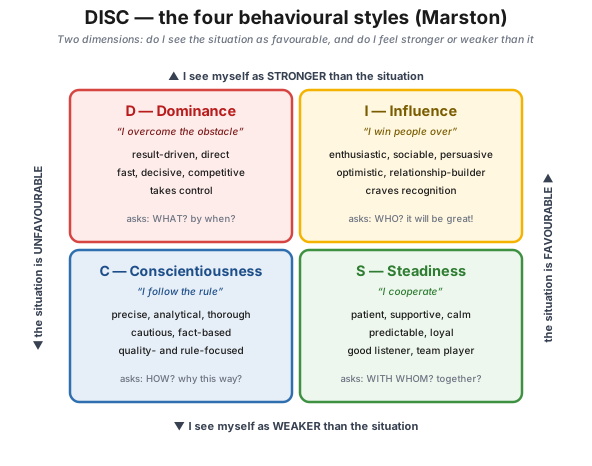
Figure 1 — the four DISC styles along Marston’s two dimensions. The top row is “I see myself as stronger,” the bottom one “as weaker”; the left column is an “unfavourable (obstacle)” situation, the right one a “favourable” situation. The two axes come from Marston; assigning a specific style to each of the four fields, and the guiding questions, are a didactic aid of established training practice.
Who is this for?
Section titled “Who is this for?”This article is for those who spend most of their work coordinating with people, and who find that the same sentence works with one colleague and not with another: shift supervisor · plant manager · process engineer · maintenance manager · HSE specialist · project manager · team leader · HR and training colleague · Lean/CI coordinator.
Learning objectives
Section titled “Learning objectives”After reading this article you will be able to:
- explain what DISC measures (behaviour) and what it does not measure (personality, ability, suitability);
- derive the four styles from Marston’s two dimensions, and recognize them in a meeting;
- adjust your own message to the other person’s style in communication;
- state how reliable DISC and MBTI are, and where those numbers come from;
- decide when DISC is the wrong tool, and what the right answer is instead.
In brief
Section titled “In brief”- Four styles: D Dominance (result), I Influence (people), S Steadiness (cooperation), C Conscientiousness (quality and precision).
- Behaviour, not thinking. DISC describes how you behave in a situation, that is, what is observable from outside. MBTI, by contrast, measures the inner, cognitive preferences.
- Two dimensions (Marston): the situation is favourable or unfavourable, and I see myself as stronger or weaker than it.
- Situation-dependent. The same person may show a different style in a different situation, because DISC describes behaviour, it does not fix a “type.”
- All four are in everyone, in different proportions; typically you have 1–2 dominant styles. The profile is written with the established notation: capital letter = high, lower-case letter = low (for example
DiSc). - Its benefit is communication: it is worth speaking in a way adjusted to the other person’s style. In practice this is why it is used as a communication, team-building and coaching tool.
Why it matters (the stakes)
Section titled “Why it matters (the stakes)”Misunderstanding rarely comes from someone saying the wrong thing. Far more often it comes from them saying the right thing, just not in the language the other person hears.
If you start your report to a result-driven shift supervisor with three minutes of background, by then you have lost their attention, and the point does not get through. If you answer a colleague tuned to precision with “we’ll sort it out,” they become distrustful and would rather check it themselves. If you change the work schedule of a team looking for stability without announcing it, they will not object, they will quietly slow down. In none of these cases is there bad intent behind it; there is a style clash, and its price is lost time, an unnecessary extra round and deteriorating trust. DISC makes this nameable, and thereby manageable.
What is the DISC model, and where does it come from?
Section titled “What is the DISC model, and where does it come from?”Short answer: DISC is a behaviour-describing framework derived from the work of Dr. William Moulton Marston, physiologist and psychologist, which builds the four styles from two simple perception questions.
Marston examined how a person perceives themselves in a situation, what emotions this perception triggers, and what behaviour follows from it. His model rests on two critical dimensions:
- Perception of the situation. Do I see it as favourable, or as unfavourable, an obstacle?
- Self-perception. Do I feel stronger or weaker than the situation?
This is how Marston tried to understand how people adapt to changing situations through their emotional reactions and the behaviour that follows them. He developed the model in the 1920s–1930s, a good friend of his popularized it, but in practice it only began to be used more widely around 1970. Today’s DiSC questionnaire is based on this: it helps people understand their own and others’ behaviour in various situations.
The four fields of the two dimensions give the four styles (see Figure 1):
- Unfavourable situation + I see myself as stronger → D (Dominance): “I overcome the obstacle.”
- Favourable situation + I see myself as stronger → I (Influence): “I win people over.”
- Favourable situation + I see myself as weaker → S (Steadiness): “I cooperate.”
- Unfavourable situation + I see myself as weaker → C (Conscientiousness): “I follow the rule.”
What are the four DISC styles (D/I/S/C)?
Section titled “What are the four DISC styles (D/I/S/C)?”Short answer: D seeks challenge and wants immediate results; I works with people and inspires them; S helps in the background, predictably and as a good listener; C is obsessed with quality, plans and re-checks.
D — Dominance
Section titled “D — Dominance”People with the D style are strong-willed, decisive people who like to take on a challenge, to act and to achieve immediate results. They feel strong even in an unfavourable situation, so they go straight at the obstacle. Their guiding question is “What? By when?”. Their tension: impatience, excessive pressure, running over other people.
How to speak to them: be concise, confident, result-focused; give them options, not a lengthy explanation.
I — Influence
Section titled “I — Influence”People with the I style are the classic “people person”: they like to take part in a team, share ideas, energize and entertain others. In a favourable situation they feel strong, so they win people over. Their guiding question is “Who is in on it? It will be great!”. Their tension: the details and the deadlines can slip away, the enthusiasm can evaporate.
How to speak to them: be enthusiastic and friendly, give room for conversation and recognition; do not smother them in dry details.
S — Steadiness
Section titled “S — Steadiness”People with the S style are helpful people who like to work in the background, to perform consistently and predictably, and are good listeners. In a favourable situation they feel weaker than the situation, so they choose cooperation. Their guiding question is “With whom? Together?”. Their tension: they avoid conflict and sudden change, and find it hard to say no.
How to speak to them: be patient, reliable, personal; do not rush them, give them time and safety for the change.
C — Conscientiousness
Section titled “C — Conscientiousness”People with the C style are obsessed with quality: they like to plan ahead, use a systematic approach, and check accuracy again and again. In an unfavourable situation they feel weaker, so they align themselves to the rule and to the facts. Their guiding question is “How? Why this way?”. Their tension: over-analysis can lead to paralysis, the tone can turn critical.
How to speak to them: be precise, logical, fact-based; give them details, data and time to think it over.
Colours, blends and intensity
Section titled “Colours, blends and intensity”Short answer: a profile is not a box but four “sliders”: all four styles are present in everyone, at different intensities, and most people are a blend of two adjacent styles.
- Intensity: capital letter = high, lower-case letter = low. The established notation of DISC practice is the
DISC (high) vs. Disc (low)logic: the profile is written with four letters, and the size of the letter shows whether that dimension is high or low. This is how profiles such asDISc,Disc,DisC,dISC,diSC,dIsC,diScordisCcome about. This notation is easy to remember, and it expresses exactly that a style is not a category but a proportion. - Blends. Most people are not “purely” one style but a blend of two adjacent styles (for example DI = energetic, result- and people-centred; SC = calm, reliable, precise). The opposite styles (D↔S, I↔C) cause the greatest tension.
- Colour code. In training practice the DISC styles are often depicted with four colours (D = red, I = yellow, S = green, C = blue), and the Insights colour-energy model uses a similar colour code. The correspondence between the two models (red ≈ D, yellow ≈ I, green ≈ S, blue ≈ C) is a didactic aid, not a theoretical identity: DISC is built on Marston’s emotional-behavioural model, whereas Insights is built on Jung’s theory of types, so the theoretical axis of the two frameworks is different.
What drives each style, and what does it fear?
Section titled “What drives each style, and what does it fear?”Short answer: behind every style there is a motivation and a fear; these two explain the behaviour under pressure.
| Style | Motivated by | Afraid of | Under pressure |
|---|---|---|---|
| D (red) | result, challenge, control | being taken advantage of, losing control | may become forceful, impatient |
| I (yellow) | recognition, company, impact | social rejection, being left out | may become scattered, superficial |
| S (green) | stability, harmony, safety | sudden change, conflict | may become passive, “dug in” |
| C (blue) | precision, quality, rules | error, criticism, a chaotic situation | may become over-analytical, rigid |
This table is a summary of established DISC training practice, so it is a didactic aid, not part of Marston’s original model. The lesson is the same as with self-awareness: if you know what drives the other person and what they fear, you can adjust your own style to them, instead of forcing yours on them.
How does DISC differ from MBTI?
Section titled “How does DISC differ from MBTI?”Short answer: DISC measures behaviour in different situations, MBTI measures the personality type. That is why DISC is typically used for communication, team building and coaching, and MBTI for type- and career-related self-awareness.
| Aspect | DISC | MBTI |
|---|---|---|
| What does it measure? | behaviour in different situations | the personality type |
| Its basis | Marston’s emotional-behavioural model | Jung’s theory of types |
| Categories | 4 styles (D/I/S/C), with intensity grades | 16 types (4 dichotomies) |
| Its nature | situation-dependent (behaviour can change) | a relatively stable preference |
| Administration | online test, paper-based test, quick card version | online test, paper-based test |
| What it is used for | communication, team building, coaching | type self-awareness, career choice |
| Display in the team | name badge, e-mail identifier | name badge, e-mail identifier |
| Feedback | printed report + overlay matrix | printed report |
It is not by chance that these four rows (administration, use, display, feedback) distinguish the two. The use row on its own justifies why DISC is the tool of everyday communication and team building: behaviour is what the other person actually sees of you, and what you can change tomorrow morning.
In short: MBTI is the “why” (the inner workings), DISC is the “how it looks” (the outward behaviour). The two do not replace each other. From the MBTI side it is worth knowing that the least preferred function, the “dark side,” comes out under fatigue, stress or pressure, which is another reason why it is useful to know our own patterns.
How reliable is DISC?
Section titled “How reliable is DISC?”Short answer: the measurement stability of DISC instruments is well documented, but most of the numbers come from the instruments’ vendors’ own materials, so it is worth reading them with the source in mind.
Two concepts must be separated. Reliability measures whether the instrument consistently measures the same thing; validity measures whether it really measures what it claims to.
Internal consistency and repeatability (instrument-vendor data)
Section titled “Internal consistency and repeatability (instrument-vendor data)”The documentation of the DISC instrument called Style Analysis reports internal consistency calculated with the Spearman-Brown “split-halves” method, and six-month retest correlations:
| DISC dimension | Split-halves internal consistency (r) |
|---|---|
| Dominance | .92 |
| Influence | .89 |
| Steadiness | .91 |
| Compliance | .90 |
The average of the six-month test-retest correlations moves in the .90 range, which means the scores change little over time. The usual correlation scale belongs to the interpretation: ±.80–.99 is unusually high, ±.70–.79 very high, ±.60–.69 high, ±.30–.59 moderately high, ±.20–.29 very low, and ±.00–.19 is practically no relationship.
Independent case study (DISCUS)
Section titled “Independent case study (DISCUS)”A South African study of the DISCUS profiling system measured reliability with the test-retest method on 90 employees. The Pearson correlations: Dominance 0.728 · Influence 0.645 · Steadiness 0.730 · Compliance 0.550, in every case at a significance level of p = 0.0001. In the validity part, criterion-based validity was used: the four dimensions of Discus were compared with the factors of the 16-PF questionnaire on 120 respondents, and significant correlations were found for all four dimensions.
It is worth noticing the difference: the numbers of the independent study are perceptibly lower than those of the vendor documentation, especially on the Compliance dimension (0.550 instead of .90). This is a good example of why it matters who does the measuring.
And MBTI on the same scale?
Section titled “And MBTI on the same scale?”Since the two instruments are constantly placed side by side, it is worth knowing how MBTI stands on the same indicators:
| Aspect | MBTI |
|---|---|
| Retest agreement | in 75–90% of cases 3–4 preferences stay the same |
| Weak point | the T–F scale has the lowest reliability |
| Independent (NAS) review | over 5 weeks 47% of respondents kept their original type classification |
| Construct validity | on the basis of more than 20 studies only the I–E scale is adequate |
| Category coverage | the 16 categories are valid for 54% of the population, the remaining 46% end up in the “closest category” |
| Form of the test | 93 forced-choice questions |
The lesson is not that “MBTI is bad, DISC is good.” The lesson is that both instruments are worth something only if you know what they measure, with what accuracy, and what they cannot be used for.
How does your style distort feedback?
Section titled “How does your style distort feedback?”Short answer: the performance review is one of the most uncomfortable leadership tasks, and your own DISC style distorts it unnoticed. Four typical distortions:
- The “D” measures by their own yardstick. They evaluate the other person by how far they meet the standards and challenges the “D” has set. Risk: anyone working at a different rhythm automatically looks weaker.
- The “I” rewards the voicing of emotions. They evaluate by how far the other person verbalizes their feelings, and see the review conversation more as an occasion for “let’s do it better” than as a confrontation about under-performance. Risk: the real problem does not get on the table.
- The high “S” is the most lenient manager. They prefer stability over change, so they tend to smooth things over. Risk: weak performance can persist for years without feedback.
- The high “C” is objective but cold. Their evaluation is well documented, detailed, critical but factual. Risk: accurate, yet demotivating if there is no recognition alongside it.
How to use it in practice
Section titled “How to use it in practice”Short answer: the benefit of DISC is not the label but the style-adjusted communication: treat the other person as suits their style, not as would be comfortable for you (this is the platinum rule, see Insights).
In a shift-based, team environment this brings fewer misunderstandings and smoother cooperation. Report concisely to the “Dominance” shift supervisor, factually and in detail to the “Conscientious” maintenance technician, patiently and predictably to the “Steadiness” colleague, enthusiastically and inclusively to the “Influence” partner. In this way DISC is the practical complement of feedback, assertive communication and team dynamics (Belbin team roles).
Hands-on — how would you introduce it tomorrow? (mini-scenario)
Section titled “Hands-on — how would you introduce it tomorrow? (mini-scenario)”You do not need a certified consultant and a questionnaire licence for style awareness to get started in a team. It fits into a 45-minute shift meeting like this:
- Draw up the square (10 minutes). Two axes, four fields, with a short description of the four styles. Do not classify anyone, just present the framework.
- Ask for self-classification, out loud (10 minutes). Everyone says which two fields they feel most at home in, and brings a concrete example from their own shift.
- Look for the opposite pairs (10 minutes). Ask those who placed themselves in opposite quadrants (D↔S, I↔C) what the last misunderstanding between them was. This is where most of the insight comes.
- Formulate a team agreement (10 minutes). For example: “the first sentence of the daily report is always the question that asks for a decision” (for the D), “we announce a change 24 hours in advance” (for the S), “every decision comes with a data set” (for the C), “we say a good result out loud” (for the I).
- Closing and homework (5 minutes). Everyone picks one colleague to whom, over the coming week, they will deliberately give feedback in that colleague’s style, and tells the next meeting what happened.
Common mistakes
Section titled “Common mistakes”- Treating it as a fixed “type.” DISC describes behaviour, which is situation-dependent, so the same person may behave differently in another situation. Instead: always speak about it tied to a situation (“in meetings you behave more like a C”).
- Reducing someone to a single letter. Most people have 1–2 dominant but several active styles. Instead: use the high/low notation (
DiSc), which expresses a proportion, not a category. - Taking your own style as the norm. Whoever communicates only in their own style loses the other three styles. Instead: the platinum rule, that is, a message adjusted to the other person’s style.
- Confusing it with MBTI. DISC is behaviour (“how it looks”), MBTI is cognitive preference (“why”), so the lens is different. Instead: first decide what you want to understand, and choose the tool afterwards.
- Taking the instrument vendor’s validity numbers as independent evidence. Instead: look at who made the study, on how large a sample, and with what comparison instrument.
When NOT to use it?
Section titled “When NOT to use it?”Short answer: there is no “best” psychological instrument, only an appropriate instrument for the given purpose. DISC is the wrong choice when you want to base a decision about people on it.
- For selection, promotion, dismissal. This is the most contested point, so it is worth seeing the picture precisely. The vendors of DISC instruments explicitly refer to predictive validity: outcomes such as sales performance, turnover or workplace accidents could, according to their own documentation, be predicted with high accuracy from the DISC scores, and they present this ability as an advantage usable in selection and in leadership. By contrast, today’s DiSC publishers (for example Wiley, which looks after Everything DiSC) and the overwhelming majority of professional consulting recommendations explicitly advise against use in selection: the instrument was designed for development, communication and team-building purposes, not for suitability screening. Practical rule of thumb: if the outcome concerns someone’s job, pay or advancement, the basis of the decision should not be a DISC profile but a structured interview, a work sample and documented performance data.
- For clinical or diagnostic purposes. DISC describes normal behaviour, not mental health. If that is the issue, a professional must be consulted.
- Where the problem is not style but system. If the same information is regularly lost between shifts, that is not the DISC profile of the participants but a missing shift handover standard. In such a case the style model is a distraction.
- For a one-off completion, without a feedback conversation. An instrument measuring personality or behaviour is only as valid and reliable as the person filling it in at that moment. Quality is ultimately decided by how it is presented, administered, scored, evaluated, and how it is talked back through with the participant. A completed questionnaire without a feedback conversation is not self-awareness, only a combination of letters.
Take it home (keys)
Section titled “Take it home (keys)”- DISC measures behaviour, it does not rate a person. Always speak about it tied to a situation, and never use it as a label.
- The benefit is in communication. Take away one thing: adjust the form of your message to the other person’s style, and leave the content unchanged.
- Write the profile as a proportion, not a category. The capital/lower-case notation (
DiSc) expresses exactly that there are four sliders. - Your feedback passes through the filter of your own style. Before an evaluation, ask whether you are measuring performance, or resemblance to yourself.
- Ask where the numbers come from. High reliability coefficients often come from vendor material; independent studies typically bring more modest values.
- Do not base a personnel decision on it. For development, coaching, team building yes; for selection and promotion no.
Self-test
Section titled “Self-test”- From which two perception questions did Marston derive the four styles, and which combination does
Cbelong to? - What does the profile notation
dIScmean, and why is it more accurate than saying “he is an I-type”? - A manager with a high “S” style is writing a performance review of a persistently under-performing colleague. What distortion threatens, and how would you counterbalance it?
Answer key
- (a) Do I see the situation as favourable or unfavourable, (b) do I feel stronger or weaker than it.
Cis the combination of an unfavourable situation + a weaker self-perception (“I follow the rule”). It is important that the field-to-letter assignment comes from training practice, not from Marston himself. - The capital letter denotes high, the lower-case letter low intensity, so
dIScmeans low D, high I, high S, low C. It is more accurate because it describes all four dimensions as proportions, instead of sorting into a single category. - The high “S” is typically the most lenient manager, because they prefer stability over change, so they may smooth the problem over. Counterbalance: performance data recorded and documented in advance, concrete examples, and a structured conversation outline that does not allow the difficult topic to be skipped.
Terminology (HU / EN)
Section titled “Terminology (HU / EN)”| Hungarian | English | Marston’s original |
|---|---|---|
| Dominancia | Dominance (D) | Dominance |
| Befolyásolás | Influence (I) | Inducement |
| Stabilitás | Steadiness (S) | Submission |
| Lelkiismeretesség | Conscientiousness (C) | Compliance |
| viselkedési stílus | behavioural style | — |
| kedvező / kedvezőtlen helyzet | favourable / unfavourable | — |
| belső konzisztencia | internal consistency (split-halves) | — |
| újratesztelési megbízhatóság | test-retest reliability | — |
| prediktív validitás | criterion / predictive validity | — |
The earlier name of “Steadiness” is submission, and “Conscientiousness” is also used under the name compliance; “Inducement” is the term of Marston’s foundational 1928 work (see References).
What are the four DISC styles?
Dominance (D: strong-willed, seeking challenge, wanting immediate results), Influence (I: a “people person,” works in a team, shares ideas, inspires), Steadiness (S: helpful, works in the background, consistent and a good listener) and Conscientiousness (C: obsessed with quality, plans ahead, works systematically, re-checks). All four are present in everyone, at different intensities.
What is the DISC model based on?
On William Moulton Marston’s two dimensions: do I see the situation as favourable or unfavourable, and do I feel stronger or weaker than it. Marston developed it in the 1920s–30s, and in practice it spread around 1970.
What is the difference between DISC and MBTI?
DISC measures behaviour in different situations, MBTI measures the personality type. That is why the typical use of DISC is communication, team building and coaching, and that of MBTI is type self-awareness and career choice. DISC uses four styles, MBTI 16 types.
How reliable is DISC?
The vendor documentation reports unusually high internal consistency (split-halves r = .89–.92 across the four dimensions) and six-month retest correlations of around .90. An independent test-retest study of 90 people measured more modest values (between 0.550 and 0.730). The difference shows well that it is worth looking at who made the study.
Can DISC be used for personnel selection?
In practice it is not recommended. The instrument vendors refer to predictive validity, but today’s DiSC publishers and the professional consulting recommendations position it as a development, communication and team-building tool, not as a suitability screen. A decision about a job, pay or advancement is better based on a structured interview, a work sample and documented performance data.
Related concepts
Section titled “Related concepts”Insights colour energies · MBTI · the MBTI test · self-awareness · assertive communication · Belbin team roles · feedback · effective meetings
Next step
Section titled “Next step”If you have understood this, from here it is worth going on — in this order:
- Insights colour energies — the related, four-colour-energy framework, the one DISC is most often confused with in practice; a good point of comparison.
- assertive communication — style awareness on its own is not enough; here you get the concrete sentence openers for difficult conversations.
- feedback — the structure of giving feedback, on which the distortion of your own style sits directly.
References / further reading
Section titled “References / further reading”- William Moulton Marston: Emotions of Normal People. Kegan Paul, Trench, Trubner & Co., 1928 — the foundational work of DISC theory, where the dominance / inducement / submission / compliance quartet first appears.
- Carl Gustav Jung: Psychologische Typen (Psychological Types), 1921 — the shared theoretical basis of MBTI and Insights; for the comparison with DISC this is the other axis.
- K. Roodt: A Reliability and Validity Study on the DISCUS Personality Profiling System. Technikon Natal, Department of Human Resources Management — the independent test-retest and 16-PF validity study cited in this article.
- National Academy of Sciences MBTI review — the source of the 47% retest agreement and the construct-validity findings cited in this article.
- Everything DiSC (Wiley) official methodological materials — the current publisher position on the scope of DiSC use, including the rejection of use in selection.