Standard operator round
≈ 17 min read · 3,391 words
The control room screen only shows what a sensor was wired to. The heat of a loosening bearing, the smell of a starting leak or the unusual noise of a pump is often noticed by the operator in the field earlier than by any online signal. The standard operator round is exactly what makes this field observation regular, recordable and retrievable. Let’s look at what it is, what the operator checks, and how digitalized field data prevents failure.
The standard operator round is a check route set out in an SOP, on which the operator records the equipment’s field parameters at pre-defined stations.
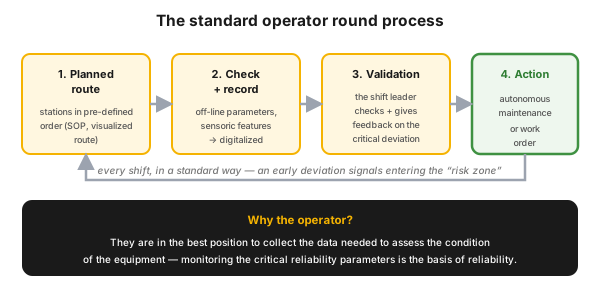 Figure 1 — the process of the round: planned route → check and record → validation → action, repeated every shift.
Who is this for?
Section titled “Who is this for?”This article is for those who work with field checks and with managing equipment condition: operator · shift leader · plant manager · maintenance technician · process engineer · asset team · reliability engineer · operations manager.
Learning objectives
Section titled “Learning objectives”After reading this article you will be able to:
- explain what distinguishes the standard operator round from a general field walk;
- list what the operator checks and records at a station (off-line parameter, sensoric feature, safety point);
- walk through how the shift leader validates the findings, and what action they turn into;
- interpret the process KPIs of the round (round completion, rounds checked, valid-finding ratio);
- recognize when the round is NOT the right tool, and what must complement it.
In brief
Section titled “In brief”- Planned route, in an SOP: the operator stops in a given order, at given stations; the route is visualized, the stops are described in writing as mandatory.
- Frequency: the round typically has to be performed twice per shift, one at the beginning of the shift, the other before its end.
- What it checks: pre-defined off-line parameters (manually measured), sensoric features (noise, vibration, smell, heat), and safety/environmental points.
- Observation only: the round is dedicated exclusively to data collection; every other physical task comes after the round, if it is not urgent or dangerous.
- Record → digitalize: the data is entered into the computer, so that it becomes statistically usable and retrievable.
- Validation + feedback: the shift leader checks the data, classifies the findings into 7 categories, discusses the critical deviation and gives feedback.
- Action: a valid finding turns into autonomous maintenance, a work order, a technology intervention or an HSE/near-miss notification.
- “Risk zone”: the round signals the equipment before it enters the risk zone; this is the basis of preventing failure.
- Mobile device: field recording and feedback are fast with an explosion-proof (ATEX) smartphone or tablet.
What is the standard operator round?
Section titled “What is the standard operator round?”The standard operator round is a field check round set out and codified in an SOP, as opposed to a general, unwritten walk. The difference lies precisely in the standardization: the asset team (operations, maintenance, technology) selects the critical equipment, defines the parameters to be checked together with their limits (min–normal–max), and arranges the stations into a logical route, visualized on a plot plan. The SOP describes who, when, where, what and how performs on the round, and it includes a visual illustration of the route.
The purpose of the round is to signal early the process safety and reliability threats by monitoring the process, the equipment and the environment in a structured way, so the asset team can intervene proactively. Importantly, the round is meant exclusively for observation and for collecting field data: the operator performs every other physical task (if it is not urgent, dangerous or immediate) after finishing the round, so that the observation does not suffer.
Why it matters
Section titled “Why it matters”The regular check of the condition of the equipment and of the field parameters warns operators and engineers when the equipment enters the “risk zone”, that is, when something goes far enough out of the limits that it may cause trouble or failure, and endanger safety and reliability.
The risk of incidents is reduced, because the quality of the logs is enhanced by information coming directly from the source. The operator records the field off-line data in digitalized form for future utilization (statistics, analyses). The round provides a method for identifying and tracking operational deficiencies: it increases safety, reliability and productivity, reduces human error, and saves time by providing consistency. Finally, it strengthens ownership, because the operator feels responsible for their equipment.
What the round contains
Section titled “What the round contains”The standard of the round is a pre-planned template (defined by the daily asset team / plant staff and described in the SOP) that the operator has to follow:
- the operator stops at every pre-defined station, in pre-defined order;
- at the given station they check pre-defined parameters (off-line measured parameters, sensoric features and other issues related to safety and environment), and record them;
- the collected field parameters and observations have to be recorded into the computer, so that the off-line data is digitalized for future use;
- the collected data is validated by the shift leader;
- the shift leader discusses the unusual findings (critical parameters out of limits), and gives feedback to the operator;
- if necessary, an action is taken (autonomous maintenance or work order).
The timing and frequency of the round is part of the standard as well: it typically has to be performed twice per shift, the first round at the beginning of the shift, the second before its end. If needed, an ad-hoc point can also be added to the round (for example a small leak to be kept under observation, or a heating compressor), which the configurator of the round inserts quickly, so that the freshly discovered issue gets more frequent attention.
The operators are in the best position to collect the data needed to assess the condition of the equipment; monitoring the critical equipment and capturing the appropriate data is the foundation of reliability management. Logbook entry formats can be templated to capture recurring events; the goal is risk management, the identification of potential failures, and getting maintenance and the process engineer to consistently monitor the “Critical Reliability Parameters” and take action. All of this is complemented by statistics from the collected data.
What does a real round look like?
Section titled “What does a real round look like?”A typical operator round in a hydrogen unit shows the structure well: around ten stations to be walked in order, each with a visualization of the route, an equipment photo and a parameter table. Typical items checked at a station: bearing temperature (even by touch), vibration and noise, lube oil level and pressure, suction and discharge pressure, vessel level and pressure, freedom from water/gas, the flame pattern of a furnace and the condition of its refractory, and at the battery limit the pressures of the feeds (gas, water, air, steam, N₂). The essence is the structure itself: the operator checks the parameters pre-defined there at a station, then records them — not the concrete numerical values.
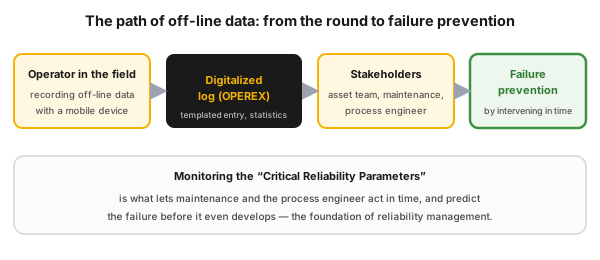 Figure 2 — the path of the field off-line data through the digitalized log to the stakeholders and to failure prevention.
How does the shift leader classify the findings?
Section titled “How does the shift leader classify the findings?”Not every detected deviation leads to the same place: when validating, the shift leader classifies the findings into seven categories, in two groups. The not valid finding is closed (no action needed), while the valid finding goes onto a concrete branch, in a maintenance or a non-maintenance direction. This ensures that every meaningful signal reaches the right process, while the noise does not load the system.
| Group | # | Category | Symptom / example | Action |
|---|---|---|---|---|
| Not valid | 1 | Rejected | a finding without sense, or a mistaken one | closed, no action |
| Not valid | 2 | Already recorded | the previous shift has already notified it, it needs no further observation (small leak of air, water or low-pressure steam) | closed, no action |
| Valid | 3 | Need observation | already recorded, but needs further observation (leakage of dangerous material) | continuous observation |
| Valid | 4 | HSE / PSM / near-miss | safety-related, non-maintenance finding | safety (near-miss) notification |
| Valid | 5 | Technology | local adjustment by the operator (flow, temperature, flapper), non-maintenance | technology intervention |
| Valid | 6 | Autonomous maintenance (AM) | the shift personnel can fix it | AM outside the round |
| Valid | 7 | Work order | a more serious failure the shift cannot solve | work order (E2E) process |
How can it be introduced?
Section titled “How can it be introduced?”The introduction is not an IT project but an organizational change: the tool on its own guarantees neither the proper use nor the business result; success depends on the processes, on involving the end users, and on the culture. It is therefore worth laying the frame in order:
- The round is defined by the daily asset team / plant management, and described by the SOP.
- The SOP contains the visualization of the route and the written description of the mandatory stops, where the operator must check the pre-defined off-line parameters and sensoric features.
- The shift leader takes care that the operator starts on time and follows the SOP.
- IT tools have to support recording the field data into the computer and the further flow of data to the stakeholders (asset team, maintenance, process engineer) for a quick overview and for predicting the failure. For field recording and feedback, a mobile device (smartphone, tablet) is the fastest solution.
Key success factors (which can also be linked to the success factors of the production system):
- strong management commitment;
- a nominated local coordinator accepted by the organization;
- a cross-functional deployment team (operations, maintenance, technology, IT);
- involving the end users already in the preparation of the SOPs;
- a test and pilot phase before the full roll-out;
- targeted training (using the tool and configuring the round);
- regular performance feedback to the operators and the shift leaders.
Process-industry and safety context
Section titled “Process-industry and safety context”The round is the shared, everyday practice of process safety and reliability. Human-detectable signs — an unusual noise, a vibration, the smell of a leak, a hot bearing — often signal trouble earlier than the instrument does; this is why the sensoric check matters. The round is the off-line counterpart of the IOW / operating window card: a parameter approaching its limit is the “risk zone”, and early detection gives time to intervene before the process has to fall back on the protection layers. In winter the round is extended with freeze-protection tasks; and the anomaly uncovered often becomes autonomous maintenance. From the reliability viewpoint, the round is the entry point to the predictive approach: regularly collected field data becomes a trend, and the trend becomes a prediction.
In an explosive atmosphere the field mobile device is of explosion-proof (ATEX Zone 1) design, with a mandatory yearly ATEX revision; without it, it cannot be taken into the zone. The recording works even without network coverage: the device collects and stores in offline mode too, then uploads the data in a batch on returning to the control room. This way the field data is never lost, and the process safety documentation stays continuous.
Measurement / audit
Section titled “Measurement / audit”The round is itself a measuring instrument, but its quality must be measured as well: did it start on time, did it cover every station, was the data digitalized, and did the validation and the feedback happen. A simple, named process-KPI frame can be used to measure the round process (all of them can be expressed in absolute numbers or in percentages, and broken down by person, shift or asset team):
| KPI | What it measures | Formula |
|---|---|---|
| Rounds started | whether the scheduled round started on time | rounds started / scheduled rounds |
| Rounds completed | whether the round was carried through | rounds completed / scheduled rounds |
| Rounds checked | whether the shift leader checked the round | rounds checked / rounds completed |
| Findings with feedback | whether the finding received feedback | findings with feedback / all findings |
| Valid-finding ratio | how much meaningful signal there is against the noise | valid findings / all findings |
| Theoretical valid findings | comparison independent of the number of rounds | 100 × valid findings / rounds completed |
At the introduction it is not only the findings that matter, but the strict adherence to the process steps and to the success factors; this is what these KPIs measure, and their target values are worth tightening year by year. The digitalized data gives statistics and a trend — this is what distinguishes it from a round “scribbled on paper”. The bar: the round data should be retrievable, and should lead to action, not merely be recorded.
Common mistakes
Section titled “Common mistakes”- “Tick-box” round — the operator records but does not look; the data is untrue, and leads nowhere.
- Paper, not digitalized — no statistics, no trend, no prediction.
- Without validation and feedback — the critical deviation does not reach the shift leader or the engineer.
- No action — the detected anomaly does not become AM or a work order.
- Instrument readings only, without sensoric signals — the early, human detection (noise, vibration, smell) is lost.
- Non-standard route/order — stations are missed, the data is not comparable.
- Other tasks during the round — if the operator fixes things along the way, the quality of the observation deteriorates; the round is for data collection only.
When NOT to use it? (the limits of the method)
Section titled “When NOT to use it? (the limits of the method)”The standard operator round is a strong tool for the regular observation of field condition, but it is not the right answer to every problem. Knowing the limits is just as important as the method itself:
| Situation | Why the round is not the primary answer | The right answer |
|---|---|---|
| The parameter is measured online, on the DCS, and wired to an alarm | the manual round is slower and rarer than continuous instrument measurement | leave it to the transmitter/DCS; the round is for the off-line, non-instrumented points |
| The root cause is a deep technology or reliability fault | observation signals the symptom but does not fix the root cause | root-cause work (5 whys), RCA, reliability engineering |
| A certified safety function is needed (protection layer) | the human round is not a certified, audited barrier | SIL/LOPA, a protection layer per IEC 61511 |
| There is no management commitment, only a “tick-box” campaign | without KPIs and feedback the round dies out | first management commitment and cadence, then the round |
Rule of thumb: the round is the strongest, cheap tool of field, off-line detection. For an instrumentable measurement, root-cause work or a certified protection function it does not replace the proper tool, but complements it.
How does this show up in digital practice?
Section titled “How does this show up in digital practice?”The principle of the round does not stop at the paper sheet and the pencil: the same logic is realized in software, in any mobile field-recording solution. Instead of the handwritten note and the paper log, here a mobile template, an e-log, a historian trend and an automatic alert make the condition and the deviation visible — the mechanism differs, the principle is the same.
| Round principle | Digital implementation | What it delivers |
|---|---|---|
| Pre-defined station and parameter | mobile template with mandatory fields | identical, consistent data in every shift |
| Recording in the field | mobile e-log with offline collection and batch upload | no data lost even without network coverage |
| Trend and statistics | historian / data-analytics connection (trends) | the trend of the parameter becomes a prediction |
| Signalling the deviation | automatic alert to the shift leader / expert | the critical finding does not go unnoticed |
| Validation and feedback | e-log approval, reporting | the fate of the finding is traceable |
Connection to OPEREX (shift log)
Section titled “Connection to OPEREX (shift log)”The standard operator round is one of the most direct application areas of the OPEREX shift log, since it demands exactly the same: digitalized, templated, mobile recording. In OPEREX the field off-line parameters and observations are recorded as templated entries; the shift leader validates and gives feedback; the stakeholders (asset team, maintenance, process engineer) immediately see the critical reliability parameters; and the action assigned to the uncovered anomaly (AM or work order) is traceable. This way the field data becomes digitalized, statistically usable and retrievable, and the failure can be predicted before it even develops; with a mobile device both the recording and the feedback are fast. The data of the round is at the same time one of the main contents of the shift handover: the outgoing shift hands over what it saw in the field.
Take it home (keys)
Section titled “Take it home (keys)”- The round is not a walk but a standard: designated stations, pre-defined parameters, a written SOP, a visualized route.
- Twice per shift: the timing of the round is part of the standard too (at the beginning of the shift and before its end).
- The round only observes: every other physical task comes after the round, so that the quality of the data collection is preserved.
- Digitalize, or there is no trend: on paper there is no statistics and no prediction; the mobile e-log gives the trend.
- A finding has a fate: the shift leader classifies into 7 categories, and the valid finding becomes an action (AM, work order, technology or HSE branch).
- Measure the process, not only the finding: round completion, rounds checked and the valid-finding ratio are what keep the system alive.
Self-test
Section titled “Self-test”- What is the difference between a general field walk and the standard operator round, and why does it matter that the round is meant exclusively for observation?
- An operator finds a heating bearing that the shift personnel can fix. Which of the seven categories does it go into, and what is the next step? And if the failure is too serious for the shift?
- Why is it not enough to measure the number of findings, and what do the “valid-finding ratio” and the “theoretical valid findings” (per 100 completed rounds) tell you?
Terminology (HU / EN)
Section titled “Terminology (HU / EN)”| Hungarian | English (canonical) | Note |
|---|---|---|
| operátori körjárat | operator round | the field check |
| off-line paraméter | off-line parameter | manually measured, not DCS |
| szenzorikus jellemző | sensoric feature | noise, vibration, smell, heat |
| kritikus megbízhatósági paraméter | critical reliability parameter | the monitored key data |
| kockázati zóna | risk zone | approaching the limit |
| validálás | validation | the shift leader’s check |
| találat | finding | the operator’s recorded observation |
What is the standard operator round?
A pre-planned check route set out in an SOP, on which the operator checks and records the off-line parameters and sensoric features of the equipment in a defined order, at defined stations, in order to signal entry into the “risk zone” in time. It typically has to be performed twice per shift.
What does the operator check at a station?
Pre-defined off-line (manually measured) parameters — e.g. bearing temperature, lube oil level and pressure, suction/discharge pressure, vessel level — as well as sensoric features (unusual noise, vibration, smell, heat) and safety/environmental points, and then records them.
Why does the data of the round have to be digitalized?
Because digitalized data can be used for statistics, trended and retrieved, so that maintenance and the process engineer, monitoring the critical reliability parameters, can intervene in time and predict the failure before it even develops; data recorded on paper is unsuitable for this.
What happens if the round finds a deviation?
The shift leader validates the data and classifies the finding into one of seven categories (rejected, already recorded, need observation, HSE/near-miss, technology, autonomous maintenance, work order). A valid finding turns into a concrete action; the round is worth something only if a deviation leads to action.
Related concepts
Section titled “Related concepts”production reliability program · shift handover · autonomous maintenance · IOW / operating window card · winterizing · housekeeping · special operating instructions · oee
Next step
Section titled “Next step”If you have understood this, from here it is worth going on — in this order:
- shift handover — how the outgoing shift passes on what was seen on the round, so that the field signal is not lost at the changeover.
- autonomous maintenance — what becomes of a smaller fault uncovered on the round, if the operator fixes it themselves.
- IOW / operating window card — the online, instrumented counterpart of limit monitoring, which complements the off-line detection of the round.
References / further reading
Section titled “References / further reading”- API RP 754: Process Safety Performance Indicators for the Refining and Petrochemical Industries. American Petroleum Institute — the measurement frame of early process safety signals (near-miss, LOPC), to which the findings of the round fit.
- CCPS (Center for Chemical Process Safety): Guidelines for Risk Based Process Safety. Wiley, 2007 — “conduct of operations” and field observation as a process safety pillar.
- John Moubray: Reliability-Centered Maintenance (RCM II). Industrial Press, 1997 — the theoretical basis of the early signs of equipment condition and of observation-based maintenance.