The PDCA cycle (Plan-Do-Check-Act) — the engine of continuous improvement
≈ 19 min read · 3,709 words
You are late for work in the morning, so the next day you set the alarm earlier, in the evening you check whether you got in on time, and you keep tuning the routine until it is just right. You do this every morning, you just don’t call it that: this is PDCA. You set a goal, try out a plan, look at the actual result, and adjust based on what you learned. Lean raises this everyday loop into a deliberate method for improvement at work. Let’s look at what it is, why it works, and how to introduce it.
PDCA is the four-step, repeating cycle of continuous improvement: we plan, try out on a small scale, verify with fact data, then standardize. The four steps are Plan, Do, Check and Act; the circle restarts at the end of every turn from a higher level. Its essence is to treat improvement as an experiment: we try out the change as a verifiable hypothesis, and the decision is made by fact data, not by impression. It is also known as the Deming cycle or the Shewhart cycle; the A3 report is practically the one-page rendering of PDCA thinking.
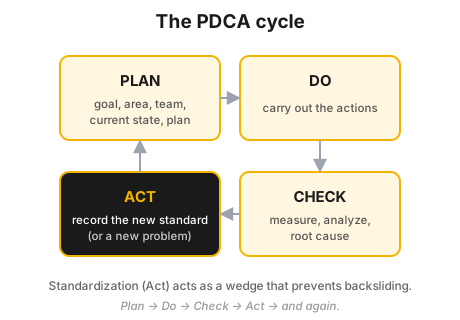 Figure 1 — the four phases of PDCA as a closed loop; at the end of each turn, standardization (Act) or a new cycle.
Who is this for?
Section titled “Who is this for?”This article is for those who actually improve processes or solve problems in practice: operator · shift and plant manager · process engineer · process technologist · quality engineer · maintenance technician · Lean/CI specialist · project manager · HSE.
Learning objectives
Section titled “Learning objectives”After reading this article you will be able to:
- state the four steps of PDCA, and justify why Check is the most frequently skipped, yet key, step;
- distinguish the everyday PDCA from the workplace one (what turns it into an explicit, layered structure);
- work through the layered frame: PHASE / ELEMENTS / CONTRIBUTORS / GATEWAYS, and say what the role of the gateway is;
- understand why PDCA, the A3 and DMAIC share the same backbone;
- recognize when PDCA is not the right tool.
The essence (TL;DR)
Section titled “The essence (TL;DR)”- Four repeating steps: Plan → Do → Check → Act, then restart.
- Experimental logic: improvement is hypothesis-testing, not brainstorming. Check is the key.
- We measure against the goal, not the impression: the result is always compared to the planned goal and to the starting point.
- Iterative: every completed turn is the starting point of a higher standard, kaizen is never “done.”
- Layered structure: every phase has a PHASE / ELEMENTS / CONTRIBUTORS / GATEWAYS layer; between phases we cross gateways (e.g. “Agree the PLAN”).
- Shared backbone: both the A3 and DMAIC build on PDCA.
Why does it matter? (the stakes)
Section titled “Why does it matter? (the stakes)”Without PDCA, improvement becomes blindly repeated action: we introduce a change and never measure back whether it actually helped. The stake is not one botched project, but the failure to learn and the slip-back that piles up with every unclosed turn.
If Check is skipped, we judge the result by feel, not by fact data. If Act is skipped, the proven solution is not built into a standard, so a few months later the old state returns, and we solve the same problem again. This is how an organization slides into firefighting: forever scrambling at the next fire, instead of learning fully from the existing one and closing it out.
What is the PDCA cycle, and how does it work?
Section titled “What is the PDCA cycle, and how does it work?”PDCA is a closed loop: you plan a change (Plan), try it out on a small scale (Do), measure the result against the goal with fact data (Check), then standardize or correct (Act), and the circle restarts. The four steps in detail:
- Plan — understand the customer need, the problem and the current state; set a measurable goal; formulate a verifiable hypothesis for the solution (against the root cause, see 5-Why).
- Do — introduce the change on a small scale, under controlled conditions, and collect data.
- Check — compare the actual result with the planned goal and the starting point: did the hypothesis work, what did you learn? This is the most frequently skipped step, yet this is what delivers the learning.
- Act — if it worked, standardize and roll it out (a new standard); if not, correct and start a new cycle.
After this the circle restarts from the new, higher level, so the organization improves step by step, on a learning basis. The driving force is a triple idea: hypothesis → experiment → evaluation (P – D – C). We test the assumption (the countermeasure) under real conditions, and the decision is brought by fact data, not by opinion.
Where does PDCA come from?
Section titled “Where does PDCA come from?”PDCA started from Walter Shewhart’s statistical quality control, and was popularized by W. Edwards Deming; hence the name “Deming cycle” (also called the PDCA wheel or PDSA). Deming himself tied the cycle to learning, which is why he often used the word Study instead of Check. Lean, through the Toyota Production System, made it the basic operation of daily problem-solving and kaizen.
Continuous improvement is a key element of corporate culture, but enthusiasm alone is not enough: it must be reinforced with a system (the structure of PDCA), otherwise the momentum dissipates. This is exactly what the cycle provides: a frame in which good intentions turn into repeatable, measurable improvement.
The difference between everyday and workplace PDCA
Section titled “The difference between everyday and workplace PDCA”At home you circle the loop freely: you tune the morning routine until it is good, and you don’t have to account to anyone. The workplace PDCA has more constraints, because others are affected too. Here you must:
- show benefits before doing anything;
- control the activity as it happens;
- communicate to all concerned what is being done and why.
That is why workplace PDCA gets an explicit, layered structure, which the next section develops.
What is the layered structure of PDCA?
Section titled “What is the layered structure of PDCA?”Workplace PDCA is a layered meta-frame: every phase has the same four layers. PHASE → ELEMENTS → CONTRIBUTORS grows ever more detailed (we zoom in on the phase), and GATEWAYS is the condition for crossing between phases.
| Layer | What it means |
|---|---|
| PHASE | the phase itself (Plan / Do / Check / Act) |
| ELEMENTS | the main building blocks of the phase (what must be achieved in the phase) |
| CONTRIBUTORS | the details that bring success, “inside” every element |
| GATEWAYS | the gate you have to pass through before moving on to the next phase |
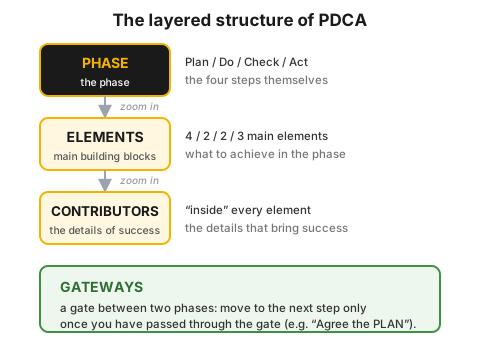 Figure 2 — the four layers of PDCA: we zoom ever deeper from the phase to the details, and the gateways let you move on between two phases.
The four phases work with 4 / 2 / 2 / 3 main elements respectively. The following sections break this out phase by phase.
PLAN — 4 questions (element)
Section titled “PLAN — 4 questions (element)”Successful planning requires answering four questions:
- Set the Goal — what do you want to achieve?
- Grasp the actual situation — where do you stand now, based on facts?
- State Activities — what do you need to do to reach the goal?
- Resources — what is needed to complete the action plan?
The four elements “inside” (contributors):
| Element | Contributors (the details of success) |
|---|---|
| Set the Goal | SMART (Specific, Measurable, Achievable, Realistic, Timebound); distinguishing the MUST from the WISH, where the MUST is the minimum Customer Requirement |
| Grasp the actual situation | clarify the problem; formulating the “would-be” ideas (what could be done); agreement on what will be done (agree what will be done) |
| State Activities | work completion: SMART, logical tasks, Responsibility, schedule and visual display; monitoring: actual vs. target (show versus target), highlighting problems, keeping up the pressure of checking for progress (apply pressure of checking) |
| Resources | 6 resource types: Money, Skilled people, Time, Expertise, Material/Equipment, Support |
GATEWAY (PLAN → DO): “Agree the PLAN” — the exhaustive plan must be approved before we start execution.
DO — 2 blocks (element)
Section titled “DO — 2 blocks (element)”Execution runs in two blocks:
| Element | Contributors |
|---|---|
| Do the activities | carrying out the tasks following your schedule (carry out the tasks, following your schedule); monitoring progress (monitor progress) |
| Adjust as needed | retargeting resources (retarget resources); changing the order of activities (change order of activities); allocating new resources (allocate new resources) |
GATEWAY (DO → CHECK): “Share big adjustments with customers” — the bigger in-flight adjustments (side effects) must be shared with the customers before we move on.
CHECK — 2 elements
Section titled “CHECK — 2 elements”The check evaluates two things: the result and the process.
| Element | Contributors |
|---|---|
| Evaluate the results | achievement of the SMART goal (SMART goal achievement); effect = no collateral damage |
| Evaluate the process (ARM) | Measure — what has happened; Record — write it down; Analyse — what does the information tell you |
The process is evaluated correctly with the help of ARM (Measure–Record–Analyse); this answers the question, “would you do it the same way again?”
ACTION — 3 elements
Section titled “ACTION — 3 elements”The intervention chooses from three elements depending on the outcome of the Check:
| Element | When | Contributors |
|---|---|---|
| Countermeasure | if you did not reach the goal | understand why it failed: the goal changed; the plan was not followed (plan not followed); wrong plan (the plan did not cover everything) |
| Standardise | if you reached the goal and the process is good | ensuring repeatability and sustainability: document what and how you did; set up visual control; scheduled evaluation / audit |
| Kaizen | always | never stand still: if the goal is reached and the process is standardized, improve either the standard or the process |
Put together, the three elements are the continuous engine of kaizen: we close a successful turn into a standard, correct a failure with a countermeasure, and keep perfecting even the best state.
PDCA as the backbone of A3 and DMAIC
Section titled “PDCA as the backbone of A3 and DMAIC”The A3 report is the one-page visual documentation of PDCA: the left side is the Plan (background, current state, analysis, goal), the right side is Do–Check–Act (countermeasure, implementation plan, result, follow-up). DMAIC (Define–Measure–Analyze–Improve–Control) is the data-driven, Six Sigma variant of the same experimental logic. Whoever understands PDCA understands both.
Process-industry context
Section titled “Process-industry context”In process industries PDCA is the engine of standardized improvement, problem-solving and corrective actions, and at the same time the background logic of MOC (MOC). Every change (parameter optimization, modifying a maintenance routine, a correction after an incident or near-miss) must be planned, introduced in a controlled way, measured and evaluated before we standardize it. Check measures whether the intervention actually eliminated the risk or the loss. This fits the continual-improvement requirement of ISO 45001 and of process-safety management.
How do you introduce it in practice?
Section titled “How do you introduce it in practice?”PDCA is not a poster on the wall, but a loop run around a concrete problem. A suggested run for a first turn:
- Choose a painful, measurable problem, and set a SMART goal for it (Plan). Record the current state with fact data, not from memory.
- Formulate a verifiable hypothesis for the solution, and get the plan approved (the “Agree the PLAN” gateway).
- Introduce it on a small scale on one shift or one line (Do), and collect data as you go.
- Measure back against the goal (Check): was the SMART goal met, is there collateral damage, would you do it the same way again?
- Close the loop (Act): if it worked, write it into a standard and roll it out; if not, a countermeasure and a new cycle.
Worked example (source-faithful). The organizers of a professional conference collected feedback from the participants after the event: the projection was hard to read from the back, there was only paid parking nearby, the lunch venue proved cramped, the timekeeping was patchy, and the foreign guests too received a Hungarian-language conference bag. This is the Check on the earlier event. For the next year’s conference these became the Plan and Act items: a larger, more visible projection, solved parking, a roomier lunch venue, stricter moderation, bilingual materials. The loop ran through at the level of a whole event: they measured what went wrong, planned the improvement, introduced it, and in the next turn measured again.
Measurement / audit
Section titled “Measurement / audit”You can follow PDCA at work with a few simple metrics: how fast the loop spins, and whether it really closes out with learning. Three useful indicators:
- Number of closed PDCA turns and their cycle time (how fast the improvement loop spins).
- Check rate: what percentage of the introduced changes were actually measured back against the goal.
- Sustainment rate: what percentage of the solutions standardized in Act still hold the result after 3–6 months.
Common mistakes
Section titled “Common mistakes”The pitfalls of PDCA almost all stem from the same thing: we leave the loop half-done, and action remains in place of learning. In anti-pattern ↔ correction pairs:
- Skipping Check (“we introduced it, it must be fine”). Why it’s a problem: without learning the cycle becomes mere action, and you don’t know whether the change helped. Instead: measure the actual result back against the goal before moving on.
- Impression instead of fact data. Why it’s a problem: the result is measured against feeling, not the planned goal, so the decision is unfounded. Instead: ARM (Measure–Record–Analyse), and the SMART goal is the yardstick.
- Too big a first step. Why it’s a problem: if you roll it out full-scale at once, one wrong assumption hits hard. Instead: test on a small scale, under controlled conditions, then roll it out.
- No Act standardization. Why it’s a problem: the successful change is not built into a standard, so a few months later it slips back. Instead: document, set up visual control and a scheduled audit (standard work).
- PDCA as a one-off project. Why it’s a problem: if the circle does not restart, improvement stops at the latest standard. Instead: treat the closed turn as the starting point of the next one (kaizen).
When NOT to use it? (limits of the method)
Section titled “When NOT to use it? (limits of the method)”For most improvements PDCA is the right base frame, but it is not the strong answer to every situation. Knowing where it falls short is just as important as the method itself:
| Situation | Why (primarily) not PDCA | The right answer | ||
|---|---|---|---|---|
| Immediate, safety-critical hazard | there is no time to plan and test; the loop is slow | immediate intervention / emergency shutdown per the relevant standard ([[lopa-sil.en | SIL/LOPA]]), with PDCA only afterward, for the investigation | |
| Unknown root cause | Do tests a blind hypothesis, which burns time | first cause investigation ([[5-miert.en | 5-Why]], [[a3-riport.en | A3]]), then PDCA for the solution |
| A one-off, non-recurring deviation | there is nothing to standardize and loop durably | one-off correction, recording the lesson | ||
| A radical, entirely new solution is needed | step-by-step refinement will not lead to a breakthrough | disruptive redesign (process redesign, innovation), then PDCA for stabilization |
Rule of thumb: PDCA is strongest for recurring, measurable, incrementally improvable problems. For an immediate hazard and an unknown root cause it does not replace the appropriate tool, but complements it.
Take it home (keys)
Section titled “Take it home (keys)”- Improve as an experiment, not as an idea: assumption → small test → fact data → decision. This is the core of PDCA.
- Check is not optional: if you do not measure back against the goal, you don’t know whether you improved. The most frequently skipped, yet most important step.
- Close it out with Act: write the proven solution into a standard, otherwise it slips back.
- The circle restarts: every closed turn is the starting point of a higher level, kaizen is never “done.”
- One sheet is enough: the A3 captures workplace PDCA on a single sheet; there the left side is Plan, the right is Do–Check–Act.
Self-test
Section titled “Self-test”- Which of the four steps is the most frequently skipped, and what is the consequence if it is left out?
- What is the difference between the everyday (morning routine) and the workplace PDCA? Name the three extra constraints of the workplace PDCA.
- Check shows that you reached the goal, and the process was good too. Which Act element do you choose, and what is the next step after it?
How does it appear in digital practice?
Section titled “How does it appear in digital practice?”PDCA does not stop on paper or on the wall board: the same loop is realized in software too, in any well-designed improvement-tracking system. Instead of the hand-kept action plan, here structured fields, enforced closure and automatic measure-back carry the “plan → do → check → close” cycle; the mechanism differs, the principle is the same.
| PDCA element | Digital implementation | What it delivers |
|---|---|---|
| Plan | structured action record: goal, owner, deadline, baseline value | the plan is recorded and trackable, it does not get lost |
| Do | status tracking, logging the steps of execution | you can see where the introduction stands |
| Check | a result field required for closure: the achievement of the goal is demonstrated | the turn cannot be closed “without checking” |
| Act | updating the standard / work instruction, promoting the solution to a template | the proven change is built in, it does not slip back |
| Iteration | automatic surfacing of recurring problems | you can see where a new turn needs to be started |
Connection to OPEREX (shift diary)
Section titled “Connection to OPEREX (shift diary)”The OPEREX shift diary is a natural trace of the PDCA Do and Check phases: the deviations, actions and their closure logged there document that the planned improvement happened and was verified. This way the cycle is traceable, auditable, and the effectiveness of the corrective actions can be measured back, giving auditable evidence of the continuous-improvement loop (ISO 45001, chapter 10: Improvement).
Terminology (HU / EN)
Section titled “Terminology (HU / EN)”| Hungarian | English | Note |
|---|---|---|
| Tervezés | Plan | problem, goal, hypothesis |
| Végrehajtás | Do | small-scale, controlled test |
| Ellenőrzés | Check | result measured against the goal |
| Beavatkozás / szabványosítás | Act | standardize or correct |
| Deming-kör | Deming cycle | the other name of PDCA (PDCA wheel, PDSA) |
| Ellenintézkedés | Countermeasure | the plan against the root cause; an Act element if the goal was not met |
| Kötelező vs. kívánatos | MUST vs WISH | the MUST is the minimum Customer Requirement |
| Kapu | Gateway | the condition for the transition between phases (“Agree the PLAN”) |
| ARM (Mérés–Rögzítés–Elemzés) | ARM (Measure–Record–Analyse) | the tool for evaluating the process in Check |
| Szabványosítás | Standardise | an Act element if the goal was met and the process is good |
What do the letters of PDCA mean?
Plan, Do, Check, Act (intervention/standardization). This is the four-step, repeating cycle of continuous improvement.
Why is PDCA a cycle?
Because it is not a one-off project: at the end of every completed turn we either standardize based on the lesson, or start a new cycle, so the organization improves continuously, step by step.
What is the connection between PDCA and the A3 report?
The A3 is the one-page, visual documentation of PDCA: the left side is the Plan (background, current state, analysis, goal), the right side is Do–Check–Act (countermeasure, plan, result, follow-up).
Why is Check the most important step?
Because it measures with fact data whether the change actually reached the goal. Without Check there is no learning, and improvement becomes blindly repeated action. Check is also the weakest link: as goals grow, the priority shifts toward the next activities (Do) instead of learning, which is how a person slides into firefighting.
What are the four questions of PLAN?
(1) Set the Goal — what you want to achieve (SMART goal, MUST vs. WISH); (2) Grasp the actual situation — where you stand now, based on facts; (3) State Activities — what you need to do to reach the goal (tasks + monitoring); (4) Resources — what is needed to complete it (6 types: money, skilled people, time, expertise, material/equipment, support). From PLAN to DO we cross the “Agree the PLAN” gateway.
What does ARM mean in the Check phase?
ARM is the tool for evaluating the process: Measure (measure what has happened) – Record (write it down) – Analyse (what does the information tell you). This is how you determine whether you would do the work the same way again.
What do I do in the Act phase if I reached the goal, and what if I did not?
If you reached the goal and the process is good: Standardise (document, introduce visual control, schedule an audit), then Kaizen (keep improving the standard or the process). If you did not reach the goal: Countermeasure — understand why it failed (the goal changed, the plan was not followed, or the plan was wrong), and start a new cycle.
Related concepts
Section titled “Related concepts”A3 report · kaizen · dmaic · standard work · 5-Why · lean
Next step
Section titled “Next step”If you have understood this, from here it is worth going on — in this order:
- A3 report — the one-page form of PDCA: on this you practice getting the loop onto a single, surveyable sheet. Start with this.
- 5-Why — the root-cause analysis that underpins the Plan hypothesis: PDCA only hits home if it aims at the right cause.
- kaizen — the culture in which the PDCA circle spins continuously, and the closed turn is always the starting point of the next.
References / Further reading
Section titled “References / Further reading”- W. Edwards Deming: Out of the Crisis. MIT Press, 1986. — the canonical foundational work on the Shewhart cycle (PDSA) and fact-based, learning-centered improvement.
- Walter A. Shewhart: Statistical Method from the Viewpoint of Quality Control. Graduate School, U.S. Department of Agriculture, 1939. — the statistical root of the cycle (specification–production–inspection loop).
- Taiichi Ohno: Toyota Production System: Beyond Large-Scale Production. Productivity Press, 1988. — PDCA as the engine of daily kaizen and root-cause-based problem-solving.
- John Shook: Managing to Learn: Using the A3 Management Process. Lean Enterprise Institute, 2008. — the A3 as the one-page practice of PDCA thinking.