Training and competence
≈ 31 min read · 6,253 words
The skill matrix is a tasks × people table: it shows who does which task at what level, and where the training gap is.
Levels are conventionally marked on a five-degree moon scale: Zero, Quarter, Half, 3-quarter, Full. Competence is the Lean “flexible manpower” pillar: it is built by repeated, hands-on practice, kept fresh by job rotation, and can be practised risk-free on a simulator. In the process industry, training, the qualification exam and periodic re-qualification are a process safety requirement.
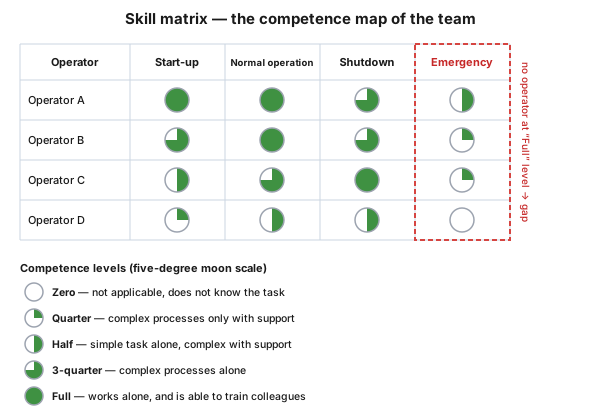
Figure 1 — the skill matrix. Team members in the rows, tasks in the columns, and in the cells the competence level as a quarter-circle symbol (Zero → Full). In the “Emergency” column there is not a single operator at “Full” level; this is an immediately visible training gap, and on a safety-critical task it is a serious risk.
Who is this for?
Section titled “Who is this for?”This article is for those responsible for training people, for the competence coverage of the shifts or for the quality of training, and whose daily decisions depend on who is allowed to do what on their own.
Plant manager / production manager · shift supervisor · control-room (panel) operator · field operator · process engineer · training lead and internal instructor · HSE · human-resources partner · OTS trainer.
Learning objectives
Section titled “Learning objectives”After reading this article you will be able to:
- build and read a skill matrix, and read a training gap out of its cells
- distinguish the two rating scales (the five-degree moon scale and the zero-to-four scale tied to the procedure), and decide which one you need
- design a training session so that the learner learns most from doing it with their own hands
- place simulator practice (OTS) and job rotation within the training system
- recognize the process safety training requirements: a qualification exam before independent work, refresher training, record keeping
- say when competence alone is NOT enough
Why it matters (the stakes)
Section titled “Why it matters (the stakes)”On a night shift a single question decides everything: is there someone in right now who can carry out this intervention independently and safely? If there is not, that is not an HR problem but an operational risk. Missing competence shows up first only as a slower reaction and more requests for help, then small deviations from normal go unnoticed, and finally, in a rare, critical situation (start-up, shutdown, emergency intervention) it turns out that nobody is at the right level. The stakes are therefore safety, availability and flexibility at the same time: can the shift cover holidays, sickness and the unexpected event.
In brief
Section titled “In brief”- Competence is a system pillar, not an HR matter. “Flexible manpower” is one of the supporting columns of the Lean operating system, and the precondition of a stable and safe plant.
- Skill matrix = making competence visible. A table, tasks × people, with the current level in the cells. It shows the strengths, the weaknesses and the training gaps.
- Five competence levels (quarter-circle or “moon scale”): Zero (not applicable) → Quarter (complex process only with support) → Half (simple task alone, complex with support) → 3-quarter (complex process alone) → Full (alone, and able to train colleagues).
- The matrix measures competence, not performance. This is the single most important misunderstanding-prevention statement: it is not an appraisal tool but a development tool.
- What sticks best is what the learner does themselves. From pure explanation only a fraction of the material remains after three months; from hands-on practice essentially all of it.
- Performance improves along a learning curve. Cycle time falls with repetition toward the lower limit set by the machine cycle time, which is why turnover, the length of the training and the quality of the training organization are decisive.
- Multi-skilling + rotation: operators know several areas, and rotation keeps the knowledge current, because what is not practised wears off.
- Simulator-based operator training (OTS): risk-free practice of critical start-up, shutdown and emergency situations, with energy awareness.
- Safety: a critical operation may only be carried out by a properly qualified operator at an independent level, and the skill matrix is what makes this auditable.
Competence as a Lean pillar
Section titled “Competence as a Lean pillar”One of the supporting columns of the Lean operating system’s house is flexible manpower: standard work and a well-maintained machine are worthless if there is nobody to operate them safely and to good quality. This pillar contains four things:
| Element of the pillar | What it means in the plant |
|---|---|
| Multi-functionality | the operator covers several areas and several tasks |
| Problem solving | they do not just operate but go down to the root cause (the 5 Whys, PDCA) |
| Understanding variability | they recognize what is normal fluctuation and what is a real deviation |
| Availability | there are enough people at the right level, when they are needed |
Capability building is therefore not a separate “training project” but a standalone element of the management infrastructure, alongside performance management, the organizational structure and the structure of continuous improvement. Its goal is twofold as well: maximize flexibility and reduce variability. The question is always the same: is there a person at the right level on every shift, for every critical task? That is what the skill matrix answers.
What is the skill matrix, and what are its competence levels?
Section titled “What is the skill matrix, and what are its competence levels?”The skill matrix is a simple visual tool: a table in which the columns are the tasks and skills, the rows are the members of the team, and the cells hold the current competence level of that person for that task. It is part of visual management, and can even be tracked as an indicator. Its purpose is to improve the team’s competence proactively: the gap should not become apparent only when there is already trouble.
The five competence levels (five-degree moon scale)
Section titled “The five competence levels (five-degree moon scale)”The most common plant notation is the five-degree moon scale, where the filled quarter-circle in the cell shows the level:
| Level | What it means |
|---|---|
| Zero (not applicable) | Does not know the task, does not perform it. |
| Quarter | Performs the complex process only with support. |
| Half | Performs the simple task alone, the complex one with support. |
| 3-quarter | Performs the complex process alone as well. |
| Full | Performs it alone, and is able to train colleagues. |
The proven criterion for gap analysis: people dedicated to the task should be at least at “3-quarter”, the substitutes at least at “half” (also written as “2-quarter”), and there should be at least one “Full” level person in every task category. The higher, independent level is the basis for authorizing safety-critical tasks: in a process plant a critical operation may only be carried out by a properly qualified operator.
The other scale: zero to four, tied to the procedure
Section titled “The other scale: zero to four, tied to the procedure”Where the work is governed by a written procedure (SOP, work instruction), the manager’s version often uses a five-step, zero-to-four numeric scale. This ties the level more precisely to the procedure and to improvement:
| Level | From the procedure (SOP) side | For a task without a procedure |
|---|---|---|
| 0 | does not know the procedure | has not started, has not acquired the technical skill |
| 1 | knows the procedure but needs the help of a more experienced colleague | can carry it out with support |
| 2 | applies it well, and recognizes deviations | performs it without support |
| 3 | is able to identify and solve the root cause of a deviation, and to update the procedure | is so much in command of the task that they solve problems and train the team |
| 4 | substantially improves the standards | substantially improves the methods |
What the skill matrix is good for
Section titled “What the skill matrix is good for”The functions of the matrix: mapping every skill required; visual information sharing; quick identification of the current and future skill demand; examining the strengths and weaknesses; planning the coverage of holidays and sickness; if done honestly, maintaining employee motivation; highlighting the training needs; monitoring training effectiveness; and increasing flexibility by having people acquire a broader set of skills.
The gap is worth designating on three grounds:
- the criticality level of the activity,
- the need for a substitute (backup),
- the standard learning curve of the task, that is, how long it takes to learn.
Figure 1 makes the lesson immediately visible: in the “Emergency” column there is no operator at “Full” level. This is exactly the kind of shortfall the matrix highlights, and this is what has to be closed with targeted training.
Building the matrix (steps)
Section titled “Building the matrix (steps)”- Map every task of the shift, the team or the area.
- Record the team members.
- Draw up a procedure (work instruction) for every task.
- Determine the skills required per task.
- Define the competence levels (Zero → Full or 0 → 4).
- Decide how you measure fulfilment.
- Assess the members against the procedures and the indicators.
- Display visually on the matrix the level of every person for every task.
The improvement loop driven by the matrix
Section titled “The improvement loop driven by the matrix”The matrix does not stop at revealing the gap: in a PDCA cycle it drives the improvement as well.
- Put a team on improving the procedure.
- Run a kaizen event on the procedure.
- Train the whole team on the new procedure.
- Check the effectiveness of the new “benchmark”.
- Improve the procedure further based on what was learned, and retrain the team.
- Review the procedure that nobody has improved for a long time.
Sustaining it includes the schedule of reassessment, reviewing the work instructions, the gap analysis against performance and the development plans, handling deviations, and updating the personal development plan (PDP).
How is effective training built?
Section titled “How is effective training built?”An adult learns effectively when the learning is experiential and connects back to their real job. This is not a matter of style: retention shows it in numbers.
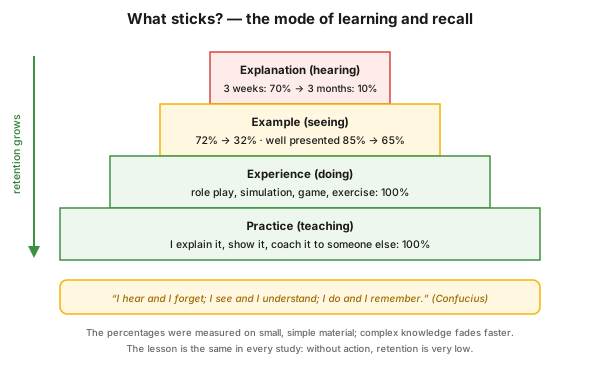
Figure 2 — the mode of learning and recall. From pure explanation 70% remains after three weeks and 10% after three months; a demonstrated example fades from 72% to 32%, and with good delivery from 85% to 65%; own experience (role play, simulation, game, exercise) and explaining, showing or coaching it to someone else give essentially full retention.
| Mode of learning | Recall after 3 weeks | Recall after 3 months | Typical format |
|---|---|---|---|
| Explanation (hearing) | 70% | 10% | lecture, notes, video, discussion |
| Example (seeing) | 72% | 32% | demonstration |
| Example (seeing), well delivered | 85% | 65% | presentation |
| Experience (doing) | 100% | 100% | role play, simulation, game, exercise, case study |
| Practice (teaching) | 100% | 100% | explaining, showing, coaching it to someone else |
A few practical consequences for designing training: a lecture should not be longer than 20 minutes; work with examples and analogies; show instead of reading out text; ask targeted questions and record the answers; and for the exercise give concrete, immediately applicable feedback.
The learning curve and deliberate practice
Section titled “The learning curve and deliberate practice”Competence cannot be “switched on” in a single training session, it is built by practice. The classic example is violinists: what distinguishes the professional from the amateur is the accumulated number of practice hours, and it is plainly visible. In production the pattern is the same: in one manufacturing example the operator’s cycle time falls with repetition along a learning curve, until it is pushed down to the machine’s cycle time.
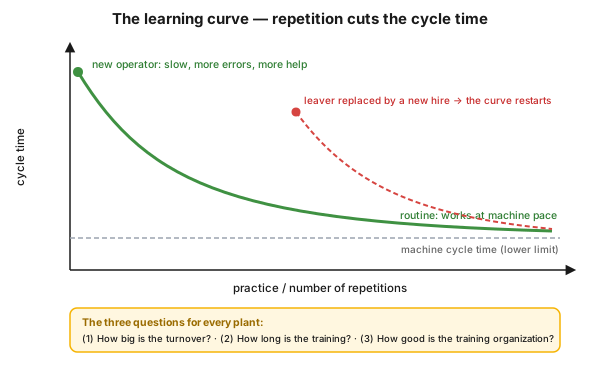
Figure 3 — the learning curve. The new operator’s cycle time falls with practice (repetition) toward the lower limit set by the machine cycle time. Every colleague who leaves restarts the curve with a new joiner.
Three key questions follow from this for every plant:
- How big is the turnover? Every leaver restarts the curve with a new, slow joiner.
- How long do we train the operators? Does the training reach the machine’s cycle time?
- How good is the training organization? The quality of the training sets the steepness of the curve.
The value of the experienced person (technician, plant manager) comes precisely from having acquired the details and subtleties over a long time. The same thing explains why an outside visitor spots at first glance the fault on the production line that the people working there no longer see: the brain gets used to a pattern. Spotting deviations also takes time, which is why a lot of time has to be spent on the gemba. Retaining experienced people is therefore not a “comfort” question but a performance and safety question.
The manager as teacher
Section titled “The manager as teacher”It is not only the operators who have to be trained: managers also have to be taught problem solving. If the leader is not a good teacher, the organization will not develop, because the chain of learning breaks at them. The basic tenet of the Toyota method says the same: continuously eliminating the roots of problems produces organization-level learning. And the place of practice is not the classroom: Lean management can be practised in the plant, on the gemba.
The ten commandments of learning and teaching
Section titled “The ten commandments of learning and teaching”Training is effective when we align it with how the brain works. Teaching principles built on brain research summarize in ten points what the instructor should do. This is the practical “user manual” of training:
| # | Commandment | Why |
|---|---|---|
| 1 | Overview before the details | the brain searches along existing “memory addresses” |
| 2 | A clear learning objective | those who understand the reasons learn more openly |
| 3 | Arouse interest | curiosity is the strongest motivation for taking in new information |
| 4 | Repeat | it is not the strength of the stimulus but the frequency of repeated occurrences that strengthens the connections |
| 5 | Address several senses | sight, hearing, touch, but the most important: the learner does it themselves |
| 6 | Watch the emotions | fear and stress inhibit, positive emotion supports memorizing and recall |
| 7 | Give feedback | feedback containing recognition, reinforcement and approval helps memorizing |
| 8 | Take breaks | the brain needs time and rest to process new knowledge |
| 9 | The right order (the red thread) | a well-built frame strengthens the link to already stored facts |
| 10 | Create connections | the brain is a system of connections and associations, learn across fields |
The quintessence: repetition and doing it yourself is what sticks, not the one-off, intensive demonstration, and the precondition for all of it is a stress-free, reinforcing environment.
The four steps of capability building
Section titled “The four steps of capability building”Training most often fails when the organization starts straight at the “course”. Competence is in fact built on four steps, and organizations typically attend only to the third.
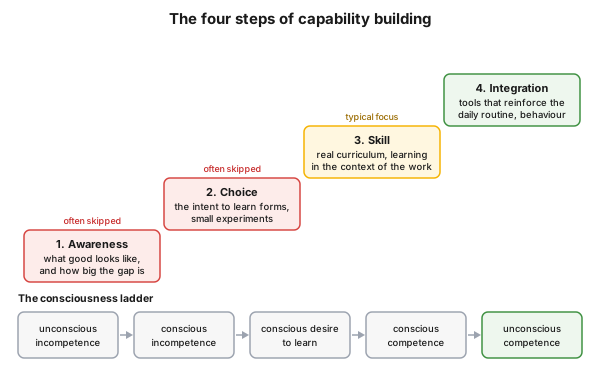
Figure 4 — the four steps of capability building and the consciousness ladder. The first two steps (awareness, choice) are often skipped, the typical organizational focus is the third (skill); without the others, however, the new knowledge does not become part of the daily routine.
| Step | What has to be achieved |
|---|---|
| 1. Awareness | the learner should understand what good is, and how big the gap is between the current and the ideal behaviour (often skipped) |
| 2. Choice | the intent to learn should form: successful small experiments should show that the effort is worth it (often skipped) |
| 3. Skill | a proper training curriculum, a broad toolkit, and learning in the context of performance (typical focus) |
| 4. Integration | every lever that drives behaviour change should work, and tools reinforcing the daily routine should sustain it |
The consciousness ladder belongs here: unconscious incompetence → conscious incompetence → a conscious desire to learn → conscious competence → unconscious competence. If the training skips the first two steps, the learner sits in the classroom but does not understand why they are there.
Multi-skilling and job rotation
Section titled “Multi-skilling and job rotation”Competence is built not only “in depth” (a professional level on one task) but also in breadth: the operator should know several technological areas. In one complex process-industry site the Lean diagnosis found that the operators’ real multi-functionality was missing, and because of this the organization was very inflexible. In another complex the same thing was visible in numbers: most control-room operators were examined on exactly two areas, and in only two combinations, so putting the shifts together moved on a permanent forced track.
The answer was three initiatives:
- A new training plan with on-the-field training, so that the operators’ area knowledge would be extended.
- A trainer–trainee system: the trainers are experienced operators who teach the colleagues with development potential; the selection is done by the shift supervisors.
- Institutionalized, standardized sectional job rotation, so that the acquired knowledge is also retained in practice.
The stated goals are equally clear: make better use of the operators’ potential, achieve better problem solving in an emergency, and grow “global” operators who see the whole complex. The measurable direction: extending operator area knowledge to about three areas, and introducing monthly or weekly job rotation, so the knowledge stays practical. In Lean terms multi-skilling means comprehensive, “2-quarter” (half) level knowledge, even across several organizational units: not everyone will be an expert in everything, but everyone should know more than a single section.
What is not practised wears off: rotation is therefore not an administrative burden but the sustaining half of training. The result is better-used expertise, less risk of dropout when one person is absent, and less coordination and shift handover loss.
OTS: simulator-based operator training
Section titled “OTS: simulator-based operator training”The OTS (Operator Training Simulator) is a simulation environment modelling the real process, in which operators can practise the plant’s start-up, shutdown, normal and emergency operations risk-free. Process safety regulation names it explicitly too: for automated processes the use of a simulator may be advantageous and appropriate in training.
OTS training:
- increases the operator’s process understanding and energy awareness: it shows how their own intervention and the parameters set influence the plant’s energy consumption (following the logic of the indicator hierarchy);
- lets the critical, rare situations (emergency shutdown, start-up) be practised without real risk, thereby building routine;
- is complemented by teaching the correct practice, for example the correct use of APC;
- needs management support to succeed, because without it the intensification of training is not sustainable.
The role of the OTS trainer
Section titled “The role of the OTS trainer”A simulator is worth something only if it has an owner. A dedicated OTS trainer designs the annual training syllabus, arranges the scheduling of the practice room, creates and stores in the system programmed emergency, start-up and shutdown situations (scenarios), plans the exercise, then evaluates and documents the interventions performed, and examines periodically. The target group is typically the shift supervisors and the control-room operators. The trainer also takes part in developing the system, and tracks how faithful the model is to the real plant.
The OTS is the “accelerator” of the learning curve: the repetitions made in the simulator push the cycle time down without the risk of the real plant, especially where real practice would be dangerous or rare.
Process-industry context and safety
Section titled “Process-industry context and safety”In the process industry training is not a matter of good intent but a standalone element of the process safety management (PSM) system (“Training and Performance”). The basic statement is hard: every other element can be in place, but without people who consistently follow the documented procedures, the chances of unsafe handling of hazardous materials are high.
Initial and refresher training. Every employee in a process safety critical position (directly operating the technology, or expected to intervene in an emergency) must be trained and qualified before starting work in a newly assigned process. In the same subjects refresher training and re-qualification are due, at intervals not exceeding three years.
The mandatory subject areas of the training procedure (six points):
- parameters for personnel performance and competency,
- qualification of instructors,
- basic skills,
- job tasks,
- refresher and supplemental training,
- record keeping.
The three basic elements of effective training:
| Element | What it gives |
|---|---|
| Classroom training | the “how and why”: why the procedures are written the way they are |
| Field training | the “how and where”: complementing the classroom material in reality |
| Skill demonstration | the learner performs the task in front of the instructor, thereby demonstrating their understanding |
The qualification exam is the precondition of independent work. Training must include qualification testing: a written test, skill demonstration where appropriate, and an assessment by the line organization that the person is able to complete the given task independently and safely. This is the regulatory anchor of what the skill matrix shows visually: independent work requires “3-quarter” level or higher.
The five mandatory data of the training record: the identity of the employee; the date of the training; the material covered; the qualification tests and their records; and the identity of the person conducting the training and the qualification. This is the audit trail that a regulatory or internal inspection asks for.
Competence alone is not enough. The regulation states separately: besides the knowledge, the employee must be physically able, mentally alert and capable of using good judgment. Among the factors that compromise fitness for duty, alcohol and substance abuse, lack of sleep, personal or family illness, death in the family, divorce, harassment and fatigue are named explicitly. This is why supervisors and shift supervisors have to be taught to recognize the symptoms and to handle them.
Putting it into practice (roadmap)
Section titled “Putting it into practice (roadmap)”You do not need a big programme for it: the steps below can be carried through even on a single plant section, and together they give the full arc of training, from the new joiner to the qualified, independent operator.
- Map the tasks and the levels for a single shift: prepare the first version of the skill matrix (it is best if the shift supervisor draws it, then shares it transparently with the team).
- Designate the gaps on the basis of criticality, the need for a substitute and the learning curve: “3-quarter” for the dedicated people, “half” for the substitutes, at least one “Full” per category.
- Assign an instructor to every new joiner from the shift, and make training a recognized task (good practice is that the designated instructor gets a separate allowance for it).
- Plan a supervised learning period of 3–4 months, during which the new joiner acquires the basics needed for their daily work.
- Close the stage with an exam: a written and oral theoretical test, and a practical (field) exam; the examiner is a representative of line management, typically the deputy plant manager.
- Appoint them to the position after the successful exam, and record as an expectation that filling a higher position requires full area and plant knowledge.
- Introduce regular rotation (on a monthly or weekly cycle), so that the knowledge covering several areas stays practical.
- Plan ahead for retirements: for the handover of knowledge it is worth hiring the successor as much as 12 months before the colleague leaves, so that the plant’s competence level does not fall back.
- Update the matrix and the development plans after every structured observation, exam and procedure change.
Exercise: 30 minutes, can be done right away
Section titled “Exercise: 30 minutes, can be done right away”Measurement / audit
Section titled “Measurement / audit”Training is a system when it is measurable. A few indicators worth tracking regularly:
| What to measure | How | A good sign |
|---|---|---|
| Competence coverage | the critical tasks of the matrix where there is no “Full” or “3-quarter” person | zero uncovered critical tasks |
| Substitutability | whether every dedicated person has at least a “half” level substitute | there is a substitute for every task |
| Re-qualification due dates | when the refresher training of the critical positions expires (max. 3 years) | no expired qualification |
| Completeness of the training record | whether the five mandatory data are there for every training | 100% |
| Training effectiveness | how long after the training it takes the operator to reach the target cycle time | shortening learning time |
| Fulfilment of the development plans | whether the sum of the personal development plans (PDP) covers the team’s skill target | the sum of the PDPs reaches the target |
| Actual delivery of rotation | whether the monthly/weekly rotation happened, documented | rotation as planned |
Common mistakes
Section titled “Common mistakes”The typical mistakes of training are not knowledge errors but system errors: nearly all of them come from treating training as an event rather than a process. In the pairs below, the right practice follows the mistake immediately.
- “Ticking off” a one-off training. Why it is a problem: competence is built by repetition, a demonstration is not training. Instead: plan along the four steps (awareness, choice, skill, integration), and give practice after the training as well.
- Ignoring turnover. Why it is a problem: every leaver restarts the learning curve. Instead: treat retention as a performance question, and plan the successor in time.
- A skill matrix without gap analysis. Why it is a problem: the matrix becomes decoration. Instead: close the gaps with targeted training, and tie them to the development plans.
- Using the matrix as performance appraisal. Why it is a problem: you lose the honest self-assessment, and the matrix gives a false picture. Instead: say it and stick to it, that the matrix measures competence, not performance.
- Only listening, no doing. Why it is a problem: from pure explanation only a fraction of the material remains after three months. Instead: every training block should end with hands-on practice or simulation.
- Stressful training. Why it is a problem: fear inhibits the brain processes. Instead: feedback containing recognition and reinforcement, with breaks.
- Breadth without rotation. Why it is a problem: multi-skilled knowledge wears off without practice. Instead: institutionalized, scheduled rotation.
- An ownerless simulator. Why it is a problem: without scenarios, evaluation and a maintained model the OTS does not train, and may even become outdated. Instead: a named OTS trainer, an annual syllabus, documented exercises, an MOC link.
- Underestimating the value of experienced people. Why it is a problem: knowledge of the subtleties is built slowly and is irreplaceable. Instead: a knowledge-transfer window before retirement, recognition of the instructor role.
When NOT to use it (the limits of the method)
Section titled “When NOT to use it (the limits of the method)”The skill matrix and the training system are a strong tool, but they do not solve everything. A few situations where something else is needed:
- When it is not the knowledge that is missing but the fitness. A well-trained employee on their own does not guarantee safe operation: fatigue, lack of sleep, illness, substance use or a serious event in private life lead to error just the same. This does not call for training but for managing fitness for duty and preparing leaders to recognize the symptoms.
- When there is a performance problem. The matrix measures competence. If somebody knows something but does not do it, that is a motivation, leadership or process question, and the terrain of the performance dialogue, not of training.
- When the process itself is bad. If the procedure is faulty or the equipment unfit, training only cements the bad practice. First standardize and improve, then teach.
- When a certified engineered protection is needed. A practised operator does not replace a certified safety function: human intervention is not a protection layer for a risk where an engineered interlock is required.
- When fast results are promised. Changing behaviour takes months and requires constant feedback. If a programme promises lasting change within a few weeks, the expectation is unrealistic.
Take it home (keys)
Section titled “Take it home (keys)”- Draw the matrix before you teach anything. The training plan follows from the gap, not the other way round.
- Look at two numbers first: how many critical tasks have no “Full” level person, and how many dedicated people have no substitute at least at “half” level.
- Design the training for doing. If at the end of the programme the participant has done nothing with their own hands, three months later hardly anything will remain.
- Say out loud that the matrix is not an appraisal. Without that you will not get honest self-assessment, and the matrix will lie.
- Close the training with an exam, and maintain the records. The precondition of independent work is qualification; in critical positions re-qualification is at most every three years.
- Rotation is part of training. What is not practised you lose, even if somebody once passed an exam on it.
Self-test
Section titled “Self-test”- On a shift, the “start-up” task has two people at “3-quarter” level and one at “half”, but none at “Full”. What does this say from the point of view of gap analysis, and what is your first step?
- After an eight-hour classroom training the group remembers almost nothing three months later. What is the most likely reason for this based on the retention data, and how would you have redesigned the day?
- An operator has passed every exam and has every required level, yet still makes a mistake on a night shift. Why is training not the answer, and what should be examined instead?
Answer key
- The level of the dedicated people may formally be in order (“3-quarter”), but at least one “Full” level person is missing from the category, so there is nobody to train others or to improve the procedure, and the substitute’s level does not reach “half” everywhere either. First step: designate who can be developed to “Full” level, and put it into their personal development plan, with practice and an instructor assignment.
- The day was without action: from pure explanation about 10% remains after three months. Redesign: blocks of at most 20 minutes, demonstration with examples, then hands-on exercise, simulation or role play, with targeted feedback; at the end the participant explains it to somebody else.
- Because it is not a knowledge problem. Fitness for duty has to be examined: fatigue, lack of sleep, illness, private-life burden, and the shift pattern and the workload. Leaders have to be prepared to recognize the symptoms.
How does this show up in digital practice?
Section titled “How does this show up in digital practice?”Training and the tracking of competence classically live on paper and on boards put up on the wall, but the same logic is realized in software too. The mechanism is different (time-stamped, searchable, alertable data), the principle is the same: it should be visible who may do what, and when their qualification expires.
| Concept (routine) | Digital implementation | Value |
|---|---|---|
| Skill matrix on the wall | digital competence matrix, with role and task levels | always current, filterable, projectable onto a shift |
| Training record | e-training log (employee, date, material, exam, instructor) | a ready audit trail, searchable evidence |
| Refresher training and re-qualification | expiry monitoring and automatic alerting | the three-year cycle does not slip out |
| Field practice | mobile, task-side checklist and recorded skill demonstration | the “doing” is documented too, not only attendance |
| Emergency routine | simulator exercise with logged scenarios and evaluation | measurable, repeatable preparedness |
| Personal development plan | digital development plan with actions tied to the gap | the plan and the gap move in one place |
Connection to OPEREX (shift log)
Section titled “Connection to OPEREX (shift log)”Competence is worth something when it is true broken down to the shift as well: who is rostered right now, and what are they trained for? The OPEREX shift log records who performed which task on which shift, and at what trained competence level, so the per-shift competence coverage and the training gaps can be tracked, compared with the skill matrix and audited. This is at once HSE evidence (a safety-critical task was performed only by a person at the right level, see the competence requirement of ISO 45001) and a trace of the fulfilment of the personal development plan. And documenting the training sessions, the repetitions and the feedback also makes the quality of the training measurable.
Terminology (HU / EN / JP)
Section titled “Terminology (HU / EN / JP)”| Hungarian | English (canonical) | 日本語 (rōmaji) |
|---|---|---|
| skill mátrix / kompetenciamátrix | skill matrix / competence matrix | — |
| rugalmas munkaerő | flexible manpower | — |
| multifunkcionális kezelő | multi-skilled operator | Tanōkō (多能工) |
| szándékos / tudatos gyakorlás | deliberate practice | — |
| betanulási görbe | learning curve | — |
| multifunkcionális betanítás | multi-skilling / cross-training | — |
| rotáció | job rotation | — |
| üzemi terep, ahol a munka történik | the real place | Gemba (現場) |
| operátor-tréning szimulátor | OTS — Operator Training Simulator | — |
| egyéni fejlesztési terv | Personal Development Plan (PDP) | — |
| kompetenciaépítés | capability building | — |
| kompetenciaszintek | Zero / Quarter / Half / 3-quarter / Full | — |
What competence levels are there in the skill matrix?
The most common is the five-degree moon scale: Zero (not applicable), Quarter (complex only with support), Half (simple alone, complex with support), 3-quarter (complex alone) and Full (alone, and able to train colleagues). For procedure-bound work a scale from 0 to 4 is also widespread, where level 3 already means root-cause analysis and training others, and level 4 the substantive improvement of the standard.
What is the skill matrix good for in shift management?
For assessing all the skills an area or team needs, for quickly identifying the current and future skill demand, for planning the coverage of holidays and sickness, for highlighting the training gaps and for increasing the team’s flexibility. At the same time it makes it auditable that a critical task was performed only by a person at the right level.
Is the skill matrix a performance appraisal?
No. The matrix measures professional competences, not performance. If it is used as a performance appraisal, employees start to defend themselves and the self-assessment becomes distorted; the matrix then gives a false sense of security.
What is deliberate practice?
Long, repetition-based, targeted practice that raises competence to a professional level: performance scales with the number of hours practised. In the brain it is not the strength of the stimulus but the frequency of repeated occurrences that strengthens the connections, and what sticks best is what the learner does themselves.
How often does training have to be repeated in process safety critical positions?
Refresher training and re-qualification have to take place at appropriate intervals, but at most every three years, and have to cover the process overview, the HSE risks and the emergency procedures. The frequency is determined by the management in charge, if legislation does not require anything stricter.
What is the OTS (Operator Training Simulator) for?
In a simulator modelling the real process, operators can practise the critical start-up, shutdown and emergency operations risk-free, improving safety and energy awareness without endangering the real plant. The exercises are worth storing as scenarios, then evaluating and documenting.
Related concepts
Section titled “Related concepts”standardized work · the House of Lean · performance management · performance board · pdca · kaizen · OPE and wrench time · operator and maintainer · shift handover · gemba walk · the indicator hierarchy · management of change · APC and soft sensors
Next step
Section titled “Next step”- Start with standardized work: a skill matrix can only be built meaningfully where the tasks have a written, maintained procedure.
- Then performance management and the performance board: this is where it turns out whether the training gap really constrains performance.
- Finally the shift handover and the gemba walk: the daily working of the trained knowledge, and the leadership presence that sustains the coaching.
References / further reading
Section titled “References / further reading”- ISO 45001 (occupational health and safety management system): competence, training and awareness requirements.
- John Whitmore: Coaching for Performance (2002), building on IBM and British Post Office research: the retention data of adult learning (hearing, seeing, doing, teaching).
- Jeffrey K. Liker: The Toyota Way: the leader as teacher, and the continuous elimination of root causes as organizational learning.
- Confucius, the classic saying on experiential learning: “I hear and I forget; I see and I understand; I do and I remember.”
- Schumacher, E. (2005), Schachl, H. (1996), Vester, F. (1997): the declared brain-research sources of the ten commandments of learning and teaching.