The trust model — the 4 elements and Covey's 13 behaviors
≈ 22 min read · 4,370 words
Think of the colleague you would blindly trust with a night shift, and the one you would not. The difference is almost never in expertise, but in something harder to grasp: you trust one and not the other. And if you were asked how you know whom you can count on, you would not point to their feelings but to what they do: they keep what they promise, they tell the truth, they do not spring bad news on you at the last minute. This is exactly what the trust model makes measurable: it breaks down into four observable elements and thirteen practicable behaviors what we would otherwise just call a “good gut feeling.”
The trust model breaks leadership trust down into four building blocks: reliability, acceptance, openness and congruence. Its core premise is that people trust you solely on the basis of your actions, not your intentions or feelings, because all they see is your behavior. Trust is therefore not an abstract feeling but is built from learnable, observable behaviors; to this Stephen M.R. Covey names 13 high-trust behaviors (talk straight, transparency, keeping commitments, listen first, and so on). High trust speeds up change and lowers its cost, while a lack of trust levies a “tax” on the organization, which is why trust is one of the decisive levers of a Lean transformation.
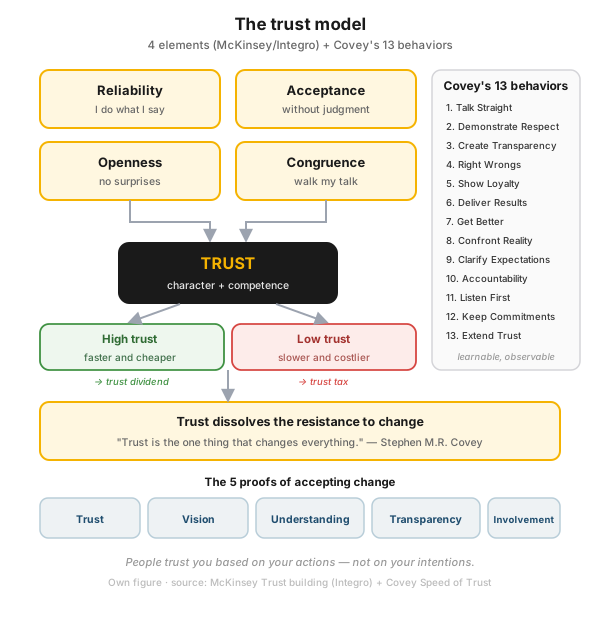 Figure 1 — the four elements of trust build the central trust (character and competence); high trust brings a “dividend” (faster, cheaper operation), a lack of trust brings a “tax.” Trust dissolves the resistance to change; Covey’s 13 behaviors and the 5 proofs of accepting change (trust, vision, understanding, transparency, involvement) turn this into practice. Own figure based on the McKinsey Trust building (Integro) material and Covey’s Speed of Trust.
Who is this for?
Section titled “Who is this for?”This article is for those whose daily work rests on people and cooperation: shift supervisor · plant manager · team leader · project manager · process engineer · HSE specialist · Lean/CI change leader · HR and organizational developer.
Learning objectives
Section titled “Learning objectives”After reading this article you will be able to:
- list the four elements of trust, and justify why all four are needed together;
- distinguish reliability from congruence (the two elements most easily conflated);
- name from Covey’s 13 behaviors at least the one most important for your own development, and use it as a checklist;
- explain why resistance to change is a symptom, not a cause, and what the 5 proofs are that dissolve it;
- draw the boundary: when trust-building is not the right answer (a certified safety function, a serious ethical breach).
The essence
Section titled “The essence”- Four elements build trust: reliability, acceptance, openness and congruence. None is enough on its own; together they add up to trust.
- Actions, not intentions: people trust you solely on the basis of your behavior. They do not see your feelings, your sincerity or your good intentions, only what you do.
- Trust = character and competence. Trust is not an abstract feeling but can be broken down into learnable, observable behaviors.
- Covey’s 13 behaviors are a concrete, practicable checklist for building trust (talk straight, transparency, keeping commitments, listen first, and so on).
- Trust dividend vs. trust tax: with high trust the work is faster and cheaper; with a lack of trust everything is slower and costlier.
- Trust dissolves resistance: according to Covey, “trust is the one thing that changes everything.” A leader must earn it before leading their people through a change.
- Trust is the core of the Mindset & Behaviours (M&B) element of the three lenses, the lever that moves the below-the-water layer of the iceberg.
Why does it matter? (the stakes)
Section titled “Why does it matter? (the stakes)”The stake of trust is that without it even a good vision, the right information and the most sincere involvement stay ineffective. If people do not trust you, they will read even your best plan as a rejection and your most open message as manipulation.
A lack of trust is not a “soft” loss but concrete slowdown and extra cost. Where trust is low, every decision comes with double-checking, an approval loop, defensive paperwork and behind-the-scenes grumbling. This is the trust tax: an invisible surcharge sits on every transaction of the organization. Where trust is high, decisions are faster, there is less control, and the work is cheaper (this is the trust dividend). Since Lean is precisely about speed and eliminating waste, a lack of trust is directly waste (muda).
What is it, and where does the model come from?
Section titled “What is it, and where does the model come from?”The trust model is one of the central tools of the Mindset & Behaviours (M&B) lens, and can be forged from two mutually reinforcing sources. One is a McKinsey leadership-development material (an adaptation by the Integro Learning Company) that breaks trust down into four elements. The other is Stephen M.R. Covey’s The Speed of Trust, which supplies the 13 behaviors of high-trust people and the central thesis that “trust is the one thing that changes everything.”
The model’s most important, context-independent claim is this: people trust you on the basis of your actions, not your intentions. The other person does not see what you feel, how sincere you are, how good your intentions are. They see only what you do. That is why trust is a matter of behavior, not rhetoric.
And like any behavior, it can be developed. According to the model’s athlete analogy, even professionals do not rely on “natural” skill alone. They do two things: they analyze their own behavior to see what works and what does not, then they practice until the new skill becomes instinctive. When we say of something that it “comes naturally,” what that really means is: we have learned what works and practiced it enough for it to feel familiar. It is the same with trust: some of its elements come naturally, others must be consciously trained.
What are the four elements of trust?
Section titled “What are the four elements of trust?”The four elements of trust are reliability, acceptance, openness and congruence, and together they build trust: the absence of any one undermines the rest. Let’s look at them one by one.
1. Reliability: “I do what I say”
Section titled “1. Reliability: “I do what I say””Reliability is the most tangible element: you do what you say, when you say you will. The reliable leader:
- makes clear promises about what, when and how they will deliver (and what they need for it);
- keeps their promises, or if they see one cannot be kept, renegotiates it in time, proactively, rather than hiding it;
- meets deadlines, is punctual, and follows through (follow-up, follow-through) on their commitments;
- never promises what they cannot keep, even when it would ease a tense situation in the short term.
The logic is hard: a broken promise may smooth over a tense moment in the short term, but in the long term it corrodes. It is hard to trust someone who makes promises they do not keep.
2. Acceptance: “without judgment”
Section titled “2. Acceptance: “without judgment””Acceptance means: you accept people as they are, without judgment. A key lesson of the model is that reliability alone does not build trust: if someone meets deadlines but is condescending in the meantime, they will not be trusted. The accepting leader:
- does not judge, criticize or belittle others;
- does not use technical jargon to make the other feel stupid or ill-informed;
- respects differences, and shows genuine interest in the other’s thinking, values and needs (inquiry);
- separates the person from their performance (delineate person from performance): they assess weak performance critically, but do not label the person;
- assumes positive intentions (assume positive intentions), listens, and lets people make mistakes and learn from them.
3. Openness: “no surprises”
Section titled “3. Openness: “no surprises””Openness: you share your feelings, thoughts and priorities, and you are open to new ideas and to changing plans. The open leader is “on the level” with others, hides nothing, and tells the whole story, even the uncomfortable details. The model’s most quotable line comes from exactly here:
“People can handle good news and bad news, but not surprises.”
From this follows the practice: if a change of plan or of results affects someone, they should be the first to know. The open leader is honest about their limits and mistakes, is straightforward, and has no hidden agendas; nor do they speak negatively about those who are absent.
4. Congruence: “walk my talk”
Section titled “4. Congruence: “walk my talk””Congruence: your words, actions and beliefs are in harmony, that is, “walk my talk.” You say and do what you truly believe in the moment, straightforwardly and honestly, even when it is uncomfortable. The congruent leader:
- talks straight (talk straight), does not play games, does not say one thing and do another;
- shares what they deeply value and truly want;
- draws clear boundaries in line with their values and priorities, and makes the rules explicit;
- does not sugarcoat and does not overly ingratiate; they tell the truth, even when it is uncomfortable;
- their body language too matches what they are saying.
How does it differ from reliability? This is the most common conflation, so it is worth separating them sharply:
| Reliability | Congruence | |
|---|---|---|
| What it promises | “I will do what I say, when I say it” | “I say what I really think, right now” |
| Focus | keeping the commitment over time | honest expression in the given moment |
| Proof | a promise fulfilled, a deadline met | a straight word, matching words and deeds |
| If it is missing | unreliable, “cannot be counted on” | two-faced, “says something other than what they think” |
An important boundary: congruence is not the same as tactlessness. Deception and rudeness do not belong here; the goal is honesty, not hurting.
What are Covey’s 13 behaviors?
Section titled “What are Covey’s 13 behaviors?”Covey’s 13 behaviors are the 13 concrete, observable actions of high-trust people, which can be used as a checklist for self-reflection and leadership development. Stephen M.R. Covey’s core thesis: “Trust is the one thing that changes everything.” For him too, trust is not an abstract feeling but a practicable behavior. The corpus’s Mindset & Behaviour decks give all 13 behaviors in the same way, as a complete list:
| # | Behavior (HU) | Original (EN) | What it means |
|---|---|---|---|
| 1 | Egyenes beszéd | Talk Straight | tell the truth, don’t beat around the bush |
| 2 | Tisztelet kimutatása | Demonstrate Respect | treat everyone with dignity |
| 3 | Átláthatóság teremtése | Create Transparency | real, verifiable information, not “PR” |
| 4 | Hibák jóvátétele | Right Wrongs | acknowledge and put right the mistake |
| 5 | Lojalitás | Show Loyalty | speak fairly of those who are absent too |
| 6 | Eredmények szállítása | Deliver Results | deliver, don’t just promise |
| 7 | Folyamatos fejlődés | Get Better | learn, develop yourself |
| 8 | Szembenézés a valósággal | Confront Reality | name the hard topics too |
| 9 | Elvárások tisztázása | Clarify Expectations | make clear what you expect |
| 10 | Elszámoltathatóság gyakorlása | Practice Accountability | take responsibility, and hold others to account |
| 11 | Előbb hallgatás | Listen First | understand first, then react |
| 12 | Ígéretek betartása | Keep Commitments | keep what you undertake |
| 13 | Bizalom kiterjesztése | Extend Trust | give trust to receive trust |
The 13 behaviors and the four elements cover the same ground, in a different breakdown. “Keeping commitments” and “delivering results” turn reliability into practice, “respect” and “listen first” turn acceptance, “transparency” and “confronting reality” turn openness, and “talk straight” turns congruence into practice. The two are therefore not competing models but the behavioral detailing of the same trust.
Why does trust drive Lean change?
Section titled “Why does trust drive Lean change?”Trust is one of the decisive levers of Lean leadership because resistance to change is not a cause but a symptom. Behind resistance there typically lies fear, confusion, distrust, a lack of information, misunderstanding, unanswered questions and an unclear goal, and much of this is precisely within the reach of the person leading the change. That is why whoever labels the other as a “resister” is in fact blaming them for their own leadership failure.
The effective leader therefore does not “break” resistance but gives proof that the change is worth accepting. Five such proofs build acceptance:
- Trust: the leader must earn trust before leading their people through a transformation. “Trust is the one thing that changes everything.”
- Vision: a vision is not handed over on PowerPoint but has to be “caught.” Until people can picture the end goal and get excited about it, they will be reluctant to set off.
- Understanding: valid, timely, reliable information, in a two-way dialogue, not a one-way presentation.
- Transparency: people should feel that they are getting the real story, not a censored PR message.
- Involvement: no one likes merely having to “drink the Kool-Aid” (that feels like manipulation). People respond well to a genuine invitation to shape the solution together.
There is a deeper operating logic in the background too. One of the core tenets of behavioral research is that it is easier to “act your way into” new thinking than to “think your way into” new action: a lasting change of mindset does not precede the change of behavior but follows it. That is why the leader’s new role also transforms: “walk the talk,” challenging the status quo, and developing subordinates as a coach, a teacher, a role model. Trust thus also works through the role-modeling lever of the mindset shift: people change when they see that their leaders behave differently.
Process-industry and safety context
Section titled “Process-industry and safety context”In a safety-critical, shift-based plant, trust is a direct safety factor, not a “soft” topic. Here the four elements manage tangible risk:
- Reliability at the shift boundary: if a shift supervisor’s or maintainer’s commitment (“we will replace the valve by the next shift”) is not fulfilled and this is not flagged, the receiving shift may work on false assumptions. Clear commitments, kept or renegotiated in time, reduce the risk that spans the shift boundary.
- Openness as no surprises in the shift handover: the outgoing shift hands over the state of the plant openly, together with the uncomfortable details (a deviation in progress, a temporary fix, an open permit), so that the incoming shift is not caught by surprise. In a safety-critical system, withheld information can lead to an incident.
- Acceptance as the basis of a just culture: the “delineate person from performance” principle (separating the system failure from personal blame) and assuming positive intent encourage the reporting of near misses and incidents. If operators fear being shamed, they report errors and risks less, yet reporting is the basis of prevention.
- Congruence in rule-following: if the leader themselves follows the PPE and permitting rules in a “walk my talk” way, the team also takes them seriously. Incongruent leadership (saying one thing, doing another) undermines the credibility of the safety rules.
- Talk straight and listen first: of Covey’s behaviors, these most encourage operators to dare to flag errors and risks without fear of retaliation.
Introduction in practice
Section titled “Introduction in practice”Developing trust is not a slogan but behavior training: by the athlete analogy, first analysis, then practice to the point of instinct. This is how a leader would introduce it starting tomorrow:
- Assess yourself along the four elements and the 13 behaviors. Where are you strong, where weak? (For example, “I meet deadlines but I listen little” = strong reliability, weak listen first.)
- Choose one weak behavior. Do not work on all 13 at once; single out the one that has the greatest impact.
- Practice it deliberately in a concrete situation. For example, at the next shift handover give the whole story, together with the uncomfortable details (no surprises).
- Close out every commitment with feedback on its completion (follow-up). This is at once reliability and accountability.
- Start with yourself. Extending trust (Extend Trust) is self-fulfilling: whoever gives trust is more likely to receive it.
Common mistakes
Section titled “Common mistakes”Every mistake violates one of the article’s claims, so the correction ties back there too:
- Citing intentions instead of actions. “But I meant well.” The other sees not your intention but your behavior. Instead: trust rests on actions; good intent must be turned into action.
- Building on reliability alone. Someone who meets deadlines but is condescending (missing acceptance) does not build trust. Instead: all four elements are needed; reliability on its own is not enough.
- Reassuring with a promise you cannot keep. It eases things in the short term, corrodes in the long term. Instead: never promise what you cannot keep, and if a commitment does become untenable, renegotiate it in time.
- Hitting someone with a surprise. Bad news can be handled, a surprise cannot. Instead: the person affected must be the first to learn of the change.
- Incongruence. Saying something other than what you do, especially with safety rules, instantly discredits both the leader and the rule. Instead: walk my talk; personal example is the strongest message.
- “Delivering” the vision on a slide. The vision is not a matter of a presentation. Instead: hand it over so that people “catch” it, can picture and want the end goal.
- One-way change communication. Announcing a finished decision (getting people to “drink the Kool-Aid”) breeds resistance. Instead: genuine involvement, joint problem-solving.
- Labeling people as “resisters.” The label makes a scapegoat and masks the real cause. Instead: treat resistance as a symptom, and look behind it for the fear, the lack of information or the unclear goal.
When NOT to use it? (limits of the method)
Section titled “When NOT to use it? (limits of the method)”Trust-building is powerful, but “more trust” is not the answer to every situation. Sometimes another tool is the right one, and knowing this is just as important as the model itself:
| Situation | Why (primarily) not trust-building | The right answer |
|---|---|---|
| A certified safety function is needed | trust is human, not a certifiable, audited protection layer | SIL/LOPA, design per IEC 61511; trust complements this, does not replace it |
| A serious ethical breach or rule violation has occurred | here the task is not to build trust but to act consistently | clear accountability, a disciplinary process, enforcement of the rule |
| A one-off transaction, where there is no recurring relationship | trust-building is time-consuming; here there is nothing to build | a clear contract, control points |
| The problem is really a lack of skill or process | trust does not make up for a missing capability or a bad process | standard work, training, process redesign |
Rule of thumb: trust is the currency of durable, recurring cooperation. It is strongest where people depend on one another over the long term. In a one-off, purely rule- or technology-driven situation, the right tool is not trust but the appropriate control or protection layer.
Take it home (keys)
Section titled “Take it home (keys)”- Trust is built from actions, not intentions: people see only what you do.
- All four elements are needed: reliability, acceptance, openness, congruence. Reliability on its own is not enough.
- Don’t surprise anyone: bad news can be handled, a surprise cannot. The person affected should be the first to know.
- The 13 behaviors are a checklist, not an exam: pick one, train it to the point of instinct, then move on.
- Resistance is a symptom: do not label it; instead give trust, vision, understanding, transparency and genuine involvement.
- Trust matters commercially too: high trust = a trust dividend (faster, cheaper); low trust = a trust tax on every transaction.
Self-test
Section titled “Self-test”- Why is reliability alone not enough for trust, and which three elements does it also require?
- State in one sentence the difference between reliability and congruence, and give a shift-operations example of each.
- For a shift that resists change, which five proofs would you give so that they accept the change, and why is resistance a “symptom,” not a “cause”?
How does it appear in digital practice?
Section titled “How does it appear in digital practice?”The principle of trust does not stop at the face-to-face encounter: several trust behaviors can be recorded and made visible digitally too. The “soft” trust thus becomes an auditable, trackable trail. The mechanism differs (not a handshake but a log entry), but the principle is the same: behavior builds trust when it reliably happens and leaves a trace.
| Trust behavior | Digital implementation | What it adds |
|---|---|---|
| Keeping commitments | an assigned action with an owner, a deadline, a closure status | makes visible whether the commitment was kept or renegotiated in time |
| Clarifying expectations | structured recording of tasks and deadlines | no “I thought you were doing it”; the expectation is recorded in writing |
| Accountability | a trackable action list, proof of closure | responsibility and completion remain searchable after the fact |
| Openness (no surprises) | a full plant-status handover with mandatory fields | the incoming party gets the whole story, together with the deviations |
| Transparency | a logged, two-way trail of shifts and meetings | the information is verifiable, not a “PR message” |
Connection to OPEREX (shift diary)
Section titled “Connection to OPEREX (shift diary)”Several elements of trust and several of Covey’s behaviors can leave an objective, auditable trail in the OPEREX shift diary, so that the “soft” trust becomes measurable and trackable:
- Keeping commitments, clarifying expectations, accountability: recording the assigned actions, deadlines and closures gives proof that the commitments were kept or renegotiated in time. This is the digital footprint of reliability.
- Openness (no surprises): the structured handover of the full plant status, the deviations and the open items guarantees that the incoming shift gets the whole story, in a trackable and auditable way (cf. ISO 45001 §10.2).
- Transparency in change: the trail of two-way communication, meetings and shift-level involvement can be documented, which supports the objective tracking of trust and transparency throughout the change process.
The OPEREX shift diary is therefore an element of the management infrastructure that makes trust behaviors routine and visible.
Terminology (HU / EN / JP)
Section titled “Terminology (HU / EN / JP)”| Hungarian | English | Japanese (rōmaji) | Note |
|---|---|---|---|
| Bizalom | Trust | shinrai (信頼) | the central concept of the model |
| Megbízhatóság | Reliability | — | “I do what I say” |
| Elfogadás | Acceptance | — | without judgment |
| Nyíltság | Openness | — | “no surprises” |
| Kongruencia | Congruence | — | “walk my talk” |
| Karakter / kompetencia | Character / Competence | — | the two sources of trust (Covey) |
| Bizalmi osztalék / adó | Trust dividend / Trust tax | — | speed and cost effect |
| Egyenes beszéd | Talk Straight | — | Covey behavior 1 |
| Bizalom kiterjesztése | Extend Trust | — | Covey behavior 13 |
| Hitelesség | Credibility | — | the basis of trust |
The four elements and the 13 behaviors are an English-source framework (McKinsey/Integro and Covey, respectively); a source-faithful Japanese equivalent can be given only for the central concept of “trust” (shinrai).
What are the four elements of the trust model?
Reliability, acceptance, openness and congruence. All four are necessary; none builds trust on its own — for example, reliability without acceptance is not enough.
Why do actions matter in trust, not intentions?
Because the other person sees only what you do; they do not know your feelings, your sincerity or your good intentions. People decide on trust solely on the basis of your observable behavior, which is why trust is a matter of behavior, not rhetoric.
What are the 13 behaviors of high-trust people according to Stephen M.R. Covey?
Talk straight, demonstrate respect, create transparency, right wrongs, show loyalty, deliver results, get better, confront reality, clarify expectations, practice accountability, listen first, keep commitments and extend trust. These are learnable, practicable behaviors.
What is the difference between reliability and congruence?
Reliability is keeping commitments (“I will do what I say, when I say it”). Congruence is honest, straightforward expression in the given moment (“I say and do what I truly believe”), even when it is uncomfortable.
Why is trust important in leading change?
According to Covey, trust is “the one thing that changes everything.” Resistance to change is a symptom (fear, distrust, a lack of information); the leader must first earn trust, otherwise the vision, the information and the involvement all stay ineffective. With high trust, change is faster and cheaper (a trust dividend).
What does the "no surprises" principle mean?
That people can handle both good and bad news, but not surprises. That is why they must be informed of every change that affects them first and in time; in the shift handover this means that the uncomfortable details (a deviation, a temporary fix, an open permit) must be handed over too.
Related concepts
Section titled “Related concepts”the three lenses · the iceberg model · the influence model · Lean leadership · behaviour change · shift handover · just-culture · lopa-sil
Next step
Section titled “Next step”If you have understood this, from here it is worth going on, in this order:
- the iceberg model — the iceberg model shows why the below-the-water layer (beliefs, trust) moves the visible behavior. Start with this: trust anchors here.
- the influence model — the four-part influence model (understanding, capability, systems, role modeling) provides the frame in which trust works as a role-modeling lever.
- behaviour change — how you turn trust into lasting behavior change in a Lean transformation.
References / Further reading
Section titled “References / Further reading”- Stephen M.R. Covey: The Speed of Trust: The One Thing That Changes Everything. Free Press, 2006. — the canonical foundational work on the high-trust behaviors, and on the character/competence and trust-dividend/trust-tax frame.
- Integro Learning Company: the model of the four elements of trust (reliability, acceptance, openness, congruence), which the referenced McKinsey leadership-development material adapted under licence.
- Jon R. Katzenbach: the behavior-first principle (“act your way into new thinking”) in organizational change management, which provides the background for practicing the trust behaviors.