SMED — quick changeover (Single Minute Exchange of Die)
≈ 21 min read · 4,161 words
In a Formula 1 pit stop four wheels are changed — in roughly two seconds. The same thing at home in the garage, with a jack and a wrench: a good half hour. The difference is not the tool, it is the method. And you don’t meet it only on the racetrack: an aircraft is “turned around” between two flights in minutes (cleaned, refuelled, re-boarded), the theatre swaps the set between scenes, and the cook prepares the ingredients while the pan is heating — not afterwards. All of this is the same lean principle: SMED, in plain terms quick changeover. The point is that a type change — the stop while you switch from one product to another — should take minutes, not hours. Let’s look at what it is, why it works, and where it is used.
SMED (Single Minute Exchange of Die) is a lean method aimed at drastically cutting the changeover time of a type change to under 10 minutes. The changeover is the unproductive downtime from the last good part of the previous product to the first good part of the next product. The essence of the method is to separate internal operations (that can only be done on a stopped machine) from external operations (that can also be done alongside a running machine), to convert as much of the internal into external as possible, and then to shorten both — so the plant becomes more flexible, produces in smaller batches, and reduces inventory. The method was developed by Shigeo Shingo in the 1950s; its literal goal is a “single-digit minute” (under 10 minutes) changeover.
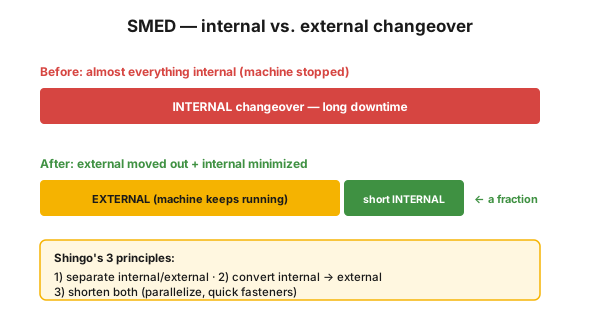 Figure 1 — the core of SMED: the external operations are moved out alongside the running machine, and the remaining internal is squeezed short. Before it, long downtime; after it, a fraction of that.
Who is this for?
Section titled “Who is this for?”This article is for those who deal in practice with changeovers and type changes: operator · production and plant manager · shift supervisor · process engineer · maintenance technician · logistics / planning specialist · Lean/CI specialist.
Learning objectives
Section titled “Learning objectives”After reading this article you will be able to:
- say when changeover time begins and ends, and why it runs to the first good part;
- distinguish internal and external changeover, and justify why separating the two is the first step;
- carry out the 6-step SMED introduction on a real changeover;
- recognize where the limit is: when NOT to chase the 10 minutes, and where speeding up must not come at the expense of safety;
- link quick changeover with small batch, heijunka and OEE.
In brief
Section titled “In brief”- SMED is the systematic reduction of the downtime tied to a type change; the goal of “single minute” is a changeover shorter than 10 minutes.
- The key concept is separating internal (doable only on a stopped machine) from external (doable alongside a running machine) changeover.
- The core of the method is Shingo’s three principles: (1) separate, (2) convert internal → external, (3) shorten both; the practical introduction has 5–6 steps.
- Changeover time is measured from the last good part to the first good part — it includes the run-down/run-up time too.
- Without quick changeover there is no small batch and no heijunka (production levelling); SMED is one of the enablers of continuous flow.
- The method is sustained by visual management, performance management and regular audit — without these it slides back.
- Speeding up must never come at the expense of safety (isolation, work permit, MOC are not an “internal step you can skip”).
Everyday quick-changeover examples (you have definitely met them)
Section titled “Everyday quick-changeover examples (you have definitely met them)”Quick changeover is not an abstract factory concept — you see it day in, day out, you just don’t call it that. The common thread: the preparation is done alongside the running of the “machine” (car, oven, aircraft), so the actual downtime is minimal.
| Everyday “changeover” | External (preparable while running) | Internal (only while stopped) |
|---|---|---|
| Pit stop (wheel change) | wheels, tools prepared, crew in position | the actual change (2 s) |
| Aircraft ground handling | catering, fuel, baggage prepared at the gate | cleaning, refuelling, boarding |
| Kitchen mise en place | every ingredient chopped, measured before cooking | the actual frying/cooking |
| Drill bit change | the next bit laid out ready to hand | the actual bit change |
The shared trick in each: move as much work as possible ahead of or behind the stop (make it external), so the real downtime is short. This is exactly what we bring into the process-industry plant as well.
Why does it matter? (the stakes)
Section titled “Why does it matter? (the stakes)”A long changeover on its own is “only” a few lost minutes — the trouble is the chain reaction it sets off. If the type change takes long, you are forced to produce in large batches (so you have to change over less often); large batches mean high inventory and a long lead time; with high inventory you cannot heijunka (level in small, mixed-sequence batches), so you become rigid and slow to shifting customer demand — and the bill at the end is tied-up capital, obsolete inventory and a lost order.
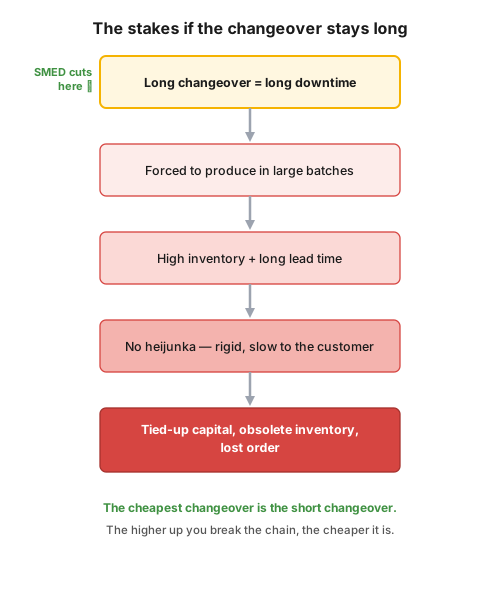 Figure 2 — the escalation of a long changeover: the higher up you break the chain, the cheaper it is. SMED cuts the chain at its very start — at the changeover time itself.
The lesson is simple: the cheapest changeover is the short changeover. That is why it pays to reduce the time of the type change rather than expensively compensate for its consequences (large inventory, slow response).
What is SMED, and where does it come from?
Section titled “What is SMED, and where does it come from?”SMED is a method aimed at drastically cutting changeover time, developed by Shigeo Shingo in the 1950s (by the same author who also systematized poka-yoke). The literal reading of “single minute”: a single-digit minute, i.e. a changeover shorter than 10 minutes. Common sense matters here: changeovers are so different that 10 minutes cannot always be set as a target — there are cases where it is unreachable for technological reasons, and cases where even without the method it is done in 4–5 minutes.
A “changeover” (set-up) is meaningful on machines able to produce several product types. On a type change the machine has to be reset (e.g. the depth of cut on a lathe) or a part of it replaced (e.g. chuck, injection-moulding tool), and often the material used has to be swapped too. Changeover is one of the main causes of planned downtime — roughly a tenth of the time spent producing goes to changeover, and this ratio deteriorates quickly: if we change over three times as often, the set-up time can eat up a significant portion of the shift.
Quick changeover is one of the pillars of the Lean operating system, in the JIT / Pull-Kanban / Flow-Heijunka / VSM / Jidoka / 5S–standard work row — its aim is better flow and, ultimately, a shorter lead time.
How does SMED work?
Section titled “How does SMED work?”SMED shortens the long changeover by first separating internal and external operations, then converting as much of the internal into external as possible, and finally speeding up both. Let’s take them in turn.
Internal vs. external changeover — the first and most important separation
Section titled “Internal vs. external changeover — the first and most important separation”This distinction is the foundation of the whole method:
- Internal changeover (internal / on-line set-up): the part that can be done only on a stopped machine — e.g. changing part clamps, tool change, machine-part replacement. Its time is downtime.
- External changeover (external / off-line set-up): the part that can be done alongside a running machine too — e.g. preparing the new tool/material, preheating, laying out and returning the tool, cleaning up and putting away after the change.
The trick: the more activities we do before or after the stop (as external), the shorter the actual downtime. Practice consistently shows that most of the seemingly “internal” steps are in fact external — they were just done while stopped until now.
Shingo’s three basic principles
Section titled “Shingo’s three basic principles”- Separate the external and the internal changeover operations.
- Of the internal operations, move whatever you can into the external.
- Improve both the external and the internal changeover so their time is reduced as far as possible.
The step order of the practical introduction
Section titled “The step order of the practical introduction”Two mutually consistent step lists have spread for the method. The 6-phase formulation marks what we do around the stop and what during the stop:
| # | Phase | When |
|---|---|---|
| 1 | Measuring the total changeover time (broken into elemental steps) | before/after the stop |
| 2 | Determining the internal and external steps | during the stop |
| 3 | Moving the external steps out of the changeover | during the stop |
| 4 | Shortening the internal steps | during the stop |
| 5 | Improving the external steps | during the stop |
| 6 | Standardizing the new changeover process | during the stop |
A more compact, 5-step textbook formulation: (1) recording the actual process, (2) separating internal/external, (3) internal → external conversion, (4) shortening the time, (5) parallelizing. The two say the same thing.
The four improving interventions — the step-level “what should I do?”
Section titled “The four improving interventions — the step-level “what should I do?””Breaking the changeover process into elemental steps, with each step you can do one of four things. This is the classic improvement matrix of the lean toolbox, which you record on an analysis sheet:
| Code | Intervention | Example | |
|---|---|---|---|
| A | Eliminate | removing unnecessary searching, walking, waiting | |
| B | Make external | preparing tool/material while the machine is running | |
| C | Make faster | quick clamps instead of bolts, [[poka-yoke.en | poka-yoke]] positioning |
| D | Make parallel | several people at once, choreographed (as in the pit lane) |
Why it matters: the related concepts
Section titled “Why it matters: the related concepts”- Set-up time: from the production of the last good part to the first good part of the new type. It includes the actual retooling and the run-up time as well (the “first good” part matters because e.g. in injection moulding the first part is often scrap). Dividing the daily changeover time budget by the time needed for one changeover, we get how many times a day we can change over.
- Batch size: the shorter the changeover, the smaller the batch worth producing.
- Heijunka (production levelling): heijunka cannot be applied without quick changeover — mixed, small-batch production requires many changeovers, which can only be afforded with a short changeover.
- OEE: changeover reduces availability (A); SMED therefore directly improves OEE, because the changeover time typically appears as a separate loss item in the breakdown.
Process-industry context and safety
Section titled “Process-industry context and safety”SMED was originally developed for discrete-manufacturing (injection moulding, forging, press-tool) changeovers, but as a systematic reduction of process time it can be applied in many areas. Typical “changeovers” in process industries:
- Servicing tank cars and loading arms: switching between arms, the documentation, hose connection and sampling preparation — much of this can be made external (the next truck’s papers, hose ends, sample container prepared), so the actual connect-disconnect time is shortened. In the yield breakdown of a loading-arm bay, the changeover can typically be audited as a separate loss item.
- Product-to-product switching in a pipelined/continuous plant: recipe change, flushing, reaching condition. The “run-down / run-up” time is, in the SMED sense, part of the changeover — this too has to be shortened.
- Maintenance / equipment changeover preparations: laying out tools, parts, permits and materials in advance (external changeover), so the actual stop is minimal.
Putting it into practice (roadmap: pilot → rollout)
Section titled “Putting it into practice (roadmap: pilot → rollout)”0. Prerequisite. Have the base of 5S and standard work in place in the chosen area — with disordered tools/materials there is no quick changeover. Choose one frequently changing-over piece of equipment that is a bottleneck as the pilot (Gemba, the real place).
- Measure the actual changeover. A small, mixed team (operator + machinist/maintenance + Lean expert) records on video and breaks into elemental steps the entire process of a real changeover, and measures the total changeover time (from the last good part to the first good part). Don’t estimate — San Gen Shugi: real place, real data, real part.
- Separate every step into an internal or external category. An immediate, investment-free gain: move the steps that can already now be done externally out of the stop.
- Convert (internal → external): look for which internal step can be made external (e.g. tool preheating, presetting on a spare set, quick connectors). This is the highest-yield step.
- Shorten the remaining internal steps (quick clamps instead of bolts, error-free positioning = poka-yoke, standard tool kit at hand), then improve the external steps too.
- Parallelize: several people at once, choreographed — “everyone has 1 small task”. Watch out for the occupational-safety space requirement and avoiding collisions.
- Standardize and anchor down: write up the new changeover as standard work (visual, unambiguous, with a safety point), train it, and make it the subject of an audit + performance management. PDCA: if there is a deviation → root-cause analysis → new standard → the loop restarts.
- Roll out: carry the proven template (record → separate → convert → shorten → parallelize → standardize) over to the next piece of equipment; the local “champion” coaches.
Hands-on / example
Section titled “Hands-on / example”The SMED simulation (workshop game). The classic training simulates a simple machine changeover: the team (1 machinist, 1 “supervisor”, 1+ timekeeper) changes the machine over from process 1 to process 2 as fast as possible. The first round is typically 4–6 minutes. Then the team analyses the recording, makes a checklist (preparing tools/parts, a standard observation sheet), and runs it again and again — the goal is toward 1 second. The lesson is not the record but three questions: were the improvements affordable, simple and feasible? If not, you are going in the wrong direction.
Pit-lane wheel change — the textbook example of SMED. The time for the same wheel change at home and in the pit lane differs by orders of magnitude — not because of the tool, but because of the division of labour and parallelization. The “home vs. pit lane” breakdown shows exactly this (illustrative numbers):
| Step | At home | In the pit lane |
|---|---|---|
| Jacking up the car | 182 s | 1 s |
| Loosening the nuts | 292 s (5 pcs) | 2 s (4 pcs) |
| Old wheel off, new on | 140 s | 2 s |
| Tightening the nuts | 280 s | 2 s |
| Lowering the car | 88 s | 1 s |
| 1 wheel | ~982 s | — |
| 4 wheels | ~3,928 s (≈ 1 hour) | 8 s (simultaneously) |
The logic transfers 1:1 to a plant: the many steps done in sequence we parallelize (D), the fastenings we make quick-connect (C), and the preparation we do while the machine is running (B).
Heijunka worked example. If we produce 5 products in daily blocks (AAAA…BBB…CC), 2–3 changeovers are needed per day; but if we produce in genuinely small batches, in mixed sequence (ABCAB…), as many as 20 changeovers may be needed — that is, the time of the type change has to be brought to a tenth. This can only be achieved with SMED; without it, production levelling (heijunka) does not work.
Homework. Choose a frequently changing-over piece of equipment in your own area. Record the steps of a real changeover, label each one internal/external, and mark what you would do with each: A (eliminate), B (make external), C (make faster) or D (make parallel). Estimate how much downtime you would gain from the B-steps alone.
Measurement / audit
Section titled “Measurement / audit”- Main metric — changeover time (C/O time): from the last good part to the first good part, including the run-up time. Trend it per changeover; the goal is reducing the spread and reducing the mean.
- Target logic: the “single minute” (under 10 minutes) is guidance, not dogma — the realistic target is set by the technology. Stepped targets: current time → SMED target → (where meaningful) OMED → OTED.
- How many changeovers/day:
number of daily changeovers = time reserved for changeover per day / time needed for one changeover. Shorter changeover → more (smaller) batches → less inventory. - Effect on OEE: changeover loads the availability (A); in OEE = A × SL × Q the drop in C/O time directly raises A (and thus OEE). The changeover can be audited as a separate loss category.
- Between-batch changeover (EPEx — “Every Product Every…”): the total time needed for all changeovers divided by the time reserved for changeover per day; quick changeover shortens the cycle.
- Audit: compliance with the SMED standard is followed on regular (gemba) audits and a visual board — this is what holds the achieved time.
Common mistakes
Section titled “Common mistakes”- Treating the 10 minutes as dogma. There are cases where it is technologically unreachable, and cases where even without the method it is 4–5 minutes — chasing the magic number is waste. Instead: set a realistic drastic reduction, tuned to the technology.
- Skipping the recording/measurement. With estimated time and a “from memory” sequence there is no improvement. Instead: record and break the real changeover into elemental steps (San Gen Shugi: real place, real data, real part).
- Only shortening, not separating. The biggest, investment-free gain comes from the internal → external conversion (B). Instead: first separate and move out the external, only then speed up.
- Leaving the run-up time out of the measurement. The changeover runs to the first good part. Instead: count the run-up / scrap ramp-up into the C/O time too.
- Not standardizing. Without audit and standard work the achieved time slides back. Instead: record it as standard work, and make it the subject of an audit (step 6).
- Sacrificing safety for speed. LOTO / work permit / isolation is not an “internal step you can skip”. Instead: build the safety and check points into the SMED standard; every change falls under MOC.
- Parallelizing while ignoring the space requirement. Several people in a tight space breed collision and accident risk. Instead: plan the parallel choreography (space requirement, routes, unambiguous responsibility).
When NOT to use it? (the limits of the method)
Section titled “When NOT to use it? (the limits of the method)”SMED is strong but not universal. Knowing when it is not the primary answer is just as important as the method itself:
| Situation | Why (primarily) not SMED | The right answer | |
|---|---|---|---|
| The changeover is one-off, non-recurring | there is nothing to build durably into a standard for a single case | one-off preparation, recording the lesson | |
| The machine has no type change at all (single-product, continuous) | there is no changeover to shorten | focus on other losses of [[oee.en | OEE]] (performance, quality) |
| The real cause is too many, unnecessary type changes | it is not the changeover that has to be sped up but the variability reduced | first batch/order planning ([[mura.en | heijunka]], EPEx) |
| The 10 minutes is technologically unreachable | physics/chemistry constrains it (e.g. heating up, reaching condition) | realistic target + technological optimization of the run-up time |
Rule of thumb: SMED is strongest for recurring, type-changing changeovers. Where the problem is really too many changeovers or a single-product process, there another tool is the right answer — SMED does not replace it, it complements it.
Key takeaways
Section titled “Key takeaways”- The cheapest changeover is the short changeover — the chain reaction of a long changeover (large batch → high inventory → rigid response) is the real cost.
- First separate, then speed up: the biggest, free gain comes from the internal → external conversion (B).
- The changeover runs to the first good part — the run-up time is included in it; without this you are cheating on the measurement.
- The “single minute” is guidance, not dogma — the realistic target is set by the technology.
- Without standard + audit it slides back — step 6 (standardization) is what holds the result.
- Speed never before safety — isolation, work permit, MOC are not a skippable “internal step”.
Self-check
Section titled “Self-check”- When does changeover time begin and end, and why do we measure it to the first good part (not to the first one)?
- A step turns out to be doable even while the machine is running, but it was done while stopped until now. Which Shingo principle and which improving intervention (A/B/C/D) applies to it, and why is this the highest-yield step?
- A manager at a single-product, continuous plant wants to launch a “SMED project”. Why might this be a poor tool choice, and what would you look at instead?
How does this show up in digital practice?
Section titled “How does this show up in digital practice?”The quick-changeover principle does not end on the production line: the same logic can be supported in software too. Instead of the stopwatch and the paper analysis sheet, here digital changeover-time measurement, an electronic checklist and an enforced sequence carry the “measure → make external → standardize” triad — the mechanism differs, the principle is the same.
| SMED principle | Digital implementation | What it delivers |
|---|---|---|
| Measuring changeover time | automatic C/O timestamp (last good part → first good part) | precise, estimate-free baseline data and trend |
| Internal/external separation | digital step list, every step labelled internal/external | makes visible what can be made external |
| External preparation | enforced preparation checklist before the stop | all material/tools ready while the machine runs |
| Standardization | digital standard work / changeover template | everyone changes over the same way, equally fast |
| Audit + sustaining | per-changeover recording, deviation alert, dashboard | the achieved time does not slide back |
Connection to OPEREX (shift diary)
Section titled “Connection to OPEREX (shift diary)”The start/end time and duration of a SMED changeover, the abnormalities tied to the changeover (e.g. a missing tool, a deviation from the standard) and the assigned corrective actions (what / who / by when) can be recorded per shift, in a structured way, in the OPEREX shift diary. This way the trend of changeover time and the deviation from the standard give a retrievable, auditable trail — which supports anchoring down step 6 (standardization) and continuous improvement (PDCA).
Terminology (HU / EN / DE)
Section titled “Terminology (HU / EN / DE)”| Hungarian | English | German / note |
|---|---|---|
| gyors átállás | quick changeover / SMED | schnelles Rüsten |
| átállás | changeover, set-up | Umrüstung |
| átállási idő | set-up time | Umrüstzeit — from the last good part to the first good part |
| belső átállás | internal / on-line set-up | internes Rüsten — only on a stopped machine |
| külső átállás | external / off-line set-up | externes Rüsten — alongside a running machine |
| átállásiidő-csökkentés | setup reduction | Umrüstzeitreduzierung |
| egy számjegyű perces szerszámcsere | Single Minute Exchange of Die (SMED) | Shigeo Shingo, 1950s |
| — | OMED / OTED | within one minute / “one-touch” changeover |
What does the abbreviation SMED mean?
Single Minute Exchange of Die — “single-digit minute die change”: the changeover must be doable in less than 10 minutes (a single-digit minute). In Hungarian it is often “quick changeover”.
What is the difference between internal and external changeover?
Internal changeover can only be done on a stopped machine (e.g. tool change), external alongside a running machine too (e.g. preparation, preheating, cleaning). The essence of SMED is separating the two and converting as much of the internal into external as possible.
When does changeover time begin and end?
From the production of the last good part to the first good part of the new type — including the actual retooling and the run-up time as well. The “first good” matters because e.g. in injection moulding the first part is often scrap.
Is the 10 minutes mandatory?
No. The “single minute” is guidance; the realistic target is set by the technology. There are cases where it is unreachable, and cases where even without it it is 4–5 minutes. Stricter target states: OMED (within 1 minute), OTED (one touch).
Why is SMED important for small batches and heijunka?
Because producing in small batches is only economical with a short changeover; production levelling (heijunka) requires many changeovers, which cannot be afforded without quick changeover.
What should I measure if I want to introduce it?
The changeover time (last good part → first good part), trended per changeover; the goal is reducing the mean and the spread. Alongside this, watch how many (smaller) batches production switches to as a result, and how the availability (A) term of OEE rises.
Related concepts
Section titled “Related concepts”heijunka | oee | standard work | 5s | kaizen | vsm | poka-yoke | just-in-time | kanban
Next step
Section titled “Next step”If you have understood this, from here it is worth going on — in this order:
- standard work — the engine of step 6: this is where you record the proven changeover so it does not slide back. Start with this.
- heijunka — why quick changeover is worth it at all: the small-batch, levelled production that SMED makes possible.
- oee — where the result shows up: the improvement in availability (A) as the changeover loss decreases.
References / further reading
Section titled “References / further reading”- Shigeo Shingo: A Revolution in Manufacturing: The SMED System. Productivity Press, 1985. — the canonical foundational work on the SMED method.
- Shigeo Shingo: Quick Changeover for Operators: The SMED System. Productivity Press, 1996. — the operator-level, practical introduction to the method.
- James P. Womack – Daniel T. Jones: Lean Thinking. Simon & Schuster, 1996. — the place of quick changeover in the system of lean flow and small batch.