Pull system: push vs. pull, heijunka and kanban
≈ 16 min read · 3,244 words
Open your fridge: you don’t keep 40 litres of milk in there “just in case.” When you lift a carton off the shelf in the shop, a gap is left on the shelf — and that gap is the only signal by which the shop knows it has to replenish. Nobody produces a month’s worth of milk ahead into the warehouse; consumption pulls the resupply. This is the essence of the pull system, as opposed to the push logic, where we produce to a forecast and the unused material accumulates as inventory. Pull is one of the core principles of Lean; its tools are kanban (the signal), heijunka (load levelling) and the milkrun (scheduled collection). Let’s look at what it is, why it works, and where it is used.
In the pull system, actual customer demand triggers production: each step produces only as much as the downstream step calls off. By contrast, in the push system production is triggered by a forecast or an internal plan, and the product is “pushed” onto the next step regardless of actual demand — this leads to overproduction and accumulating work-in-process inventory. Pull minimizes inventory and overproduction, because it sets a cap on the material in the system. Its tools are kanban (the pull signal), heijunka (levelling the load over time) and the milkrun (a scheduled replenishment round). Pull is the fourth of the five Lean principles (Value → Stream → Flow → Pull → Perfection), and it presupposes a stable, flowing process.
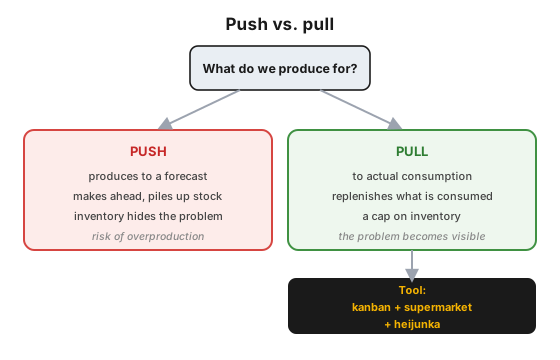 Figure 1 — push produces to a forecast and piles up inventory; pull replenishes only what is consumed, with kanban, a supermarket and heijunka.
Who is this for?
Section titled “Who is this for?”This article is for those who deal with production and inventory planning in practice: operator · shift and plant manager · production planner · logistics and supply-chain specialist · process engineer · Lean/CI specialist · maintenance planner.
Learning objectives
Section titled “Learning objectives”After reading this article you will be able to:
- distinguish the push and the pull logic, and say what each one risks;
- explain why pull is the fourth Lean principle, and why it first needs a flowing process;
- understand the goal of heijunka (load levelling), and work through a concrete example of how it frees hidden capacity without investment;
- recognize the three elements of a working pull (signal · rule · frequency) and the role of the milkrun;
- draw the boundary: what can be controlled on the pull principle in the process industry, and what cannot.
In brief (TL;DR)
Section titled “In brief (TL;DR)”- Push: produces to a plan/forecast → overproduction and accumulating inventory.
- Pull: downstream demand pulls production → only what is actually needed is created.
- Pull is the fourth Lean principle (Value → Stream → Flow → Pull → Perfection).
- Its precondition: a flowing process and stable, low-variability operation (see muri, mura).
- Tools: kanban (signal), heijunka (levelling), milkrun (scheduled replenishment).
- Heijunka smooths the load over time through scheduling — not by building new capacity; it makes the free capacity visible.
Why it matters (the stakes)
Section titled “Why it matters (the stakes)”Overproduction is Lean’s “number one” waste — and not by chance. Making one extra item seems cheap in itself; the trouble is the chain reaction it sets off. The unused material sits there as work-in-process inventory, ties up capital and storage space, and — worst of all — hides the problems: a faulty step stays invisible behind the large buffer until the accumulated stock runs out. In the process industry there is the added factor that long-standing material degrades or goes off-spec, so in the end it means a write-down or scrap.
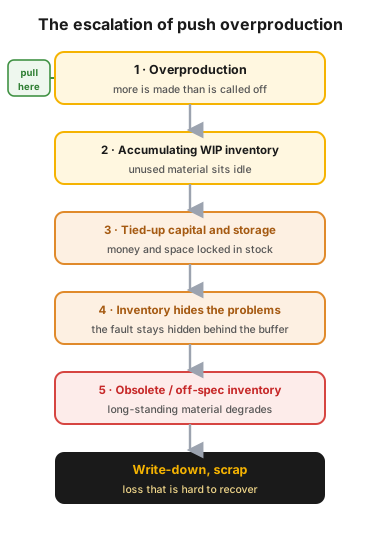 Figure 2 — the escalation of push overproduction: the longer you let the chain build, the more expensive it gets. Pull breaks it at the very start of the chain — at the origin, at the overproduction — by setting a cap on the inventory in the system.
The lesson: the cheapest inventory is the inventory that was never produced. Pull is strong precisely because it intervenes at the start of the chain — it does not let the surplus arise at all.
What is the difference between the push and the pull system?
Section titled “What is the difference between the push and the pull system?”Push produces to a forecast and “pushes” the product onto the next step; pull produces only when the downstream step signals demand. This signal-based brake is the essence of the difference:
- Push: production is triggered by a plan/forecast, and the product is passed on regardless of actual demand. Its risk is overproduction and accumulating work-in-process inventory — the two main wastes (see muda). Moreover, the inventory hides the problems of the process.
- Pull: an upstream step produces only when the downstream step signals demand (classically with a kanban signal). This way there is an upper limit on the material in the system, and the problem becomes visible.
The push→pull switch is a characteristic step of Lean transformation, after the value stream has been mapped (VSM) and flow has been established. This order is no accident: pull on an unstable, non-flowing process only causes chaos.
Heijunka — production levelling
Section titled “Heijunka — production levelling”Heijunka is the smoothing of production and load over time through scheduling — not by building new capacity. The aim is for the peak loads to level out and the existing capacity to be better utilized. Pull can only pull evenly if the call-off itself is levelled; heijunka creates this rhythm.
The classic lesson comes from a tank-truck loading example: if we look at the arriving trucks on average, the system appears overloaded, and the obvious (but expensive) reaction is to build a new loading station. The real question, however, is not the average but the distribution of the load.
| Metric | Baseline (no scheduling) | After scheduling (levelling) | Improvement |
|---|---|---|---|
| Trucks served | 10 (4× 30 m³ + 6× 15 m³) = 210 m³ | 12 (4× 30 m³ + 8× 15 m³) = 240 m³ | +20% vehicles · +14% fuel |
| Capacity | sized for the peak, with congestion | the free 50% also used | with no investment |
(Average loading time ~20 min/truck, average changeover time ~10 min, 6:00–12:00 window — the scenario’s data.)
Scheduling the arrivals (levelling) made the previously hidden ~50% free capacity visible and usable — with the same infrastructure, without a new loading station. Instead of building for the peak, we smooth the load.
Kanban and milkrun — how does pull work in practice?
Section titled “Kanban and milkrun — how does pull work in practice?”A working pull consists of three simple elements: a signal, a rule and a frequency. Downstream consumption pulls upstream replenishment, so no overproduction arises:
- Signal: e.g. an empty bottle / an empty storage slot → this is the kanban card, the pull signal.
- Rule: every empty is replaced by a full one — consumption pulls the replenishment, nothing else.
- Frequency: e.g. a daily collection — the milkrun (scheduled round) collects the kanbans and delivers the replenishment.
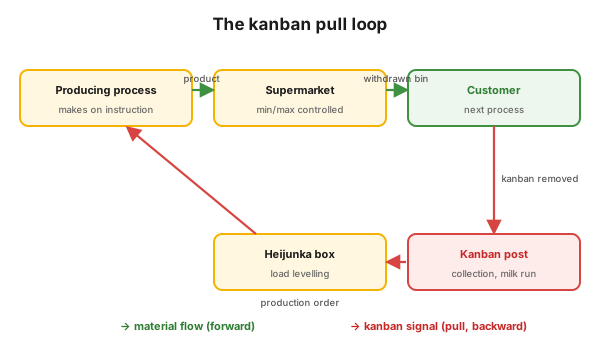 Figure 3 — the kanban pull loop: material flows forward (producing process → supermarket → customer), while the kanban signal runs backward (customer → post → heijunka box → production). The milkrun collects the signals from the post.
The key to the loop is that the signal travels backward and the material forward — the opposite-direction flow of the two produces the pull. For the detailed mechanics of the kanban card (card types, sizing, two-card system), see separately: kanban.
Process-industry context
Section titled “Process-industry context”In the continuous-operation process-industry environment the classic discrete pull is only partially applicable — a distillation column does not stop on a kanban signal. But at the input and output ends of the chain the principle very much holds:
- Blending and delivery. In the storage and logistics stage, production planning according to customer call-off is the direct appearance of the pull principle: we blend and deliver only as much as the customer actually calls off.
- Intermediate tank stock as a symptom. Accumulating tank inventory is the symptom of push-like overproduction — the same phenomenon as the intermediate buffer of discrete manufacturing, only in liquid form.
- Heijunka in logistics. Scheduling deliveries (on the model of the tank-truck example) reduces congestion and waiting, and the kanban principle supports the pull-based replenishment of storage levels (min/max levels, a refill signal).
When NOT to use it (the limits)
Section titled “When NOT to use it (the limits)”Pull is strong but not universal. Knowing where it is not the right answer is just as important as the method itself:
| Situation | Why (primarily) not pull | The right answer | ||
|---|---|---|---|---|
| No stable flow — the process stutters, high variation | pull’s signal-based replenishment on an unstable base causes chaos | first [[vsm.en | VSM]] + establishing flow, reducing [[mura.en | variability]] |
| Very volatile, unpredictable demand | the buffers empty out before the replenishment arrives | first heijunka (levelling), possibly planned stock ahead of the bottleneck | ||
| A continuous, non-stoppable process step | a column cannot be started/stopped on a signal | pull on the input and output (delivery, storage level), not at the core | ||
| One-off, custom production (no repetition) | there is nothing to “replenish,” no stable consumption rhythm | project-/order-based production, not supermarket pull |
Rule of thumb: pull is strongest for repeating, levellable consumption alongside stable flow. Where this is missing, flow and levelling must be established first — pull is the consequence of these, not the starting point.
Putting it into practice (roadmap)
Section titled “Putting it into practice (roadmap)”Pull is not a stand-alone tool but a control principle laid onto a stable process. Suggested order:
- Map the value stream (VSM), and mark where work-in-process inventory accumulates — these are the push symptoms.
- Create flow by eliminating bottlenecks and unnecessary inventory points; without this, pull is not stable.
- Level the load (heijunka): smooth the distribution of demand over time, so the call-off gives an even rhythm.
- Define a pull loop: choose the signal (empty slot / kanban), the rule (empty to full) and the frequency (milkrun cadence). Set an upper limit on the work-in-process inventory.
- Measure and refine (pdca): track the trend of the work-in-process inventory and the service level; where it empties out or overflows, adjust the levels and the frequency.
Hands-on / mini-scenario
Section titled “Hands-on / mini-scenario”Discrete example (supermarket pull). In a parts supply, the warehouse keeps a large batch “just in case.” Introduce a min/max level and a kanban signal: if the level falls below the min, the milkrun replenishes a standard batch. Inventory settles with an upper limit, replenishment follows consumption — there is no more “dead” pile.
Process-industry example (delivery pull). At a product tank, delivery has so far been “pushed” by production. Switch to customer call-off: the delivery order is the signal, the milkrun-like scheduled removal is the frequency, the tank’s min/max level is the upper limit. Congestion drops, and the trend of the intermediate inventory becomes visible.
Homework. Choose an intermediate inventory point in your own area. Write down: what is the signal, what is the rule, what is the frequency, and what upper limit you set on the inventory — then estimate how much tied-up stock you free up.
Measurement / audit
Section titled “Measurement / audit”The effect of pull lands in two places: in the inventory and in the service. Auditable metrics:
- Level / trend of work-in-process inventory at the pull points (the goal: decreasing, then stable, below the upper limit).
- Lead time — pull shortens it, because less material waits in buffers.
- Service level (how many times there was a shortage at the downstream step) — pull must not come at the expense of availability.
- Evenness of the load (heijunka) — the peak/valley ratio and the free capacity utilized.
Target logic: the goal is not to drive inventory to zero (that would cause shortages), but to eliminate the surplus while keeping the service level stable.
Common mistakes
Section titled “Common mistakes”The pitfalls of pull almost all stem from violating the order and the stability. In anti-pattern ↔ correction pairs:
- Pull without flow. Without a stable, flowing process, kanban causes chaos: the buffers now empty out, now overflow. Instead: first VSM + flow, then pull — it is the fourth principle, not the first.
- Sizing for the peak instead of heijunka. We build expensive new capacity while scheduling would make the existing one enough. Instead: level first (heijunka), and look at the free capacity — often the answer is there.
- Taking work-in-process inventory as “normal.” Accumulating inventory becomes habitual, and hides the problems. Instead: treat inventory as a symptom of push overproduction, and put an upper limit on it.
- Pull on a variable process. With high variability pull is unstable, the signal chain falls apart. Instead: first reduce the variation (mura, muri), then pull.
- Mistaking kanban for pull. We introduce a card, but the logic is still push (we produce ahead “around the card”). Instead: the goal is the pull logic (replenishing consumption), not the presence of the card.
Key takeaways
Section titled “Key takeaways”- Let consumption pull, not the forecast push — let downstream demand trigger production, not the internal plan.
- Inventory is the symptom of push: accumulating intermediate material is not “normal” but hidden overproduction — put an upper limit on it.
- Flow first, then pull: pull is the fourth principle; without a stable, flowing process it causes chaos.
- Heijunka = smoothing over time, not new capacity: it makes the free capacity visible, instead of sizing for the peak.
- The three elements of pull: signal · rule · frequency — the simple loop, collected by a milkrun, is the most effective.
- Kanban ≠ pull system: kanban is a tool, pull is the system; the goal is the pull logic, not the card.
Self-check
Section titled “Self-check”- What is the difference between push and pull in one sentence, and which leads to accumulating work-in-process inventory — why?
- In the tank-truck example, why was no new loading station needed, and what exactly did heijunka (levelling) make visible?
- List the three elements of a working pull, and say what the role of the milkrun is in the loop.
How does this show up in digital practice?
Section titled “How does this show up in digital practice?”The pull principle does not end on the production line: the same logic is realized in software too, in any well-designed inventory- and production-control system. Instead of the physical kanban card or empty storage slot, here an automatic refill signal, an inventory cap and call-off-based scheduling pull the replenishment — the mechanism differs, the principle is the same.
| Pull principle | Digital implementation | What it delivers |
|---|---|---|
| Pull signal (kanban) | an automatic refill alert when the level falls below the min | consumption triggers the replenishment, not the plan |
| Inventory cap (WIP cap) | the system does not allow more open items than the limit | work-in-process inventory does not run away |
| Frequency (milkrun) | a scheduled, recurring replenishment cycle in the system | even, predictable resupply |
| Heijunka (levelling) | levelling and sequencing the call-offs/tasks over time | the peak load smooths out, the free capacity shows |
| Detecting the push symptom | the accumulating work-in-process inventory as a trend, with an alert | overproduction becomes visible and auditable |
Connection to OPEREX (shift diary)
Section titled “Connection to OPEREX (shift diary)”The pull signals, the storage levels and the delivery call-offs can be logged in the shift diary (OPEREX), so the symptoms of overproduction (push) — accumulating work-in-process inventory, congestion — become visible as a trend and auditable, laying the ground for pull-directed improvement. From the per-shift entries it becomes clear where a persistently high intermediate inventory settles, and logging the delivery call-offs helps with heijunka-like levelled scheduling.
Terminology (HU / EN / JP)
Section titled “Terminology (HU / EN / JP)”| Hungarian | English | 日本語 / note |
|---|---|---|
| Toló rendszer | Push system | produces to a forecast |
| Húzó rendszer | Pull system | produces to consumption |
| Termelésszintezés | Heijunka / production levelling | 平準化 — smoothing the load over time |
| Húzójel | Kanban | 看板 — the pull signal (card / empty slot) |
| Ütemezett begyűjtés | Milkrun | the replenishment round |
| Szupermarket | Supermarket | min/max controlled intermediate inventory |
| Éppen időben | Just-in-Time (JIT) | the goal of pull-based supply |
What is the difference between the push and the pull system?
Push produces to a forecast/plan and passes the product on regardless of actual demand — this leads to overproduction and accumulating work-in-process inventory. Pull produces only when the downstream step signals demand (e.g. kanban), so it puts an upper limit on inventory and minimizes overproduction.
Why is pull better than push?
Because it produces according to actual customer demand, so it minimizes overproduction and tied-up inventory — the two main types of waste — and the inventory does not hide the problems of the process.
What is the goal of heijunka?
Smoothing production and load over time, so the existing capacity is better utilized and we don’t size for the peak with an unnecessary investment. In the tank-truck example, scheduling made ~50% free capacity visible, with +20% vehicles served, without investment.
What drives the kanban system?
Actual consumption (the pull signal, e.g. an empty storage slot). Rule: every empty is replaced by a full one, at a given frequency (milkrun) — so there is no overproduction.
Can pull be applied in the process industry if the technology is continuous?
Partly. The continuous core (e.g. a column) cannot be started/stopped on a kanban signal, but at the input and output — at the storage levels and in the customer-call-off delivery — the pull principle is directly applicable, and it holds the intermediate tank inventory with an upper limit.
Are kanban and the pull system the same thing?
No. Pull is the system (consumption pulls production), kanban is only one of its tools (the carrier of the signal). There can be pull without a kanban card, and kanban can be used badly, in a push-like way — the goal is always the pull logic.
Related concepts
Section titled “Related concepts”kanban · muda · mura · muri · vsm · smed · jidoka · the five principles
Next step
Section titled “Next step”If you have understood this, from here it is worth going on — in this order:
- kanban — the detailed mechanics of the pull signal: card types, sizing, the two-card system. The tool level of pull.
- mura — the unevenness that heijunka smooths out; without it, pull stays unstable. This is how you understand why you have to level first.
- VSM — the value stream map with which you find the push symptoms (where work-in-process inventory accumulates) before introducing a pull loop.
References / further reading
Section titled “References / further reading”- Taiichi Ohno: Toyota Production System: Beyond Large-Scale Production. Productivity Press, 1988. — the canonical foundational work on the pull system and kanban; Ohno drew the idea of pull from the replenishment logic of American supermarkets.
- James P. Womack – Daniel T. Jones: Lean Thinking. Simon & Schuster, 1996. — the source of the five Lean principles (Value → Value Stream → Flow → Pull → Perfection).
- Mike Rother – John Shook: Learning to See. Lean Enterprise Institute, 1999. — value stream mapping, supermarket pull and the practical introduction of heijunka.