Kaizen (continuous improvement)
≈ 20 min read · 3,993 words
Think of your own kitchen: over time the wooden spoon, the salt and your favorite mug all end up right where your hand reaches, because bit by bit you moved them so you would have to reach less. Nobody bought a new kitchen for it, yet month after month the old one got a little faster. The same thing improves the recipe you cook for the tenth time, or the morning routine that gets you out the door on time. This is kaizen, in English continuous improvement: not the big splash, but the many small, never-stopping steps. Let’s look at what it is, why it works, and how a plant builds it into its everyday life.
Kaizen is continuous improvement made of small steps: not from large capital, but from the workers’ creativity, with everyone involved. It comes from the Japanese kai (change) and zen (good): “change for the better.” Its engine is the PDCA cycle (Plan-Do-Check-Act), and its goal is that the production system approach the ideal state (True North) in a never-ending loop. In contrast to large, capital-intensive innovation (kairyo), kaizen makes what already exists a little better every day.
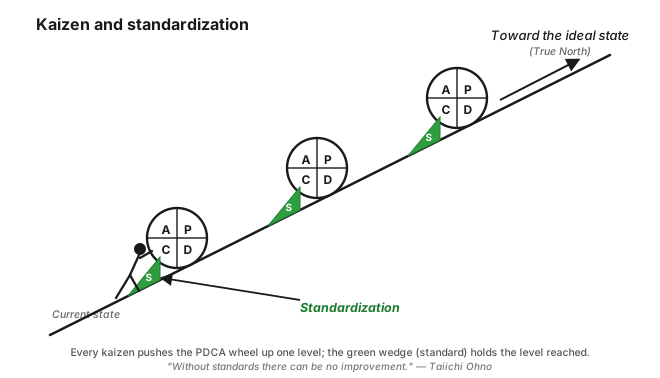 Figure 1 — with each turn kaizen pushes a PDCA wheel up the slope toward the ideal state; the green wedge (standardization) holds the level reached so it does not roll back.
Who is this for?
Section titled “Who is this for?”This article is for those who improve in their daily work, or who lead improvement: operator · shift and plant manager · process engineer · maintenance technician · quality engineer · Lean/CI specialist · production manager · HSE.
Learning objectives
Section titled “Learning objectives”After reading this article you will be able to:
- explain what kai + zen means, and how kaizen differs from kairyo / kakushin innovation;
- list the four principles of kaizen, and apply them to a concrete work step;
- distinguish point, system and blitz (kaikaku) kaizen by their scope and duration;
- build a working suggestion system, and know why the “idea box” fails without a plan;
- draw the line: when kaizen is the wrong tool, and when capital investment (kairyo) is needed instead.
The essence (TL;DR)
Section titled “The essence (TL;DR)”- Kaizen = kai (change) + zen (good): continuous, incremental improvement for the better. In English continuous improvement, in German kontinuierliche Verbesserung.
- Its essence is the small step, from little money, with everyone involved — in contrast to kairyo / kakushin innovation, which solves a problem with large capital (e.g. a new machine).
- Its engine is the PDCA cycle: set the goal, execute, measure, standardize, then restart.
- Two preconditions: a working suggestion system (collecting, evaluating and rewarding ideas) and that everyone practices it, not a select group.
- Its scope can be point kaizen (local, as little as 1 day), system kaizen (the whole value stream, weeks to months) or a concentrated kaikaku (a 2-5 day workshop).
- It is not “silver-bullet hunting”: it delivers results even without capital outlay, but it requires a cultural shift (time, discipline, honesty).
Why does it matter? (the stakes)
Section titled “Why does it matter? (the stakes)”Whoever stands still actually falls behind. A production system does not stay good on its own: standards wear down, good habits loosen, and meanwhile the competitor gets a little better every month. The stake of kaizen is exactly this slow, invisible erosion.
The good news: the turnaround is cheap. Kaizen needs primarily not money, but the creativity of the people you already have and a system that collects and keeps it. That is why it pays to start before the gap grows into a forced investment (into kairyo).
What is kaizen, and where does it come from?
Section titled “What is kaizen, and where does it come from?”Kaizen is the cornerstone of the Toyota Production System (TPS) and of the Lean generalized from it: the daily engine of the “absolute elimination of waste.” The core of the idea is that a successful organization is filled with capable problem-solvers who recognize the value of incremental process gains. This is not decoration, but a condition for the system to work. The word “lean” was popularized by The Machine That Changed the World (Womack, Jones, Roos, 1990): the TPS is lean because it produces an excellent product from a fraction of the resources (human effort, space, investment, inventory, operating cost).
By the precise definition, kaizen is an endless process of small improvement steps, for which we use primarily not material resources but the workers’ creativity. Most kaizens have at least a minimal cost, but we do not solve the problem by buying a new machine, and we often cover the material needs of the implementation from recycled material.
How is kaizen different from innovation? Kaizen improves in small steps, out of creativity; innovation comes when the improvement can only be realized with capital. The two are not opposites but a choice: you always have to think through which is justified.
| Concept | What it means | Resource |
|---|---|---|
| kaizen | small, continuous improvement, with everyone involved | creativity, minimal money |
| kairyo / kakushin (innovation) | the improvement can only be realized with capital investment (e.g. a new machine for a capacity shortfall) | significant capital |
| kaikaku (reengineering) | a concentrated improvement workshop (2-5 days); it does not replace kaizen | the team’s time |
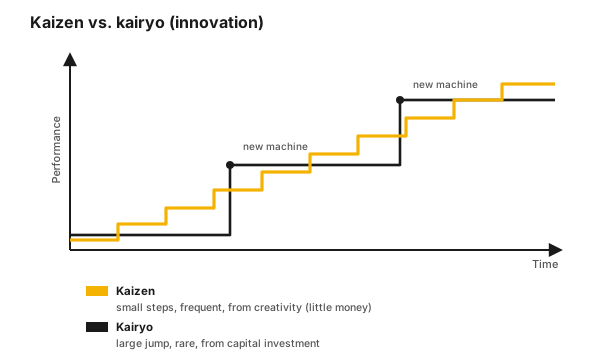 Figure 2 — kaizen climbs continuously in many small steps from the creativity of the people you already have; kairyo climbs in rare, large jumps by acquiring a new machine. The two complement each other, but kaizen is the one that never stops.
Kaizen forms the foundation of the House of Lean together with 5s: the two pillars, just-in-time and jidoka, stand on this continuous-improvement foundation, and together they deliver the goal: best quality, lowest cost, shortest lead time, safety.
How does kaizen work?
Section titled “How does kaizen work?”Kaizen starts with a simple set of questions, runs in a closed improvement loop (PDCA), and appears in three kinds of scope. Let’s take them in turn.
The four principles of kaizen
Section titled “The four principles of kaizen”These four questions help even an experienced professional, and for a beginner they almost guarantee a solution that increases safety, quality and efficiency:
- Shorten — Can a motion be made shorter by bringing the object of the motion closer? Can an unnecessary element be dropped from the operation?
- Combine — Can the two operations be done in parallel? Can two tools be made into one that suits both tasks?
- Rearrange — Can the layout or the sequence of operations be changed so that the work becomes more efficient?
- Simplify — Can the tools or methods be simplified so that they still meet the requirements?
The engine: the PDCA cycle
Section titled “The engine: the PDCA cycle”The execution engine of kaizen is the PDCA cycle (Plan-Do-Check-Act): you set the goal and the metric, you try the change on a small scale, you measure the result with fact data, then you fix the new good practice as a standard, and the cycle restarts from a higher level. The hero figure shows this: every kaizen pushes a PDCA wheel up the slope, and standardization is the wedge that prevents rolling back.
The detailed breakdown of PDCA’s four phases (the four questions of PLAN, Check as the weakest link, the three outcomes of Act) lives in a separate article: PDCA cycle.
The scope of kaizen
Section titled “The scope of kaizen”- Point kaizen — solving a local problem, for example making the tool layout of an operation more ergonomic. It can be done in as little as one day.
- System kaizen — when the problem affects not one operation but the whole production system (for example the kanban system does not work well in an area). Here mapping the material and information flow (vsm) is indispensable; often several weeks or months.
- Kaizen blitz / kaizen event (kaikaku) — a concentrated form: a 2-5 day workshop that starts with training, then data collection and analysis, goals and tasks, implementation, assessment of the results and correction, and finally the steps of sustainment and the presentation. Effective, but it does not replace everyday kaizen.
Documentation tools
Section titled “Documentation tools”- Kaizen sheet — the detailed elaboration of the proposal: it depicts the current and the planned state, and can even serve as a work order.
- Kaizen plan sheet — a table summarizing the status of the proposals: a short description of the problem and the proposal, the owner, the planned implementation time and the planned effect with a metric. It should be posted visibly together with the piece-count report, and completion is marked by coloring.
How do you introduce it in a plant?
Section titled “How do you introduce it in a plant?”Introducing kaizen is not the installation of a tool, but the building of a culture: first assess the organization and the culture honestly, and only then come the value-stream actions. In practice this is the “organize, focus, start” logic, whose kaizen-specific key is the suggestion system.
- Assign the responsibility. At first even one person, but for a large plant a team of 3-4 has also proven itself. The team does not do the kaizen itself: it teaches, facilitates and supports, while the engineers, supervisors and operators do the improvement as part of their own work. This is at once bottom-up and top-supported.
- Secure leadership commitment. The senior-management circle should understand and accept the cultural change; in the initial period it should meet regularly, until kaizen reaches the “this is how we do it here” level.
- Build a suggestion system. Since the essence of kaizen is worker creativity, launching the suggestion system must be preceded by careful planning. The “let’s put out an idea box” approach is doomed to fail.
The full, value-stream-level introduction recipe (the 8-step cycle that goes from assessing the current state, through the future state and the kaizen actions, to testing, even for a large process-industry plant) appears in a separate article: 8-step Lean introduction.
Process-industry context and safety
Section titled “Process-industry context and safety”For a long time the continuous-operation industries were slow to adopt kaizen, partly because their metrics (inventory turnover, defective-product ppm) looked competitive. The typical risk here is the “silver bullet” mindset: in a capital-intensive environment, management tends to expect the spectacular leap from technology or new equipment, and to underrate the disciplined, process-oriented kaizen, which requires time, discipline and teamwork.
Why does it nevertheless work excellently in process industries? The staff’s capabilities (technical knowledge, problem-solving ability) are usually there; beyond the capable person and time, the resource needed for kaizen is negligible. The missing factor is mostly the environment, the company culture. The key attribute of the introduction is “brutal honesty”: it starts with an honest assessment of leadership and culture, and requires confronting the organizational silos and the ingrained habits.
Typical early results without capital outlay in a process-industry plant (illustrative, organization-specific examples):
- reducing machine start-up failures after maintenance from 3.5% to below 1%;
- improving cooling-tower control, so that the Fe/Cu ppm in the circulated water drops below the detection limit, and cooling-water heat-exchanger re-tubing decreases by 30-60%;
- improving the metering and mixing systems, so that butane can be safely dosed without exceeding the vapor-pressure limit;
- reducing the middle-distillate inventory by 36% while lowering product loss.
The numbers are source-specific illustrations; in your own plant the actual target values must be grounded in measurement.
Safety aspect. The four principles of kaizen have the explicit goal that every improvement also increases safety, not only quality and efficiency. In a process-industry plant this is not an option but a precondition. Among the standard work elements, safety, the check point and what to do in case of a deviation have a prominent role. The safety or procedural impact of any kaizen change must be carried through the relevant procedures (related area: moc, change management).
Hands-on / example
Section titled “Hands-on / example”Kaizen versus kairyo at a tank-truck loading station. The average loading time is 20 minutes/truck, the changeover time 10 minutes; in the 6:00-12:00 window 10 trucks were loaded (210 m³). The naive reaction: “let’s build another loading station” — that is kairyo, capital investment. The kaizen solution is the scheduling (leveling) of the trucks, which turned the same capacity into 12 trucks (240 m³): +20% truck count and +14% fuel volume, with no investment. The lesson is in the right metric: the workload showed that half the capacity was free. The details of the workload calculation: oee.
Going to the root cause. Kaizen does not stop at the symptomatic fix. Improving a stopped machine reaches the real cause along the chain of 5-Why: the problem is not the blown fuse, but the missing preventive maintenance. Fixing the root cause takes more time in the short term, but it pays off quickly, because the fault does not recur, and this leads to higher OEE, better productivity and a more motivated workforce. The full 5-Why walkthrough: 5-Why.
Related tools from the kaizen toolbox: 5s (the everyday terrain of kaizen on your own work area), smed (reducing changeover time), standard work (the foundation and the closure of the improvement), jidoka (immediate signaling of a deviation), san-gen-shugi (gemba, genbutsu, genjitsu: decide at the real place, with the real object, with real data; “never look for the root cause in an Excel sheet”).
Homework. Choose a recurring, annoying step in your own work, and run the four kaizen questions on it (shorten, combine, rearrange, simplify). Write down the proposal on a kaizen sheet: what the current and the planned state are, who the owner is, and on which metric the effect will show.
Measurement / audit
Section titled “Measurement / audit”A KPI system makes kaizen auditable, otherwise “measurement on its own is not enough; the observation must be turned into action.”
- Marks of a good kaizen KPI: simple and easy to measure, actionable (you can act on it), high-impact, typically non-financial and often leading (forward-looking); it should be SMART. Per level, at most 5-6 KPIs, with well-defined targets.
- Cascading: the KPIs break down from the top down (KPI → PI → I), and each level supports the one above it.
- Rhythm: daily and weekly review at the team level (on visual boards), biweekly and monthly review at the management level.
- Visual management as an audit tool: the performance board is worth something only if a regular, action-generating discussion belongs to it. “The dialogue is what counts.”
A typical target metric of kaizen is equipment effectiveness (OEE); its formula and loss breakdown are in a separate article: oee.
Common mistakes
Section titled “Common mistakes”- Hunting for a “silver bullet.” Expecting the leap from spectacular technology, and looking down on slow-maturing kaizen. Why it’s a problem: the daily gain compounds, and so does skipping it; capital investment does not substitute for discipline. Instead: first run kaizen to the full, switch to kairyo only where capital is genuinely needed (see the kaizen-vs-kairyo decision).
- Only a select group “does kaizen.” Why it’s a problem: for kaizen to work it is indispensable that everyone practices it, not an elite team. Instead: let the operator, supervisor and engineer do the improvement as part of their own work; the Lean team only facilitates.
- An ill-considered suggestion system. Putting out an idea box without a plan. Why it’s a problem: the proposals get no response, or a slow one; failure is guaranteed. Instead: a predefined collection, evaluation and feedback process, with a quick reaction.
- Measurement without action. Why it’s a problem: the performance board on its own does not improve anything. Instead: turn the KPI deviation into a preventive or corrective measure, and let a regular dialogue belong to it.
- No standardization at the end. Why it’s a problem: if the “Act” step is skipped, the process slips back. Instead: fix the new good practice as a standard (this is the green wedge of the hero figure).
- Symptomatic treatment instead of the root cause. Why it’s a problem: skipping 5-Why makes the fault return again and again. Instead: take every improvement through to the root cause.
When NOT to use it? (limits of the method)
Section titled “When NOT to use it? (limits of the method)”Kaizen is strong but not universal. Knowing where it is not the answer is just as important as the method itself:
| Situation | Why (primarily) not kaizen | The right answer | ||
|---|---|---|---|---|
| A genuine capacity or technology limit | you cannot break through a physical ceiling with small steps | kairyo — targeted capital investment (e.g. a new machine, new technology) | ||
| An immediate, big leap is needed (market pressure, regulation) | kaizen is incremental, not revolutionary | a concentrated kaikaku or an investment project | ||
| There is no stable base (no [[5s.en | 5s]], no [[standard-munka.en | standard work]]) | there is nothing against which to define “better” | first the stable base, then kaizen |
| No leadership commitment / honest culture | kaizen’s cultural engine is missing, and it dies out | first the “brutal honesty” assessment and leadership support |
Rule of thumb: kaizen is strongest for the everyday, small-step improvement of an existing process. It does not replace the physical limit and the big leap — it is complemented by kairyo and kaikaku.
Take it home (keys)
Section titled “Take it home (keys)”- Whoever stands still falls behind: standards wear down on their own; kaizen holds and raises the level with the small daily gain.
- Small step, little money, everyone: the primary source of improvement is creativity, not capital — and not that of an elite team.
- Four questions for anything: shorten, combine, rearrange, simplify — start with these on a painful step.
- PDCA + standard: closing the loop is standardization; without it the improvement slips back.
- Kaizen vs. kairyo is a conscious decision: where capital is needed, do not force kaizen, and vice versa.
- A suggestion system without a plan = failure: collection, quick feedback, implementation, verification.
Self-test
Section titled “Self-test”- What is the difference between kaizen and kairyo in terms of resource and frequency? Give an example of each.
- An operator complains that they have to reach a lot for a tool. Which kaizen principle would you start with, and what would your concrete proposal be?
- Management would start the suggestion system with the idea of “let’s put out idea boxes.” Why does this fail, and what is the right minimum?
How does it appear in digital practice?
Section titled “How does it appear in digital practice?”The principle of kaizen does not end on the production line: the same “notice → try → measure → keep” logic is realized in software too. Instead of the paper kaizen sheet and the posted plan sheet, here a structured deviation log, action tracking and a live KPI board carry the continuous-improvement loop — the mechanism differs, the principle is the same.
| Kaizen element | Digital implementation | What it delivers |
|---|---|---|
| Collecting an idea / proposal | a digital proposal form, with mandatory fields (problem, proposal, expected effect) | not a single idea is lost, and it becomes measurable |
| PDCA “Plan/Do” | a recorded deviation + an assigned action (owner, deadline) | the improvement is trackable, it does not remain a verbal promise |
| PDCA “Check” | automatic re-measurement of the KPI tied to the action | fact data decides, not impression |
| Standardization (Act) | the proven solution locked into digital standard work / a template | the result does not slip back |
| Visual management | a live performance dashboard, a daily/weekly dialogue rhythm | the board generates action, it does not only display |
| Recurrence monitoring | automatic detection of recurring problems | the need for a root cause becomes visible |
Connection to OPEREX (shift diary)
Section titled “Connection to OPEREX (shift diary)”The daily “fuel” of kaizen is exactly what a shift diary records: the deviations (deviation management) during the shift, the problems that arise, the ideas and the actions assigned to them (what is to be done, who is responsible, by when). The OPEREX shift diary makes this structured and retrievable: the deviation log provides the “Plan” input of the kaizen loop (the current state, the pain points), the action list provides the “Do,” and the KPI board provides the metrics of the “Check” and the rhythm of the daily-weekly reviews. This way kaizen does not remain a one-off workshop but becomes a continuous, auditable improvement loop across shifts.
Terminology (HU / EN / JP)
Section titled “Terminology (HU / EN / JP)”| Hungarian | English | Japanese / other |
|---|---|---|
| folyamatos fejlesztés | continuous improvement | kaizen (改善; kai = change, zen = good) |
| innováció (tőkével) | innovation / reengineering | kairyo, kakushin |
| koncentrált fejlesztő workshop | kaizen blitz / kaizen event | kaikaku |
| ideális állapot | ideal state | True North |
| javaslati rendszer | suggestion system | Verbesserungsvorschlagwesen |
| kaizen lap | kaizen sheet | Problemblatt |
| kaizen tervlap | kaizen plan sheet | Kaizenzeitung |
| Terv-Csináld-Ellenőrizd-Beavatkozz | Plan-Do-Check-Act | PDCA |
What is kaizen, simply?
From the words kai (change) and zen (good): “change for the better.” A never-ending series of small, continuous improvement steps, with everyone involved, primarily from the workers’ creativity, not from large capital.
What is the difference between kaizen and kairyo (innovation)?
Kaizen improves in small steps, from minimal money, with creativity. Kairyo (or kakushin) comes when the problem can only be solved with capital investment, for example when we buy a new machine for a capacity shortfall. You always have to think through which is justified.
Kaizen and PDCA — are they the same?
No. PDCA (Plan-Do-Check-Act) is the execution engine of kaizen: you set the goal and the KPI, you try it, you measure and analyze, then you fix the new good practice as a standard, and you restart the loop.
How much does a kaizen cost?
Typically little; we often solve the implementation from recycled material. The early results are often achievable without capital outlay. The real “cost” is not money, but time, discipline and the cultural shift.
Who does the kaizen — a separate team?
No. For kaizen to work it is indispensable that all workers practice it, as part of their own work. The Lean/kaizen team teaches, facilitates and supports; it does not do the improvement in their place.
What is the difference between point, system and blitz kaizen?
Point kaizen solves a local problem, in as little as a day. System kaizen affects the whole value stream, and takes weeks to months. The kaizen blitz (kaikaku) is a concentrated, 2-5 day workshop; effective, but it does not replace everyday kaizen.
Related concepts
Section titled “Related concepts”lean | pdca | 5-why | vsm | 5s | smed | standard work | jidoka | san-gen-shugi | just-in-time | oee | 8-step Lean introduction | moc
Next step
Section titled “Next step”If you have understood this, from here it is worth going on — in this order:
- pdca — the execution engine of kaizen in detail: the four questions of PLAN, Check as the weakest link, the three outcomes of Act. Start with this.
- 5-Why — the root-cause analysis that turns kaizen from a symptomatic fix into a durable solution.
- 8-step Lean introduction — the full, value-stream-level introduction recipe in a process-industry plant.
References / further reading
Section titled “References / further reading”- Masaaki Imai: Kaizen: The Key to Japan’s Competitive Success. McGraw-Hill, 1986. — the foundational work that introduced the concept of kaizen to the Western world.
- Taiichi Ohno: Toyota Production System: Beyond Large-Scale Production. Productivity Press, 1988. — the canonical source on the TPS and the elimination of waste.
- James P. Womack, Daniel T. Jones, Daniel Roos: The Machine That Changed the World. Rawson Associates, 1990. — the introducer of the “lean” concept.
- Raymond C. Floyd: Liquid Lean: Developing Lean Culture in the Process Industries. CRC Press, 2010. — the process-industry application of Lean and kaizen.
- Lean szótár (Lean dictionary). KAIZEN PRO Kft., Budapest, 2013. — a Hungarian Lean glossary (definitions of kaizen, kairyo, kaikaku, suggestion system).