Long-term reliability program
≈ 17 min read · 3,408 words
A medical student does not begin with surgery, and a musician does not begin with a concert: first they learn the words and basic concepts of their own field. Reliability is the same, except that most plants skip this step. Everyone means something different by “reliability,” so the initiative stays a pile of divergent actions. Let’s look at what a long-term reliability program is, what it is built on, and why its success hangs on one single thing: leadership.
A long-term reliability program empowers the Reliability Leader and the team to deliver a program plan of outstanding value to the organization.
Its starting point is that reliability, like safety, is not the exclusive business of the maintenance department but a business requirement and everyone’s shared task. The program is built on the Uptime Elements framework, which organizes reliability into five knowledge domains (REM, ACM, WEM, LER, AM) and four leadership principles (integrity, authenticity, accountability, purpose), anchored in international standards (ISO 55001, ISO 31000).
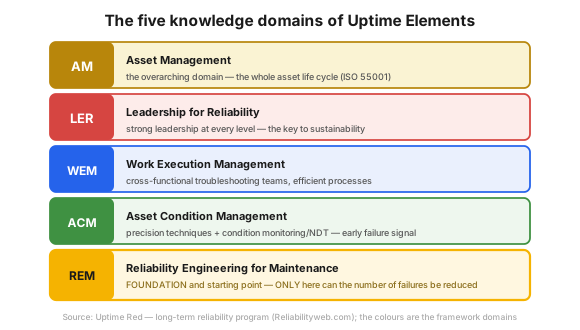 Figure 1 — the five knowledge domains of Uptime Elements; REM is the foundation, AM the overarching frame.
This is the summary article of the chapter. It links every earlier topic of the Maintenance Excellence chapter (from the bathtub curve to the CMMS) into one long-term, leadership-driven program.
Who is this for?
Section titled “Who is this for?”For those who are accountable for reliability and want a lasting program, not a one-off campaign: reliability engineer · maintenance manager · plant manager · shift supervisor · asset management specialist · production and senior leadership · process safety specialist.
Learning objectives
Section titled “Learning objectives”After reading this article you will be able to:
- explain why reliability is a business requirement and not a maintenance task;
- list the five knowledge domains of Uptime Elements, and justify why REM is the foundation;
- explain the four leadership principles and the “there is no reliability without integrity” claim;
- name the executive sponsor’s duties across the three phases of the project;
- outline a change management model for launching your own program.
The essence
Section titled “The essence”- Reliability is a business requirement, not a maintenance task: everyone’s shared business, just like safety.
- The program empowers the Reliability Leader and the team to deliver the high-value program plan.
- Five knowledge domains: REM (foundation) · ACM · WEM · LER · AM (overarching). Four principles: integrity · authenticity · accountability · purpose.
- There is no reliability without integrity: integrity here is not a moral but a performance concept.
- Maturing is progressive, not instant: “a mountain with no summit.”
- Around 70% of initiatives fail; the secret of the successful 30% is leadership at every level, with an executive sponsor.
What is a long-term reliability program?
Section titled “What is a long-term reliability program?”A program that empowers the Reliability Leader and the team to deliver a program plan that creates outstanding value for the organization, along their own sub-goals. Its starting point is that reliability is not the exclusive remit of the maintenance department but a shared task that concerns everyone, and that it is closely bound up with safety performance.
The program is built on the Uptime Elements framework, which draws on surveys carried out under the Uptime Awards at 400 organizations following best practice, on international standards and on studies by recognized authorities. It understands itself in two ways: on the one hand it is a map that makes the interdependencies between the reliability elements interpretable; on the other hand it is a common language, because acquiring knowledge always starts with learning a professional vocabulary built from words, concepts and ideas, just as it does for the medical student or the musician.
Why it matters (the stakes)
Section titled “Why it matters (the stakes)”A well-introduced program brings early, visible results: committed and empowered colleagues, better financial results, fewer safety and environmental events, energy savings, more effective recruitment and retention, a better reputation and brand. Reliability maturity, however, builds progressively: embedding into the culture is not instant. Anyone expecting a full transformation after the first few months will wrongly conclude that the program is not working.
The five knowledge domains
Section titled “The five knowledge domains”Uptime Elements builds reliability on five knowledge domains (see Figure 1):
- REM — Reliability Engineering for Maintenance. The starting point and most important domain of the system, because only within it can the number of failures be reduced. If governance, asset management, condition monitoring and work execution are all of a high standard, you can become more efficient, but the number of failures does not fall. Its aim: preventing the failure mode, predicting the potential failure mode, meeting the requirements. REM is the framework’s knowledge domain and is not identical to the RCM method under SAE JA1011 (see design for reliability, reliability strategy, FMEA, criticality analysis, root cause analysis).
- ACM — Asset Condition Management. Its three principles: precision techniques (lubrication, alignment, balancing) to eliminate defects; condition monitoring and non-destructive testing for early failure identification; a unified information management and decision-support system (IoT, analytics, cloud). (See asset condition management, vibration analysis.)
- WEM — Work Execution Management. Guidance for handling efficiently the tasks arriving from the REM and AM domains. Its strongest concept is the cross-functional troubleshooting team, which works with empowerment on five sources of failure: raw materials and process inputs, operating discipline, maintenance readiness, maintenance materials and storage, and design, delivery and installation. (See preventive maintenance, CMMS.)
- LER — Leadership for Reliability. The road to success runs through leadership, but the results require the involvement of the whole workforce. (See reliability KPIs.)
- AM — Asset Management. The overarching domain, which handles the whole asset life cycle. Asset management is not a noun but a verb: “this is what we do.” (See asset management (ISO 55000).)
The four principles of Reliability Leadership
Section titled “The four principles of Reliability Leadership”The framework does not start with tools but with four leadership principles: the commitment and involvement of any team rests on these.
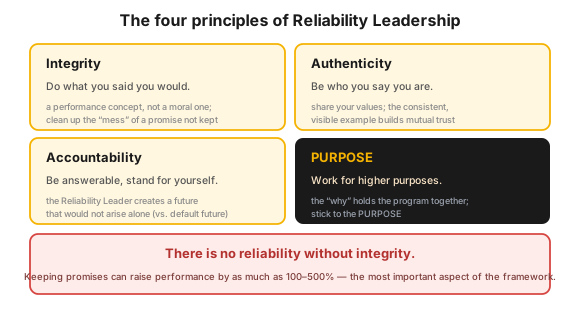 Figure 2 — the four principles and the central claim.
- Integrity — do what you said you would. In the context of Uptime Elements, integrity is not moral or ethical but a performance concept: the state of wholeness/soundness. The bicycle wheel is the vivid image: with intact spokes the performance potential is 100%, with broken spokes the ability to function drops. Integrity is not binary; it is more like a slightly leaking bucket: you are either moving toward credible conduct or away from it. You fill the bucket by clearing up the “mess” of a promise not kept quickly, by owning it and not shifting it onto external circumstances.
- Authenticity — be who you say you are. A consistent, visible example builds trust even in those who do not share your values, and this mutual trust is the foundation of Reliability Leadership.
- Accountability — be answerable, stand behind your position. The Reliability Leader creates a possible future that would not come about by itself, and does so through a statement (a speech act). The default future is neither good nor bad: it is what happens anyway if we change nothing. If that is acceptable, there is no need for Reliability Leadership.
- PURPOSE — work for higher purposes. The leitmotif of the program is a memorable triad. WHY: start with the question, and stick to the PURPOSE. WHAT: track its fulfilment so that everyone communicates consistently (this is where Uptime Elements supplies the common language). HOW: empower frontline colleagues to execute, so they can determine their own future.
There is no reliability without integrity. Keeping promises can raise performance by as much as 100–500%: this is the most important aspect of the Uptime Elements Reliability Framework. A lack of integrity leads to system-level friction.
This is not a slogan but a direct mapping:
| Where integrity is… | …there reliability is |
|---|---|
| the integrity of the system | the reliability of the system |
| the integrity of the structure | the reliability of the structure |
| the integrity of the brand | the reliability of the brand |
| the integrity of the data | the reliability of the data |
| the integrity of the people | the reliability of the people |
The structure of the program
Section titled “The structure of the program”A long-term program built on Uptime Elements consists of the following:
- Creating the future verbally: write a reliability statement, so the team also sees exactly what goals are to be reached.
- Committed work focused on the vision.
- Be authentic, do what you said you would. If you fail, clear up the mess you caused.
- Act: “the universe only listens to action.”
In their own area the Reliability Leader works with four questions, continuously looking for an opportunity to make an impression:
- What is reliability? · 2. What is the source of reliability? · 3. How are reliability decisions made? · 4. What is my role in reliability?
Scope and maturity
Section titled “Scope and maturity”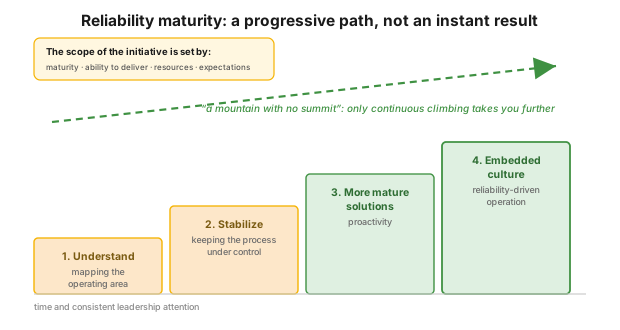 Figure 3 — reliability maturity is a progressive path, not an instant result.
Improving reliability performance is a progressive process. The organization must first understand and stabilize its operating area in order to move toward more mature solutions. The scope of the initiative is set by four factors: reliability maturity, the organization’s ability to deliver, resource constraints and stakeholder expectations. Reliability is not a destination but a long journey: it is like a mountain with no summit, where you only get further by climbing continuously.
Leadership support, sponsorship and vision
Section titled “Leadership support, sponsorship and vision”The foundation of Reliability Leadership is continuous and visible senior leadership role modelling and integrity. Without senior leadership support the initiative does not become embedded in the culture, and the results cannot be sustained.
The executive sponsor is a senior leader with a stake in the project’s success, accountable for delivering the asset management strategy and the reliability program. They are the champion of the project: their task is to identify and communicate the need for change, and to work out the change management model. Their responsibility spans the three phases of the project:
- Planning and design: identifying stakeholders, communicating the need for change, securing resources and training needs.
- Delivery: keeping to the schedule, removing obstacles, developing and communicating the policy, celebrating successes.
- Transition: reviewing the project, ensuring the sustainability of the changes, reinforcing the new behaviour patterns.
Alignment/vision matches the reliability strategies to the corporate and organizational goals and creates a horizontal connection: it bridges the functional silos. The Reliability Leader must align the efforts at the highest possible level of influence, clarifying their own role and that of others. (For the human side of change, see change-curve.)
Roles and responsibilities at every level
Section titled “Roles and responsibilities at every level”Reliability has an owner at every level, and the roles are not interchangeable: senior management sets the risk frame, the employee reports the failure.
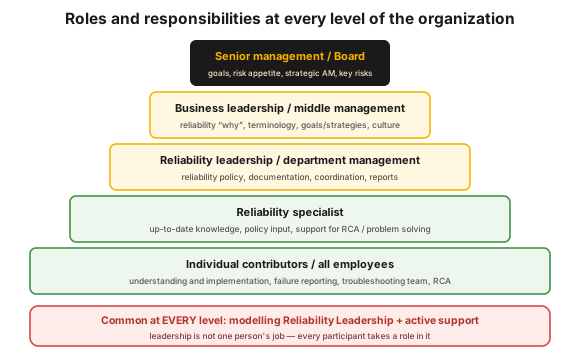 Figure 4 — responsibilities from senior management down to every employee.
- Senior management / Board: defining the organizational goals and the risk appetite, the strategic asset management approach, identifying the key risks.
- Business leadership / middle management: developing the reliability “why” statement and the terminology, high-level goals and strategies, shaping the culture, gaining acceptance for the performance targets.
- Reliability leadership / department management: developing and updating the reliability policy, documenting and coordinating the activities, reporting to senior management.
- Reliability specialist: up-to-date professional knowledge, contributing to the policy, supporting root cause analysis and problem solving.
- All employees: understanding and implementing Reliability Leadership, reporting failures, joining the cross-functional troubleshooting team, taking part in RCA.
Common at every level: modelling Reliability Leadership and giving active support, because leadership is not one person’s job.
Why do programs fail?
Section titled “Why do programs fail?”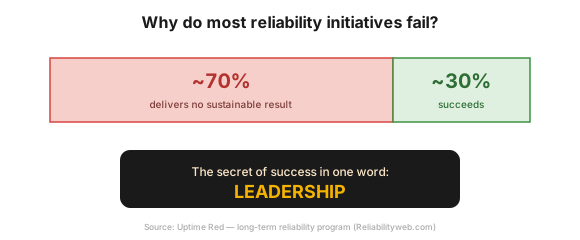 Figure 5 — the sobering statistic and the lesson.
Around 70% of reliability initiatives deliver no sustainable result. What sets the successful 30% apart? The answer is a single word: leadership. World-class organizations adapt modern methods as early as the early stage of the asset life cycle, not only in the operating and maintenance phase, so they put their knowledge of failure modes to use already at the design table.
The introduction material of a process-industry group-level reliability program (anonymized extract) breaks the same thing into four success factors: strong senior leadership support; a solid, central program plan built with the organization’s best specialists; the appointment of a dedicated senior program manager; dedicated, competent resources (asset management teams, reliability engineers). The last two are the most frequently omitted elements: a program does not work with a part-time owner.
Common mistakes
Section titled “Common mistakes”The typical pitfalls are not technical but leadership and timing errors:
- Treating reliability as a maintenance task: it is a business initiative, just like safety.
- Launching without executive sponsorship: it does not become embedded in the culture and is not sustainable.
- Expecting instant results: maturing is progressive, you have to stabilize first.
- Lack of integrity: system-level friction, “there is no reliability without integrity.”
- Skipping REM: the other domains only add efficiency, but do not reduce the number of failures.
- Applying it only in the O&M phase: world-class practice starts at the design table.
When NOT to use it? (the limits of the method)
Section titled “When NOT to use it? (the limits of the method)”The long-term program strengthens the leadership and cultural side of reliability. It is not the first step in every situation:
| Situation | Why this is not primarily the answer | The right answer |
|---|---|---|
| The default future is acceptable (current performance is durably adequate) | the program exists to create a future that would not come about by itself | stay with the existing routine, do not launch a program |
| There is no executive sponsor, only a campaign | without support it does not become embedded in the culture | first a sponsor and a “why” statement, then the program |
| The goal is to eliminate one specific failure | the program is a framework, not a troubleshooting tool | RCA, FMEA, criticality analysis |
| You only want to improve efficiency | governance, ACM and WEM alone do not reduce the failure count | targeted process improvement, then building up REM |
| A certified protective function is needed | the leadership framework is not an audited barrier | design according to SIL/LOPA |
Rule of thumb: for a single asset or failure mode you need a targeted method. Launch the program when you want to make reliability the organization’s way of working for the long term.
How can the program be introduced in practice?
Section titled “How can the program be introduced in practice?”The introduction follows the change management model of the framework, in this order:
- Identify the need: show why the new way of working is required, from the plant floor to the boardroom.
- Identify the people: involve the informal leaders, and set up a committed project steering committee.
- Communicate and teach the four principles: it is not enough to talk about them, they must also be modelled.
- Define the vision: a statement that is understandable at every level, from which you derive the program plan.
- Define the impact: training needs, role redesign, schedule.
- Identify the obstacles: human/cultural, procedural and structural factors; these must be removed.
- Identify the successes: first the measures of success, then incremental success targets, measurement and celebration.
- Identify further opportunities: when you think you have reached the end, you are in fact at the first stop of the next phase.
Hands-on — the first week
Section titled “Hands-on — the first week”Write your own reliability statement on one page: what is the WHY (the purpose), what is the WHAT (two or three measurable results on a one-year horizon), and who owns the HOW. Then put the four Reliability Leader questions to five colleagues: the spread of the answers to “what is reliability?” shows how far the common language is missing.
How does this show up in digital practice?
Section titled “How does this show up in digital practice?”The weakest point of the program is traceability: on paper the statement, the failure list and leadership attention fade fast.
| Program element | Digital implementation | What it delivers |
|---|---|---|
| Failure reporting | shift log entry or CMMS work order with timestamp and owner | the failure is not lost, reporting discipline is measurable |
| ACM / condition monitoring | condition-based (PdM) alert from vibration, thermal and oil data | the potential failure mode is visible early, not at the shutdown |
| Troubleshooting team | a shared action register tagged by the five sources of failure | the recurring failure source is demonstrable, RCA has an input |
| Success measures | asset condition and reliability dashboard | the incremental success target is visible and can be celebrated |
| Active leadership support | the trail of acknowledgement, feedback and recognition in the log | the “modelled behaviour” becomes measurable |
Industrial and safety context
Section titled “Industrial and safety context”The program is industry-independent: the ISO/IEC/SAE standards anchor applies to any asset-intensive industry (energy, manufacturing, chemicals, mining, facilities). Safety and reliability are closely linked: fewer failures mean fewer hazardous operating states and incidents.
Connection to OPEREX (shift log)
Section titled “Connection to OPEREX (shift log)”The long-term program comes alive at shift level: the statement, the main risks and the performance targets become daily practice in the shift log (OPEREX). This is where the troubleshooting team gets the auditable record of failures (RCA input), and where “active support” becomes measurable.
Terminology (HU / EN)
Section titled “Terminology (HU / EN)”| Hungarian | English (canonical) | Note |
|---|---|---|
| Megbízhatóság alapú vezetés | Reliability Leadership | the leadership knowledge domain of the framework |
| RCM vezető | Reliability Leader (CRL) | a specialist certified by the AMP credential |
| Vezetői szponzor | Executive sponsor | the champion of the change |
| Alapértelmezett jövő | Default future | what happens by itself |
| Megbízhatósági nyilatkozat | Reliability statement | the verbally created future |
| Érettségi mátrix | Maturity matrix | the framework’s standalone assessment tool |
| Az 5 terület | REM / ACM / WEM / LER / AM | the knowledge domains |
The terminology follows the usage of Uptime Elements.
What is a long-term reliability program?
A program that empowers the Reliability Leader and the team to deliver a program plan that creates outstanding value for the organization. Its starting point is that reliability is a business requirement and everyone’s shared task, not just maintenance’s.
What is the program built on?
On the Uptime Elements framework: five knowledge domains (REM, ACM, WEM, LER, AM) and four leadership principles (integrity, authenticity, accountability, purpose), anchored in international standards (ISO 55001, ISO 31000).
Why do around 70% of initiatives fail?
Because the leadership needed for a sustainable result is missing: the continuous, visible senior leadership role modelling and integrity, with a dedicated program manager and competent resources.
Why is there "no reliability without integrity"?
Because integrity here is a performance concept (the state of wholeness/soundness). Keeping promises raises performance by as much as 100–500%; a lack of integrity causes system-level friction.
Take it home (keys)
Section titled “Take it home (keys)”- Reliability is a business requirement, not maintenance’s private affair: treat it the way you treat safety.
- Common language first, tools second: Uptime Elements is a map and a dictionary at the same time.
- REM is the foundation: the other domains make you more efficient, but only REM reduces the failure count.
- Without integrity there is no reliability: keeping a promise is measurable performance, not a moral question.
- WHY, WHAT, HOW: the purpose holds it together, measurement aligns it, empowerment executes it.
- Leadership decides: without an executive sponsor, a dedicated program manager and competent resources, the program lands in the 70%.
Self-test
Section titled “Self-test”- Why does the framework say that the number of failures can be reduced only within REM? What do the other four domains give you then?
- Formulate the “default future” of your own area in one sentence, and decide: is it acceptable? What follows from your answer?
- Name the three project phases of the executive sponsor, and one concrete task for each.
Related concepts
Section titled “Related concepts”operational excellence | reliability strategy | the bathtub curve | criticality analysis | FMEA | root cause analysis | design for reliability | asset condition management | vibration analysis | infrared thermography | oil analysis | preventive maintenance | maintenance planning and scheduling | operator-driven reliability | CMMS | asset management (ISO 55000) | reliability KPIs | risk management | training and onboarding | change-curve
Next step
Section titled “Next step”If you have understood this, from here it is worth going on — in this order:
- reliability strategy — the entry point to the REM domain: from the program plan to a concrete maintenance strategy.
- reliability KPIs — the measures of success, without which you cannot even set a success target.
- asset management (ISO 55000) — the overarching AM domain and the standards frame.
References / further reading
Section titled “References / further reading”- Reliabilityweb.com (NetexpressUSA Inc.), Terrence O’Hanlon: Uptime Elements reliability framework, Hungarian translation — the primary source of this article.
- Association of Asset Management Professionals (AMP): the CRL (Certified Reliability Leader) credential program, which provides a unified approach to building a sustainable reliability and asset management framework.
- Terry Wireman: The NEW Asset Management Handbook (ISBN 9781939740519) — the background of the vision and asset management concept.
- Asset management and risk: ISO 55000/55001/55002; ISO 31000, ISO/IEC 31010.
- Reliability data, condition monitoring, methods: ISO 14224; ISO 17359, ISO 13372/13373/13381, ISO 18436-x, ISO 29821, ISO 18434, ISO 20958; IEC 60300, IEC 60812 (FMEA), IEC 61078 (RBD); SAE JA1011/JA1012 (RCM); ISO 9001, ISO 14001, ISO 50001.