Autonomous maintenance
≈ 16 min read · 3,119 words
Autonomous maintenance (jishu hozen) means operators themselves perform simple maintenance jobs on their own equipment, so faults are fixed faster.
In English it is called autonomous maintenance or maintenance by operators, in Japanese jishu hozen. It covers lubrication level checks, leak searching, re-tightening bolts and gaskets, venting, and cleaning with visual inspection. Because the operator is right next to the machine, they react faster to a fault they find, which improves asset condition, reduces downtime and increases reliability. It has two guiding principles: it prevents equipment deterioration through correct operation, and it keeps the correct operating condition through correct management. It changes the traditional “I operate it, you fix it” attitude: it creates a win-win situation between operator and maintainer, and builds a sense of ownership toward the equipment.
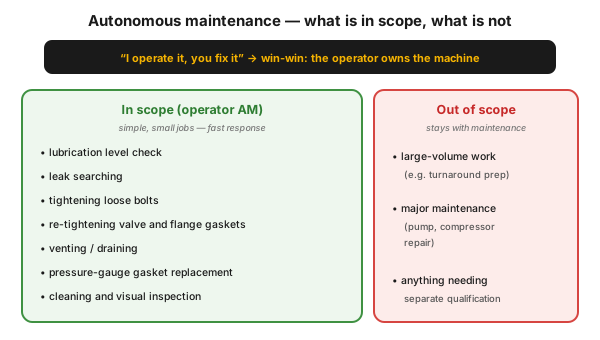 Figure 1 — the scope of AM: what the operator does, and what stays with maintenance.
Who is this for?
Section titled “Who is this for?”This article is for those who meet the small anomalies of equipment and the maintenance–operator boundary in daily operations: operator, shift leader, plant manager / asset team leader, maintainer and reliability engineer, process engineer, plus the HSE / process safety (PSM) function that oversees the framework.
Learning objectives
Section titled “Learning objectives”After reading this article you will be able to:
- say what autonomous maintenance is, and what work belongs to it (and what does not);
- list the conditions of a safe introduction and the seven-step framework;
- explain why a job safety analysis (JSA) is mandatory for every single activity;
- decide when a fault must be escalated to the risk assessment meeting instead of AM;
- name the typical metrics of AM and the rhythm of reporting.
In brief
Section titled “In brief”- The operator does the small job: lubrication, leak searching, bolt/gasket re-tightening, venting/draining, cleaning and visual inspection next to the machine, fast.
- The shift in attitude: “I operate it, you fix it” turns into win-win and ownership; the operator owns the machine.
- Two guiding principles: you prevent equipment deterioration through correct operation, and keep the correct operating condition through correct management.
- Scope boundary: AM is not high-volume work (turnaround preparation) or serious work (pump or compressor repair) — that stays with maintenance.
- Defined assets: every plant designates in documentation which equipment AM may be performed on.
- Strong documentation: an AM process description, SOPs for the individual jobs, safety rules, risk assessment (pressure, temperature, hazardous medium), a minimum tools list.
- Only an examined operator, on a written work order, after the safety conditions are met, then feedback to the shift leader.
- If it cannot be repaired as AM: the fault goes to the daily risk assessment meeting (RBWS), and from there enters the normal maintenance process.
- It is measured: the hours worked and the cost are recorded, followed by monthly/quarterly reporting and an annual self-audit.
- A pillar of TPM: autonomous maintenance is the second pillar of TPM; the boundary is the key to operator–maintainer collaboration.
Why it matters
Section titled “Why it matters”Autonomous maintenance (AM) makes it possible for operators to carry out directly those simple/small maintenance jobs that by their nature fit into operations and do not clash with the operator’s core duties. Because the operator is on site, they react faster when they notice a fault: as a result asset condition improves, the number of shutdowns/upsets decreases, and reliability increases.
AM rests on two classic guiding principles: it prevents equipment deterioration through correct operation, and it keeps the equipment in the proper operating condition through correct management. This requires the operator to know their machine well, to recognize when it behaves differently from usual, and to document every observation during the round.
The other important benefit is cultural: AM breaks down the traditional “I operate it, you fix it!” attitude and creates a win-win situation between operator and maintainer. The operator becomes proud of the equipment they know intimately; this is the “ownership” foundation of the production reliability program in practice.
What is autonomous maintenance, and what work belongs to it?
Section titled “What is autonomous maintenance, and what work belongs to it?”Autonomous maintenance is the small, well-bounded maintenance the operator performs on their own machine; high-volume and serious repair does not belong to it. Doing this work becomes part of operating the production assets: it is more advantageous and more efficient if the personnel already present handle it operationally than if a maintenance contractor were called. Typical AM activities:
- checking lubrication levels;
- searching for leaks;
- tightening loose bolts;
- re-tightening / re-sealing valve gaskets and flange gaskets;
- re-sealing the gasket of the vent/drain plug;
- venting / draining the process equipment;
- replacing the gasket under a pressure gauge;
- cleaning and visual inspection.
AM is not about the following: high-volume work (e.g. preparing a major overhaul/turnaround) or serious maintenance (e.g. pump or compressor repair). Every plant designates in its documentation which equipment AM work is performed on.
Conditions of introduction: documentation, tools, examination
Section titled “Conditions of introduction: documentation, tools, examination”AM is safe only under strict conditions. The related documentation:
- an AM process description;
- work procedures (SOPs) for the individual jobs;
- safety rules, a risk assessment and the specified risk factors (pressure, temperature, hazardous medium);
- the list of the minimum tool kit (wrenches, gaskets, grease, pliers, hammer, brush, screwdriver, tarpaulin, shovel, etc.).
The introduction follows the seven-step framework below:
- Designating the activities. Starting from the group-level minimum list and tailoring it to local practice, define which jobs fall within the scope of AM; the list can be extended regularly.
- Job safety analysis (JSA) per activity. A separate JSA is prepared for every designated job, with the involvement of local HSE and the process safety (PSM) organization; this decides whether, from a safety viewpoint, the operator may perform it, and under what safety measures.
- Competence and training. A competence level recorded per activity, training material with the JSA and pictures of the steps, then theoretical and practical training with a documented examination: only an examined operator may do the job.
- Tool and material needs. Working out the minimum tools list and providing the tools to the operators; setting up controlled material supply and storage (a small plant “H” store).
- Alignment with the affected organizations. Documented alignment of Operations, Maintenance, the SSC and, where needed, the occupational safety representation.
- Extending the job description to the AM jobs.
- A reporting and continuous improvement process. Daily recording of the jobs and the hours spent, monthly and quarterly reporting, plus an annual self-audit (see the Measurement and audit section).
Controlled execution
Section titled “Controlled execution”AM does not work on a “do it as you see fit” basis: it is a controlled process (Figure 2).
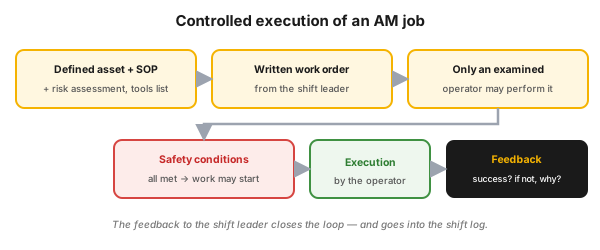 Figure 2 — the controlled execution of an AM job, from the written work order to the feedback.
- The shift leader (or a person authorized by them / the operational coordinator) is responsible for issuing the written work order for the AM job. The order includes the name of the designated employee, the safety measures and the estimated duration (start and finish).
- Only an employee who has passed the examination on the AM training and procedures may perform it.
- The designated employee may only start if all safety conditions prescribed in the order have been met.
- After the job the employee gives feedback to the shift leader: was it successful, and if not, what was the reason, plus what material was used.
- If the fault cannot be repaired as AM: it does not stay with the operator. The shift leader prepares a report, which goes to the daily risk assessment meeting (RBWS, Risk Based Work Selection), and from there moves on into the normal (E2E) maintenance process, where operational maintenance deals with it.
Measurement and audit
Section titled “Measurement and audit”Autonomous maintenance really comes alive when it is measured: the work done and the hours spent must be recorded daily, and regular reporting must follow. The typical metrics:
| Metric | What it shows |
|---|---|
| Work hours performed by operators | per activity and per shift |
| Cost saved with AM | the value of substituting maintainer/contractor work |
| Operator vs. SSC/contractor hour ratio | how much of a given activity AM performs |
| Number of trained operators | an indicator of coverage and capacity |
| Material and tool cost | material used, tools purchased or rented |
| Activities that can be taken over | which SSC/contractor jobs could still move into AM |
The report is discussed monthly by the asset team (AT) and quarterly by the business team (BT), and the improvement proposals are born from this. Compliance with the rules is checked by an annual self-audit against a checklist (the AM audit questionnaire): this closes the continuous improvement loop.
Connection to TPM and the operator–maintainer boundary
Section titled “Connection to TPM and the operator–maintainer boundary”Autonomous maintenance is the second pillar of TPM (Total Productive Maintenance), jishu hozen. In the logic of TPM the operator “takes the machine in hand” daily (cleans, lubricates, inspects) and signals the anomaly early, so the maintainer can concentrate on complex, planned work. Good functioning requires a clear but cooperative division of labour; its details are discussed in the operator–maintainer collaboration article. AM is therefore not “doing the maintainer’s job for free” but the correct allocation of responsibility: daily basic care and early signalling belong to the operator, skilled repair to the maintainer.
Process-industry and safety context
Section titled “Process-industry and safety context”In a Seveso plant AM is safety-critical — which is exactly why the framework is strict. Even a “simple” gasket re-tightening can be dangerous if the equipment is under pressure, hot or contains a hazardous medium; this is why a risk assessment per job is mandatory, together with specifying the risk factors (pressure, temperature, medium), the written work order, the examination and the fulfilment of the safety conditions before the start. Breaking containment under pressure, draining and venting are the territory of LMRA/JSA. AM therefore does not loosen discipline but tightens it: fast operator intervention is permitted only in a controlled, trained and documented form, and loss reduction can never come at the expense of safety.
How you would introduce it tomorrow (mini-scenario)
Section titled “How you would introduce it tomorrow (mini-scenario)”If, as a shift leader, you started with a single activity, the first round would look roughly like this:
- Choose a low-risk job (e.g. a lubrication level check on a specific pump), and designate the equipment.
- Prepare the JSA with the involvement of HSE and process safety; write down the safety conditions (e.g. machine stopped, medium removed).
- Write an SOP for that job, with step-by-step photos, and put together the minimum tool kit.
- Train and examine 1–2 operators; add the job to their job description.
- Issue a written work order for the first real case; the job may only start once the safety conditions are met.
- Ask for feedback (was it successful, what was the reason, what was used), and record the hours. If it does not work as AM, take it to the risk assessment meeting.
- After a month look at the metrics, and decide which activity you bring in next.
Common mistakes
Section titled “Common mistakes”- AM without a framework: “the operator will just do it” without an SOP, risk assessment and examination — this leads to an accident.
- Too wide a scope: serious repair (pump, compressor) or turnaround preparation under the “AM” label.
- No tools: the lack of the minimum tool kit leads to rushing and improvisation.
- Without a written work order and feedback: it is not documented who did what, and whether it succeeded.
- The job description is not extended: formally it is not clear that AM is the operator’s task.
- An operator without an examination: “I showed it once” is not training.
- No escalation: the fault that cannot be repaired is “left with” the operator instead of being taken to the risk assessment meeting.
- No measurement: without hours and reporting AM cannot be audited, and the improvement does not happen either.
When NOT to use it? (the limits of the method)
Section titled “When NOT to use it? (the limits of the method)”Autonomous maintenance is not a universal tool; there are situations where it is expressly the wrong choice:
- If, according to the JSA, the job is not safe with an operator. If the equipment cannot be brought into a safe state (under pressure, hot, hazardous medium) and the JSA says no, the job stays with maintenance.
- High-volume or complex work. Turnaround preparation, pump or compressor repair does not fit into AM; the normal maintenance process is meant for these.
- If the framework is missing. Without an SOP, risk assessment, examination, tools or a written work order it is forbidden to perform the work as AM.
- If it would jeopardize the core duty. Only operator capacity above what safe operation requires may be spent on AM; if there is none, it must not be forced.
- On a certified safety function. No intervention whatsoever may be performed “as AM” on a SIL-rated safety instrumented system (LOPA and SIL).
Take it home (keys)
Section titled “Take it home (keys)”- Start with a single, low-risk activity, and build from the JSA: the framework comes before the work.
- Only an examined operator, on a written work order, after the safety conditions are met: this is not a loosening but a tightening.
- Build feedback and hour recording into every AM job; without measurement AM is invisible.
- Fix the escalation route: whatever does not work as AM goes to the risk assessment meeting.
- Do not forget the scope boundary: serious and high-volume work belongs to maintenance.
Self-test
Section titled “Self-test”- On the round an operator finds a loose flange bolt on a hot line under pressure. May they do it as AM, and what does the answer depend on?
- Why is the JSA mandatory per activity, and who must be involved?
- What happens to a fault that cannot be repaired as AM?
Answer key: 1) Only if the JSA prepared for that activity rates it safe and the equipment can be brought into a safe state, there is an SOP for it, the operator has passed the examination, and the shift leader has issued a written work order; if any of these is missing, no. · 2) Because every job has a different risk profile; local HSE and process safety (PSM) decide per activity whether it can be performed by an operator and under what measures. · 3) The shift leader prepares a report, which goes to the daily risk assessment meeting (RBWS), and from there enters the normal maintenance process.
How does it show up in digital practice?
Section titled “How does it show up in digital practice?”The principle of autonomous maintenance does not stop at the paper work order: the same “detection → work order → execution → feedback” loop is realized in software too, only the mechanism is more modern and auditable.
| Concept | Digital implementation | Value |
|---|---|---|
| Detecting an anomaly on the round | mobile operator round / e-log entry | an immediately recorded, searchable trail, on the spot |
| Ordering the AM job | CMMS work order (with safety conditions, tied to the examination) | only an authorized person may do it, every condition is documented |
| Feedback on the job | structured confirmation on the work order (success/reason/material) | an auditable result, no information lost |
| Recording hours and material | automatic KPI collection | the monthly/quarterly report produces itself |
| Escalation | a digital report to the risk assessment meeting | not a single fault disappears from the system |
Connection to OPEREX (shift log)
Section titled “Connection to OPEREX (shift log)”The data footprint of AM naturally fits into the shift log. The written work order, the execution and the mandatory feedback (was it successful, and if not, why) can be recorded and retrieved in OPEREX; this closes the loop toward the shift leader. The log links the standard operator round (where the anomaly, the leak, the loose joint, the missing lubrication is detected) to the AM action: the round observation becomes an entry, the entry an AM work order, that a completed job and a feedback, all in one auditable chain. This way it is visible shift by shift what was done on the equipment, by whom and with what result.
Terminology (HU / EN / JP)
Section titled “Terminology (HU / EN / JP)”| Hungarian | English (canonical) | 日本語 (rōmaji) |
|---|---|---|
| autonóm karbantartás | autonomous maintenance | jishu hozen (自主保全) |
| karbantartás operátorokkal | maintenance by operators | — |
| napi alapápolás | basic care (clean, lubricate, inspect) | — |
| írott megrendelés | written work order | — |
| korai hibajelzés | early failure detection | — |
| eszközlista (minimum) | minimum tools list | — |
| munkabiztonsági elemzés | job safety analysis (JSA) | — |
| kockázatértékelő értekezlet | risk based work selection (RBWS) / gatekeeping | — |
The English and Japanese technical terms are validated from the bilingual source and from established TPM terminology.
What is autonomous maintenance?
The practice in which operators directly carry out simple, small maintenance jobs on their own equipment (lubrication, leak searching, bolt/gasket re-tightening, venting, cleaning and visual inspection). Because the operator is next to the machine, they react faster to the fault, which improves reliability.
What work is NOT autonomous maintenance?
High-volume work (e.g. preparing a major shutdown/turnaround) and serious maintenance (e.g. pump or compressor repair) are not AM; these stay with maintenance. AM is about small, well-bounded jobs that can be done quickly.
Can anyone perform AM work?
No. Only an operator who has passed the examination on the AM training and procedures, on a written work order, and they may only start once all prescribed safety conditions are met. At the end of the job it is mandatory to report the result back to the shift leader.
What happens if the fault cannot be repaired as AM?
The shift leader prepares a report on it, which goes to the daily risk assessment meeting (RBWS), and from there moves on into the normal (E2E) maintenance process, where operational maintenance handles it.
How is autonomous maintenance measured?
With daily hour recording and regular reporting: operator work hours per activity/per shift, the cost saved with AM, the operator vs. SSC/contractor hour ratio, the number of trained operators, material and tool cost. The report is discussed monthly by the asset team and quarterly by the business team, and an annual self-audit checks it.
How does AM relate to TPM?
Autonomous maintenance is the second pillar of TPM (Total Productive Maintenance), jishu hozen. TPM entrusts daily basic care and early failure signalling to the operator, and frees the maintainer for complex, planned work; the clear, cooperative boundary between the two is the key.
Related concepts
Section titled “Related concepts”production reliability program · TPM · operator–maintainer collaboration · standard operator round · 5S · housekeeping · special operating instructions · training and competence
Next step
Section titled “Next step”- Start with the standard operator round: this is where the anomalies that trigger AM work are detected.
- Look at TPM as a whole, to see where AM fits in as the second pillar.
- Go deeper into operator–maintainer collaboration, so that you see the responsibility boundary clearly.
References / further reading
Section titled “References / further reading”- Seiichi Nakajima: Introduction to TPM: Total Productive Maintenance (TPM Nyumon), Japan Institute of Plant Maintenance (JIPM): the canonical source of autonomous maintenance (jishu hozen) as a pillar of TPM.
- Japan Institute of Plant Maintenance (JIPM): the custodian of the TPM and jishu hozen methodology.