5S methodology
≈ 8 min read · 1,535 words
5S is a Japanese-origin visual workplace-organization method built on five sequential steps that each start with “S” — Seiri (Sort), Seiton (Set in order), Seiso (Shine), Seiketsu (Standardize) and Shitsuke (Sustain). Its goal is to create and durably maintain an orderly, transparent, efficient and safe work environment. Its guiding principle is “a place for everything, and everything in its place,” so no time is lost searching and hidden risks (a leak, a blocked escape route, a tool left behind) become visible. 5S is the stabilizing foundation of the Lean operating system, the base on which standard work and visual management are built.
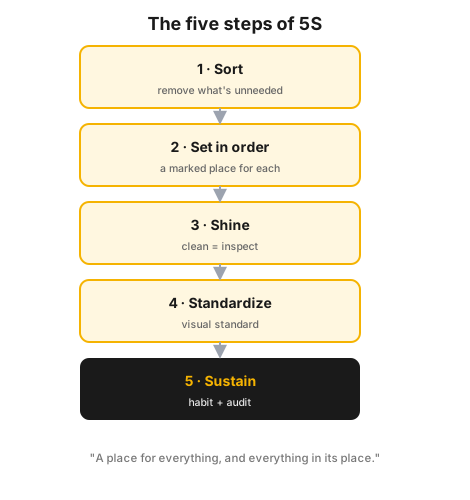 Figure 1 — the five steps of 5S.
- 5S is not a one-off clean-up but a sustained system: order made visible and self-maintaining.
- Five steps: 1S remove the unneeded, 2S a marked place for each item, 3S cleaning = inspection, 4S visual standard, 5S sustained as a habit + audit.
- Clutter creates search time (waste), confusion and hidden safety risk — 5S eliminates it.
- In process industries 5S is a direct safety tool: clear escape routes, early leak detection, clean work.
- Without 4S (standard) and 5S (sustain) the result slides back — hence the audit and the daily routine.
- Measurable: a 5-question, scored audit sheet (see below, downloadable template).
- OPEREX link: end-of-shift 5S status and audit results can be logged auditably in a shift diary.
What 5S is and where it comes from
Section titled “What 5S is and where it comes from”5S spread from the Toyota Production System (TPS); its name comes from the initials of five Japanese words. It is a “defined, simple visual method” that keeps the workplace neat and clean to eliminate waste (muda), unevenness (mura) and inflexibility (muri). A successful 5S produces a workplace where “everything has its place and everything is in its place”: tools sit at the point of use, at eye level, visible — not hidden away in boxes.
The five steps
Section titled “The five steps”1S — Sort (Seiri)
Section titled “1S — Sort (Seiri)”Separate what is needed from what is not, and remove the unneeded. Every item is qualified: is it needed at all, and if so, is its quantity and quality appropriate? The unneeded is marked with a red tag and moved to a separate red-tag (holding) area; a designated owner always decides on each item (keep elsewhere, relocate, sell or scrap). Uncertain items get a yellow tag with a decision due by a set date.
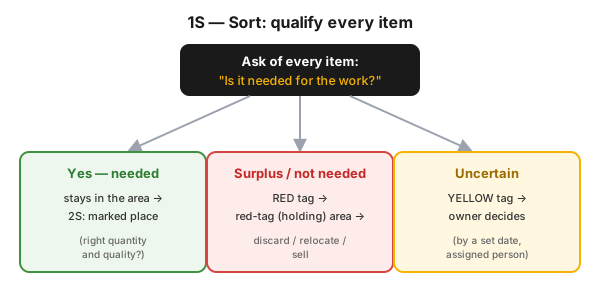 Figure 2 — the 1S sorting decision logic.
2S — Set in order (Seiton)
Section titled “2S — Set in order (Seiton)”Everything gets a designated, visually marked place. Location is decided by frequency and nature of use: an individually, daily-used tool goes at or next to the workstation; a shared daily item in a central place; an equipment-specific item next to the machine; a rarely used item near the department in a visualized location. Tools: labels, floor marking, shadow boards, color coding, min/max visualization. The goal is to find any tool in ~30 seconds and to make its return location unambiguous.
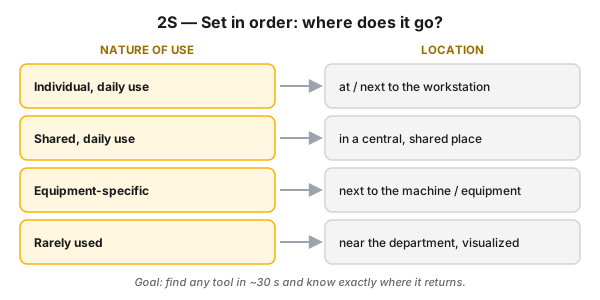 Figure 3 — the 2S placement logic (frequency of use → location).
3S — Shine (Seiso)
Section titled “3S — Shine (Seiso)”Cleaning the whole work area, which is also inspection: while cleaning, leaks, corrosion, wear or loosened joints become visible. 3S targets the source of contamination, not just the symptom. It starts with an initial deep clean, then a cyclical cleaning plan (daily/weekly/monthly/yearly) with owners — the real question is “10 minutes a day, or a whole shift once a month?”.
4S — Standardize (Seiketsu)
Section titled “4S — Standardize (Seiketsu)”Locking in the first three S’s with a visual standard: a needed-items list, labels and markings, a cleaning schedule and log, a reference photo of the ideal (standard) state, and a training matrix. The aim is for anyone to maintain the state identically and for deviation to be instantly visible.
5S — Sustain (Shitsuke)
Section titled “5S — Sustain (Shitsuke)”Holding and improving the achieved state through a daily routine (e.g. a few minutes at end of shift), training, regular audits and recognition. This is the hardest step because it must become a habit; without a standard and audits the state slides back into stagnation and then disorder.
5S and safety (process industry / Seveso)
Section titled “5S and safety (process industry / Seveso)”In a continuously operating hazardous facility, 5S is a direct safety tool, not cosmetics — as the source material stresses, “a clean workplace increases both product and occupational safety.” Concretely:
- the color-coded traffic and escape routes set up in 2S, and the shadow-boarded, always-clear location of emergency exits and fire equipment, speed up emergency response;
- orderly chemical and tool storage reduces the risk of wrong intervention and hazardous-material release;
- 3S-as-inspection detects early steam, oil or lubricant leaks, corrosion and loosening (together with pipe labeling);
- the trip and accident hazard of disorderly cables/hoses is removed by sorting and arrangement.
Waste reduction must never come at the expense of safety: in motion and layout optimization, occupational-safety and Ex (explosion-protection) rules take precedence.
Putting it into practice (PDCA roadmap)
Section titled “Putting it into practice (PDCA roadmap)”5S starts in a designated pilot area, in a PDCA cycle:
- PLAN — choose the area (Where?) and team (Who? — everyone in their own area), train, capture the current state with a photo.
- DO — in 1S→5S order: red/yellow tagging and red-tag area; ideal layout, floor and location marking, shadow boards; deep clean and a cyclical cleaning plan; a written 5S work instruction and standard photo; a 5S board, audit sheet and audit plan.
- CHECK — regular (e.g. weekly) audits, comparing the state to the standard.
- ACT — communicate audit results, build them into performance reviews, implement the “quick-win” improvements raised.
Hands-on — 5S workshop and homework
Section titled “Hands-on — 5S workshop and homework”The source material (Lean Academy, 5S workshops) includes concrete, runnable exercises:
- 5S game / simulation — a short group game that lets people experience how much time and error clutter causes, and how much order improves.
- Timed process exercise — participants run a full process against the clock (the source’s example: signing a contract — call the customer, agree the terms, fill in the contract, request manager approval). First in a disorderly setting, then after 5S — the difference in time is the lesson.
- Homework — everyone applies 1S–2S to their own area (needed-items list, red-tag area, location marking), then fills in the 5S Audit Sheet and posts the standard-state photo.
- “Quick win” — a fast, small-scope but visible improvement (e.g. tidying one cabinet or shortening a document path) to build commitment.
5S audit and scoring
Section titled “5S audit and scoring”5S lives only if it is measured. The proven audit sheet scores five questions (one per step), with a designated area 5S owner, a date and monthly tracking. Downloadable, brand-free version: 5S Audit Sheet template.
| Step | Audit question (yes → point) |
|---|---|
| 1S Sort | Is there any unneeded item in the area (vs. the needed-items list)? |
| 2S Set in order | Are needed items in their designated places (per the standard photo)? |
| 3S Shine | Are items/containers clean and tidy? Do markings clearly identify the contents? |
| 4S Standardize | Is the standard-state photo and the identifying labeling displayed? |
| 5S Sustain | Is the audit sheet present, and the current 5S result on the performance board? |
Office vs. plant
Section titled “Office vs. plant”5S is not only for the shop floor: it works in the office too (tidy cables, document structure, “needed items” from drawer to shelf). The source shows concrete office “quick wins” (e.g. shortening an over-long document path) — the principle is the same, only the items differ.
Common pitfalls
Section titled “Common pitfalls”- Doing only 1S–3S (order and cleanliness) and skipping 4S and 5S → the state slides back.
- Treating 5S as a one-off action, without audits and a daily routine.
- Private tool sets (instead of shared) — making standardization harder.
- 3S as “just cleaning”, without inspection — losing early fault detection.
- Sacrificing safety for the appearance of “order” (e.g. a blocked valve for a tidier layout).
OPEREX link (shift diary)
Section titled “OPEREX link (shift diary)”The source explicitly ties 5S to the “My area” shift handover. A digital shift diary (OPEREX) captures this in a structured way: the outgoing shift documents the area’s housekeeping state (optionally with a photo), the incoming shift acknowledges it, and the weekly/monthly audit result plus corrective actions (what / who / by when) are retrievable as an ISO 45001 §10.2 audit trail. Thus 5S becomes a shift-by-shift measured, auditable routine rather than a campaign.
Terminology (HU / EN / JP)
Section titled “Terminology (HU / EN / JP)”| Hungarian | English (canonical) | 日本語 (rōmaji) |
|---|---|---|
| Szelektálás | Sort | Seiri (整理) |
| Elrendezés | Set in order | Seiton (整頓) |
| Tisztítás / ellenőrzés | Shine | Seiso (清掃) |
| Standardizálás | Standardize | Seiketsu (清潔) |
| Fenntartás | Sustain | Shitsuke (躾) |
| Árnyéktábla | Shadow board | — |
| Piros címke | Red tag | — |
English terms validated from the bilingual source material (Lean Academy, 5S guideline).
What do the five "S" letters mean?
Seiri (Sort), Seiton (Set in order), Seiso (Shine), Seiketsu (Standardize) and Shitsuke (Sustain) — from separating items to daily-sustained order.
Why aren't the first three S's enough?
1S–3S remove chaos, but without 4S (Standardize) and 5S (Sustain) the state slides back. Durable results come only from a visual standard and regular audits.
How does 5S improve safety in a process plant?
It clears walkways and escape routes, reduces trip and falling-object hazards, gives orderly chemical storage, and through regular cleaning-as-inspection makes leaks or faults visible early.
How does 5S relate to shift handover?
Sustaining 5S depends on regularly handing over “your area”; the area’s housekeeping is a checked point of the shift handover that a digital shift diary can document and audit.
Related concepts
Section titled “Related concepts”muda | mura | muri | standard work | visual management | gemba-walk | kaizen | shift handover | A3 report