The iceberg model: why mindset is the key to transformation
≈ 17 min read · 3,409 words
A new system has just been rolled out at your site: shiny new boards, KPIs, morning meetings, training courses. Six months later, everything is back to the old ways. The boards have ended up in a dusty corner, the old habits have returned. Sound familiar? This is the fate of most transformation programs, and almost never because the tools were bad. What happens is that the program treated the tip of the iceberg: the part it could see, the behavior. Below the water, however, the larger block remained, the one that actually decides: how people think and feel. The iceberg model makes exactly this visible, and shows how lasting change can be achieved after all.
According to the iceberg model, behavior is only the visible tip of the iceberg; below the waterline, thinking, values and identity remain hidden. The hidden layer comprises thoughts and feelings, values and priorities, as well as needs and identity. About 70% of transformation programs fail to reach their goal, typically because of employee mindsets and behaviours. Lasting, sustainable change comes about only when we also address the layers below the water, with four simultaneous levers: understanding and commitment, aligned systems, skills and role modeling.
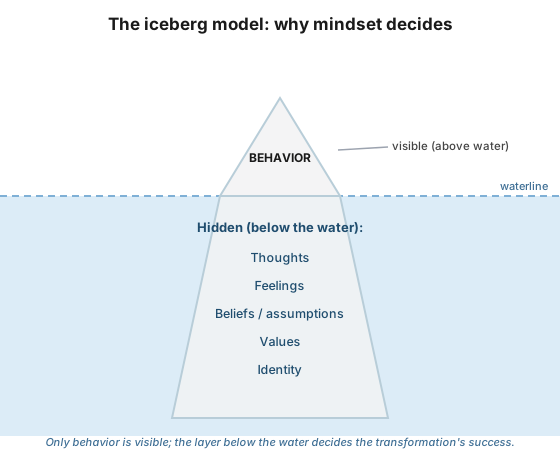 Figure 1 — only behavior is visible above the waterline; the layer below the water (thoughts, feelings, values, identity) decides the success of the transformation.
Who is this for?
Section titled “Who is this for?”This article is for those who want to launch or sustain change in an organization: plant and site manager · shift supervisor · Lean/CI specialist · change leader · HR and training · project manager · team leader.
Learning objectives
Section titled “Learning objectives”After reading this article you will be able to:
- explain why most transformation programs fail, and what the main cause is;
- name the layers of the iceberg, and show which is visible and which decides;
- distinguish a mindset shift achieved by compulsion (compliance) from one achieved by inner choice;
- list the four levers, and justify why all four are needed at once;
- recognize when the iceberg model is not the right tool.
The essence
Section titled “The essence”- ~70% of transformations fail, most often because of mindset/behavior and leadership conduct that does not support the change.
- Iceberg model: behavior is the visible tip; below it, hidden, are the thoughts/feelings, values/priorities, needs/identity.
- What we manage is behavior; what we do not see is the layer below the water, yet this is what decides the change.
- Two kinds of shift: compulsion (compliance) or inner choice (a genuine shift in thinking); only the latter lasts.
- Four levers are needed at once: understanding and commitment, aligned systems, skills, role modeling.
- The iceberg is the mindset element (M&B) of Lean’s three lenses: even the best technical system stalls if the layer below the water does not move.
Why do 70% of transformations fail?
Section titled “Why do 70% of transformations fail?”About 70% of transformation programs fail to reach their set goal. Yet the cause of failure is rarely the wrong tool or an incomplete plan: in the overwhelming majority of cases it is the human factor that sinks the program.
If we break the failures down by cause, the pattern emerges:
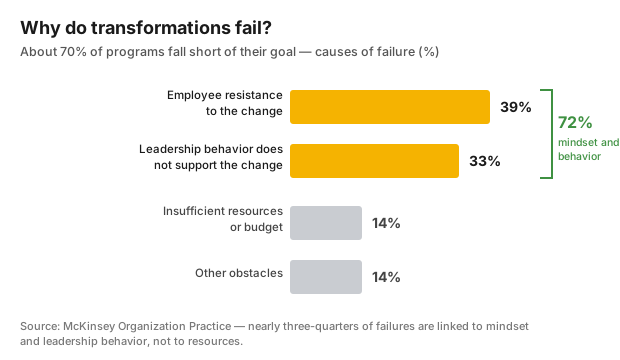 Figure 2 — the causes of failure: employee resistance and leadership conduct that does not support the change together account for nearly three-quarters of failures; lack of resources is a far smaller factor.
- employee resistance to the change (the largest single item),
- leadership behavior that does not support the change,
- insufficient resources or budget,
- other obstacles.
The common denominator is striking: the two biggest causes, resistance and leadership conduct, are both about mindset and behavior, not about tools or money. Programs concentrate on the visible layer (behavior, tools, processes) and leave out the layer below the water (thinking, values, identity). Yet behavior springs from these, which is why treating the surface alone does not hold.
The layers of the iceberg: what do we see, and what really decides?
Section titled “The layers of the iceberg: what do we see, and what really decides?”The essence of the iceberg model is that what we see on the surface and try to manage is only behavior, while the decisive mass sits below the waterline, invisible. The mindset is typically well below the waterline, which is why it is hard to notice and to address.
| Layer | Where it is | What it contains |
|---|---|---|
| Behavior | above the waterline (visible) | what we do; this is what we see and try to manage |
| Thoughts / feelings | below the water | how we interpret the situation |
| Values / priorities | below the water | what matters to us |
| Needs / identity | deep | who I am, what I need |
Why this shape? The iceberg metaphor is not decoration: it teaches that the small tip above the water is held in place by the large block below. If you only carve the tip (a rule, a reward), the block pushes it back to the old state. The tip moves for good only if the layer below the water also moves.
Compliance vs. choice: why is a rule not enough?
Section titled “Compliance vs. choice: why is a rule not enough?”A mindset shift can be achieved in two ways, and the two differ fundamentally in quality: compulsion is fast but shallow, inner choice is slower but lasting.
- By compulsion (compliance): we prescribe, reward and drill the desired behavior. It is fast and seems to work, but as soon as the compulsion or the reward ends, the old behavior returns, because the underlying layer has not changed.
- By inner choice: a genuine shift in thinking, when the person themselves sees the point of it and feels it is their own. Slower, but lasting, because the layer below the water has moved too.
How do we move the layer below the water? The four levers
Section titled “How do we move the layer below the water? The four levers”A lasting mindset change stands on four equal conditions. The idea can be put in a single sentence: “I will change my mindset and my behavior if…”, and this sentence can be completed in four ways. This is McKinsey’s influence model (Influence Model), and its point is that all four conditions must be met at once.
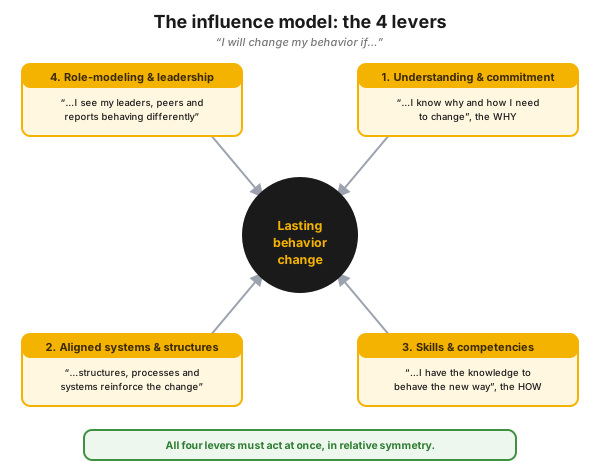 Figure 3 — the four levers from the influence model: lasting behavior and mindset change comes about only when all four (role modeling, understanding and commitment, aligned systems, skills) act at once, in relative symmetry.
- Understanding and commitment: “…I know why and how I must change, I agree with it, and it makes sense to me.” This calls for a story (the mission, the vision and the values, formulated and told consistently at every level).
- Aligned systems and structures: “…the structures, processes and systems support the desired change.” This includes the goals and metrics, the management processes, as well as rewards, recognition and consequences.
- Skills and capabilities: “…I have the knowledge and the ability to behave in the new way.” This calls for training, on-the-job development, coaching and talent management.
- Role modeling: “…I see that my leaders, my peers and my reports also behave differently.” The leader is no exception: they too work in the new way, are present at the gemba, and take part in the training.
All four at once are needed. If any one is missing, the layer below the water does not move, and the change slides back. If there is understanding but no skill, the person would want to but cannot; if there is skill but no role model, the whole thing is not credible; if everything is in place but the systems reward the old behavior, the structure works against the change.
| Lever | The end of the sentence | If it is missing |
|---|---|---|
| Understanding and commitment | “I know why and how” | it seems a pointless compulsion |
| Aligned systems | “the systems support it” | the structure rewards the old behavior |
| Skills and capabilities | “I am able to do it” | they would want to, but do not know how |
| Role modeling | “others behave differently too” | not credible, “do as I say, not as I do” |
The iceberg in the Lean system: the M&B element of the three lenses
Section titled “The iceberg in the Lean system: the M&B element of the three lenses”The iceberg is not a standalone theory: it is one element of Lean’s three lenses. A Lean implementation succeeds only if all three lenses are present at once: the Operating System (the process, the way it creates value), the Management Infrastructure (the KPIs, performance boards, dialogues), and the Mindsets & Behaviours (how people think and behave). The iceberg is precisely this third lens.
This explains why the best technical solution is not enough. However perfect a performance board and set of metrics you introduce, if the underlying mindset does not support it, the system does not sustain itself. That is why a sustainable effect always requires role modeling and aligned systems, not just tools.
Industrial and process-safety context
Section titled “Industrial and process-safety context”In a process-industry Lean or safety program the iceberg is not an abstract HR concept: the layer below the water decides whether the plant is safe. The energy awareness of panel operators, the problem-solving attitude and above all the willingness to report near-misses all spring from the deeper layer.
Take the example of the near-miss. The visible behavior is whether the worker reports the near-accident. The layer below the water, however, decides whether they do: if their earlier experience is that the reporter gets punished or blamed (value: “protect yourself, don’t speak up”), then it is no use prescribing the report, it will not happen. Addressed with the four levers, though, it moves: the leader reports their own mistakes too (role modeling), the system is blame-free and easy to use (aligned structure), people understand why it matters (understanding), and know how to do it (skill).
In practice: how you would introduce it tomorrow
Section titled “In practice: how you would introduce it tomorrow”The iceberg model is not a poster on the wall, but a diagnostic and intervention mindset. This is how it can be translated into everyday leadership practice:
- Name the concrete behavior you want to change (e.g. “near-misses are not reported”, “no straight feedback is given”). Let it be observable, not general.
- Go below the waterline. Ask (or observe at the gemba): what thought, experience or value lies behind the behavior? What makes it rational for the person to behave exactly this way?
- Go through the four levers. Which one is missing? Do they understand why it is needed (understanding)? Do they know how (skill)? Does the system support it, or does it reward the old behavior (structure)? Do they see that the leaders act this way too (role model)?
- Start with the weakest lever, but do not forget: a single lever on its own is not enough. Without role modeling the rest is not credible, which is why the leader’s own change of behavior is almost always the first step.
- Give it time. Behavior becomes ingrained through repetition and coaching (see behavior change); months rather than weeks, sometimes years.
Common mistakes
Section titled “Common mistakes”- We only manage the behavior. A rule and a reward, without addressing the underlying value or identity, give a shallow, reverting change. Instead: go below the waterline, and understand what holds the behavior in place.
- We rely on a single lever. Only training (skill), but no role model and no aligned system, so it is ineffective. Instead: check all four levers, and supply the one that is missing.
- “They’ll get used to it.” Compulsion (compliance) alone does not bring a lasting shift. Instead: aim for inner choice, for the person to want it and understand it themselves.
- The leader exempts themselves. If role modeling is missing, the other levers also become non-credible. Instead: the change begins with the leader’s own behavior, visibly.
- Impatience. We expect a quick, few-week “culture change”. Instead: plan in months, with repetition and continuous coaching.
When NOT to use it? (the limits of the model)
Section titled “When NOT to use it? (the limits of the model)”The iceberg model is a strong frame, but it is not the right answer to every problem. It is important to know when another tool is needed:
| Situation | Why (primarily) not the iceberg | The right answer |
|---|---|---|
| The problem is technical or process-related (bad layout, faulty equipment) | there is no “below the water” cause, the problem is material | VSM, kaizen, 5S, an engineering solution |
| Handling a safety-critical risk | mindset is not a certified protection layer | LOPA / SIL, IEC 61511, an engineered barrier |
| An immediate, one-off fix is needed | mindset work is slow, here a quick intervention is needed | ad-hoc root-cause analysis (5 Whys), immediate action |
| The cause of the behavior is really a skill gap | here the problem is not the value but the knowledge | targeted training, on-the-job development |
Rule of thumb: the iceberg is strongest where a recurring, human behavior does not change despite the rule. Where the problem is material, technical or safety-critical, the appropriate technical tool comes first, and mindset work at most complements it.
Take it home (keys)
Section titled “Take it home (keys)”- Behavior is only the tip. If you want lasting change, target the layer below the water (thought, value, identity), not just what you see.
- The main cause of failure is human. Nearly three-quarters of transformations fail because of resistance and leadership conduct, not because of resources.
- Choice instead of compulsion. Prescribed behavior slips back; a change felt as one’s own endures.
- All four levers are needed. Understanding, system, skill, role modeling; the lack of any one drags the iceberg back.
- Change begins with the leader. Without role modeling the other levers are not credible.
- Give it time. The layer below the water moves through repetition and coaching, not through a single campaign.
Self-test
Section titled “Self-test”- Name the four levels of the iceberg (from the visible tip to the deepest), and say which one we usually see and manage.
- A team gives no straight feedback despite the training. Which lever would you start the diagnosis with, and what question would you ask “below the waterline”?
- Why does behavior achieved by compulsion (compliance) slip back, and what is needed for it to last?
How does it appear in digital practice?
Section titled “How does it appear in digital practice?”The principle of the iceberg does not stop at leadership conversations: the aligned systems lever today lives to a large extent in digital structures. A well-designed digital operating system does not change the mindset itself, but it reinforces the desired behavior day by day, and makes visible when the layer below the water is not moving; the mechanism differs, the principle is the same.
| Iceberg / lever principle | Digital implementation | What behavior it reinforces |
|---|---|---|
| Aligned system (aligned systems) | structured, daily digital routines and templates | the desired behavior becomes part of the daily work, not a separate effort |
| Making the deep visible | visual KPI and behavior feedback | if the report or the routine is missing, it becomes apparent at once |
| Blame-free reporting | easy, low-friction near-miss / idea capture | it dissolves the underlying value of “don’t speak up, protect yourself” |
| Role modeling | logged, visible leadership participation and feedback | the trail of role modeling is visible to everyone |
| Understanding and commitment | transparent display of goals and results | everyone sees why and where the change is heading |
Connection to OPEREX (shift diary)
Section titled “Connection to OPEREX (shift diary)”One lever of the mindset shift is aligned systems and structures, and the shift diary (OPEREX) is precisely such a structure. The blame-free recording of the near-miss, the standard shift handover and the visual feedback reinforce the desired behavior day by day, and make it visible when the layer below the water is not moving (for example when the near-miss report is regularly missing). The diary does not replace the leadership’s mindset work, but of the four levers it makes the system lever tangible and measurable.
Terminology (HU / EN)
Section titled “Terminology (HU / EN)”| Hungarian | English | Note |
|---|---|---|
| Jéghegy-modell | Iceberg model | behavior vs. hidden layers |
| Gondolkodásmód és viselkedés | Mindsets & Behaviours (M&B) | the layer below the water + the visible tip |
| Kényszer / megfelelés | Compliance | shallow, reverting shift |
| Belső választás | Choice | genuine, lasting mindset shift |
| Vezetői példamutatás | Role modeling | the 4th lever |
| Befolyásolási modell | Influence Model | the frame of the four levers (McKinsey) |
| Megerősítő rendszerek | Aligned systems & structures | the 2nd lever |
The Iceberg model and the Influence Model belong to the established, public canon of change management and Lean. The concept has no established Japanese equivalent.
What percentage of transformation programs fail?
About 70% of them fail to reach their set goal, most often because of employee mindsets and behaviours, and leadership conduct that does not support the change. These two human-related causes together account for nearly three-quarters of failures.
What is the iceberg model in change management?
Behavior is the visible tip of the iceberg; below the waterline, hidden, are thoughts and feelings, values and priorities, as well as needs and identity. We do not see these, but for lasting change they must be addressed, because behavior springs from them.
What are the four levers for a mindset shift?
Understanding and commitment, aligned systems and structures, skills and capabilities, and role modeling. All four are needed at once for the layer below the water to move as well; the lack of any one drags the change back.
What is the difference between compliance and inner choice?
Compliance is behavior achieved by compulsion (a rule, a reward, drilling); it is fast, but once the pressure ends the old ways return. Inner choice is a genuine shift in thinking, when the person sees the point of it themselves; it is slower, but lasting, because the layer below the water has changed too.
Related concepts
Section titled “Related concepts”the three lenses · the influence model · behaviour change · resistance to change · change-curve · ci-mindset · Lean leadership · the executive gemba walk · near-miss · shift handover
Next step
Section titled “Next step”If you have understood this, from here it is worth going on, in this order:
- the influence model — the detailed frame of the four levers: how you design concrete interventions for each.
- resistance to change — why people resist change, and how to handle it (the most common symptom at the tip of the iceberg).
- behaviour change — why becoming ingrained takes time, and why continuous coaching is indispensable.
References / Further reading
Section titled “References / Further reading”- Emily Lawson – Colin Price: The psychology of change management. McKinsey Quarterly, 2003 — the classic formulation of the four conditions (Influence Model) and the frameworks of mindset change.
- Scott Keller – Colin Price: Beyond Performance: How Great Organizations Build Ultimate Competitive Advantage. Wiley, 2011 — the performance and health framework, with the background of the success and failure of transformations.
- James P. Womack – Daniel T. Jones: Lean Thinking. Free Press, 1996 — the background of Lean as a complete system (Operating System, Management Infrastructure, Mindsets & Behaviours).