Performance board rollout — the 6-step process (PROC341)
≈ 24 min read · 4,735 words
On a car’s dashboard you can see at a single glance whether there is enough fuel, whether the engine is overheating, whether you are over the speed limit. A performance board is the same thing for a plant team: a wall where the shift’s performance is immediately visible, and where it instantly stands out if something deviates from the target. But the board does not start working just because you hang it up. Its rollout has its own script, a six-step process (PROC341), and most rollouts fail not on the board itself but on the absence of the system behind it. Let’s look at how you roll out a performance board step by step, what to watch for during the rollout, and when this is NOT the right tool.
Rolling out a performance board is a six-step process (PROC341): from concept through pilot to building it together and improving it. The six steps: (1) introducing and “selling” the concept to the rollout team and to production management; (2) selecting 2–3 pilot areas and identifying the key stakeholders; (3) defining the board’s content with a balanced, small set of metrics; (4) designing the performance review structure with an agenda, roles and rules; (5) creating, installing and starting to use the board together; (6) continuous improvement and expansion using the lessons from the pilot. The engine of the process is ownership: the board is built and updated by the very team that will work with it. The real goal is not the board, but a working performance management system across the whole plant.
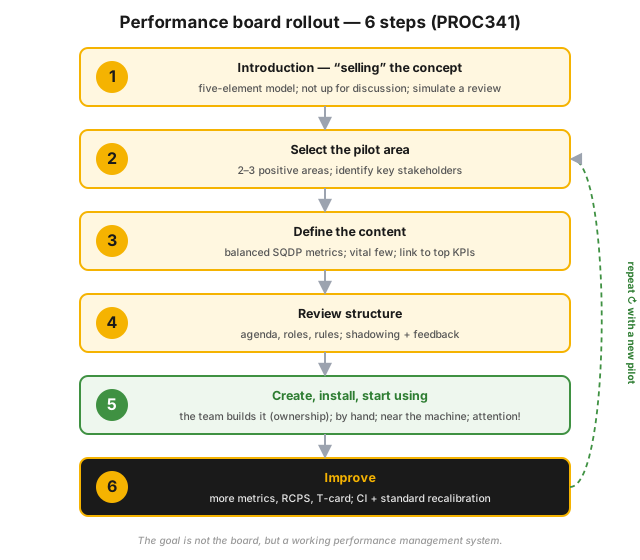
Figure 1 — the six steps of PROC341. Steps 1–4 are the preparation and the structure (yellow), step 5 is the physical launch (green), step 6 is sustaining and expanding (dark). The process must be repeated with the next areas, using what was learned from the pilot.
Who is this for?
Section titled “Who is this for?”This article is for those who are rolling out or running the performance management of a team or a plant: plant manager and shift supervisor · team leader · Lean/CI specialist · process engineer · HSE · production support (LLC, maintenance, quality) · operator.
Learning objectives
Section titled “Learning objectives”After reading this article you will be able to:
- list the six steps of PROC341 in the right order, and state the purpose of each;
- decide where to start with a pilot, and whom you need to identify as key stakeholders;
- assemble a balanced, small-set (SQDP) pilot board content, tied to the top KPIs;
- run a disciplined review structure that does not drift into a problem-solving meeting;
- draw the line: when the board is NOT the right answer (a strategic/planning problem, a lack of commitment).
The essence (TL;DR)
Section titled “The essence (TL;DR)”- The rollout is 6 steps (PROC341): Introduction, Select pilot, Content, Review structure, Create/start, Improve. This is the how-to: what to do, in what order, what to watch for.
- Ownership at every step. You choose the metrics and targets together with the stakeholders, and the board is built by the team itself, so the numbers become “their own.”
- Pilot first, spread afterwards. Start with 2–3 areas with a positive attitude, preferably within the chosen value stream, so it becomes a good example for the roll-out.
- Balanced, few metrics. A vital few covering the four areas (safety, quality, customer service/delivery, productivity: SQDP), with a visible link to the top KPIs.
- The review is structure, not improvisation. A clear agenda, participants, roles, rules, preparation and duration. The review is not a problem-solving meeting; keep the discipline.
- The first weeks are critical. A lot of time must be invested before the first return arrives; shadow the reviews, and “the operator is the customer”: listen to them, help them, coach them.
- The end of the rollout is not the board: the real goal is a working performance management system, of which the board is only a small part.
This article describes the rollout process. For what the performance board is, its four main parts (Tracking / Action / Trends / Information), the color code and the “own your numbers” principle, see performance board. The details of the dialogue and the escalation: performance dialogue. The whole framework (the five elements): performance management.
Why does it matter? (the stakes)
Section titled “Why does it matter? (the stakes)”Most operational improvements fail not on the good ideas, but on the missing performance management. The board can be put up in an afternoon, but if you do not roll out the system that goes with it, in a few weeks it becomes dead decoration on the wall.
The typical failure is not dramatic but slow. Familiar sentences from the shop floor: “I come to work to earn money, I have no real goal”; “Everyone talked about the change, but then everyone went on doing what was best for their own department”; “We talk about flow and pull, but I am still rewarded for machine speed”. If the board does not answer these, then it is not performance management, just another poster.
So the stake is twofold. On the one hand, a badly rolled-out board remains “the boss’s board”: the team does not feel the numbers are their own, the review becomes an empty formality, and the problem that could have been caught when it arose grows until it becomes unmanageable. On the other hand, an early, spectacular failure destroys the credibility of the whole improvement program: that is why we start with a pilot, with a positive area, and that is why the attention of the first few weeks is critical. This tool does not pay off immediately: a lot of time must be put in before the first benefit appears.
How do you roll out a performance board step by step?
Section titled “How do you roll out a performance board step by step?”The rollout breaks down into six steps to be carried out in order. The first four are preparation and structure, the fifth is the physical launch, the sixth is sustaining and expanding. Each step has a few key points; these are what we have merged into the practical description below.
Step 1 — Introduction: how do you “sell” the concept?
Section titled “Step 1 — Introduction: how do you “sell” the concept?”The first thing is to bring the concept of performance management to the rollout team and to production management (along the five-element model). The boards and their purpose must be thoroughly “sold”: you have to show why they are needed and what their benefit is.
The emphasis matters, however: the fact of the rollout is not up for discussion (“the introduction is not up for discussion”). So the “buy-in” is thorough and convincing, but it does not mean that you vote on rolling out the board. Participation is in the how, not in the whether. Therefore:
- Use examples, explain concretely how the board is to be used.
- Simulate a review (or a similar demonstration), so the team sees what the daily practice will be like.
The goal is for the team to understand: we perceive a significant part of information visually, so visual management communicates faster than a spreadsheet. And that below-target performance cannot be corrected after the fact; the problem has to be prevented.
Step 2 — Pilot area: where do you start?
Section titled “Step 2 — Pilot area: where do you start?”Do not start on the whole plant. Choose 2–3 pilot areas, preferably within the chosen value stream (where relevant). Two criteria are critical:
- Positive attitude. Choose areas where people are open; these will be the good example for the later expansion (roll-out). Starting with a resistant area risks the credibility of the whole program.
- Identifying the key stakeholders. Already when selecting the pilot, identify the key people (operators, team leader), so you can involve them in the next steps. The newcomers, too, must have the board and its purpose thoroughly “sold” to them during the process.
Step 3 — Content: what should the board show?
Section titled “Step 3 — Content: what should the board show?”This is where it is decided what the pilot board will show. The guiding principle is the balanced set of metrics that covers the four main areas (the SQDP framework):
- S — Safety,
- Q — Quality,
- Customer service / Delivery,
- P — Performance / Productivity.
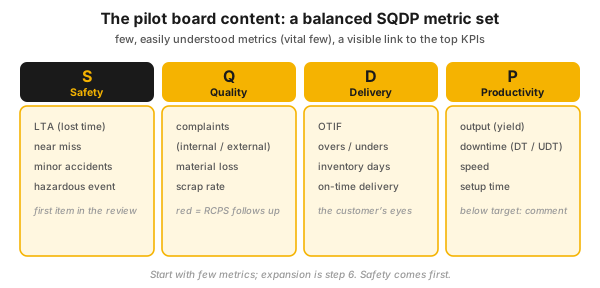
Figure 2 — the balanced SQDP content of the pilot board, with a few typical metrics per column. Safety comes first; every red (below-target) value always has a comment attached, which triggers an action.
Three rules for the content:
- Involve all the stakeholders in choosing the metrics and in target setting. This is what creates ownership: the team will track its own metrics and its own targets, not those imposed from above.
- Focus on the vital few. Do not start with too many metrics, but keep the whole picture in mind for the future (the expansion is step 6).
- A visible link to the top KPIs. The metrics should be easy to understand, and it should be clear how they connect to the top-level KPIs. The target values tracked on the board must match the numbers of OGSM; the KPIs connect the levels in a cascade (I → PI → KPI). The targets should be SMART: the group has influence over them, the way of measuring is measurable and agreed, they are challenging but attainable, realistic, and time-bound.
Step 4 — Review structure: how does the board become a dialogue?
Section titled “Step 4 — Review structure: how does the board become a dialogue?”The board on its own is worth nothing without dialogue. This step lays down the standard of the review meeting, clearly defining:
- the agenda / topics, the attendees, the rules, the roles, the responsibilities and the preparation, the duration.
Guiding principles:
- The posted information must be used (“make sure posted information is used”), it is not decoration. The focus is on the improvement areas and the actions.
- Everyone should be active. The review is not one person’s monologue; every participant contributes.
- Keep the discipline, this is NOT a problem-solving meeting. The review takes stock of performance, assigns and tracks actions; the actual root-cause solving (RCPS) happens elsewhere, in a different time frame. If the review turns into a problem-solving session, the agenda falls apart and the time overruns.
- Shadow the reviews, especially at the beginning, and give feedback. For the rollout to succeed, involve the key leaders in the shadowing too; this is both quality assurance and a visible sign of leadership commitment.
Step 5 — Create, install, start: who should build the board?
Section titled “Step 5 — Create, install, start: who should build the board?”Now the physical board is built, and here the who builds it question is the most important:
- The boards should be built by the teams themselves, the ones who will work with them (“the actual creating/building of the boards should be done by the teams that will actual work with the boards”). This is the keystone of ownership.
- Keep it simple. Manual updating from charts, not computer printouts. Writing by hand creates the “own your numbers” responsibility and makes the team think (handwriting helps to think).
- Location: near the machine, in a safe and preferably not too noisy place.
- In the first weeks the attention is critical to success. A lot of time must be invested in this tool before the first return appears; this is not an investment that pays off immediately.
- “The operator is the customer!” (Operators are the customer!): listen to, help and coach the support functions, so that the board becomes the operators’ success, not administration forced upon them.
Step 6 — Improve: how do you keep it alive and spread it?
Section titled “Step 6 — Improve: how do you keep it alive and spread it?”When the initial board is going well, expansion and sustaining come next:
- Add more metrics (the set deliberately narrowed in step 3 can now be expanded).
- Train the team in RCPS tools (root-cause problem solving), so that the actions target the root cause, not just the symptom.
- Add a problem- and improvement-tracking system, a T-card or similar, so that open items do not get lost.
- Kick off continuous improvement (CI), and recalibrate the standards / targets; the board is not static.
- Repeat the process with the next areas, building in the lessons and experience learned from the pilot.
- Do not let the attention slip away from a board that is already running (“let the attention, focus and follow up not slip away from boards that are already up and running”). The most insidious mistake of the rollout is leaving a working board to itself.
Ownership and roles around the board
Section titled “Ownership and roles around the board”Ownership is not a slogan. On the example of a concrete plant board it can be clearly seen that for every element of the board four things are recorded:
- Owner: who is responsible for the element,
- Who updates it: often someone other than the owner,
- How often (frequency): per shift / daily / weekly / monthly,
- Where the source document is: the data source of the update.
A few typical role assignments from the example (anonymized, with generic roles):
| Board element | Owner | Who updates | Frequency |
|---|---|---|---|
| Safety Cross | safety officer | shift supervisor + operators | every shift / day / month |
| I-MR (trend) charts | LLC / responsible engineer | the responsible person prints, the shift supervisor posts | weekly |
| Customer complaint tracking | quality (content) | quality updates, shift supervisor on the board | daily (green/red) / monthly (Pareto) |
| Action list | maintenance (cell leader) | maintenance | weekly |
| Shift-level follow-up (set-up, speed, downtime, loss) | shift supervisor | target by LLC, monthly by shift supervisor, shift by operator | every shift / month |
| Operator action tracking, real-time production | shift supervisor / operators | operators | daily / every shift |
For this, the team leader must keep a hand on performance during the day: the root causes that come up are forgotten by the next day, or the problem grows unmanageable. The leader at every level must be empowered to own the performance of their own level without micromanagement.
Ownership also determines the level of problem handling: at least 80% of problems must be solved where they arise (at the machine/team level). If an action is not resolved within one week, it must be escalated to the next level. The rare, strategic or planning-type matters are handled not on the board but as a separate project (A3 / Six Sigma).
The most important warning of the rollout: “Some people think that the goal is to have performance boards on the shopfloor, the real goal is to have an effective performance management system in place.” The board is a small part of the whole system. If the project’s measure of success is “how many boards hang on the shop floor,” the rollout has missed its goal.
Process-industry context and safety
Section titled “Process-industry context and safety”In a process-industry plant the SQDP framework is the standard of shift-level visual management, and the metrics of the four areas translate into the typical plant language: safety (LTA, near miss), quality (complaints, material loss), delivery (OTIF, inventory days, overs/unders) and productivity (throughput [t/day], filling-arm/setup time, downtime UDT/UPDT, specific energy [GJ/t]). The pilot area is typically a concrete block or unit (a unit of the value stream), and the cascade mirrors the OGSM Tier logic: plant-level (Tier 1) → block-level (Tier 2) → unit-level board (Tier 3). The pace of updating follows the nature of the machine: the metrics of continuously running process units are updated hourly, the metrics of batch- or order-based production per order.
Safety first, a Seveso emphasis. In a Seveso plant the prevention orientation is critical: the safety part of the board (Safety Cross, near miss, “4 Non-Negotiable”, alert) makes the HSE status visible on the front line, and safety stands at the head of the SQDP framework. That is also why, in choosing the location (step 5), a safe, low-noise place near the machine matters: the board must not obstruct safe working.
The rollout in practice (workshop)
Section titled “The rollout in practice (workshop)”The rollout is best practiced on a short, tangible exercise before you go live. A proven training scenario looks like this:
Situation. The plant manager decides to roll out the performance board in the plant, and to support it with daily review meetings. The group’s task is to help them:
- Develop a performance board (with balanced SQDP content, with few metrics).
- Prepare and hold a daily review meeting with the team.
Roles (assign them).
- Team leader: they hold the review meeting.
- Plant manager: observes, gives feedback, asks questions and challenges.
- The others: the team, who take part in the review.
Flow. Put up the metrics, mark target and actual (red = below target, which needs a comment), then act out the daily review: the team leader goes through the deviations, assigns an action (Who / What / When), and the plant manager shadows and gives feedback. The exercise lives through exactly what steps 4 and 5 of the rollout are: how the board becomes a disciplined dialogue, and how the difference between “the boss’s board” and “our board” feels.
Take it further. In the second round, swap roles, and deliberately “get one thing wrong” (e.g. the review slips into problem solving), then discuss what happened. Acting out the mistakes teaches faster than reciting the rule.
Measurement / audit: how do you know it is going well?
Section titled “Measurement / audit: how do you know it is going well?”The rollout is “done” not when the board is hung up, but when the system has solidified. A few auditable signs with which you can check the quality of the rollout:
| Check point | Good sign | Bad sign |
|---|---|---|
| Updating | written by hand from charts, every shift | computer printout, missed update |
| Comments | every red (below-target) value has a comment | empty red fields, without justification |
| Actions | clear Who / What / When, with an owner | “we should solve this”, without an owner |
| Review discipline | by the agenda, does not slip into problem solving | monologue, overrun time, RCPS in the review |
| Shadowing | key leaders shadow regularly + feedback | no one looks in on the review |
| Ownership | the team calls the board “its own” | “the boss’s board”, no one updates it |
| The 80% rule | daily matters solved on the spot, the rest escalated | everything escalates upward or dies |
The goal is not the number of boards, but that the underlying routine (updating, dialogue, action tracking, coaching) is alive and disciplined.
Common mistakes
Section titled “Common mistakes”It is worth looking at each mistake paired with the correct practice; most can be traced directly back to skipping one of the six steps:
- Turning the rollout into a debate. The buy-in is thorough, but rolling out the board is not a vote. Instead: participation is in the how, not in the whether (step 1).
- Starting on the whole plant at once, without a pilot. There is no learning loop, and an early failure brings the whole program down. Instead: 2–3 pilot areas, within the value stream (step 2).
- Starting with a negative-attitude area. It becomes a bad roll-out example. Instead: choose an open, positive area for the pilot.
- Leaving the stakeholders out of choosing the metrics and targets. There is no ownership, the board remains “the boss’s board”. Instead: joint choice of metrics and targets (step 3).
- Starting with too many metrics. The “track the vital few” principle is violated, the board becomes unreadable. Instead: few, balanced SQDP metrics; the expansion is step 6.
- A computer printout instead of writing by hand. The ownership and the “handwriting helps to think” effect are lost. Instead: manual updating from charts (step 5).
- Turning the review into a problem-solving meeting. The discipline and the agenda fall apart. Instead: the review assigns and tracks actions; RCPS at a separate time (step 4).
- Others (an external team) build the board, not its users. There is no ownership. Instead: the board is built by the team that will work with it (step 5).
- Putting the board in a remote / noisy / dangerous place. Instead: a place near the machine, safe, quiet (step 5).
- Underestimating the attention of the first weeks, or letting the focus go from a board that is already working. Instead: intensive presence at the beginning, and deliberate attention to the running boards too (steps 5–6).
- “The goal is the board” thinking. Instead: the real goal is a working performance management system, of which the board is a small part.
When NOT to use it? (limits of the rollout)
Section titled “When NOT to use it? (limits of the rollout)”The performance board is strongest for visualizing and managing daily, recurring, locally manageable performance. There are times when another tool is the right answer:
| Situation | Why (primarily) not the board | The right answer |
|---|---|---|
| There is no real leadership commitment to the daily review and coaching | a board without the system is empty decoration | first the performance management system and the leadership cadence |
| A strategic / business problem (not a daily operational matter) | this has to be solved as a project, over a longer time frame | a dedicated project, A3 / Six Sigma, not the daily board |
| A planning / engineering problem | it should not be tracked but eliminated at the root cause | process redesign, RCPS, a technical solution |
| The team has no influence over the metric | SMART is violated (the group must have influence over it) | put a metric on the board that the team can move |
| A one-off, non-recurring deviation | there is nothing to build lastingly into the daily routine | an ad-hoc root-cause analysis, recording the lesson |
Rule of thumb: the board is strongest at the lowest, operational level of the cascade, where performance changes hour by hour / day by day, and the team can directly affect it. The more strategic or planning-type the problem, the more a project, not a daily board, is the right tool.
Take it home (keys)
Section titled “Take it home (keys)”- The board is not the goal, the system is. If you only put up the board without the daily dialogue, action tracking and coaching, in a few weeks it stays a dead poster.
- Ownership at every step. Joint choice of metrics and targets, and the team builds the board that will work with it; writing by hand makes the numbers “their own”.
- Pilot first. Start with 2–3 positive areas, learn from it, and spread further with the lessons; not on the whole plant at once.
- Few, balanced metrics (SQDP), tied to the top KPIs and to OGSM; the expansion can wait for step 6.
- A disciplined review that does not slip into problem solving; a comment for the red value, Who / What / When for the action.
- The attention of the first weeks decides. Shadow, give feedback, and do not let a board that is already running be left to itself.
Self-test
Section titled “Self-test”- List the six steps of PROC341 in order, and say in which step the board’s content is decided and in which the discipline of the review is.
- Why do we start with exactly 2–3 pilot areas and a positive attitude, and how is this experience put to use in step 6?
- In the review someone starts to solve a problem down to its root, and the time overruns. What is the rule, and where does this work actually belong?
How does it appear in digital practice?
Section titled “How does it appear in digital practice?”The logic of the performance board does not stop at the physical wall: the same “visualize, track, assign and close” principle is realized in software too. The mechanism is different (recorded data and workflow instead of writing by hand), the principle is the same.
| Board principle | Digital implementation | What it adds |
|---|---|---|
| Tracking (balanced metrics) | automatically collected KPI/OEE data, target vs. actual, green/red | a real-time, error-free status picture |
| Own your numbers | the team records/acknowledges its own shift data | ownership digitally, with an audit trail |
| Actions (Who / What / When) | an action with owner and deadline, with a reminder | not a single action gets lost |
| Escalation (1 week / 80%) | automatic escalation when the deadline is exceeded | the open item reaches the right level |
| Review structure | a digital agenda template, fixed participants/roles | the review is not improvisation, it has a searchable trail |
| Trends | a historian trend, an I-MR view automatically | the long-term change is immediately visible |
Connection to OPEREX (shift diary)
Section titled “Connection to OPEREX (shift diary)”The digital counterpart of the problem- and improvement-tracking system (T-card) recommended at step 6 of the rollout is the shift diary. In OPEREX the actions assigned in the review, with owner and deadline (Who / What / When), the open RCPS items and the escalated problems can be stored in a structured, searchable and auditable way. This way the manual board keeps its ownership (“own your numbers”) logic, but the most fragile point of the rollout, the follow-up of actions, becomes a closed loop shift by shift: at the shift handover the open actions can be handed over, and the one-week escalation deadline can be monitored automatically.
Terminology (HU / EN / JP)
Section titled “Terminology (HU / EN / JP)”| Hungarian | English | Japanese | Note |
|---|---|---|---|
| performance board bevezetése | establish performance board | — | the PROC341 process |
| bevezetés / „eladás” | introduction / selling the boards | — | step 1 |
| pilot-terület | pilot area | — | step 2, 2–3 areas |
| tartalom meghatározása | define content | — | step 3, SQDP + vital few |
| teljesítmény-review struktúra | performance review structure | — | step 4 |
| árnyékolás | shadow (review) | — | observing the review + feedback |
| létrehozás / telepítés / indítás | create / install / start to use | — | step 5 |
| fejlesztés | improve | 改善 (kaizen) | step 6, continuous improvement |
| tulajdonlás | ownership | — | the engine of the process |
| kulcs-stakeholder | key stakeholder | — | operator, team leader |
| kiegyensúlyozott mutatókészlet | balanced set of indicators | — | SQDP |
| stratégia-lebontás | OGSM / Hoshin | 方針管理 (hoshin kanri) | the source of the targets |
How many steps is the rollout of a performance board?
Six (PROC341 “Establish Performance Board”): (1) Introduction and “selling” the concept; (2) selecting the pilot area and identifying the stakeholders; (3) defining the board’s content; (4) designing the review structure with roles and rules; (5) creating and starting the board together; (6) continuous improvement and expansion.
Who should build the performance board?
The very team that will work with it; this is what creates ownership. The board should be kept simple, with manual updating from charts instead of computer printouts, and placed near the machine, in a safe, quiet place.
How many metrics should a new performance board start with?
With the “vital few” metrics that cover the four main areas (safety, quality, customer service/delivery, productivity: SQDP). Do not start with too many metrics, but keep the whole picture in mind for the expansion in step 6. The metrics should be easy to understand and clearly tied to the top KPIs.
Why is it important to start with a pilot area, and how many should we choose?
It is worth starting with 2–3 pilot areas, preferably within the chosen value stream and with a positive attitude. The pilot gives a learning loop: we build the experience and lessons into the rollout of further boards in step 6, and a good pilot is a convincing example for the roll-out.
Is the review meeting also a problem-solving meeting?
No. The review takes stock of performance, focuses on the deviations and assigns/tracks actions, but the actual root-cause solving (RCPS) happens separately, in a different time frame. Discipline must be kept in the review, otherwise the agenda falls apart.
What is the most important pitfall of the rollout?
To believe that the goal is the board. The real goal is a working performance management system across the whole plant; the board is only a small part of it. The other common mistake is that the attention slips away from a board that is already working.
Related concepts
Section titled “Related concepts”performance board · performance dialogue · performance management · visual management · ogsm · rcps · KPI cascade · KPI, PI, I · pdca · shift handover
Next step
Section titled “Next step”If you have understood the rollout process, from here it is worth going on, in this order:
- performance board — what the board is exactly: the four main parts (Tracking / Action / Trends / Information), the color code and the “own your numbers” principle. The rollout produces this product.
- performance dialogue — the heart of step 4: how a disciplined, substantive dialogue emerges in front of the board, and how the escalation works.
- performance management — the wider frame (the five elements), of which the board and the review are the daily, operational manifestation.
References / Further reading
Section titled “References / Further reading”- Hoshin Kanri (policy deployment) — the public, Japanese-origin methodology of strategy deployment (方針管理), from which the cascade of the targets tracked on the board (OGSM → I → PI → KPI) derives. See OGSM.
- Visual management and daily management — the established Lean practice for making performance visible and for the daily review cadence; the performance board is one of its most widespread implementations. See visual management.
- Raymond C. Floyd: Liquid Lean: Developing Lean Culture in the Process Industries. CRC Press, 2010 — the application of Lean management and performance practices in the process industries, as further reading.