Technology's role in the asset team
≈ 21 min read · 4,241 words
On a night shift, the pressure drop of a column creeps up slowly, almost imperceptibly. The operator sees the trend, but the parameter is still within limits, so “there is nothing to do about it.” In the morning, at the daily meeting, someone says out loud: it has been rising for two weeks. That is when it turns out this is not an instrument fault but a change in the feed composition, and if it goes on like this, in a few weeks it will become a capacity constraint. The role that watches this trend professionally, understands it and turns it into an intervention proposal is technology: the asset team’s technology leader and the process technology engineers working alongside them. Let’s look at what technology’s role is in the asset team, where it sits in the matrix, and how it is built into the daily operating rhythm.
In the asset team, technology is owned by the asset team technology leader, who is directly responsible for the assigned unit’s technology.
In the matrix organisation this leader is an equal partner with the other two asset team leaders (operations and maintenance); in the hierarchy, however, they report to the process technology manager. They work in a partnership with the dedicated process technology engineers and, from the operations side, with the operational technology coordinator. The daily product of the role is technology monitoring (daily and periodic) and troubleshooting, which are fixed elements of the operating rhythm.
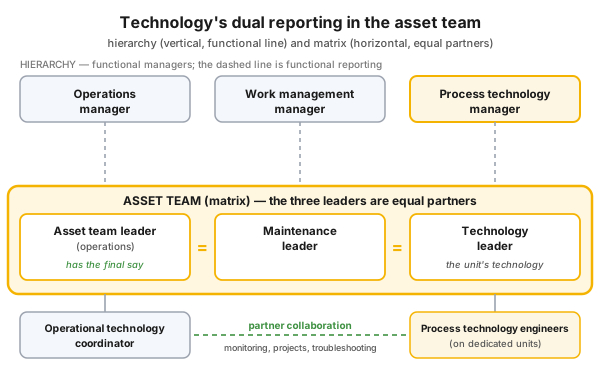 Figure 1 — technology’s dual reporting: vertically it reports to the process technology manager (functional line), horizontally it is an equal partner in the asset team.
Who is this for?
Section titled “Who is this for?”This article is for those who touch the technology role in day-to-day operations: process technology engineer · asset team (plant) leader · operational technology coordinator · maintenance leader · shift supervisor and operator · process technology manager · production planner · energy engineer · HSE.
Learning objectives
Section titled “Learning objectives”After reading this article you will be able to:
- distinguish the hierarchical and the matrix reporting of technology, and say which one governs what;
- place the roles of the technology leader and the process technology engineer in the asset team;
- describe what the partnership with the operational technology coordinator means;
- say where the daily and the periodic technology monitoring, and troubleshooting, belong in the operating rhythm;
- recognize the typical pitfalls of the technology role (dragging out the daily meeting, the “I know everything” trap).
In brief
Section titled “In brief”- Technology is one of the asset team’s three equal legs: operations, maintenance, technology. The team’s mandate is the triad “operate it, maintain it, optimize it,” and the owner of optimization is primarily technology.
- The asset team technology leader is directly responsible for the technology of the assigned unit, and also for all the process technology engineers in that team doing their work to the right standard.
- Dual reporting: in the matrix an equal partner with the asset team leader and the maintenance leader; in the formal organisation the process technology manager is their superior, who ensures the professional standard and the alignment.
- The process technology engineer covers the whole of the technology activity, depending on the unit’s size and complexity; their functional boss is the process technology manager, their matrix leader is the asset team technology leader.
- From the operations side the operational technology coordinator is the partner: neither subordinate nor superior, but a partner in monitoring, projects and problem handling.
- The role lives in the operating rhythm: daily technology monitoring at the daily meeting, periodic monitoring and troubleshooting at the weekly meeting, results and risks at the monthly review.
- The technology leader’s authority is largely informal: it comes from experience and standing, not from the organizational box.
What this article does NOT cover
Section titled “What this article does NOT cover”This article is about the organizational role of technology: where it stands in the matrix, whom it works with, and how it fits into the operating rhythm. It does not cover the professional depth of the technology work. If that is what you are after, you will find it in the technology excellence chapter:
- the questions of control and advanced process control: advanced process control and soft sensors;
- the technology operation of a specific unit group: the distillation complex (CDU);
- the methodology of energy and yield optimization: the energy and yield workstream.
Why it matters (the stakes)
Section titled “Why it matters (the stakes)”If technology has no named owner in a unit, the consequence is rarely spectacular; it is quiet and slow instead. The yield drifts gently off plan, the consumption of catalyst and auxiliaries grows without explanation, the quality “giveaway” (giving away better-than-needed quality for free) becomes built into the normal, and energy consumption slowly creeps up. None of these triggers an alarm, yet these are what make the difference between a well-run and a mediocre unit.
The second stake is troubleshooting. If technology problems are handled under the pressure of the daily meeting, two bad things happen at once: the daily meeting drags out and loses its discipline, while the problem gets a superficial, symptomatic answer. This is exactly why an orderly operating rhythm separates the two: the daily forum identifies, the weekly forum solves.
What is technology’s role in the asset team?
Section titled “What is technology’s role in the asset team?”The asset team consists of the representatives of three functions — operations, maintenance and technology — supplemented by the experts needed for the given question (process safety, HSE, energy, excellence development). The team’s shared mandate can be summed up in a single sentence: operate it, maintain it and optimize it — the asset entrusted to you. Technology carries primarily the third verb, but not in isolation: optimization only works if the daily data of operations and the real condition of the equipment are also built into the proposal.
The representative of technology is the asset team technology leader. They are the official representative of the technology discipline in the team, and are directly responsible for the technology of the assigned units. Where they do not run the units directly, the professional coverage is provided by the process technology engineers, but it remains the technology leader’s responsibility that every process technology engineer in the team works to the right standard.
How does it fit into the matrix and the hierarchy?
Section titled “How does it fit into the matrix and the hierarchy?”The technology role has two reporting lines at once, and this is not a contradiction but the essence of the matrix:
| Reporting | To whom | What it governs |
|---|---|---|
| Matrix (horizontal) | the asset team leader (operations) and the maintenance leader | the daily operation, the unit’s shared goals, the cross-functional decisions |
| Hierarchy (vertical) | the process technology manager | the professional standard, the methodology, the development, the resources and personnel questions |
In the matrix the technology leader is an equal partner with the other two leaders. This equality has one important limit: in a decision situation the asset team leader has the final say, because the legal responsibility rests with them. This is not a ranking of professional opinion but the clarification of responsibility and decision-making.
On the hierarchy side, the process technology manager is the leader of the technology discipline: they professionally direct and align the asset teams’ technology leaders and the process technology engineers, and they are responsible for the quality of the technology work being uniform across the site. In the matrix they themselves are equal with the other functional managers, for example the manager directing maintenance work.
Who is the process technology engineer, and how is the work divided?
Section titled “Who is the process technology engineer, and how is the work divided?”The process technology engineer is the daily doer of the technology work. How many such roles there are in an asset team depends on the unit’s size, scope and complexity: the typical setup is one technology leader, with dedicated process technology engineers covering the technology activities alongside them.
The process technology engineer has the same duality as their leader: in the formal organisation the process technology manager is their boss, in the matrix the asset team technology leader. In practice the two do not compete: the discipline provides the method, the training and the professional yardstick, while the asset team provides the daily priority and the context.
The technology leader and the process technology engineers cooperate as partners: in monitoring, in projects, in individual questions and in problem handling they are partners rather than boss and subordinate. This is also why the technology leader is an informal leader, whose authority derives from professional experience and from colleagues’ respect.
How does it work with the operational technology coordinator?
Section titled “How does it work with the operational technology coordinator?”Operations provides not only the asset team leader but several daily roles too, among them the operational technology coordinator. Their job is to support the technology activities from the operations side, safely and efficiently. In many organizations the daily tasks related to energy efficiency also belong here.
The relationship with the technology leader and the process technology engineers is a partnership, not superior-subordinate: partners in monitoring, in projects, in the questions that arise and in problem-solving. This pairing provides the two halves of a technology proposal:
| Question | Who brings the answer |
|---|---|
| What does the process show, what is the technology cause, what is the optimum? | technology leader, process technology engineer |
| What can be realized safely in today’s condition, who does it and when? | operational technology coordinator, shift |
| What does the equipment condition allow, when is there time for it? | maintenance leader |
If these three viewpoints do not meet, the technology proposal is either not realized or does not last. If they meet, the decision is made at one table, in one meeting. It is no accident, either, that good practice has the three asset team leaders’ offices physically close to each other: the matrix works in the corridor too, not only in the meeting.
Where does technology appear in the operating rhythm?
Section titled “Where does technology appear in the operating rhythm?”Technology work is not an event but a rhythm. The operating rhythm is the order of the regular, structured meetings that carry information from the bottom up, and feedback and decision from the top down. Three well-separated products of technology are built into this order: the daily technology monitoring, the periodic technology monitoring and troubleshooting.
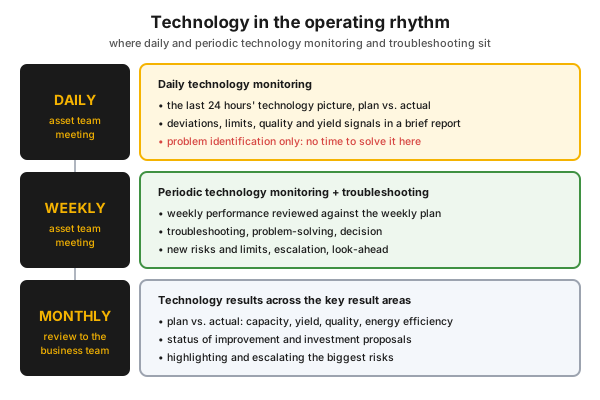 Figure 2 — the daily meeting identifies, the weekly meeting solves, the monthly review accounts: the place of technology monitoring and troubleshooting in the operating rhythm.
Daily asset team meeting. Here the technology leader (or, in their absence, the process technology engineer) briefly comments on the last 24 hours’ technology monitoring: where the unit stands against the daily plan, what deviation, constraint or quality signal there is. The daily meeting is for handling the daily tasks, not for problem-solving and not for troubleshooting, because there is simply no time for that. Here the brief identification of the problem takes place.
Weekly asset team meeting. This is where the periodic technology monitoring comes up: the review of the weekly performance against the weekly plan, the identification of new risks and constraints. And this is the place for problem-solving, troubleshooting, decision and escalation, as well as looking ahead, including the longer-term development and investment topics.
Monthly asset team review. The asset team reports to the business team along the key result areas. The areas directly affecting technology: meeting the production plan, quality (feed, products, yields, chemicals, catalysts, quality giveaway), optimizing capacity and maximizing added value, energy efficiency, and the development proposals.
Process-industry and safety context
Section titled “Process-industry and safety context”In the process industry the technology role directly touches process safety. Technology monitoring follows the parameters, some of which are also of safety significance: a parameter drifting to the edge of the safe operating range first becomes a technology question, then a safety one. Technology therefore does not stop at yield and consumption, but works together with operational risk management: identifying the constraints, examining them and taking the risk-reducing measure is the asset team’s shared responsibility.
Two boundaries are worth keeping clear:
- Technology monitoring is not a protection layer. Trend watching and analysis are important, but they do not replace the certified safety functions and the interlocking systems (see ESD systems and integrity operating windows).
- Technology optimization is not change management. If the optimization proposal touches the design basis, the parameter limits or the equipment, the change goes through the management-of-change procedure (see MOC), not through the verbal consensus of the weekly meeting.
Introduction in practice
Section titled “Introduction in practice”If you are now setting up or reviving the technology role in an asset team, this order works:
- Name the owner. Name who the asset team technology leader is, and list which units they are directly responsible for, and which are covered by the process technology engineers.
- Fix the dual reporting. Write on one page what belongs to the matrix (daily priority, shared goals) and what to the discipline (methodology, quality, development). Have all three leaders read and accept it.
- Define the content of the daily monitoring. Agree on which indicators technology reviews every day, and in what format it can be told in 3–5 minutes at the daily meeting.
- Separate the daily and the weekly forum. At the daily meeting the brief identification of the problem happens, with an owner; the solution goes to the weekly meeting. This rule is enforced by the asset team leader.
- Start the troubleshooting agenda. Let there be a fixed agenda item at the weekly meeting for the open technology problems, with an owner and a deadline.
- Seat the three leaders next to each other. Where possible, the physical proximity of the offices is the cheapest working intervention to bring the matrix to life.
- Build continuity. The multi-year stability of the key roles matters because much of the technology knowledge and equipment familiarity is experiential and tied to the person.
Exercise (doable in a week). Take the daily-meeting minutes of the last four weeks, and mark how many technology topics came up, and how many of these reached a closed solution at the weekly forum. The ratio alone shows whether the separation of daily identification and weekly solving works at your place.
Measurement / audit
Section titled “Measurement / audit”The working of the technology role is worth measuring on two levels:
| What we measure | How | What it signals |
|---|---|---|
| Whether the daily monitoring happens | whether the technology comment was given at the daily meeting | the basic discipline of the rhythm |
| Problem lead time | closing a technology topic identified at the daily meeting at the weekly forum | whether the daily/weekly separation works |
| Age of open troubleshooting items | the age of the oldest open technology problem | whether unsolved items are piling up |
| Plan-actual gap on the key areas | yield, quality, energy efficiency at the monthly review | the result of the technology work |
The organizational form itself is worth reviewing from time to time: good practice reviews it every two years, with a small, “fresh-eyed” assessment group made up of experienced leaders, running the examination along the logic of PDCA. The reason is that the organization may be fine on paper while the practice differs significantly from it.
Common mistakes and their correction
Section titled “Common mistakes and their correction”| Anti-pattern | Why it’s a problem | Correct practice |
|---|---|---|
| The technology leader is a “guest” in the asset team, called only when there is a problem | Optimization is left out of the daily decisions, technology reacts after the fact | Sits at every daily and weekly forum as an equal member |
| The technology problem is solved at the daily meeting | The forum drags out, the solution is superficial, the other topics get squeezed out | Daily meeting: brief identification; weekly meeting: troubleshooting and decision |
| The technology leader wants to carry everything alone | The process technology engineers do not grow up, and the bottleneck becomes the leader themselves | Assigns the units to the engineers, and is responsible for the standard of their work |
| The dual reporting is lived as “two bosses” | Priority conflict, procrastination, dodging of responsibility | Clear separation: daily operation belongs to the asset team, the professional standard to the discipline |
| The operational technology coordinator is treated as a subordinate | The feasibility viewpoint of operations is lost, the proposal stays on paper | Partnership: technology content and operational feasibility together |
| The technology role changes every six months | Equipment and process familiarity is lost, everything restarts | Multi-year continuity in the key roles, with deliberate succession |
When NOT to use this framework?
Section titled “When NOT to use this framework?”The matrix-based asset team and the dedicated technology role within it are not for every situation:
- In a very small, simple unit, where technology questions are rare, a separate technology leader role is a superfluous layer. There the disciplinary coverage (one technologist over several units) is enough.
- In a crisis, in a plant upset, it is not the consensus of the matrix that decides, but the empowered single-person command under the relevant emergency order. Technology here gives expert support, not co-decision.
- For a change touching the design basis, the forum is not the weekly meeting, but the management of change (MOC) and the project process.
- If the organization is not willing to grant empowerment, the matrix exists only on paper: the technology leader becomes responsible for everything, but can decide nothing. In that case the question of empowerment must be settled first.
Take it home (keys)
Section titled “Take it home (keys)”- Name who owns the unit’s technology, and write down which units they run directly and which the engineers cover.
- Make the dual reporting unambiguous: daily operation belongs to the asset team, the professional standard to the process technology discipline.
- Maintain the separation of daily identification and weekly solving, and measure how many topics reach closure.
- Treat the operational technology coordinator as a partner: technology content and operational feasibility together make a good decision.
- Build continuity in the key roles, because much of the technology knowledge is experiential.
Self-test
Section titled “Self-test”- Whom does the asset team technology leader report to in the hierarchy, and with whom are they equal in the matrix?
- Why do we not solve the technology problem at the daily asset team meeting, and where does it go instead?
- What is the difference between the role of the process technology engineer and the operational technology coordinator?
Answer key
- In the hierarchy the process technology manager is their superior; in the matrix they are an equal partner with the asset team leader (operations) and the maintenance leader, with the proviso that in a decision situation the asset team leader has the final say because of their legal responsibility.
- Because the daily meeting is for handling the daily tasks, and there is not enough time for problem-solving; there only the brief identification of the problem happens. The solution, the troubleshooting and the decision are at the weekly asset team meeting.
- The process technology engineer carries out the technology activities on behalf of the technology discipline (functional boss: the process technology manager, matrix leader: the asset team technology leader). The operational technology coordinator supports the technology activities from the operations side (often together with energy efficiency), and works in a partnership with the technology players.
How does it appear in digital practice?
Section titled “How does it appear in digital practice?”The technology role is largely information work: reading trends, recognizing deviation, formulating a proposal and following it up. That is why this is one of the roles that “shows through” most into digital operation: the mechanism is different, the logic is the same.
| Concept | Digital implementation | Value |
|---|---|---|
| Daily technology monitoring | daily trend and plan-actual view generated from the process data store (historian), with a fixed indicator set | always the same picture, without manual data collection |
| Deviation signal at the daily meeting | logged deviation entry with an owner, automatic assembly of the daily agenda | the point raised is not lost at the end of the meeting |
| Daily identification → weekly solution | action tracking that lifts the daily entry onto the weekly problem-solving agenda | the separation of the forums can be kept with discipline |
| Periodic monitoring | automatic generation of the periodic performance report for the key areas | the review shifts from a data dispute to a substantive one |
| Troubleshooting | structured problem recording, root-cause analysis and measure in one place | the lesson stays retrievable for the next similar case |
| Dual reporting | role and permission management that serves the disciplinary and the asset team view at once | both lines work from the same data |
Connection to OPEREX (shift log)
Section titled “Connection to OPEREX (shift log)”The daily product of the technology role — the monitoring finding and the deviation that follows from it — is exactly the content that belongs in the shift log (OPEREX). A technology topic raised at the daily meeting gets an owner, a deadline and a trail here, so it can be followed whether it reached the weekly troubleshooting and the closure. The same log connects the three functions: the operator’s observation, the technology interpretation and the maintenance intervention are seen on one timeline — the information most often missing in troubleshooting.
Terminology (HU / EN / JP)
Section titled “Terminology (HU / EN / JP)”| Hungarian | English | 日本語 (romaji) |
|---|---|---|
| Üzemeltetés (az asset team egésze mint ernyő) | Operations (as the integrated unit) | 操業 (sōgyō) |
| Üzemvitel (a szűk funkció, operátorok) | Operations (function) | 運転 (unten) |
| Eszköz-csapat | Asset team | — |
| Asset team vezető (üzemvitel) | Asset team leader | — |
| Asset team technológiai vezető | Asset team technology leader | — |
| Folyamattechnológus | Process technology engineer | — |
| Folyamattechnológiai vezető | Process technology manager | — |
| Üzemviteli technológiai koordinátor | Operational technology coordinator | — |
| Üzleti team | Business team | — |
| Mátrix-szervezet | Matrix organisation | — |
| Technológiai monitoring | Technology monitoring | — |
| Hibakeresés | Troubleshooting | — |
| Működési ritmus | Operating rhythm | — |
| Kulcs-eredményterület | Key result area | — |
| Felhatalmazás | Empowerment | — |
Who is responsible for a unit's technology in the asset team?
The asset team technology leader, who is directly responsible for the technology of the assigned units. Where they do not run the unit directly, the process technology engineers provide the professional coverage, but it remains their responsibility that every technologist in the team works to the right standard.
Whom is the technology leader accountable to, when there is both a matrix and a hierarchy?
To both, but on different questions. For the daily operation, the shared goals and the cross-functional decisions they are accountable to the asset team, where they are an equal partner with the other two leaders. For the professional standard, the methodology and their development they are accountable to the process technology manager, who is their superior in the formal organisation.
What is the difference between the process technology engineer and the operational technology coordinator?
The process technology engineer is a person of the technology discipline, who carries out the unit’s technology activities. The operational technology coordinator supports the same work from the operations side, often together with energy efficiency. Their relationship is a partnership, not superior-subordinate.
Why do we not solve technology problems at the daily meeting?
Because the daily asset team meeting is for handling the daily tasks, and there is not enough time for problem-solving. There the brief identification of the problem happens; the troubleshooting, the problem-solving, the decision and the escalation are on the agenda of the weekly meeting.
Does the asset team technology leader have the authority to give instructions to operations?
No, and that is not their role. In the matrix they bring the technology position as an equal party, but in a decision situation the asset team leader has the final say, because the legal responsibility rests with them. The technology leader’s power is the professional argument and the informal authority that comes from experience.
Related concepts
Section titled “Related concepts”operations (the asset team) | operational excellence | MOS | shift handover | performance management | integrity operating windows | alarm management | operational risk assessment | MOC | advanced process control | the distillation complex (CDU) | the energy and yield workstream | operator and maintainer
Next step
Section titled “Next step”- operations (the asset team) — first it is worth understanding the logic of the asset team as a whole: why it is an integrated unit, and why alignment is what decides.
- MOS — then the operating system and the forum cadence: where the daily, weekly and monthly rhythm fits.
- advanced process control — finally the professional depth: what technology works with when it optimizes.
References / further reading
Section titled “References / further reading”- ISO 55000 / ISO 55001 — the asset management standard family: the framework of asset-centric, cross-functional responsibility and the life-cycle view.
- Jay R. Galbraith: Designing Organizations / Star Model — the classic organizational-design work on matrix organizations, including the question of dual reporting and decision rights.
- IEC 61511 — the standard of functional safety in the process industry, which delimits technology monitoring from the certified protection layers.