Robust performance dialogue, escalation and corrective action
≈ 25 min read · 5,034 words
The shift starts and an indicator on the board turns red. In one version of the story the team leader looks at it, says “that’s not right,” and someone gets a named task the same day. In the other version everyone walks past it, and by the next morning the cause of the problem has been forgotten. What separates the two is not the board and not the metric, it is the conversation that turns numbers into action. That is the robust performance dialogue: not a report-out and not a monologue, but a fact-based exchange that produces an action with an owner and a deadline for every gap. Let’s look at what it is, how it runs level by level, and when a stuck problem has to be escalated.
A robust performance dialogue is a fact-based, multi-party conversation that turns every gap into a corrective action with a named owner and a deadline. It is the fourth element of performance management: not a monologue (one person speaking at length), but a dialogue in which the participants set performance expectations, take on responsibility and accountability, and accept the consequences of failure or the recognition of success. It runs at a different rhythm at each level, and two ground rules govern it: at least 80% of problems must be solved where they arise, and if any action is not resolved within a week, it has to be escalated to the next level.
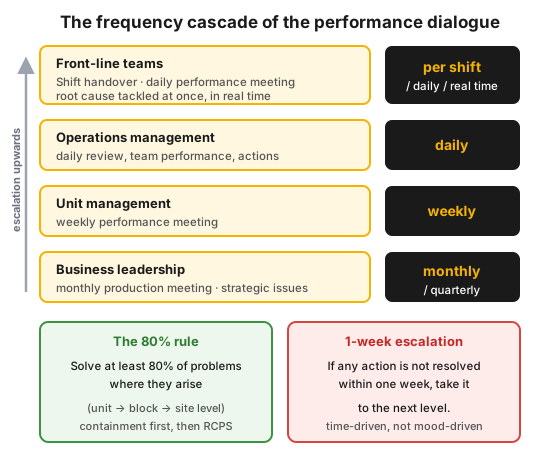
Figure 1 — the frequency cascade of the performance dialogue. The further down the organization you go, the more frequent the dialogue, because on the front line the root cause is forgotten by the next day; stuck actions escalate upwards.
Who is this for?
Section titled “Who is this for?”This article is for those who run or live through performance meetings in practice: shift supervisor · plant manager · team leader · operator · process engineer · production and HSE manager · Lean/CI specialist · reliability engineer.
Learning objectives
Section titled “Learning objectives”After reading this article you will be able to:
- tell a dialogue from a monologue, and explain why it is the dialogue that turns the numbers on the board into action;
- recognize the marks of a good performance dialogue, and build an audit checklist from them;
- set the right dialogue rhythm level by level, from the front line through operations management and unit management up to the business level;
- apply the 80% rule and the one-week escalation threshold;
- frame a SMART action using the five questions of corrective action (owner, deadline, definition, reporting, support).
In brief
Section titled “In brief”- Dialogue, not monologue. A monologue is one person speaking at length; a dialogue is a conversation between two or more people. Performance management calls for effective human interaction: setting expectations, taking on responsibility and accountability, accepting the consequences or the recognition.
- A “good dialogue” can be measured against concrete marks: a productive joint working session, joint issue identification, reading the scorecard beforehand, focus on the gaps, disciplined progress tracking, clear ownership of actions. That list doubles as an audit checklist.
- Three building blocks organize the dialogue: the process (when, how often, with whom, where), the content (what we talk about and on what data), and the behaviors (how we talk about performance).
- A simple set of questions carries you through the dialogue: What is my output? Does it meet the standard? If not, why? What were the main problems? What am I going to do? Is that enough? What help do I need? The last question is where the helpers are brought in.
- Frequency cascade: front line = per shift or daily, operations management = daily, unit management = weekly, business leadership = monthly or quarterly. The rhythm is dictated by the time horizon of the issues that come up.
- 80% rule + one-week escalation: solve at least 80% of problems where they arise, at unit, block and then site level; if no action is closed within a week, take it to the next level. Containment first, RCPS afterwards.
- The five questions of corrective action (What is happening? Why? What needs to be done? Who does it? By when?) make sure that every gap produces a SMART action tied to an owner and a date.
- Capability is the bottleneck: information is only half the story; leading a dialogue takes skill, and that is built over weeks and months of training and coaching.
Why does it matter? (the stakes)
Section titled “Why does it matter? (the stakes)”Measuring on its own is not enough: performance below target cannot be corrected after the fact, so the problem has to be prevented. The numbers on the board are only worth something if dialogue and action follow them. Tracking KPIs on their own, without dialogue and action, is not performance management.
The risk is not one missed meeting, it is the chain reaction that follows from it. In many cases the action aimed at the root cause is simply never taken, so a small issue grows and grows. On the front line a single day is enough for that: by the next morning the root cause has been forgotten, or the problem has swollen to a size that looks unmanageable.
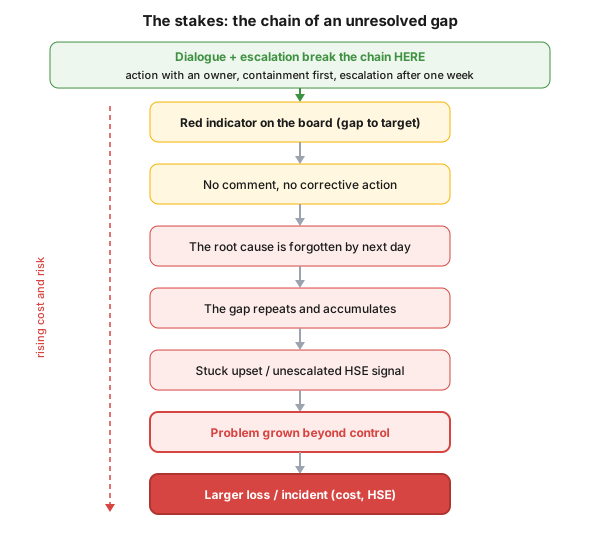
Figure 2 — the escalation of an unresolved gap: the longer an action stays open, the more expensive and the riskier it becomes. The robust dialogue and the one-week escalation break the chain at its very start, at the point where the gap arises.
The lesson is simple: the cheapest gap is the one dealt with when it arises. That is why it pays to invest attention at the start of the chain, in a disciplined dialogue and a clean escalation threshold, rather than in expensive repairs at the end.
What is a robust performance dialogue?
Section titled “What is a robust performance dialogue?”The robust performance dialogue is the fourth element of performance management: the conversation that turns numbers into action, not the measurement and not the board. The core idea is a sharp contrast:
- Monologue: one person speaking at length.
- Dialogue: a conversation between two or more people.
What a dialogue is really about is effective human interaction: people set performance expectations for other people, take responsibility for those expectations, hold themselves accountable for their actions, and accept the consequences of failure or the recognition of success. The aim is to make the organization manageable: performance gaps should reach the right decision level in a structured way and at the right frequency, and turn into action immediately.
The dialogue takes place around the performance board. The board is the arena (the indicators tracked, the red/green status, the action list), and the dialogue is the process that brings it to life. The build of the board, its four main parts and the “own your numbers” ownership logic are covered there; this article is the home of the dialogue, escalation and corrective action.
Which three building blocks make up the dialogue?
Section titled “Which three building blocks make up the dialogue?”A well-prepared performance dialogue has three building blocks, and the most common mistake is to attend only to the content and not to the process and the behaviors:
| Element | What it organizes | Key questions |
|---|---|---|
| Process | the frame of the meeting | When do we talk? How often? Who should be there? How do we prepare? Where? |
| Content | what we talk about and on what basis | What do we talk about? What data does this performance meeting need? |
| Behaviors | the quality of the conversation | How do we talk about performance? |
The process supplies the rhythm and the cast (see the frequency cascade), the content supplies the scorecard and the gaps, and the behaviors decide whether the meeting becomes productive joint work or a blame-laden report-out. Robustness comes from all three aligning.
What does a good performance dialogue look like?
Section titled “What does a good performance dialogue look like?”A good performance dialogue is a productive joint working session that keeps the focus on the gaps and closes with a clear action tied to an owner. In practice this can be measured against concrete marks, so the list also works as an audit checklist:
- A productive joint working session, not a report-out.
- Joint issue identification and problem-solving.
- A value-creating spirit: the focus is on what can be achieved.
- Challenging the accepted norms: “How could we do this better?”
- Delegating responsibility to the appropriate people.
- Participants have read the scorecard in advance and formed a view (they were given time to prepare).
- Focus on the indicators showing gaps to targets.
- Agreement on priorities and on root-cause corrective actions.
- Disciplined review of progress: the effect of the corrective actions is reviewed.
- Fact-based discussion about root causes and about what the unit can control or influence.
- Clear ownership of actions: corrective actions are completed to plan.
What is the dialogue’s simple set of questions?
Section titled “What is the dialogue’s simple set of questions?”For its own output, the front-line team uses a set of self-reflective questions that is easy to remember and leads to root-cause problem-solving and to drawing in help:
- What is my output? (The targets and the output should be clear.)
- Does it meet the standard?
- If not, why not? (This is where root-cause problem-solving starts.)
- What were the main problems?
- What am I going to do?
- Is that enough?
- What help do I need? (This is where others are drafted in to help out.)
This is the front line’s simple, self-reflective question set. The leadership or team-level dialogue adds to it the five questions of corrective action, which lead all the way to defining the corrective action.
How often should you hold a performance dialogue?
Section titled “How often should you hold a performance dialogue?”At a different rhythm level by level: per shift or daily on the front line, weekly higher up, monthly or quarterly at the top. Review and problem-solving should happen within a timeframe that fits the issues coming up. The rhythm is layered by level (see Figure 1):
| Level | Frequency | Forum | What it looks at |
|---|---|---|---|
| Front-line teams | per shift / daily / in real time | shift handover, daily performance meeting | root-cause identification, immediate action |
| Operations management | daily | daily review | team performance, tracking of actions |
| Unit management | weekly | weekly performance meeting | unit performance, escalated issues |
| Business leadership | monthly / quarterly | monthly production meeting | strategic, long-term issues |
The levels are tied together by feedback loops: gaps and actions flow up and down.
Why this rhythm? On the front line the team leader has to keep a hand on performance during the day, because “by the next day or by the end of the week the root cause has already been forgotten, or the problem has grown so large that it looks unmanageable.” Higher up the opposite holds: senior leadership’s issues are strategic, with long-term consequences, so “it is not productive to solve them weekly or monthly.” An area manager with several hundred people reporting in only needs to look at them monthly; the leadership team quarterly. The key is to give the leader at every level the room (empowerment) to own the performance of their own level without micromanagement.
When should a problem be escalated?
Section titled “When should a problem be escalated?”When no action is resolved within one week at the level where it came up. The dialogue produces action, and two ground rules govern those actions.
The 80% rule. With performance management we aim to deal with problems at the level where they arise. The actions created on the board belong to the team that owns the process; if the team cannot get a given problem moving, it uses the existing systems (T-card, work order) for help. The principle: at least 80% of problems have to be solved where they arise, along the chain of unit, block and then site level. This strengthens the front line’s independence and reduces unnecessary management intervention.
The escalation rule. If no action is resolved within one week, it is time to escalate to the next level. Escalation is therefore time-driven, not mood-driven: a clean threshold (one week) decides it, not who is loudest in the meeting. The three-level escalation chain runs upwards from the point where the issue arose, from level 1 to level 2 and then level 3. This makes sure that an unresolved upset or a safety observation does not get stuck, but reaches the right decision-maker in time.
The scale of problem responses (how big a tool for how big an issue):
| Type of issue | Time | Tool | Where it is handled |
|---|---|---|---|
| Frequent, everyday operational problems | ~1 day | basic RCPS, 5 Whys, hypothesis tree | on the board, as an immediate action |
| Design / process / engineering / quality problems | ~1 week and beyond | Six Sigma / A3 toolkit | project / project plan |
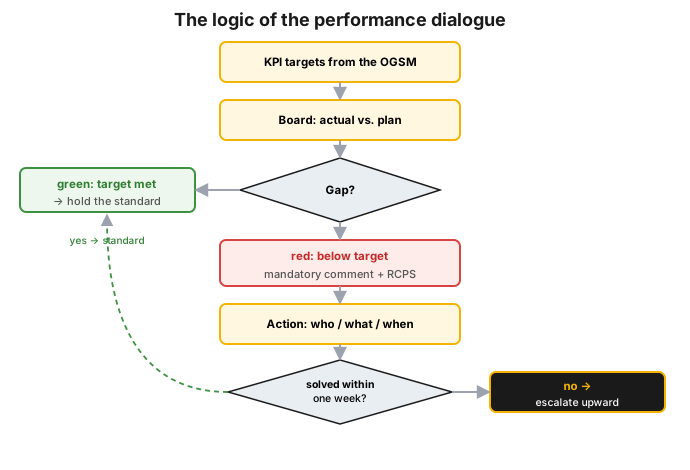
Figure 3 — the decision logic of the performance dialogue: KPI target → board (actual vs. plan) → gap? → on red, a mandatory comment and RCPS → action (who/what/when) → resolved within one week? If not, escalate to the next level.
What are the five questions of corrective action?
Section titled “What are the five questions of corrective action?”The leadership or team dialogue leads to defining the corrective action, through five questions that build on each other. The emphasis is always on starting the corrective action, never on blame:
- What is happening? What are the gaps to target? Are there worrying trends?
- Why? What caused the gap? Do we really understand the root causes? Is more investigation needed?
- What needs to be done? What will solve the problem and prevent recurrence? Will it solve it completely? Is anything else needed to close the gap? Is short-term containment needed?
- Who does it? Who owns the action? Do they need support from the team?
- By when? Is it a priority? What is the deadline? What are the intermediate milestones? How will it be followed up?
The “Why?” stage is where genuine root-cause analysis happens, rather than treating the symptom. The “What needs to be done?” stage separates the long-term correction, the prevention and any immediate containment. This logic is the same as the reasoning behind CAPA (corrective/preventive action) in the process industry: from the root cause through correction and prevention to naming the owner and the deadline.
How do you word a SMART corrective action?
Section titled “How do you word a SMART corrective action?”A good action has an unambiguous owner, a deadline, a precise definition, explicit reporting and named support; a vague action cannot be followed up and most likely will not get done. Actions written on the board should be clear, specific and well defined, and the person concerned has to know it has been assigned to them. A good action has five characteristics, illustrated with “say / don’t say” pairs:
| An action needs… | Say it like this ✅ | Don’t say ❌ |
|---|---|---|
| an unambiguous owner | “Stefan, this one is yours.” | “OK guys, you’ll do the report, right?” |
| a deadline | “Next Thursday, by the end of the shift.” | “Let’s see whether we get it done in time.” |
| a precise definition | “Three half-hour follow-up meetings on Monday, Wednesday and Friday at 14:00.” | “An opportunity for better communication.” |
| explicit reporting | “Send me an email when you’re done.” | (nothing) |
| help and support | “Ask Paula and Miroslav for help, they know they are meant to support you.” | “Do whatever it takes.” |
The facilitator discusses, defines and prioritizes the action together with the team, and then someone takes on responsibility for carrying it out. The close should never be “Everyone clear? OK, good then…” Instead, have the owner say the task back: “Stefan, what was your task again?” On the board the format is simple, Who / What / When:
| Who | What | When |
|---|---|---|
| Bill B. | replaces the anvil covers | 12 Dec |
| Bob D. | reworks the SOP | 11 Dec |
| John | calls maintenance | 14 Dec |
Putting it into practice
Section titled “Putting it into practice”The performance dialogue is not a theoretical concept: it can be introduced with a plant manager in as little as a half-day workshop. In practice it breaks down into two tangible tasks with which you support the plant manager:
- Build a performance board for the unit: pick the handful of indicators to be tracked (safety, quality, volume, cost), mark the red/green status, and put an action list next to it (Who / What / When).
- Prepare and hold a daily review meeting with the team around the board: read the scorecard together, identify the gaps, and assign an action with an owner and a deadline to every gap.
How you would introduce it tomorrow (mini-scenario):
- Day 1: draw up the board and fix the time of the daily 15-minute meeting, right after the start of the shift.
- Week 1: hold the meeting standing, in front of the board; for every red indicator work through the question set (What is the output? Does it meet the standard? If not, why?), and close every point with a Who / What / When action.
- Weeks 2-3: introduce the one-week escalation threshold; take the actions that have been open for a week to the next level.
- At the beginning, shadow the dialogue (shadow review): watch whether everyone gets room, whether the focus is on the gaps and whether every action is tied to an owner, then give feedback to the facilitator.
Why is information alone not enough?
Section titled “Why is information alone not enough?”Because the right information is only half the story. For the performance management system to be genuinely effective, people need the skill to use that information: to decide, to solve problems, to plan action. The hard part is building those skills through training and coaching. It is a time-consuming process, and asking good questions is the key.
Running a good meeting often calls for a fundamental change of attitude and behavior from the team members. Understanding that is one thing, making it happen is quite another, and it usually relies on continuous feedback and coaching over weeks and months. That is why it is worth shadowing the dialogue (shadow review) at the start of the rollout and giving feedback; the principles of feedback are covered in a separate article.
Process-industry context and safety
Section titled “Process-industry context and safety”In a continuously operating process-industry and Seveso plant, the lowest and most critical element of the dialogue cascade is the shift handover: this is where open actions, gaps, risks and the safety status are passed on. Because operation is continuous, the transfer of information between shifts directly affects plant safety: a lost open point becomes the next shift’s blind spot. At the daily and weekly forums, working through the production and safety KPIs (availability, downtime, near misses, status of work permits) is the standard. The issues discussed here are tied to the focus KPIs; the specific internal target figures are confidential plant data, so we do not treat them as general benchmarks.
Common mistakes
Section titled “Common mistakes”The anti-patterns below are tied back to the article’s own claims, each with the correct practice:
- Monologue instead of dialogue. One person talks, the rest are passive, there is no joint issue identification. Instead: a productive joint working session where every participant is active.
- Unprepared participants. They have not read the scorecard beforehand, so the dialogue degenerates into reciting data. Instead: give time to prepare, and expect the scorecard to be read in advance.
- A blame frame. The dialogue is about reciting past mistakes rather than about corrective action; this breeds defensiveness. Instead: keep the focus on the gap and on the corrective action (see the effects of “bad feedback”).
- A vague action. “Get it done in time,” “let’s communicate better,” with no owner, no deadline and no verifiable definition. Instead: a SMART action (Who / What / When + reporting).
- Skipping containment. The root cause is hunted straight away while the process or safety is not stabilized. Instead: containment first, RCPS afterwards.
- The root-cause action never happens. After treating the symptom the issue “goes to sleep,” then grows larger. Instead: name and track the preventive action that targets the root cause.
- The wrong frequency. The front line needs real time or per shift; chewing over strategic issues weekly, on the other hand, is unproductive. Instead: match the rhythm to the time horizon of the issue.
- No escalation, or escalating too early. Breaking the clean one-week threshold: either the issue gets stuck, or every trifle is pushed upwards. Instead: hold the time-based threshold.
- Micromanagement. Leaders give no room, and the front line does not own its own performance. Instead: empowerment, delegating responsibility to the appropriate level.
- Closing without a say-back. “Everyone clear? OK” and the owner has not actually understood the task. Instead: have the owner say the task back.
When NOT to use it? (limits of the method)
Section titled “When NOT to use it? (limits of the method)”The performance dialogue is a strong routine, but it is not the right answer to every problem. Knowing when a different tool is needed matters just as much as the method itself:
| Situation | Why the daily dialogue is not the (primary) answer | The right answer |
|---|---|---|
| A complex engineering/design problem | a 15-minute board meeting will not solve a cause analysis that takes weeks | a structured project: A3, Six Sigma / DMAIC toolkit |
| A strategic, long-term issue | chewing it over daily or weekly is unproductive | the less frequent (monthly/quarterly) forum of the higher level, OGSM deployment |
| A certified safety function is needed | an action from the dialogue is not an audited protection layer | risk analysis and design to standard (LOPA / SIL, IEC 61511) |
| A one-off, non-recurring gap | there is nothing to build into a lasting routine for a single case | ad hoc cause analysis, recording the lesson |
| A systemic performance problem (wrong targets, missing measurement) | the dialogue treats the symptoms, not the cause | first the fundamentals of performance management (metric, target, accountability) |
Rule of thumb: the daily performance dialogue is strongest for frequent gaps that can be solved where they arise. For a large, complex or safety-critical issue it does not replace the appropriate project or protection layer; in that case the dialogue’s job is to escalate it.
Take it home (keys)
Section titled “Take it home (keys)”- The board is not management. It is the dialogue that turns a number into action; a red indicator without a comment and an owner is dead data.
- Dialogue, not monologue: everyone is active, the focus is on the gaps, and the close is an action tied to an owner.
- The issue dictates the rhythm: real time or per shift on the front line, weekly higher up, monthly or quarterly at the strategic level.
- 80% where it arises, escalation after one week: escalation is a time-driven decision, not a mood-driven one.
- Containment first, RCPS afterwards: stabilize first, then look for the root cause, and always name the root-cause action.
- SMART action: owner, deadline, precise definition, reporting, named support, and have the task said back to you.
Self-test
Section titled “Self-test”- What is the difference between a dialogue and a monologue, and why is it the dialogue that turns the numbers on the board into corrective action?
- What dialogue frequency would you set for a front-line team and for an area manager, and how would you justify the difference?
- An action attached to a safety observation has been open on the board for 8 days. What do the 80% rule and the one-week escalation prescribe, and which comes first: containment or RCPS?
How does this show up in digital practice?
Section titled “How does this show up in digital practice?”The principle of the performance dialogue does not stop at the physical board: the same logic can be realized in software, in any well-designed digital operation. In place of the handwritten comment and the action list on paper, structured fields, enforced acknowledgement and automatic escalation monitoring keep the dialogue in a closed loop. The mechanism is different, the principle is the same.
| Element of the dialogue | Digital implementation | What value it adds |
|---|---|---|
| Mandatory comment on a red indicator | the system does not let you move on without a comment | no gap goes uncommented, the action starts |
| Corrective action (Who / What / When) | a structured action field with owner, deadline and status | the vague, untrackable task is ruled out |
| Shift handover as dialogue | open actions are passed on automatically from shift to shift | the exchange does not vanish at the shift boundary |
| One-week escalation threshold | the system makes open actions older than one week visible | the stuck issue does not stay stuck, it escalates in time |
| Disciplined progress tracking | a time-stamped status and closure log | an auditable trace of the corrective actions |
Connection to OPEREX (shift log)
Section titled “Connection to OPEREX (shift log)”The most fragile point of performance management is tracking the output of the dialogue. The result of the performance dialogue — the mandatory comment attached to indicators that fall short of target (red), the gaps discussed, and the corrective actions handed out (owner, deadline, description, reporting method, status) — can be entered into the OPEREX shift log as structured, time-stamped fields. This rules out vague, untrackable task assignment: the system enforces the SMART format (Who / What / When).
The shift handover is itself a performance dialogue: in OPEREX, open actions can be passed on from shift to shift, the next shift takes over the open points on a factual basis, and the exchange does not vanish at the shift boundary. The one-week escalation deadline can be monitored by machine: the system makes stuck open actions older than a week visible, and provides a trail of the escalation decisions. The ownership logic of the manual performance board is preserved, but tracking becomes a digitally closed loop. This also provides the audit trail required by ISO 45001 (§10.2 corrective action / §10.3 continual improvement).
Terminology (HU / EN / JP)
Section titled “Terminology (HU / EN / JP)”| Hungarian | English | Note |
|---|---|---|
| teljesítménydialógus | performance dialogue | the 4th element of performance management |
| (robusztus) dialógus vs. monológ | (robust) dialogue vs. monologue | 2+ participants vs. one person speaking |
| frekvencia-kaszkád | frequency cascade | review rhythm by level |
| műszakátadás | shift handover | the lowest-level dialogue |
| eszkaláció | escalation | to the next level after one week |
| azonnali elhárítás | containment action | before RCPS, for the safe state |
| gyökérok-problémamegoldás | RCPS (Root Cause Problem Solving) | see RCPS |
| korrekciós / megelőző intézkedés | corrective / preventive action (CAPA) | owner + deadline mandatory |
| elszámoltathatóság | accountability | taking responsibility for one’s actions |
| felhatalmazás / tér adása | empowerment | instead of micromanagement |
What is a robust performance dialogue, and how is it different from a monologue?
A performance dialogue is a fact-based conversation about performance between two or more people, in which everyone is active: they set expectations, take on responsibility and accountability, and accept the consequences of failure or the recognition of success. A monologue, by contrast, is one person speaking at length. Effective performance management calls for dialogue, not monologue: it is the dialogue that turns the numbers on the board into corrective action.
When should a problem be escalated to the next level?
When no action is resolved within one week at the level where it came up. Escalation is time-driven, not mood-driven: a clean threshold (one week) decides it. Containment (immediate action) always comes first, and only then the root-cause analysis (RCPS).
What share of problems should be solved where they arise?
At least 80%. Under the ground rule of performance management, the overwhelming majority of issues have to be settled at level 1, where they arise, along the chain of unit, block and then site. Only the remainder escalates to the higher levels.
How often should you hold a performance dialogue?
It differs by level. Front-line teams per shift or daily (shift handover, daily meeting), operations management daily, unit management weekly, business leadership monthly or quarterly. It is frequent on the front line because the root cause is forgotten by the next day; it is less frequent higher up because the issues there are strategic.
What questions does defining a corrective action work through?
Five questions that build on each other. What is happening? (gaps, trends); then Why? (root cause); then What needs to be done? (correction and prevention, possibly containment); then Who does it? (owner and support); and finally By when? (deadline, milestones, follow-up). The result is always a SMART action: an unambiguous owner, a deadline, a precise definition, a reporting method and named support.
Why is "get it done in time" a bad way to put it?
Because it has no named owner, no specific deadline and no verifiable definition, so it cannot be followed up and most likely will not get done. A good action is specific and named: “Stefan, this one is yours, by the end of the shift next Thursday, and send me an email when you’re done.”
Related concepts
Section titled “Related concepts”performance management · performance board · the performance-board rollout · feedback · pdca · shift handover · RCPS · ogsm · visual management · mos
Next step
Section titled “Next step”Once you have this, here is where to go next, in this order:
- performance board — the board the dialogue takes place around: the four main parts and the “own your numbers” ownership logic. Start here if the arena is not yet clear.
- feedback — the behavioral layer: how to give feedback so that it creates trust and improvement rather than defensiveness.
- performance management — the five elements of the whole framework, of which the dialogue is the fourth step, the one that turns things into action.
References / further reading
Section titled “References / further reading”- Scott Keller – Colin Price: Beyond Performance: How Great Organizations Build Ultimate Competitive Advantage. Wiley, 2011 — the canonical, public exposition of “performance and health” management (the McKinsey framework).
- ISO 45001:2018, §10.2 (nonconformity and corrective action) — the reference for the standard background of corrective action and the audit trail.