Lean leadership as coaching — the GROW and OILS frameworks, and the leader's new role
≈ 29 min read · 5,771 words
Two leaders meet the same situation on the shift. One steps up and says only: “this is how you do it, check the instruction.” The other stops, watches the work through, and then asks: “what do you want to achieve with this, and what is getting in your way?” The first is done in two minutes, but next week has to stand there again. The second takes longer, but the colleague will solve it on their own next time. This is the difference between supervision and coaching, and it is exactly what Lean leadership asks of the leader.
In Lean leadership, coaching is the skill with which the leader helps a colleague toward their own goals and solutions through questions, not instructions. The structure of the conversation is provided by the GROW model (Goal, Reality, Options, Wrap-up), and its feedback by the OILS framework (Observation, Impact, Listen, Suggestion). Coaching is based on one’s own observation (sit-in), not on assumption or someone else’s account. Since lasting behavioral change means building new neural connections, it can only be achieved through repetition, constant coaching and continuous feedback; therefore, whoever promises fast behavioral change is misleading you.
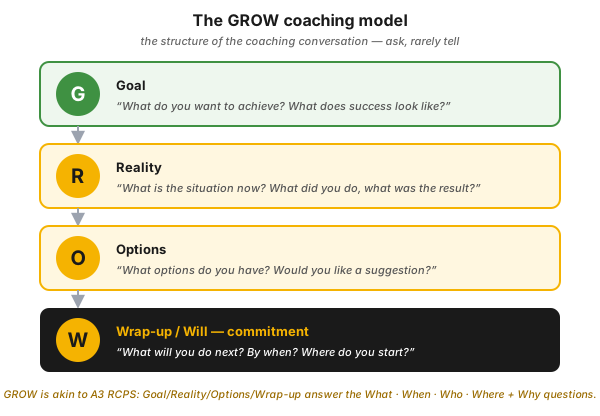
Figure 1 — the GROW coaching model. The conversation moves along the Goal → Reality → Options → Wrap-up arc, throughout in the balance of ask and tell. GROW is akin to A3 RCPS: the four steps answer the What · When · Who · Where + Why questions.
Who is this for?
Section titled “Who is this for?”This article is for those who are responsible on a daily basis for the performance and development of others, or who are sitting in such a conversation as the coached party: shift supervisor · plant manager · process engineer · maintenance manager · team leader · Lean/CI coordinator and navigator · HR and training specialist · project manager · experienced operator as trainer.
Learning objectives
Section titled “Learning objectives”After reading this article you will be able to:
- distinguish coaching from supervision, from giving instructions and from correcting mistakes;
- run a coaching conversation through the four steps of the GROW model, with their associated questions;
- move deliberately along the ask-and-tell scale, from reflecting to the assertive statement;
- give concrete, non-judgmental feedback with the four steps of the OILS framework;
- justify why behavioral change requires repetition, reinforcement and time;
- measure and plan your own use of leadership time with a time-log exercise.
The essence
Section titled “The essence”- A change of role: the supervisor walks around in isolation and checks compliance; the coach is present in the field two-way, as part of the team, and gives capability-building feedback.
- The GROW model: Goal (what do you want to achieve?), Reality (where are you, what works and what doesn’t?), Options (what options do you have?), Wrap-up / Will (what will you do, by when, how committed are you?).
- Ask > tell: the effective coach asks rather than tells, and deliberately chooses among reflecting, the clarifying, facilitating and challenging question, and the assertive statement.
- OILS feedback: a concrete Observation, Impact (the effect on me), Listen (a pause, listening), Suggestion (a concrete suggestion or acknowledgment).
- Sit-in: the coaching’s objective data comes from sitting in and observing, not from assumption.
- Behavioral change takes time: new neural connections are built through repetition and feedback, not in a single training; positive feeling (acknowledgment) supports learning, while fear and stress inhibit it.
- The leader’s four roles: teacher, coach, role model, challenger, visibly “walking the talk.”
- The higher purpose of the improvement team is not improving the process but training the line leaders into process thinkers.
Why does it matter? (the stakes)
Section titled “Why does it matter? (the stakes)”The absence of coaching does not blow up; it quietly makes things more expensive. If the leader gives a ready answer to every problem, the team learns that it is not worth thinking: in the next similar situation it stops again and waits for the leader.
From this a well-known chain begins. First the leader’s time runs out, because every decision funnels to them. Then their own time gets squeezed out of improvement: according to a process-industry survey, more than 40% of front-line leaders’ working time went on administration and meetings, while by the golden rule of practice they should spend ~80% of their time on four core areas (performance management, talent development, continuous improvement, and bridging organizational boundaries). Finally the organization’s capability stalls: no new knowledge is built, the mistakes recur, and the Lean tools come and go “as projects.”
What does coaching mean in Lean leadership?
Section titled “What does coaching mean in Lean leadership?”Coaching is steering people toward their goals and the mutual sharing of experiences, for the sake of a jointly agreed result. It is a tool for learning and development that uses the daily work as a learning occasion.
Just as important is what it is not:
| Coaching is NOT… | Coaching, rather, is… |
|---|---|
| correcting someone’s behavior or action | the tool for learning and development |
| an instruction to do something for the goal | steering the other toward their own goals |
| the role of the all-knowing expert or supervisor | the mutual sharing of experiences and opinions |
| dealing with personal problems | inspiring and supporting the other |
Coaching is strongest when a new task or area of responsibility comes to someone, when a mistake or a performance shortfall has occurred, when someone is stuck on a problem, or when a skill needs to be learned and developed. Why does it work? Because people typically learn best by discovering for themselves, and are far more motivated to implement a solution they decided on themselves.
How is the coach different from the supervisor?
Section titled “How is the coach different from the supervisor?”The difference is not in the technique but in the intent: the supervisor wants to catch you, the coach wants you to succeed.
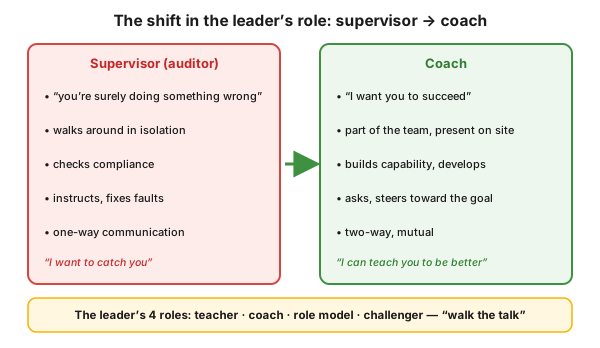
Figure 2 — the shift in the leader’s role. The supervisor (auditor) checks compliance and looks for faults, in isolation; the coach is part of the team, asks questions, builds capability, and wants people to succeed.
| Supervisor (auditor) role | Coach role | |
|---|---|---|
| Intent | “I want to catch you,” “you’re surely doing something wrong, and I will find it” | “I want you to succeed,” “you’re surely doing something right,” “you can do it” |
| Added value | “I point out what is wrong”; limited in what I can influence | “I teach you to be more effective”; I can influence and change how things happen |
| Behavior | walks around in isolation, performs compliance activity, announces the change | two-way, part of the team, present in the field, holds feedback and capability-building conversations |
The coach and the auditor thus require a different way of thinking and a different behavior. The teaching and mentoring quality of the leader decides whether the organization develops: if the leader is not a good teacher, the organization will not learn.
How is a coaching conversation structured? The GROW model
Section titled “How is a coaching conversation structured? The GROW model”The coaching conversation has a structure, and this is provided by GROW: four steps through which the topic travels, from the goal to the concrete commitment. Several coaching models exist; in practice this is the most widespread skeleton.
| Step | Purpose | What the coach does | Typical questions |
|---|---|---|---|
| G — Goal | the goal of the learning project or of today’s conversation | confirms the topic, agrees a concrete goal for the conversation, and, if it makes sense, a longer-term goal too | “What do you want to achieve? What is the goal of today’s meeting? We have 30 minutes, what would you use them for? What does success look like?” |
| R — Reality | becoming aware of the present situation | invites self-assessment, helps recall and make use of earlier successes, and checks the assumptions | “What is the current situation? What have you done so far? What was the result of these? What similar past experience can you learn from? Who is involved?” |
| O — Options | exploring alternatives | goes through the full range of options, asks the coachee for a proposal, cautiously offers their own, and makes sure there is a decision | “What options do you have? What else could you do? What would be the consequence of this? Who else could help? Would you like a suggestion?” |
| W — Wrap-up / Will | a concrete, realistic plan and commitment | commits to action, surfaces the obstacles, makes the steps and the timing concrete, and agrees on the support needed | “What will you do next? Of the options outlined, where will you start? By when? Whom do you need to involve? What do you need from me? When shall we review it again?” |
It is no accident that GROW is familiar from the Lean tools: Toyota originally used the A3 RCPS to coach people, and the similarity between the two frameworks is strong. Goal, Reality, Options and Wrap-up logically answer the What · When · Who · Where questions and the Why behind them, so the A3 itself works as a coaching tool. The performance board can be used the same way: there the goal is already given, the coach only picks up the topic, clarifies the present state with questions, has options sought, and has the team set up the actions.
How much should you ask, and how much should you tell?
Section titled “How much should you ask, and how much should you tell?”Balancing between asking (ask) and telling (tell) applies to all four elements of GROW. The goal is not for the coach to never say anything, but to deliberately choose where they stand on the scale.
| Tool (from asking to telling) | What it is good for | Example |
|---|---|---|
| Reflecting (paraphrase) | mirrors back what was heard and checks understanding | “It sounds like this is what you want to focus on…” |
| Clarifying question | makes precise, concretizes | “What exactly should we focus on? What led here?” |
| Facilitating question | moves forward, opens up the thinking | “What do you want to achieve? Where are you now, what works and what doesn’t?” |
| Challenging question | dislodges from the comfort zone | “What would be the goal that would mean a breakthrough? On a scale of 1–10, how committed are you?” |
| Assertive statement | the coach’s own viewpoint, but handed back with a question | “Based on what you said, I suggest we focus on this. What do you think?” |
Weak coaching, by contrast, responds from reflex: “that’s your problem,” “let me tell you how to fix it.” In this case the coach hides their own intent, withholds information, listens “as a pause while reloading,” asks only closed questions, and hands out the ready answer. Conscious coaching is the opposite of this: it reveals its intent, shares the data, listens in order to learn and understand, asks open questions, and adjusts its style to exploring the options.
How do you give useful feedback? The OILS framework
Section titled “How do you give useful feedback? The OILS framework”The backbone of coaching is feedback, and this has its own four-step structure: OILS. Its essence is that it starts from observation, not from judgment.
- O — Observation: describe the concrete observation. “I see that the goals are not clear to your team.”
- I — Impact: say what effect it has on you or on the work. “I feel this affects how much they want to do the task entrusted to them.”
- L — Listen: pause, and listen to the clarifying questions. “What do you think about this?”
- S — Suggestion: give a concrete suggestion or acknowledgment, encouragement. “I suggest we fix the goals in advance, before the analysis.”
Receiving feedback is just as much a skill: don’t argue and don’t defend, ask questions for understanding, acknowledge the other’s viewpoint, say thank you, and then decide to what extent and how you apply it.
What is the coaching’s data built on? The sit-in
Section titled “What is the coaching’s data built on? The sit-in”Coaching is not an ad hoc event but a routine, and its basis is one’s own observation. The sit-in means that the coach is present at the work and works from what they see, not from assumptions or other people’s accounts.
What this delivers in practice:
- the sit-in is the key to having objective data for a valuable coaching conversation;
- the differing practices become visible: different colleagues carry out the same process differently, and the individual good solutions also come to light;
- coaching thus becomes a regular individual goal- and task-alignment: as often as every six weeks instead of the twice-a-year appraisal;
- the team leader tracks the short-term, individual goals in an action plan;
- the coaching appointments can be posted on the team board, so the conversation is not “whenever it happens to fit” but a planned event.
Why does behavioral change take time?
Section titled “Why does behavioral change take time?”Because lasting behavioral change physically means building new neural connections, and this process has its own speed. The brain consists of several billion neurons connected by axons through synapses; learning itself is nothing other than creating new connections and strengthening existing ones.
Three conclusions follow from this for leadership:
- Repeat. It is not the strength of the stimulus but the frequency of repeated occurrences that strengthens the new connections. Coaching presence must therefore be built into the daily routine (regular Gemba presence), not into a once-a-year training.
- Reinforce. Fear and stress inhibit the brain’s processes, while positive feelings support the retention and recall of information. Feedback that contains acknowledgment, reinforcement and approval directly aids the consolidation.
- Be patient. Changing the behavioral patterns of adults takes time and requires constant feedback. Whoever promises fast change is misleading you. A sustainable 5S or Lean program drags on for exactly this reason: it has to ripen into a habit.
The place of practice, moreover, is not the classroom. Proficiency requires practice, and Lean leadership can be practiced in the plant: head for the Gemba. Noticing deviations is itself a time-consuming skill, because the brain gets used to a given pattern, and that is why an outside visitor notices at first glance what is already invisible to the locals. The deeper, brain-development background of learning and behavioral change is elaborated in the learning organization article.
The leader’s new role: teacher, coach, role model, challenger
Section titled “The leader’s new role: teacher, coach, role model, challenger”In the Lean transformation the leader’s role goes beyond giving instructions. It is about four roles practiced at once:
- Teacher — develops on the job, and is able to run the onboarding themselves.
- Coach — steers with questions and builds capability (GROW, OILS).
- Role model — visibly “walks the talk” for every team member; they themselves model the expected behavior (for the depth of role modeling, see role modeling on the gemba).
- Challenger — questions the status quo with ideas that stretch and develop people.
Throughout, the leader is responsible for the personal development of their direct reports, not only for their results.
The mindset change starts from the leadership, at every level: the effective leader holds the view that “change begins with me” (see change begins with me), and critically asks themselves: “what do I have to do differently so that I inspire others to change?”. For this, as many people as possible must be involved from the line in the transformation.
Resistance here is not an enemy but a symptom: behind it there is typically fear, confusion, distrust, a lack of information, misunderstanding, unanswered questions or an unclear goal. That is why the effective leader provides evidence for acceptance: builds trust, gives a vision (that people can imagine and get enthusiastic about), shares valid, timely and reliable information, is transparent (does not deliver a censored PR message), and involves people. The basis of all this is trust, which the leader must first earn.
Coaching as a capability lever (the 3rd lever of the influence model)
Section titled “Coaching as a capability lever (the 3rd lever of the influence model)”Of the four levers of the influence model, the third is skills and capabilities: “I have the knowledge and the ability to behave in the new way.” Coaching is its practical instrument, with three elements:
- Role-tailored training — a comprehensive training program, adapted to the differing needs of the individual roles; the shift supervisor needs a different skill than the panel operator.
- Training path — not a one-off event but planned capability development carried through the entire professional career (see capability building and training and onboarding).
- A formal coaching process — regular and structured, to strengthen motivation and personal development.
This is also the core of the leadership behavior change. In observed practice, the pattern of “disrespect” (shouting, ordering people about and arguing from rank, threats, letter-writing, the absence of effective communication with the front line) switches to the pattern of “caring”: constructive feedback, persuasion, coaching, and a genuine connection with the front line.
The higher purpose of the improvement team
Section titled “The higher purpose of the improvement team”James Womack puts it sharply: most of the Lean community believes that improvement teams exist to improve processes. This may be true, but the higher purpose is to make line leaders better at every level by training them into effective process thinkers.
The same logic drives the senior-leadership gemba walk too: its point is not for the leader to look at something, but for the organization’s process thinkers to teach senior management to think in a process-centered way. That is why the senior leader’s role on the walk is to ask (5 Whys, not 1 Who), to rarely or never give an answer, to show respect toward everyone, and to make it clear that the management of the end-to-end process is critical. The biggest obstacle is “gemba phobia”: senior leaders were trained to have to know every answer and to be responsible for everything; this is what they must unlearn. In Womack’s call: “If not you, who? If not now, when?”
Process-industry context and safety
Section titled “Process-industry context and safety”In a continuously operating, hazardous facility, the coaching style is not stylistic decoration but a direct safety tool.
The front-line leader (shift supervisor, daily staff) is closest to where the risk arises. By the golden rule of practice, they should spend ~80% of their time on four core areas:
| Core area | What it means in practice |
|---|---|
| Performance management | understands, reviews and communicates the daily performance against the goals; a weekly review with the higher level; daily and weekly activity plans from the key people |
| Talent development | directly coaches and teaches the key people, manages the development of subordinates, with a strong presence and a detailed knowledge of the process |
| Continuous improvement | understands the Lean tools and their application in their own area; drives performance daily (problem solving, waste elimination), and reinforces the production system every day |
| Bridging organizational boundaries | removes the obstacles that hinder the area’s performance, standardizes within and across areas, ensures a collaborative environment |
The safety benefit follows from this: with questioning, non-punitive leadership, the front line openly discusses the near-misses and the workarounds, instead of hiding them, since fear inhibits learning here too. This is how the safety culture becomes fact-based.
How do you introduce it in practice? (roadmap)
Section titled “How do you introduce it in practice? (roadmap)”The order below follows the logic of a leadership pilot, and can be started tomorrow:
- Measure where your time goes. Choose a representative sample of the leaders, and have them keep a time log of their activities for five days, in half-hour increments.
- Group the time into the four core areas (performance management, talent development, continuous improvement, bridging organizational boundaries), collecting the administration separately.
- Make a concrete commitment. A proven set of leadership commitments: I spend at least 40% with my people, 4 hours a week on sit-ins, 4 hours a week on coaching and feedback, I hold the daily check-in every day, and one longer meeting a week. The time spent in the field can thus be raised from the typical 10–20% to 40–50%.
- Introduce a coaching routine. Post the coaching appointments on the team board, and set the individual goal- and task-alignment to a regular rhythm (e.g. every six weeks instead of twice a year).
- Work from sit-ins. Before every coaching conversation, have your own observation; run the conversation through GROW, and give the feedback with OILS.
- Track it in an action plan. Record the short-term, individual goals in writing, and pick up there next time.
- Remove the obstacles from above. Take the result of the time log to the higher level: reducing the paperwork and running meetings more effectively is a system-level decision, not the shift supervisor’s.
Hands-on part
Section titled “Hands-on part”- Time-log exercise. For five days, in half-hour increments, record your own activities, then total them by the four core areas and administration. The power of the exercise is that you yourself produce the data, so it is hard to dispute, and it makes you aware at once of where your day goes.
- One sit-in and one GROW. Sit in next to a colleague on a shift to observe, note down facts (not judgments), then run a GROW conversation with them about what you saw. Give the feedback with OILS.
- Ask-tell self-observation. In your next leadership conversation, draw a line down the margin of your notes, and at each of your utterances mark whether it was a question or a statement. At the end, look at the ratio.
- Scenario exercise in a team. Take a real sticking point (for example: a shift supervisor refuses to use the performance board), and draw up an action list for all four levers of the influence model, then discuss it.
Measurement and audit
Section titled “Measurement and audit”Coaching is alive when it leaves a trace. What is worth measuring:
| What you measure | How | What it shows |
|---|---|---|
| Leadership field time | time log, five days, half-hour increments | the gap between intent and reality |
| Sit-in hours | weekly count and hours | whether there is objective data for coaching |
| Coaching conversations | logged occasion and participant | whether it is routine or occasional |
| Rhythm of individual goal-alignment | time between two alignments | a six-week rhythm or twice a year |
| Closing of actions | the completion rate of the action plan | whether the commitment is real |
Common mistakes
Section titled “Common mistakes”- Pursuing coaching as supervision. Why it’s a problem: the “I want to catch you” intent freezes people and hides the real problems. Instead: the coach’s intent is for the other to succeed; their presence is support, not inspection.
- Only telling (tell), never asking (ask). Why it’s a problem: the ready answer kills learning, and in the next similar situation they call you again. Instead: move deliberately along the scale: reflecting, the clarifying, facilitating and challenging question, and only at the end the assertive statement.
- Answering from reflex. Why it’s a problem: the “that’s your problem, let me tell you how to fix it” attitude hides the intent, withholds the data, and works with closed questions. Instead: reveal your intent, share the data, ask openly, and hold a genuine pause.
- Expecting lasting change from a single training. Why it’s a problem: the new behavior consolidates only through repetition and feedback. Instead: build a daily routine, and count in years, not weeks.
- Punitive feedback. Why it’s a problem: fear and stress inhibit learning, so it obstructs exactly what you want to achieve. Instead: OILS: concrete observation, impact, pause, suggestion or acknowledgment.
- Ad hoc coaching. Why it’s a problem: without a sit-in and a posted rhythm there is no objective data, and it will not become a habit. Instead: a planned coaching appointment on the board, based on a sit-in.
- Fragmenting the leadership time. Why it’s a problem: if the time drains into administration, none is left for coaching, however good the intent. Instead: measure it with a time log, commit to a concrete number of hours, and take the obstacles to the higher level.
- Taking process improvement as an end in itself. Why it’s a problem: the improved process degrades again if no capability was left behind. Instead: use every improvement project as a teaching occasion too, so that leaders become process thinkers.
When NOT to use it? (limits of the method)
Section titled “When NOT to use it? (limits of the method)”Coaching is the strongest leadership tool for lasting capability building, but it is not the right first answer in every situation:
| Situation | Why not primarily coaching | The right answer |
|---|---|---|
| Acute danger, emergency, alarm | here there is no time for questions and consensus | a direct, unambiguous instruction; coaching comes after the event |
| Missing basic capability or expertise | questions cannot elicit what is not there | targeted training and onboarding (capability building, training and onboarding), then coaching |
| Deliberate rule-breaking, a disciplinary matter | coaching is not a disciplinary tool, and mixing the two makes both lose credibility | the regulated employer procedure, kept separate from the developmental conversation |
| A personal, private-life or health problem | coaching is expressly not the handling of personal problems | the appropriate professional or support service, not the leader |
| A system fault behind the behavior (a bad process, a missing tool, a distorted incentive) | even the best coaching does not solve what does not depend on the person | fixing the process, the tool or the measurement system; coaching is only effective after that |
| A certified safety function is needed | the coaching culture is not an audited protection layer | protection designed per SIL/LOPA, IEC 61511 |
Rule of thumb: coaching builds capability. If the gap is not one of capability but of information, tools, process or regulation, that must be put right first.
What this article does NOT cover
Section titled “What this article does NOT cover”This article is about the how of Lean leadership: about coaching as a concrete leadership skill and conversation technique. The broader topics belonging to it are carried by separate articles:
- Lean leadership — the principles and roles of Lean leadership, the diamond model, the True North and the leadership characteristics (the hub of this article).
- feedback — the principles of feedback in detail, beyond OILS.
- gemba walk and the senior-leadership gemba walk — the mechanics of the gemba walk: what you look at, what questions you ask, how you move through a value stream.
- capability building — the system of skill development: the capability matrix, learning paths, the architecture of organizational capability building.
- the learning organization — the leader as teacher, the logic of organizational learning and the accumulation of wisdom.
Also not the subject of this article are the profession of professional (external, accredited) coaching, the design of performance-appraisal and remuneration systems, and personality and typology models.
Take it home (keys)
Section titled “Take it home (keys)”- Change your intent, not your technique: don’t want to “catch” the other, want them to succeed. The rest follows from this.
- Give the conversation structure: with GROW, coaching is not a friendly chat but a workflow from goal to commitment that fits into 30 minutes.
- Ask more than you tell, but know when you move to the assertive statement. Measure the ratio on yourself once.
- With feedback, start with observation: with OILS the feedback is about a fact, not a person, and closes with a suggestion or acknowledgment.
- Work from a sit-in: if you haven’t seen it yourself, there is nothing to coach on. The observation is the data.
- Plan in years, not weeks: behavior consolidates through repetition and reinforcement; whoever promises fast change is misleading you.
- Protect your time: measure it with a time log, commit to a concrete number of hours for sit-ins and coaching, and take the obstacles up to the system level.
Self-test
Section titled “Self-test”- What is the difference in the intent of the supervisor and the coach, and how does this show up in concrete behavior (presence, communication, feedback)?
- Take a stuck colleague through the four steps of GROW in your head: give one question for each step, and name whether it was a clarifying, facilitating or challenging question or an assertive statement.
- Which of the four steps of OILS is most often skipped, and what is the consequence of this in the conversation?
How does it appear in digital practice?
Section titled “How does it appear in digital practice?”The principle of coaching does not stop at a conversation caught in the corridor: the same logic is also realized in software. Instead of the paper note and memory, here a structured conversation template, a logged observation and a tracked action make the development visible; the mechanism differs, the principle is the same.
| Coaching principle | Digital implementation | What it delivers |
|---|---|---|
| Sit-in = objective data | a logged, timestamped field observation, even with a photo | the conversation is built on fact, not on memory |
| GROW = structure | a structured conversation template with the four steps | the conversation does not drift, and is comparable |
| OILS = feedback | a recorded observation–impact–suggestion entry | the feedback is not lost between shifts |
| Commitment and deadline | an action with an owner and a deadline, with automatic follow-up | the “we discussed it” becomes measurable completion |
| Leadership time | logging of coaching and observation hours, a trend | the commitment is demonstrable, not just a promise |
| Repetition and rhythm | scheduled, reminded coaching appointments | the routine does not depend on the daily firefighting |
Connection to OPEREX (shift diary)
Section titled “Connection to OPEREX (shift diary)”The weakest link of coaching is traceability: the observations of the sit-in, the coaching conversations, the individual development plans and the leader’s field time easily become an informal practice that cannot be reconstructed afterwards. The OPEREX shift diary makes this auditable: the leadership coaching and observation hours, the reinforcing feedback and the improvement actions can be recorded with a timestamp, tied to a shift. This way the leader’s commitment (for example the 4+4 hours a week) is measurable and demonstrable, and coaching becomes not a campaign but a routine followed shift by shift.
Terminology (HU / EN / JP)
Section titled “Terminology (HU / EN / JP)”| Hungarian | English (canonical) | Japanese (rōmaji) | Note |
|---|---|---|---|
| coaching | coaching | — | steering toward goals, not instruction |
| coach / coacholt | coach / coachee | — | the one who gives / the one who receives the coaching |
| GROW-modell | GROW model | — | Goal · Reality · Options · Wrap-up (Will) |
| OILS-visszajelzés | OILS feedback | — | Observation · Impact · Listen · Suggestion |
| kérdezés vs. közlés | ask vs. tell | — | the coach prefers asking |
| facilitáló hallgatás | facilitative listening | — | open question, pause, mirroring |
| beülés / megfigyelés | sit-in | — | the coaching’s objective data |
| terepi jelenlét | gemba presence | Gemba (現場) | the place of practice is the plant |
| coaching-kata | coaching kata | Kata (型) | a repeated, structured coaching routine |
| példakép | role model | — | “walk the talk” |
| kihívó | challenger | — | stretching, developmental goals |
| folyamatgondolkodó | process thinker | — | the higher purpose of improvement |
| on-the-job tréning | on-the-job training | — | development during work |
What are the four steps of the GROW model?
Goal, Reality (the current reality), Options and Wrap-up, also known as Will (closing and commitment). The coaching conversation follows this structure, in the balance of asking (ask) and telling (tell), and the coach asks rather than tells.
What is the difference between coaching and supervision?
Supervision checks compliance and looks for faults (“I want to catch you”), in isolation. Coaching is two-way, part of the team, present in the field, and supports by steering people toward their goals, with capability-building feedback (“I want you to succeed”).
What is the OILS feedback framework?
Observation (a concrete observation), Impact (what effect it had), Listen (a pause, listening), Suggestion (a concrete suggestion or acknowledgment). Good feedback is built on observation, not on judgment.
What is a sit-in in coaching?
The sit-in means sitting in and observing: the coach is present at the work and works from what they see. This provides the coaching’s objective data, instead of assumptions and other people’s accounts, and this is how the differing practices and the individual good solutions come to light too.
Why is a single Lean training not enough to change behavior?
Because lasting behavioral change means building new neural connections, which requires repetition and continuous feedback. A single training does not create a habit, so the promise of a fast transformation is unrealistic.
What are the four roles of the Lean leader?
Teacher, coach, role model and challenger. They visibly “walk the talk,” are responsible for the development of their direct reports, and also teach on the job. The higher purpose is to develop the leaders themselves into process thinkers.
Related concepts
Section titled “Related concepts”Lean leadership · role-modeling · feedback · the influence model · the trust model · change starts with me · capability building · training and onboarding · learning organization · gemba-walk · the executive gemba walk · A3 report · performance dialogue · mos
Next step
Section titled “Next step”If you have understood this, from here it is worth going on, in this order:
- feedback — the principles of feedback in detail; OILS is only the skeleton, here the full skill is built around it.
- gemba-walk — where you get the own observation needed for coaching, and how to be present in a way that develops.
- capability building — how individual coaching becomes system-level capability development across the whole organization.
References / Further reading
Section titled “References / Further reading”- Max Landsberg: The Tao of Coaching. HarperCollins, 1996 — the canonical exposition of the GROW model (Goal, Reality, Options, Wrap-up) applied to the coaching conversation.
- John Whitmore: Coaching for Performance. Nicholas Brealey Publishing, 1992 — the classic foundational work of the GROW model in performance coaching.
- John Shook: Coaching (Lean Enterprise Institute, 2014) — on the Lean leader’s coaching role; a discussion of the John Wooden teaching method and the layers of capability development.
- Mike Rother: Toyota Kata: Managing People for Improvement, Adaptiveness and Superior Results. McGraw-Hill, 2009 — the improvement kata and the coaching kata as a repeated, structured coaching routine.
- Stephen M. R. Covey: The Speed of Trust: The One Thing That Changes Everything. Free Press, 2006 — trust as the basis of leadership impact, with a list of high-trust behaviors.