Production reliability program
≈ 17 min read · 3,439 words
A pump fails at two in the morning, and the shift’s first question is: “have we called maintenance yet?” Yet the operator had been hearing for days that the bearing was humming differently, there was just no one and nowhere to report it to. That moment is the essence of a production reliability program: the condition of the equipment is looked after not by the repair crew but by the person who lives with it day in and day out. Let’s look at what this framework is, why operator work can have as much impact on asset reliability as maintenance, and how it can be introduced in a plant.
A production reliability program makes asset reliability the active responsibility of operators, not only of maintenance: operations own reliability.
Its core proposition is that operator work has at least as much, and in many cases more, impact on asset reliability than maintenance, because the operator lives with the equipment day in and day out and is the first to notice the onset of deterioration. The program is built on the ownership of reliability, on operational discipline and on the partnership between production and maintenance, in which maintenance is an equal partner; and through standardized operator work processes it moves the plant from reactive (“it breaks, we fix it”) working to proactive, risk-based thinking.
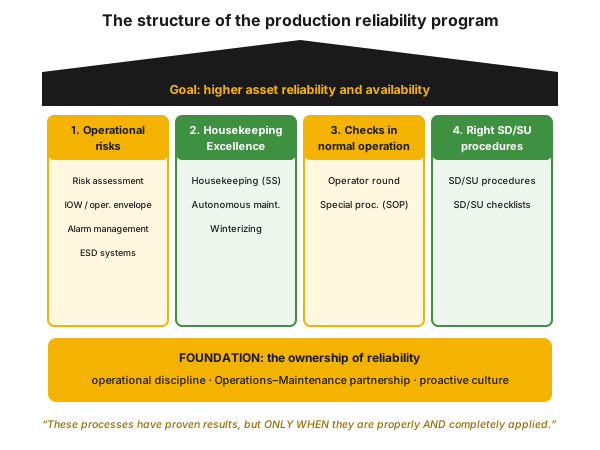 Figure 1 — the four program-area pillars on the common foundation of the ownership of reliability; the goal is higher asset reliability and availability.
Who is this for?
Section titled “Who is this for?”This article is for those who are accountable for equipment reliability on the boundary between production and maintenance: operator · shift supervisor · plant manager · maintenance technician · reliability engineer · process engineer · HSE / process safety specialist · plant and production management.
Learning objectives
Section titled “Learning objectives”After reading this article you will be able to:
- explain why the ownership of asset reliability belongs to the operator (to production), and why maintenance is an equal partner;
- list the four program areas of the program and the fifth, supplementary element (training);
- distinguish reactive, task-based working from proactive, risk-based thinking;
- say what operational discipline means, and what it can be measured on;
- outline how you would start a reliability program in your own plant.
The essence
Section titled “The essence”- The operator “owns” reliability too. A telling analogy: who owns the reliability of a car? Not the mechanic, but the driver. In the same way, the equipment belongs to the operator, who lives with it day in and day out.
- Operations = Maintenance. The program rests on an equal partnership between production and maintenance: production owns reliability, maintenance contributes methods, skills, expertise and support in a timely and effective way.
- From reactive to proactive. The goal of the program is the shift from “task-based” working that waits for failure to a risk-based, failure-preventing culture, which reduces unplanned events and increases availability.
- It is organised around four program areas: (1) managing operational risks, (2) housekeeping excellence, (3) operate and check during normal operation, (4) right SD/SU procedures, supplemented by the training of operators.
- Operational discipline: every plant and asset is operated and maintained according to the regulations, programs, procedures and standards that have been implemented, and these are strictly followed.
- It works only when fully applied. These processes have proven results, but ONLY WHEN they are properly AND completely applied.
- OPEREX connection: the digital backbone of the program is an electronic shift log, through which the operational data (round, deviation, bypass, action) flows in an auditable way.
What is a production reliability program, and where does it come from?
Section titled “What is a production reliability program, and where does it come from?”A production reliability program is a framework that raises the reliability of the assets of a manufacturing site, and that the whole of production (operations, maintenance, technology) carries together. The dimensions presented here give the operator (Operations) side of the system; every topic is approached with the same three-point logic: WHY is it important? · WHAT does it contain? · HOW can it be implemented?
Why can operator work have as much impact as maintenance?
Section titled “Why can operator work have as much impact as maintenance?”Because the operator lives with the equipment day in and day out and is the first to notice the onset of deterioration, before it turns into a failure. The starting point of the program is a surprising but well-defensible claim: “Operations can have a bigger impact on asset reliability than Maintenance.” The foundation of this is a cooperative partnership between production and maintenance, in which the two sides are equal: production owns reliability, and maintenance, as a dedicated partner, provides timely and effective methods, skills, expertise and support.
The ownership of reliability
Section titled “The ownership of reliability”The deep foundation of “Reliability Excellence” is establishing the ownership of reliability, which a simple car analogy illuminates:
Who owns reliability? The mechanic? No. Reliability belongs to the driver / operator. Operators live with the equipment day in and day out, much like the driver of a car, and a good operator has an inherent feel for when the equipment’s performance begins to deteriorate or is in jeopardy.
If operators develop a sense of ownership for their own equipment, the desire grows to fix it before it breaks — that is, to avoid failure. And reliability benefits from a proactive culture.
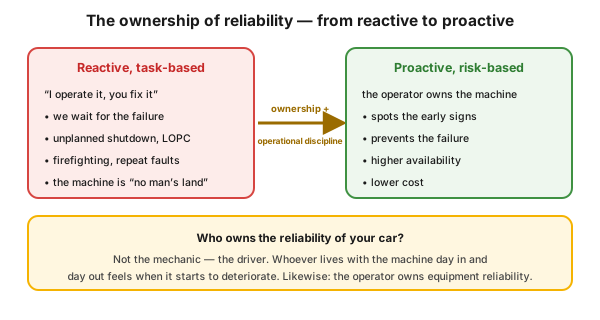 Figure 2 — ownership and operational discipline as the driving force: from reactive, task-based thinking to proactive, risk-based thinking.
Program objectives
Section titled “Program objectives”The program sets out eight objectives, and these give its “North Star”:
- increase asset reliability;
- increase the effectiveness of operator work processes;
- standardize operator work processes in all areas;
- increase operational discipline;
- increase operators’ awareness of reliability gaps;
- increase data transparency;
- reduce the plant’s operating costs;
- support the safety culture in all areas and across all shifts.
Operational discipline — the axis of the program
Section titled “Operational discipline — the axis of the program”Operational discipline is one of the key concepts of the program, and it can be summed up in one sentence: every plant and asset is operated and maintained according to the regulations, programs, procedures and standards that have been implemented, and these are strictly followed. Every element of the program, from the round to the checklist, ultimately makes this discipline visible, measurable and sustainable.
The four program areas (the content map)
Section titled “The four program areas (the content map)”The program arranges the reliability-related operator processes into four areas. In the knowledge base each sub-concept gets its own detailed article; this hub is the entry point.
1. Managing operational risks
Section titled “1. Managing operational risks”The identification, analysis, evaluation and control of hazards: the engine of the shift from reactive thinking to proactive, risk-based thinking.
- risk assessment — the risk assessment process, the PHA methods (HAZOP, What-if/HAZID, LMRA, JSA), MOC and the shared risk register.
- alarm management — alarm handling as a layer of protection, the lifecycle and bad-actor alarms.
- Cross-functional improvement teams — the tactical mechanism for solving complex reliability issues that cut across several functions (see below).
2. Housekeeping excellence
Section titled “2. Housekeeping excellence”The orderly, disciplined, “owned” plant as a lever of reliability.
- housekeeping — order that is “maintained” (not “achieved”), the plant application of 5S, the monthly audits.
- autonomous maintenance — maintenance with operators: the simple jobs, ownership and the TPM connection.
- winterizing — freeze protection, the checking of steam traps and tracing, winter preparation.
3. Operate and check during normal operation
Section titled “3. Operate and check during normal operation”The regular, standardized checking of the equipment and the process while running.
- the standard operator round — the planned route, the digitisation of off-line parameters, the critical reliability parameters.
- IOW and the process card — operating envelopes, the Integrity Operating Window and deviation monitoring.
- ESD systems — operating the emergency shutdown systems, trip testing and the bypass register.
4. Right SD/SU procedures
Section titled “4. Right SD/SU procedures”The correct, repeatable procedures for shutdowns, start-ups and normal operation.
- SD/SU procedures and checklists — keeping the shutdown/start-up procedures up to date and the checklists that go with them.
- special operating procedures (SOP) — the precise description and up-to-date maintenance of non-daily, critical activities (chemical cleaning, catalyst handling, decoking).
Supplementary: the training of operators
Section titled “Supplementary: the training of operators”The fifth, supplementary element of the program is the training and competence development of operators (a technical and a “blue collar” career path); this is set out in detail in the training, onboarding and competence article. The lesson is memorable: an operator without formal training knows “where three buttons are on the operator screen: stop, start and reset”, and is much more likely to suffer a severe injury on the job.
Cross-functional improvement teams
Section titled “Cross-functional improvement teams”One implementation mechanism of the program is the cross-functional improvement team: it is formed from the professionals best placed to see the problem, when an issue is complex and cuts across several functions. The team is tactical in nature (not systemic or organizational-structural), and works with a clear charter, metrics (KPIs) and a lifecycle:
| Event | Purpose |
|---|---|
| Pre-initiation | Setting the objectives and the metrics (KPIs); selecting the members and defining their roles |
| Initiation | Clarifying the charter, objectives, KPIs and roles |
| Kick-off | Discussing the problem, an initial action plan for data collection |
| Weekly meetings (30–60 minutes) | Issues, actions, progress; alignment with the sponsor |
| Team dismissal | Sharing the lessons learned, finalizing the results |
Typical examples from practice: an ESD team, an LOPC team, a corrosion team, a water treatment team, an on-line analyser team.
Process-industry and safety context
Section titled “Process-industry and safety context”The program was written for Seveso-classified, continuously operating process industry — crude oil processing and chemicals — where reliability and safety are inseparable: a failure here is not only lost production but can be LOPC (loss of primary containment), fire, injury or an environmental event. That is why every element of the program is at once a reliability and a safety tool, from the risk assessment and the ESD trip test to winterizing (a frozen line can cause LOPC). Improving reliability may never come at the expense of safety; the two are two outputs of the same proactive, disciplined culture.
How can the program be introduced in practice?
Section titled “How can the program be introduced in practice?”The program is not “paper” but implemented and observed practice: every element has a local regulation, an SOP and an example behind it. The typical logic of introduction:
- Write the standard (site/plant-level regulation, SOP, checklist) for the given element.
- Train the operators (where relevant, closing with an exam, for example in autonomous maintenance).
- Divide the area between the shifts, with owners and a validator.
- Audit regularly (for example a monthly housekeeping audit, an annual process documentation audit), and turn the deviations into SMART actions.
- Make the results visible and recognize them: a performance board, recognition of good practice.
The bar: the program is alive when it works shift by shift and leaves an audit trail, that is, when it is routine and not a campaign.
Putting it into practice — a shift supervisor’s first 30 days
Section titled “Putting it into practice — a shift supervisor’s first 30 days”If you had to start tomorrow, do not start with the whole program but with a single element, and take it through the full logic:
- Week 1 — the standard operator round. Designate a planned route with fixed stops, and define at each station the few critical reliability parameters (vibration, temperature, leakage) that the operator records every shift.
- Week 2 — deviation handling. Introduce one simple rule: a value outside the limits goes to the shift supervisor, who decides whether autonomous maintenance or a work order is needed. A persistent deviation (for example beyond 24 hours) gets an automatic alert.
- Week 3 — the housekeeping baseline. Divide the area between the shifts, and start a monthly housekeeping audit measured on a uniform checklist; put the result on the performance board.
- Week 4 — feedback and routine. Go through the first month’s deviations with the shift, turn the open points into SMART actions, and record that from now on this is part of daily operation, not a project.
These four weeks already give a working, measurable reliability core, which you can then extend with the other program areas.
Common mistakes
Section titled “Common mistakes”- “It breaks, we fix it” — reliability belongs to maintenance alone. Why it’s a problem: the early detection that only the operator, who lives with the machine day in and day out, could provide is lost; the plant stays reactive. Instead: production owns reliability, maintenance is an equal, dedicated partner.
- Partial, tick-box introduction of the program. Why it’s a problem: a round that stops halfway, a checklist that is not followed or unaudited order all slide back; these processes deliver results only when properly AND completely applied. Instead: full, sustained application with regular audits.
- The round as pure data collection, without feedback. Why it’s a problem: if no decision and no action follow the recorded deviation, the data is dead and ownership is damaged. Instead: the shift supervisor validates the deviation, gives feedback, and it turns into an action (autonomous maintenance or a work order).
- Reliability at the expense of safety. Why it’s a problem: in a continuously operating, Seveso-classified plant a failure is not only lost production but can be LOPC, fire or injury. Instead: safety takes precedence; reliability and safety are two outputs of the same proactive culture.
- The cross-functional team becomes a permanent organizational unit. Why it’s a problem: the team is tactical, with a clear charter and lifecycle; if it becomes structural, it loses focus. Instead: objective, KPIs, then dismissal when the problem is solved, with the lessons shared.
When NOT to use it? (the limits of the method)
Section titled “When NOT to use it? (the limits of the method)”A reliability program strengthens asset reliability from the operational, human side, but it is not the right answer to every problem. Knowing the limits is just as important as the program itself:
| Situation | Why this is not primarily it | The right answer |
|---|---|---|
| A certified safety function (a layer of protection) is needed | operational discipline and good housekeeping are not a certified, audited barrier | SIL/LOPA, design to IEC 61511 |
| The root cause is a deep technology or design fault | operational routine does not fix a poor design | root-cause analysis, FMEA, redesign |
| A one-off, non-recurring problem | there is no need to build a whole program around it | a targeted risk assessment or a cross-functional team for the single issue |
| There is no leadership commitment, only a campaign | without audits and cadence the program slides back | first leadership commitment and a regular rhythm (MOS), then the program |
Rule of thumb: the program is the strongest tool for the operational, human and discipline side of reliability. For a safety-critical barrier, a design fault or a one-off issue it does not replace the appropriate tool but complements it.
Take it home (keys)
Section titled “Take it home (keys)”- Asset reliability belongs to production too, not only to maintenance: the first to sense the trouble is the one who lives with the machine.
- From reactive to proactive: the goal is to prevent the failure, not to wait for it; this proactive culture is the biggest lever of reliability.
- Operational discipline = by the rules, strictly. The elements of the program (round, checklist, audit) make this visible and measurable.
- It works only when properly AND completely applied: a half solution slides back.
- Reliability and safety are the same culture: reliability may never come at the expense of safety.
- Start small: with one program element (the standard operator round is the best entry point), then extend with the other areas.
Self-test
Section titled “Self-test”- Why can operator work have a bigger impact on asset reliability than maintenance? Justify it with the car analogy.
- List the four program areas of the program, and give one concrete element for each (and name the fifth, supplementary element).
- What does operational discipline mean, and what are the two or three concrete things you would use to measure whether it really holds in a plant?
How does this show up in digital practice?
Section titled “How does this show up in digital practice?”The two hardest-to-grasp elements of a reliability program, ownership and operational discipline, become real by being measurable and retrievable. In a paper shift log this is lost; in a well-organised digital working environment, however, the same logic is recorded in a structured way, with a timestamp and tied to an owner. The mechanism differs, the principle is the same.
| Program element | Digital implementation | What it delivers |
|---|---|---|
| Operator round | field data captured on a mobile device, with predefined stations and parameters | the off-line data can be analysed digitally, the round is auditable |
| Operating envelopes (IOW) | continuous limit monitoring, automatic alerting of a persistent deviation into the log | the deviation does not go unnoticed, it reaches an owner |
| ESD / protection bypass | an electronic register of bypass status and trip tests, with notification on change | a bypassed protection is visible and accountable |
| Risk and incident actions | a single action register with an owner and a deadline | “no forgotten action”, closure is trackable |
| Housekeeping / audit | scheduled digital audit, scoring, trend | the state is measurable and does not slide back |
Connection to OPEREX (shift log)
Section titled “Connection to OPEREX (shift log)”The digital backbone of a reliability program is an electronic shift log, and this connection is not bolted on but follows from the way the program works. Its data flows (the digitisation of the off-line data of the operator round, the automatic alerting of an IOW deviation into the electronic log after 24 hours, the notifications of the register of ESD bypasses and MOS bypasses, and the tracking of risk and incident actions) are all entries in the same log. The OPEREX shift log delivers exactly this: a structured, timestamped, owner-linked, retrievable and auditable record, on which the two hardest-to-grasp elements of the program — ownership and operational discipline — finally become measurable. This way the program lives on not as a document but as a daily measured routine.
Terminology (HU / EN)
Section titled “Terminology (HU / EN)”| Hungarian | English (canonical) | Note |
|---|---|---|
| termelési megbízhatósági program | production / operations reliability program | the framework |
| megbízhatóság tulajdonlása | ownership of reliability | the soul of the program |
| operatív fegyelem | operational discipline | by the rules, strictly followed |
| eszközmegbízhatóság | asset reliability | the main objective |
| rendelkezésre állás | availability | the first factor of OEE |
| reaktív → proaktív gondolkodás | reactive → proactive (risk-based) thinking | the culture change |
| cross-funkcionális csapat | cross-functional team | the mechanism of introduction |
| LOPC | Loss of Primary Containment | loss of primary containment |
What is the essence of a production reliability program in one sentence?
It makes asset reliability the active responsibility of operators and of production (not only of maintenance), and through standardized operator processes it moves the plant from reactive working to a proactive, risk-based culture.
Why can operator work have as much impact on reliability as maintenance?
Because the operator lives with the equipment day in and day out and is the first to notice the onset of deterioration (vibration, sound, leakage, temperature). If they own reliability, they prevent the failure rather than wait for it — this proactive culture is the biggest lever of reliability.
What does operational discipline mean?
That every plant and asset is operated and maintained according to the regulations, programs, procedures and standards that have been implemented — and that these are followed not “roughly” but strictly. The elements of the program make this discipline visible and measurable.
What does the program consist of?
Four program areas — (1) managing operational risks, (2) housekeeping excellence, (3) operate and check during normal operation, (4) right SD/SU procedures — plus the training of operators. Each area stands on the common foundation of the ownership of reliability.
Why does the program work only when "completely applied"?
Because reliability processes have proven results, but not with a partial, tick-box introduction: a round that stops halfway, a checklist that is not followed or unaudited order all slide back. The outcome depends on proper AND complete application.
Related concepts
Section titled “Related concepts”risk assessment · IOW and the process card · alarm management · ESD systems · housekeeping · autonomous maintenance · winterizing · the standard operator round · special operating procedures · SD/SU procedures · TPM · operator and maintainer · OEE · shift handover · training and competence
Next step
Section titled “Next step”If you have understood this, from here it is worth going on — in this order:
- the standard operator round — the fastest entry point: this is where the daily, measurable reliability routine begins.
- risk assessment — the engine of the shift from reactive to proactive, from hazard identification to control.
- autonomous maintenance — the tangible extension of ownership: the operator carries out the simple reliability jobs themselves.
References / further reading
Section titled “References / further reading”- Raymond C. Floyd: Liquid Lean: Developing Lean Culture in the Process Industries. Productivity Press, 2010 — the process-industry foundational work on operations-driven reliability and operator ownership.
- API RP 584: Integrity Operating Windows. American Petroleum Institute — the canonical, public framework of IOWs (operating envelopes).
- IEC 61511: Functional safety — Safety instrumented systems for the process industry sector — the international standard for ESD/SIL systems.
- Seveso III Directive (2012/18/EU) — the control of major-accident hazards, the legal frame that links process safety and reliability.