Operations' role in the asset team
≈ 23 min read · 4,654 words
When a pump breaks down in a plant, three people know about it: the operator who hears it, the maintainer who repairs it, and the technologist who knows what the process can bear without it. The question is never who is the smartest, but who says the final word. This simple situation explains why a process-industry asset team is typically built like this: the three functions work as equal partners, but leadership is provided by the one who owns the equipment and carries the legal responsibility. That is operations. Let’s look at what this means in the matrix, into what daily roles it breaks down, and why the shift personnel belongs precisely here.
In the asset team, operations provides the team leader, because operations is the owner of the core equipment. In the matrix organization the operations leader is a peer of the maintenance and technology leaders, but in a decision theirs is the strongest vote, because the legal responsibility rests with them. Operations’ daily work is carried by three coordination roles (general, toward maintenance and toward technology), and the shift personnel too is assigned to the asset team leader, for ownership and a short communication path.
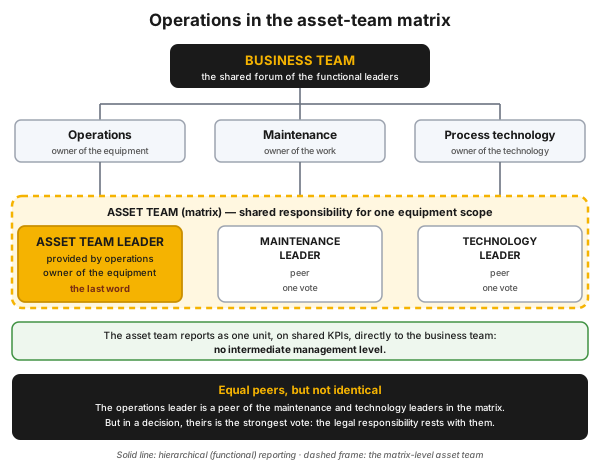 Figure 1 — the asset-team matrix: the three functions keep their hierarchical reporting line, but in the matrix they form one team whose leader is provided by operations.
Who is this for?
Section titled “Who is this for?”This article is for those who work in this matrix day after day, or are building it up right now: plant manager · shift supervisor · operator · maintenance leader · maintenance planner · process technologist · operations and production manager · HSE specialist · Operational Excellence / CI specialist · organizational developer.
Learning objectives
Section titled “Learning objectives”After reading this article you will be able to:
- justify why operations provides the asset team leader, and what the term “owner of the equipment” means;
- explain how peer equality and the right of the last word can coexist;
- name operations’ three daily coordination roles, and say which one is for what;
- justify why the shift personnel is assigned to the team leader;
- recognize where this organizational question ends, and where the shift-related professional routines begin.
The essence
Section titled “The essence”- The asset team is a matrix overlay on the functional organization: the three functions keep their own professional reporting line, but their primary role is within the team.
- The asset team leader is provided by operations, because operations is the owner of the equipment; maintenance and technology are the two key supporting areas.
- In the matrix the operations leader is a peer of the other two leaders, but in a decision theirs is the strongest vote, the right of the “last word,” because of the legal responsibility.
- Operations’ daily work is carried by three coordination roles: general, toward maintenance and toward technology; the latter two work as partners, not in a superior-subordinate way, with the other two functions.
- The shift personnel is assigned to the asset team leader, because this makes ownership unambiguous and the communication down to the lowest level short and undistorted.
- The asset team reports as one unit to the business team on shared KPIs, with no intermediate management level.
- The shift-related routines (handover, planning, review, round) appear here only by name: they have their own articles.
Why does it matter? (the stakes)
Section titled “Why does it matter? (the stakes)”An asset team can be set up on paper too: we appoint three leaders, call a daily meeting, and it’s done. What still decides whether it works is the question of leadership. If there is no clear team leader, the matrix brings back exactly what it set out to eliminate: silo operation. Maintenance optimizes its own work schedule, technology the yield, and operations the daily stability, and every disputed matter among the three escalates upward, stuck for weeks.
The stakes are more concrete than this. If operations is not the leader, then an intervention on the equipment is decided by someone who does not bear its consequence. Legal and safety responsibility, however, does not get shared out: the plant manager is responsible for what happens on their territory, even if the decision was made by someone else. The “one team, one responsible person” rule is not a love of hierarchy but responsibility alignment: the decision right goes where the consequence also lands.
Why is the operations leader the leader of the asset team?
Section titled “Why is the operations leader the leader of the asset team?”The asset team leader is provided by operations, because operations is the owner of the core equipment: they operate it, they know its current state, and they carry the legal responsibility for its operation. Maintenance and technology, by comparison, are the two key supporting areas — not subordinate, but indispensable partners in their own field.
This decision rests on three practical reasons:
| Reason | What it means in practice |
|---|---|
| Ownership | The equipment’s daily state, its start-up, shutdown and keeping in operation are in operations’ hands, so responsibility is most natural there too. |
| Legal responsibility | The operations leader is officially the head of the plant(s); toward the authorities they are the responsible person, and in this role they are not replaceable (a stand-in covers only the daily operational matters; the regulatory representation is covered by the superior operations leader). |
| Continuity | Operations is the only function that is present continuously, in every shift, so it is the one that can hold the team together in real time. |
The asset team leader’s task is therefore not to “direct” the other two functions, but to align them for safe and undisturbed operation, and to maintain effective feedback and communication within the team, toward the other asset teams and toward the business team. One of their most important leadership tasks is specifically to create constructive collaboration among the team members.
How can someone be a peer and still have the last word?
Section titled “How can someone be a peer and still have the last word?”In the matrix the asset team leader is a peer of the maintenance and technology leaders: the three functions work at the same level, with shared responsibility for one equipment scope. In decision-making, however, the operations leader has the strongest vote, the so-called right of the “last word,” precisely because of the legal responsibility.
This duality only seems contradictory if we mix up the concepts of collaboration and decision:
- At the level of collaboration there is no superior-subordinate relationship. The three leaders jointly shape the team’s opinion; the maintenance and technology leaders are authorities in their own field, who typically act as informal leaders, on the basis of their experience and esteem, not their position.
- At the level of decision, however, there needs to be an endpoint. If the shared opinion does not form, or there is time pressure, the operations leader decides and takes responsibility for it.
Importantly, this does not abolish the functional reporting lines. In the formal organization the maintenance leader reports to the head of maintenance, the technology leader to the head of process technology, who oversees the professional quality and the alignment of their work. In the matrix, however, their primary role is in the asset team. And the team reports, as one unit, on shared KPIs, to the business team, with no intermediate management level.
What daily coordination roles belong to operations?
Section titled “What daily coordination roles belong to operations?”Operations provides not only the team leader but also the roles that carry the team’s daily operation. These report to the team leader and coordinate in three directions: inward, toward the plant’s own work, and outward, toward maintenance and technology.
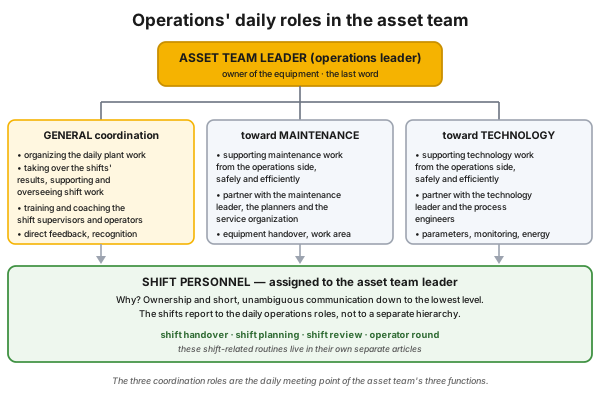 Figure 2 — the three daily coordination roles under the operations leader, and the shift personnel assigned to them.
1. General coordination. This role organizes the plant’s daily operational work in a safe, efficient and reliable way. They take over and summarize the shifts’ performance and results, support and oversee shift work, and train, coach and develop the shift supervisors and operators, giving them direct feedback and recognition. On a larger or more complex area this role can be filled by several people, and on a complex team it may also take on maintenance tasks.
2. Coordination toward maintenance. This role supports the maintenance activity from the operations side, safely and efficiently: equipment handover, a safe work environment, creating the operational conditions for the work. It works with the asset team’s maintenance leader, the work planners and the representative of the service (support) organization as a partner, on an equal footing.
3. Coordination toward technology. The same logic toward technology: operations-side support of the technological activity, the parameters and the monitoring, typically together with the energy-efficiency tasks. It likewise works in a partner relationship with the asset team’s technology leader and the process engineers.
Depending on the team’s size and local needs, further operations roles can be created (for example a training coordinator, an HSE or process-safety coordinator, a project coordinator, an energy controller). In practice the general coordinator often takes on the HSE and process-safety tasks, and the technology coordinator the energy-efficiency ones.
Why does the shift personnel belong to the team leader?
Section titled “Why does the shift personnel belong to the team leader?”The shift personnel is assigned to the asset team leader for two reasons: this makes ownership unambiguous, and the communication down to the lowest level of the organization short and direct. The shifts report to the daily operations roles (general, maintenance and technology coordination), not to a separate, parallel hierarchy. The advantage of this model is that it is simpler to operate from a control standpoint.
An alternative arrangement also exists, where the shifts report to the production shift manager, if such a position exists in the organization. Its strength is different: it is easier to achieve coordination and consistency within a given shift crew (typically a four-shift system operates), from the viewpoint of operations as a whole. The choice is therefore not “good or bad,” but a direction:
| Model | Who the shift reports to | Its strength |
|---|---|---|
| Asset team model | the asset team leader (operations leader) | ownership, short communication path, simpler daily control |
| Shift manager model | the production shift manager | consistency within a shift crew, site-level alignment |
What this article does NOT cover
Section titled “What this article does NOT cover”This article covers an organizational question: the role of operations in the asset team. The shift-related professional routines are only named here, because each has its own detailed article in the production excellence chapter:
- shift handover — the content, process and pitfalls of the structured shift handover.
- the operator round — the operator round (boardwalk) as a standardized sensing routine.
- the production reliability program — the program-level frame of shift planning, shift review and operations-driven reliability.
This article likewise does not cover the professional depth of the maintenance and technology functions, nor the details of the asset team’s operating rhythm (daily, weekly, monthly forums): for these, see the MOS and operations (integrated unit) articles.
Industrial / process-industry and safety context
Section titled “Industrial / process-industry and safety context”In a process-industry environment this allocation of roles is not a matter of organizational-development taste. In Seveso-classified, major-accident-hazard plants the responsibility for operation is named, and toward the authority the operations leader is the responsible person. That is why it is no accident that they are the one who gets the last word in the matrix: the decision right and the legal responsibility must not separate.
The same logic applies on the safety line too. One of the asset team’s key tasks is operational risk management: identifying and assessing the risks, investigating the limits and taking the mitigating measures. This is closely intertwined with process-safety management and with understanding the hazards arising from operation, so it requires knowledge that is present in the freshest form in operations. For the related methodology, see the operational risk assessment, the MOC and the IOW technology card articles.
A further, often underestimated element: the representative of the service (support) organization is also integrated into the asset team, being responsible for the efficiency of the maintenance work execution, even if organizationally they are not part of production. Coordination toward operations therefore does not stop within one’s own company.
Introduction in practice
Section titled “Introduction in practice”If you are now introducing this model in an existing organization, the following order works. The steps are valid even if you do not create a new organizational unit: the asset team is an overlay, not a reorganization.
- Designate the equipment scope (the “asset”) the team is responsible for. Let the boundary be drawn along operational logic, not by the organizational map.
- Appoint the asset team leader from operations, and state publicly that they are the owner of the equipment and have the last word.
- Assign the maintenance and technology leaders as peers, and record that their primary role is in the team, while their professional reporting remains toward their own function.
- Set up the three daily coordination roles (general, toward maintenance, toward technology), and describe on one page who coordinates what.
- Assign the shift personnel to the team leader, and make it clear that the shifts report to the daily coordination roles.
- Delimit the decision authority: what the team decides on its own, and what must be escalated upward (matters affecting another team or the whole of production, unplanned, or with a long-term effect).
- Seat the three leaders physically close to each other.
- Start the operating rhythm (daily, weekly, monthly forums), and keep it disciplined. The structure dies without dialogue.
Measurement / audit — how do you know it really works?
Section titled “Measurement / audit — how do you know it really works?”The biggest trap in measuring an organizational model is that on paper it is almost always fine. In practice, however, it can look quite different. That is why it is worth reviewing the effectiveness of the asset team’s operation regularly, roughly every two years.
The proven method is a small, “cold eyes” evaluation team:
| Element | Recommended practice | |
|---|---|---|
| Headcount | 3–4 people | |
| Duration | about one week | |
| Composition | led by production’s senior leader or their delegate (typically the operations leader), alongside 2–3 experienced leaders from the business team; experienced asset team leaders may also be invited | |
| Key criterion | the team should include someone with real experience of a well-functioning asset team management | |
| Methodology | evaluation and improvement following the [[pdca.en | PDCA]] cycle |
| Output | feeding the local experience back into the governing document, so the “standard” stays alive |
The evaluation’s typical questions probe the elements discussed in this article: whether operations really provides the leader, whether the parties are actually peers, whether all three coordination roles work, whom the shift really reports to, and whether the decision authority is alive or everything slips upward.
Common mistakes
Section titled “Common mistakes”- The leader is provided by “the strongest function.” Why it’s a problem: if leadership goes to whoever happens to carry more weight in the organization (typically maintenance or technology), the decision right is severed from the legal responsibility. Correctly: the leader is provided by operations, because they are the owner of the equipment.
- “Peer equality” is read as a consensus obligation. Why it’s a problem: the team stays in debate, the decision slips, meanwhile the plant runs. Correctly: equality in collaboration, a clear final word in the decision.
- The coordination roles command. Why it’s a problem: the coordinator toward maintenance or technology becomes a “customer,” and the partner relationship degrades into a hierarchy. Correctly: all three roles work as a bridge, on an equal footing with the other function’s representatives.
- The shift operates as a separate island. Why it’s a problem: if the shift personnel does not clearly belong to the team leader, no one feels the plant is theirs, and communication becomes indirect. Correctly: the shift is assigned to the asset team leader, and reports to the daily coordination roles.
- The team exists on paper, without a rhythm. Why it’s a problem: without asset team forums, performance reviews and a disciplined agenda, the matrix re-siloes within a few weeks. Correctly: the structure is kept alive by the operating rhythm (see MOS).
- There is no stated decision boundary. Why it’s a problem: if it is not clear what falls within the team’s remit, either everything goes upward, or the team decides on something that also affects another area. Correctly: the independent decision scope and the escalation point are recorded in writing.
- Rotating leaders. Why it’s a problem: frequent turnover in the key positions breaks up the accumulated shared experience and confuses the staff. Correctly: one should aim for several years of continuity in the key positions.
When NOT to use it?
Section titled “When NOT to use it?”The asset team model is strong, but it is not for everything:
- When the equipment scope is not identifiable. For an activity where there is no stable, delimitable asset group (for example a site-level service spanning several plants), the matrix only adds a needless layer.
- When there is no real empowerment in the organization. If the business team does not delegate actual decision rights, the asset team becomes just another meeting, not an operating unit. Then sorting out the empowerment is the first step, not setting up the team.
- When the main problem is professional, not organizational. If the equipment stops because the maintenance strategy is wrong or the technology is not sufficiently understood, the asset team does not solve it. There the reliability strategy or the root-cause analysis is the right tool.
- In regulatory and legal representation. The asset team leader is replaceable in the daily operational matters, but toward the authorities they are not: there the superior operations leader steps in. The matrix does not override the legal responsibility order.
- In a crisis, during a live emergency intervention. Then it is not matrix logic but the emergency procedure and the designated chain of command that applies (see ESD systems, shutdown/startup procedures).
Take it home (keys)
Section titled “Take it home (keys)”- Leadership follows ownership. The asset team leader comes from operations, because the equipment is theirs and the legal responsibility rests with them too. If this is not the case in your organization, sort this out first.
- Separate collaboration and decision. Equality in the joint work, a clear final word in the decision. It is worth recording these two sentences explicitly with the team.
- The three coordination roles are a bridge, not a command. If one of them starts to behave as a “customer,” the matrix degrades into a hierarchy.
- The shift is not a separate world. Assign it to the team leader, so that ownership is unambiguous and the communication path short.
- The structure is kept alive by the rhythm. Without forums, discipline and consistency, even the best organizational chart dies.
- Look at it from outside every two years. A 3–4-person, cold-eyes team shows in a week what works in reality and what only on the organizational chart.
Self-test
Section titled “Self-test”- Why exactly does operations provide the asset team leader, and what is the legal aspect of this?
- How can it coexist that the asset team leader is a peer of the other two leaders, and that in a decision theirs is the strongest vote?
- Name operations’ three daily coordination roles, and say why each one exists.
Answer key
- Because operations is the owner of the core equipment: they operate the equipment, know its current state, and are present continuously, in every shift. Legally, the operations leader is officially the head of the plant(s), the responsible person toward the authorities, and in this role not replaceable. That is why the decision right goes where the responsibility also is.
- Because the two things apply to different levels. In collaboration there is no superior-subordinate relationship: the three leaders jointly shape the team’s position, and the maintenance and technology leaders act as informal authorities in their own field. In the decision, however, there needs to be an endpoint: if there is no shared position or there is time pressure, the operations leader decides, because they also bear the consequence.
- General coordination: organizing the plant’s daily operational work, taking over the shifts’ results, training, coaching and giving feedback to the shift supervisors and operators. Coordination toward maintenance: operations-side support of the maintenance work (equipment handover, safe work environment), in a partner relationship with the asset team’s maintenance leader, the planners and the service organization. Coordination toward technology: operations support of the technological activity, the parameters and the monitoring, typically together with energy efficiency, in a partner relationship with the technology leader and the process engineers.
How does it appear in digital practice?
Section titled “How does it appear in digital practice?”The logic of the asset team does not stop at the organizational chart. The same principle — that the decision should be made where the responsibility is, and that all three functions see the same daily picture — is realized in software too. The mechanism differs, the principle is the same.
| Concept | Digital implementation | Value |
|---|---|---|
| The owner of the equipment | a responsible person assigned to the asset in the register, with every entry and action tied to this owner | unambiguous ownership, not lost in the “whose matter is this” question |
| Equal functions, one final word | a shared daily surface seen by all three functions, but a named approver on the decisions | fast collaboration, yet decided matters |
| The three coordination roles | role-based views and notifications (operations, maintenance, technology thread) | everyone sees their own thread, but from the same data |
| Shift → daily role reporting | a structured shift entry that automatically flows into the daily summary | short communication path, no manual re-typing and information loss |
| Independent decision scope and escalation | a rule-based escalation signal if a matter falls outside the team’s remit | the empowerment is not a verbal promise but a working mechanism |
| Two-yearly effectiveness review | a retrievable decision and action log the evaluation team works from as fact | the audit is built on a trail, not on memory |
Connection to OPEREX (shift log)
Section titled “Connection to OPEREX (shift log)”The asset team’s daily reality is decided where the three functions actually meet: in the shift log (OPEREX). The daily decisions of the operations leader and the three coordination roles, the facts arriving upward from the shifts, the deviations and the actions issued live here in one place, retrievably, and all three functions see the same thing. This way the “owner of the equipment” does not stay a label on the organizational chart, but is visible daily: who was responsible for what, and what the consequence of the decision was.
Terminology (HU / EN / JP)
Section titled “Terminology (HU / EN / JP)”| Hungarian | English | Japanese (romaji) |
|---|---|---|
| Üzemeltetés (the umbrella, the asset team as a whole) | Operations (as an integrated unit) | 操業 (sōgyō) |
| Üzemvitel (the narrow function: the daily running of the process) | Operations (function) | 運転 (unten) |
| Eszköz-csapat | Asset team | — |
| Asset team vezető | Asset team leader | — |
| A berendezés gazdája | Core equipment owner | — |
| Üzleti csapat (the forum of the functional leaders) | Business team | — |
| Mátrix-szervezet | Matrix organization | — |
| Egyenrangú fél | Peer | — |
| Az utolsó szó joga | The rule of “the last word” | — |
| Felhatalmazás, döntési jog delegálása | Empowerment | — |
| Tulajdonlás | Ownership | — |
| Műszakszemélyzet | Shift personnel | — |
| Kiszolgáló (támogató) szervezet | Service (support) organization | — |
| Működtetési ritmus | Operating rhythm | — |
Why does operations provide the asset team leader?
Because operations is the owner of the core equipment: they operate the asset, know its current state, are present in every shift, and the legal responsibility for the operation rests with them too. Maintenance and process technology, by comparison, are the two key supporting areas, as equal partners.
If they are peers, who decides in case of a dispute?
The asset team leader. In the matrix the three leaders are peers at the level of collaboration, but in decision-making the operations leader has the strongest vote, the right of the “last word,” because they carry the legal responsibility.
What daily coordination roles belong to operations?
Three: general coordination (organizing the plant’s daily work, taking over the shifts’ results, training and coaching the shift supervisors and operators), coordination toward maintenance (operations-side support of the maintenance work) and coordination toward technology (operations support of the technological activity and the monitoring). The latter two work in a partner, not a superior-subordinate, relationship with the other two functions.
Why does the shift personnel belong to the asset team leader?
Because of ownership and short, unambiguous communication: this way the shifts’ information reaches directly the leader responsible for the plant, and the operation is also simpler to run from a control standpoint. The shifts report to the daily operations coordination roles. An alternative also exists, where the shifts report to the production shift manager: its strength is consistency within the shift crew.
Does the functional reporting line cease in the matrix?
No. The maintenance and technology leaders still report, in the formal organization, to their own function, which ensures the professional quality and the alignment. Their primary role, however, is in the asset team, and the team reports as one unit, on shared KPIs, to the business team.
Does this article also cover shift handover and the round?
No, it only names them. Shift handover, shift planning, shift review and the operator round are independent professional routines with their own articles: shift handover, the operator round, the production reliability program.
Related concepts
Section titled “Related concepts”operations (integrated unit) · operational excellence · MOS · OGSM · shift handover · the operator round · the production reliability program · operator–maintainer · operational risk assessment · MOC · Lean leadership and coaching · success factors of the production system
Next step
Section titled “Next step”- Start here: operations (integrated unit) — the base article of the asset team concept, the cross-functional integration and the rope analogy.
- Then: MOS — the operating rhythm that keeps the asset team alive day by day.
- Next: shift handover — the first concrete shift routine in which the roles above become tangible on a daily level.
References / further reading
Section titled “References / further reading”- ISO 55000 / ISO 55001 — the asset management standard family: the standard frame of asset-centered responsibility and ownership (see asset management (ISO 55000)).
- Seveso III Directive (2012/18/EU) — the regulatory frame of major-accident-hazard plants, which requires named responsibility for operation.
- Jay R. Galbraith: Designing Matrix Organizations that Actually Work — the classic, public literature of the matrix organization: authority, dual reporting and decision rights.
Updated: 2026-07 · lang: en · cluster: lean-opex · funnel: TOFU