Kanban — the signaling tool of the pull system
≈ 22 min read · 4,498 words
Picture a supermarket shelf: as soon as you take a box off it, the one behind it slides forward, and the gap tells the person restocking that it needs replenishing. No one produces ahead into the warehouse on a “just in case” basis — the shelf only calls for as much as the customer has actually taken. That is exactly what kanban is: a simple visual signal — a card, an empty bin or a painted location — that says what and how much needs replenishing, and, by the mere fact of appearing, also when. Let’s look at what it is, how it realizes the pull system, and where it is used.
Kanban is a visual signal — a card, a bin or a painted location — that gives an instruction to produce or to move material, and by doing so it realizes the pull system. In Japanese “sign board, card”; it is the fundamental tool of Just-In-Time production: it shows what and how much to produce or move, and its appearance also gives the timing. Its iron rule: never produce and never move material without a kanban. This way processes only make as much as the next (customer) process has actually consumed — and since every kanban represents a given quantity of inventory, the number of cards sets an upper limit on total inventory. The pull system is the principle; kanban is the tool that realizes it.
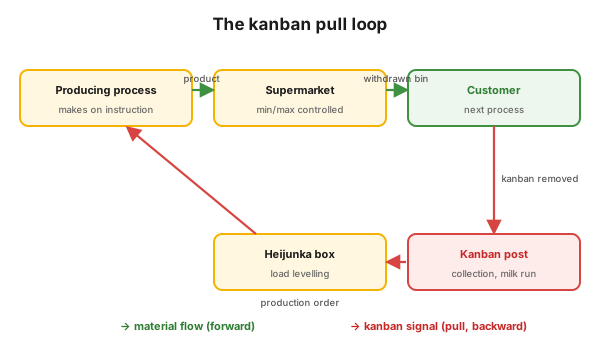 Figure 1 — the kanban pull loop: along the top, material flows from the producing process through the supermarket to the customer (forward); along the bottom, the kanban signal runs backward from the customer through the post and the heijunka box to production (pull).
Who is this for?
Section titled “Who is this for?”This article is for those who work with day-to-day pull operation and material supply: operator · material handler (water spider) · production and plant manager · shift supervisor · logistics / material-supply specialist · process engineer · Lean/CI specialist · planner.
Learning objectives
Section titled “Learning objectives”After reading this article you will be able to:
- distinguish the two main kanban types (withdrawal vs. production instruction), and say what each communicates;
- list the six rules of kanban, and name the iron rule among them;
- walk through the kanban loop (replenishment loop) from the customer to the supermarket;
- estimate how many kanban are needed in a loop, and decide when there are too few and when too many;
- draw a sharp line between the kanban (tool) and the pull system (principle);
- draw the boundary: when is kanban not enough on its own in a process plant.
In brief (TL;DR)
Section titled “In brief (TL;DR)”- Kanban is a visual signal (card, bin, painted location, electronic signal) that instructs production or material movement — its meaning is “sign board”.
- Its two main functions: communication (what, how much, from where, to where) and continuous improvement (gradually cutting the cards surfaces the problems).
- Kanban is the engine of the pull system: customer withdrawal triggers replenishment, so it prevents overproduction and sets an upper limit on inventory.
- Two main types: withdrawal kanban — a movement instruction, like a shopping list; and production-instruction kanban — a manufacturing work order.
- Six basic rules govern it (see below); the 3rd is the iron rule: no production or movement without a kanban.
- The number of kanban can be calculated: approximately n = replenishment time × customer demand / pack quantity.
- In the process industry (liquid, bulk product) kanban often appears as tank-level control: min/max/safety levels start and stop production.
Why it matters (the stakes)
Section titled “Why it matters (the stakes)”What is at stake with kanban is the balance between inventory and service. If you size it wrong or roll it out without discipline, you can fail in two directions: either production stops because there are not enough signals in the loop, or capital and space are tied up by needlessly accumulated inventory — which, on top of that, hides the underlying problems.
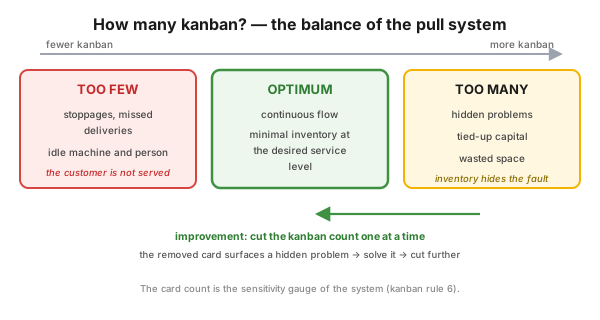 Figure 2 — balancing the number of kanban: with too few signals, stoppages and unserved customers; with too many, tied-up capital and a masked fault; at the optimum, continuous flow with minimal inventory. The direction of improvement: cut the card count one at a time, and solve the problem that surfaces.
The lesson is simple: kanban is not “introducing cards” but disciplined pull operation. Misunderstood kanban is the most expensive kind — pull on the surface, push in reality.
What is kanban, and how does it realize the pull system?
Section titled “What is kanban, and how does it realize the pull system?”Kanban is the physical signal of the pull system: it carries information about customer consumption backward to production, so each process only replenishes as much as the following one has taken. In Japanese the word means sign board, card; in the Toyota Production System (TPS) it was developed by Taiichi Ohno as the fundamental tool for realizing JIT (Just-In-Time). The goal of JIT is that the needed material be available in the needed quantity at the needed time — kanban is the practical carrier of this “quantity control”.
Its appearance can vary widely: the most common is a colored, laminated card, but it can be a transport or storage bin (box/tray kanban), a golf ball or plastic disc, a painted storage location, or an electronic signal. What matters is not the form but the function: an instruction to produce or to move.
How does kanban work? (types, rules, loop)
Section titled “How does kanban work? (types, rules, loop)”Kanban carries two kinds of signal, is governed by six rules, and lives in a closed loop (replenishment loop). Let’s take them in turn.
The two main kanban types
Section titled “The two main kanban types”Both types give the source, the destination, the part number and the required quantity:
-
Withdrawal kanban (parts-withdrawal / pick-up / transportation kanban) — a movement instruction, a “shopping list”. With it we pick up material from the previous process. Its subtypes:
- inter-process kanban (inter-process / pick-up) — orders from an internal process,
- supplier kanban (supplier) — orders from an external supplier; on it we also note the kanban cycle,
- customer kanban (customer) — to avoid confusion, this is what we call the supplier kanban the customer sends toward us.
-
Production-instruction kanban (production-instruction kanban) — a manufacturing work order, ordering the production of one product. Its subtypes:
- in-process kanban (in-process) — orders the production of the part consumed by the next process,
- signal kanban (signal / “triangle” kanban) — for processes with long changeover and large batches (e.g. injection molding, forging); it is not on every bin, but one per type is placed among the bins, and it contains the batch size (how many bins to produce) and the standard quantity (after which bin to insert the card = the reorder point).
Further practical variants: pass-through kanban (for FIFO flow between two processes), temporary kanban (a temporary inventory increase for maintenance / a differing number of working days; single-use, clearly distinguishable), substitute / dummy kanban (when the customer kanban is temporarily not visible but the order is on its way), pool kanban (when demand variability > ±10%, and heijunka is therefore hard to set) and the box/tray kanban (the empty bin itself is the signal).
The six rules of kanban
Section titled “The six rules of kanban”| # | Rule | Function | |
|---|---|---|---|
| 1 | The later process goes to the earlier one, and takes from it only as much as the kanban signals | Creates the pull; the “replenishment” principle is born here | |
| 2 | The earlier process produces only as much and in the order that the kanban signals | Production information; prevents overproduction; serves as a work order | |
| 3 | Nothing is produced or moved without a kanban | The system’s iron rule — this is what makes it pull | |
| 4 | A kanban must always be attached to the goods | Makes it visual, showing what the signal belongs to | |
| 5 | A defective product is not passed on to the next process | Prevents the defect from spreading, identifies the faulty process — the JIT and [[jidoka.en | jidoka]] link |
| 6 | Reducing the number of kanban increases the system’s sensitivity | Cutting inventory = cutting waste and a more sensitive, improving system |
The kanban loop (replenishment loop)
Section titled “The kanban loop (replenishment loop)”The classic pattern, read backward from the customer:
- The customer takes one unit → the kanban attached to it comes off the product and goes into the kanban post.
- The material handler (water spider / mizusumashi) collects and forwards it on the milk run round — ideally straight into the heijunka box in front of the production line (a load-levelling device).
- The producer takes the kanban out of the heijunka box in order, and produces the quantity marked on the card → here the kanban functions as a manufacturing work order.
- The kanban is put on the finished product, which goes to the designated location (usually the supermarket), from where the customer can take it again.
The sum of the four segments (time spent in planning + waiting in the queue/heijunka box + production time + finished-goods delivery) is the replenishment time.
Supermarket and pull loop
Section titled “Supermarket and pull loop”The supermarket is a controlled (min/max) quantity of inventory stored at the start/end of processes — typically in a dynamic, gravity-flow rack where every material has a precise location. When the material handler picks up a product, the kanban that comes off reorders its production. The supermarket helps enforce the FIFO principle and coordinates lines running at different rates. The pull loop runs from the start of the process to the supermarket at its end: the production kanban that comes off the withdrawn material returns to the start of the process, and reproduction begins.
How can it be applied in the process industry? (context + safety)
Section titled “How can it be applied in the process industry? (context + safety)”Kanban, devised for discrete (piece) manufacturing, can also be applied in the process industry (petroleum processing, chemicals, bulk/liquid product), typically with a “kanban in the tank” logic: instead of a card, the level control itself is the signal.
- Tank level as kanban: minimum level = “start production” signal; maximum level = “stop production” signal. The safety level is a reserve covering customer-demand fluctuation and equipment availability (OEE) — the equivalent of safety stock in the discrete system. The rotating stock corresponds to cycle stock.
- Pull principle in a piped/tank system: withdrawal by a downstream unit (e.g. blending, packaging) starts the production of the upstream unit; the upstream unit does not fill above the max (against overproduction and tank overfilling).
- Maintenance and spares management: the supplier/inter-process kanban works excellently for replenishing spare parts and chemicals (two-bin system): the emptied bin/card is the reorder signal.
Kanban rules 3 and 5 (no material without a kanban; a defective product is not passed on) are also useful from a change-management (MOC) and traceability standpoint: kanban is a documented, visual signal that leaves an audit trail. In an “empty tank = production signal” operation the signal must be reliable and visually unambiguous (in line with the ISO 45001 / visual-workplace principles) — an ambiguous signal leads to an operational error.
How would you introduce it? (roadmap)
Section titled “How would you introduce it? (roadmap)”Kanban is not the first step — it has prerequisites. Suggested order (action-led steps):
- Stabilize first. Kanban assumes a balanced load and acceptable quality: first you need 5S, standard work, basic quality (jidoka / poka-yoke) and a predictable changeover. Kanban laid on top of an unstable process amplifies the problems, it does not solve them.
- Map the value stream (VSM). On the current-state map, identify where to link continuous flow and where to link a supermarket + kanban loop. The goal of the future state: every process step should be linked to the customer by continuous flow or a pull system.
- Choose pull points and supermarkets. Where direct flow is not achievable (different rates, long changeover, a shared resource), a supermarket goes there. Define the min/max level and location for every item.
- Size the kanban (see the formula in the Measurement section). Start with more kanban rather than fewer (for safety), then gradually cut them.
- Design the physical tools: card types, kanban post, heijunka box, milk run route and schedule, the material-handler (water spider) role.
- Roll out the six rules and train the team. Enforcing rule 3 (no production without a kanban) and rule 5 (a defective one does not move on) in particular is critical.
- Operate, then improve. After stable operation, remove the kanban one at a time: the dropped card causes a problem at some point; investigate it and eliminate it — this is the continuous-improvement engine of kanban.
Roles: the material-handler operator (water spider / mizusumashi) collects and loads; the line operator produces only the quantity per the kanban; the group/shift supervisor is the overseer of the min/max levels, the kanban count and rule compliance, and handles the deviations (empty supermarket, accumulating kanban).
Hands-on / mini-scenario
Section titled “Hands-on / mini-scenario”Kanban-count calculation (homework). In a supermarket loop the replenishment time T_R = 4 hours, the customer process demand D_C = 120 pcs/hour, the container (unit load) Q_P = 60 pcs. How many kanban are needed?
n = (T_R × D_C) / Q_P = (4 × 120) / 60 = 8 kanban.
Now calculate it with other parameters too: what happens to n if the replenishment time is halved (with SMED, a more frequent milk run)? And if the container size is halved? (The first gives half as many cards, the second twice as many — the directions are opposite.)
Kanban simulation (tabletop scenario). Lay 8 cards into the loop, and “take out” the cards one at a time, as if the customer were consuming. Watch where the system stalls:
- If you put in only 6 cards instead of 8, then on a strong burst of customer withdrawals the supermarket empties before the replenishment gets back → stoppage (too few kanban).
- If you put in 12 cards instead of 8, the loop is always “full”, and the excess masks it if replenishment slows down somewhere → hidden problem (too many kanban).
- In the stable loop, cut the card count one at a time (8 → 7 → …): at the point where the process first stalls, a real bottleneck or fluctuation surfaces — investigate and eliminate it. This is the continuous-improvement engine of kanban (rule 6).
Homework. Choose, in your own area, a repeatedly, relatively stably consumed material (a spare part, a chemical, a semi-finished product). Estimate the T_R, D_C and Q_P values, calculate n, then write down: where you would put the supermarket, what the min/max level would be, and which kanban type (withdrawal vs. production instruction) you would use.
How do you measure it? (metrics, formula)
Section titled “How do you measure it? (metrics, formula)”Number of kanban — the ideal (approximate) formula:
n = (T_R × D_C) / Q_P
where n = number of kanban, T_R = the replenishment time of one kanban, D_C = the demand of the customer process over the T_R time unit [pcs/day, pcs/hour or pcs/minute], Q_P = the pack (unit-load) quantity.
Number of kanban — the realistic, inventory-breakdown formula (for the finished-goods supermarket):
n = (cycle stock + safety stock + buffer stock) / container size
where cycle stock covers the normal customer withdrawals (≈ production rate × replenishment time × (1 + safety factor)), safety stock covers the fluctuation of the production rate, and buffer stock covers the fluctuation of customer demand.
The number of kanban determines the performance of the pull system: too few → constant stoppages, missed deliveries, idle machine/person; too many → needless tie-up of space and money in inventory (see Figure 2). We tune the optimum statistically, minimizing total inventory at the desired delivery service level (e.g. 99% on-time fulfillment).
Process improvement in the kanban system = inventory (and thus kanban) reduction, achievable by:
- reducing any of the four replenishment times, or increasing the frequency of customer withdrawal → smaller cycle stock,
- reducing the fluctuation of the production rate → smaller safety stock,
- reducing the fluctuation of customer demand (e.g. heijunka) → smaller buffer stock.
Audit checklist (what to look for at the gemba):
- Is there a product/bin with no kanban on it? (Rules 3 and 4 are broken.)
- Is anyone producing without a kanban or beyond the kanban? (overproduction.)
- Are kanban accumulating at the post / is the supermarket persistently empty? (a sizing or stability problem.)
- Is a defective product moving on? (rule 5.)
- Is the min/max level up to date relative to customer demand? (a kanban-count review.)
Common mistakes
Section titled “Common mistakes”In anti-pattern ↔ correction pairs (tied back to the article’s own claims):
- Kanban cards without the rules. They introduce the cards but do not enforce the 6 rules — this is a “push system in kanban costume”. Instead: enforce rule 3 (no production without a kanban) and rule 6 (cutting the card count) — discipline is what makes the system pull.
- Introduction without stability. Kanban laid on an unbalanced load, poor quality or an unpredictable changeover amplifies the problems. Instead: first the stable base (5S, standard work, jidoka), then kanban.
- Too many kanban “for safety”. It masks the problems and ties up capital. Instead: the goal is a gradual, controlled reduction toward the optimum (Figure 2).
- Too few kanban too soon. Constant stoppages, an unserved customer. Instead: do the reduction one at a time, by solving the problem that surfaces.
- The max level > the safety/technological filling limit (in the process industry). Instead: the kanban upper limit must never override the safety limit — align it with the HAZOP/LOPA assumptions.
- An ambiguous visual signal. If the “empty = produce” signal is not unambiguous, unintended production/stopping arises. Instead: make the signal reliable and unambiguous (visual-workplace principles).
- Neglecting the maintenance of the kanban. When customer demand changes, the system drifts. Instead: review the min/max levels and the kanban count regularly.
When NOT to use it (the limits)
Section titled “When NOT to use it (the limits)”Kanban is strong but not universal. Knowing where it is not the right answer is just as important as the method itself:
| Situation | Why (primarily) not kanban | The right answer | |
|---|---|---|---|
| One-off, non-repeating manufacturing (project shop, unique batch) | there is no stable, recurring consumption to replenish | make-to-order, scheduling / [[vsm.en | VSM]] |
| Unstable, wildly fluctuating demand or process | the pull loop falls apart, an empty supermarket or a pile-up | first stabilization ([[5s.en | 5S]], standard work, heijunka), then kanban |
| A certified safety function is needed (overfill protection) | kanban is a logistics signal, not a certified protection layer | design per [[lopa-sil.en | SIL/LOPA]], IEC 61511 |
| The goal is direct continuous flow (one-piece flow) | where flow can be achieved, no intermediate supermarket is needed | continuous flow; kanban only where flow cannot be linked |
Rule of thumb: kanban is strongest for repeating, relatively stable consumption. For one-off manufacturing, an unstable process and certified safety, it does not replace the appropriate tool — the prerequisite for pull is stability.
Key takeaways
Section titled “Key takeaways”- Kanban is a signal, not paperwork: customer withdrawal pulls the replenishment — do not produce and do not move without a kanban.
- Tool ≠ system: kanban is the tool of the pull system; the card alone does not make it pull.
- The card count is the gauge: too few → stoppage; too many → tied-up capital and a masked fault. Cut it one at a time, in a controlled way.
- Stability first, then kanban: laid on an unstable process, the signal only amplifies the trouble.
- In the process industry the level is the signal: min/max/safety levels start and stop — but the max never overrides the safety filling limit.
- Rule 5 is a quality gate: a defective product does not move on — this ties kanban to built-in quality.
Self-check
Section titled “Self-check”- What is the difference between the withdrawal and the production-instruction kanban — which is the “shopping list” and which the “manufacturing work order”?
- List the six rules, and say which is the iron rule, and which ties kanban to built-in quality.
- In a loop the supermarket regularly empties, and the customer receives no delivery. Are there too few or too many kanban? What do you do — and how would you not solve it (what would be the “push in kanban costume”)?
How does this show up in digital practice?
Section titled “How does this show up in digital practice?”The kanban principle does not end at the physical card: the same pull signal is realized in software too, in any well-designed digital workflow. Instead of the laminated card and the painted location, here the digital kanban board, WIP limit and automatic reorder point carry the pull — the mechanism differs, the principle is the same.
| Kanban principle | Digital implementation | What it delivers |
|---|---|---|
| Visual signal (card) | digital kanban columns (to do → in progress → done) | the work and the work-in-progress are visible at a glance |
| Pull replenishment | automatic reorder point: reaching the min level triggers an order | no manual watching, no over-ordering |
| Inventory upper limit | a WIP limit on the column | the system does not allow more concurrent work than permitted |
| Rule 6 (cutting the card count) | gradually tightening the WIP limit | the bottleneck and the hidden problem surface |
| Kanban post / status | a time-stamped, searchable event log (emptying, replenishment) | the deviation is traceable and auditable |
| Rule 5 (a defective one does not move on) | a gated step: a defective item cannot be advanced to the next state | the defect is stopped at the point where it arises |
Connection to OPEREX (shift log)
Section titled “Connection to OPEREX (shift log)”The effectiveness of kanban depends on whether the signals, levels and deviations are visible and traceable. The daily operation of the pull system produces many small events: start/stop decisions (a tank reaching min/max), an empty supermarket, accumulating kanban, a missed replenishment. The shift log (OPEREX) records these in a time-stamped, searchable form, so that:
- at the shift change it is clear which pull loop has a deviation (empty/full, waiting kanban),
- at an audit it is traceable whether anyone produced without a kanban, or above the max,
- for the kanban-count / min-max review there is factual data available (when and how many times the supermarket emptied), not memory.
This way kanban’s “visual but volatile” signals become a durable, auditable trace — the pull system becomes measurable and improvable.
Terminology (HU / EN / JP)
Section titled “Terminology (HU / EN / JP)”| Hungarian | English | 日本語 / note |
|---|---|---|
| kanban | kanban (sign board) | 看板 — sign board / card; the Japanese word is not inflected in English (one kanban, two kanban) |
| húzó rendszer | pull system / pull production | produces for actual consumption |
| toló rendszer | push system / push production | produces for a forecast |
| anyagfelvevő kanban | withdrawal / pick-up / transportation kanban | a movement instruction |
| termelési utasítás kanban | production(-instruction) kanban | a manufacturing work order |
| jel kanban | signal kanban | triangle kanban; a large-batch, long-changeover process |
| szupermarket | supermarket | min/max controlled inventory |
| húzó hurok | pull loop | start of process → supermarket → back |
| pótlási idő | replenishment time | the total time of the kanban loop |
| kanban-postahely | kanban post | the collection point for the kanban that come off |
| terheléskiegyenlítés | heijunka / levelling | 平準化 — the levelled sequencing of the kanban |
| anyagmozgató operátor | water spider / mizusumashi | 水すまし — collects and loads |
What is the difference between kanban and the pull system?
The pull system is the principle — only produce as much as the next/customer process has consumed. Kanban is the tool that realizes it: the visual signal that carries the consumption information back to production. Kanban is the most common pull tool (alongside CONWIP), but the two are not identical.
How many kanban are needed in a loop?
Approximately n = replenishment time × customer demand / pack quantity, more precisely the sum of cycle, safety and buffer stock divided by container size. Too few → stoppage; too many → needless inventory. After stable operation, cut it one at a time.
Is kanban always a card?
No. Kanban can be a card, an empty storage bin (box kanban), a painted location, a golf ball/disc, or an electronic signal. In the process industry, a tank level (min/max) is often the kanban. The form is secondary; the function (a production/movement instruction) is primary.
How does kanban drive continuous improvement?
Every kanban represents a given quantity of inventory. If we remove a kanban one at a time from a stable system, at some point a shortage/stoppage arises — this points to a hidden problem that we investigate and eliminate. This is how the kanban count is the gauge of improvement.
Can kanban be used in a Seveso plant for a hazardous material?
Yes, and the principle (min/max/safety level, inventory upper limit) is distinctly favorable, because it reduces accumulated inventory and thereby the risk profile. But the kanban max level must never override the technological/safety overfill limits, and the setting must be consistent with the safety documentation (e.g. the HAZOP/LOPA assumptions).
What is the supermarket in kanban?
A controlled, min/max quantity of intermediate inventory (typically in a gravity-flow rack, with a precise location for every item), from which the customer process withdraws, and the kanban that comes off reorders production. The supermarket links processes running at different rates, and ensures FIFO where direct continuous flow cannot be achieved.
Related concepts
Section titled “Related concepts”pull system · VSM · muda waste · 5S · jidoka · poka-yoke · SMED · gemba · Just-In-Time (JIT)
Next step
Section titled “Next step”If you have understood this, from here it is worth going on — in this order:
- pull system — the system level of which kanban is the signal: push vs. pull, heijunka (levelling) and the milk run. Start with this, to see what the card fits into.
- VSM — where to link continuous flow, and where to place a supermarket + kanban loop: the value-stream map marks the pull points.
- jidoka — the built-in quality behind rule 5 (a defective one does not move on); the prerequisite for stable pull is good quality.
References / further reading
Section titled “References / further reading”- Taiichi Ohno: Toyota Production System: Beyond Large-Scale Production. Productivity Press, 1988. — the original, canonical description of kanban and the pull system.
- Yasuhiro Monden: Toyota Production System: An Integrated Approach to Just-In-Time. Industrial Engineering and Management Press, 1983 (in several expanded editions) — a detailed engineering treatment of the kanban types and rules.
- Mike Rother – John Shook: Learning to See. Lean Enterprise Institute, 1999. — the connection between the supermarket, the pull loop and VSM.
- James P. Womack – Daniel T. Jones: Lean Thinking. Simon & Schuster, 1996. — pull as the fourth Lean principle.