Feedback — principles, good vs. poor, a structured process
≈ 20 min read · 4,087 words
Two colleagues tell you the same thing about the same mistake of yours. After the first one you want to put it right almost immediately; after the second one you would rather defend yourself and prove that they are wrong. The same content, two opposite reactions, and the difference does not lie in the message but in how it was delivered. That is what feedback is about: it does not matter who is right, it matters that the other person hears your point of view and knows where they stand and what to do next. Let’s look at what effective feedback is, why it works, and how you give it well.
Feedback is the skill of talking about a specific, observed behaviour in a way that builds development and trust rather than defensiveness. Its seven principles: take your time, give feedback often, refer to specific data, don’t assume that you are right, ask questions, make suggestions and follow through on them, and finally ask for feedback on how you give feedback. Feedback is the skill that makes the fifth element of performance management (rewards, consequences and recognition) and the performance dialogue actually work: measurement turns into real improvement only when the deviation is followed by fair, developmental feedback and coaching.
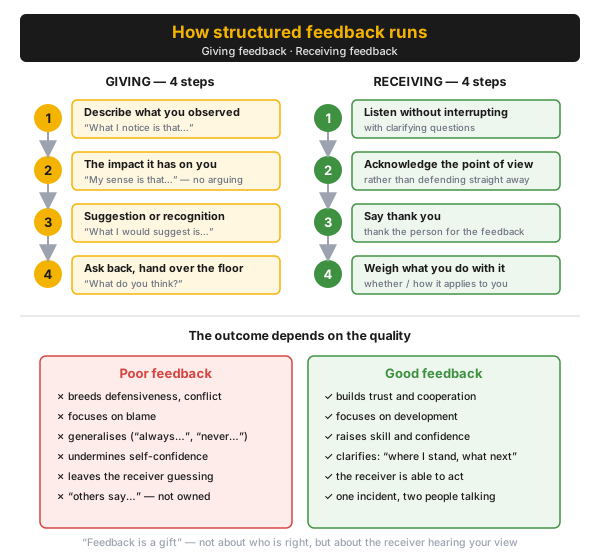
Figure 1 — how structured feedback runs. On the left the four steps of giving (observation, impact, suggestion, asking back), on the right the four steps of receiving (listening, acknowledging, thanking, weighing), and at the bottom the outcome of good vs. poor feedback. The standardized structure reduces defensiveness on both sides.
Who is this for?
Section titled “Who is this for?”This article is for anyone who gives or receives feedback day to day and wants to do it better: shift supervisor · plant manager · group and team leader · process engineer · HSE/safety manager · reliability engineer · project manager · mentor and coach · HR business partner.
Learning objectives
Section titled “Learning objectives”After reading this article you will be able to:
- list and interpret the seven principles of effective feedback;
- tell good feedback from poor feedback by their outcome;
- work through the four steps of giving and the four steps of receiving feedback;
- place feedback within the system of performance management (recognition, consequence, coaching);
- draw the line: when spontaneous feedback is NOT the right answer.
In brief
Section titled “In brief”- Feedback is a skill, not a verdict. The goal is not to settle “who is right,” but for the receiver to hear your point of view and to know where they stand and what to do next. “Perception is reality.”
- Seven principles: take your time, give it often, cite specific data, don’t assume you are right, ask questions, suggest and follow through, ask for feedback on your feedback.
- Good and poor feedback part ways in the outcome: poor feedback breeds defensiveness and blame; good feedback builds trust, skill and self-confidence, and leaves the receiver able to act.
- A structured run: four steps when giving (a specific observation, the impact on you, a suggestion or recognition, “what do you think?”), four steps when receiving (listen without interrupting, acknowledge the point of view, say thank you, weigh it).
- Feedback is the 5th element of performance management (rewards, consequences, recognition): when it is applied fairly, to peers and to superiors alike, the whole system becomes manageable.
- Feedback plus coaching builds capability over weeks and months. There is a big gap between understanding and change: a one-off piece of feedback is not enough, it takes repeated coaching.
- “Feedback is a gift.” For the giver it is not about self-justification; for the receiver it is their own decision what to do with it (when to “unwrap” it).
Why does it matter? (the stakes)
Section titled “Why does it matter? (the stakes)”A single missing or badly delivered piece of feedback looks cheap on its own. The problem is the chain reaction it sets off when nobody reflects on the deviation in time and in a developmental way. A problem that goes undiscussed does not solve itself: it recurs, the receiver does not know where they stand, and the blaming climate silences the very people who could speak up.
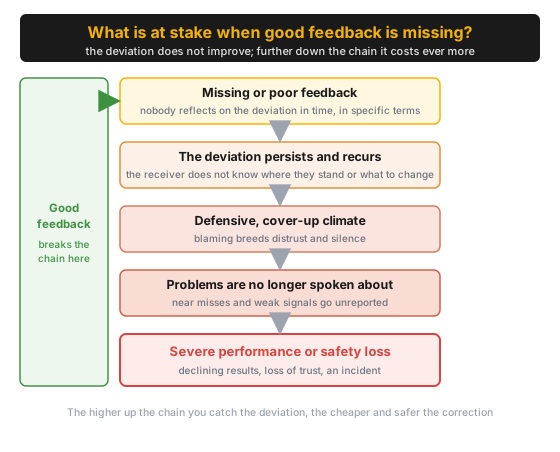
Figure 2 — the escalation of the stakes. Missing or poor feedback turns into a recurring deviation, a defensive climate, then unspoken problems, and finally a severe performance or safety loss. Good feedback breaks the chain right at the start, at the immediate, specific reflection.
This bites hardest with negative feedback. If the criticism only comes up at the annual appraisal, the receiver has had no chance to correct course for months and the whole thing hits them as a surprise: that is why the annual appraisal is the worst possible moment to give negative feedback. The lesson is simple: the higher up the chain you catch the deviation, the cheaper and safer the correction.
What is it, and where does it come from? — the Management Infrastructure view
Section titled “What is it, and where does it come from? — the Management Infrastructure view”The fifth of the five elements of performance management is rewards, consequences and recognition. This is the element many organizations are very weak at: when people understand the consequences of their own performance and see those consequences applied fairly to their peers and their superiors as well, the whole performance management process becomes far easier to manage. The daily, practical tool of this element is feedback: without it the performance dialogue hollows out into a conversation without consequences.
Feedback is therefore not a stand-alone “soft skill” but the operational part of the Lean Management Infrastructure. A deviation surfaced in the performance dialogue turns into a change of behaviour and performance only if the leader gives developmental feedback and the receiver meets it with reflection rather than defence. The method sums up the goal in a single sentence: measurement on its own is not enough, observations have to be turned into action.
What are the seven principles of effective feedback?
Section titled “What are the seven principles of effective feedback?”Effective feedback rests on seven principles: take your time, give it often, cite specific data, don’t assume you are right, ask questions, suggest and follow through, ask for feedback on your feedback. Together they serve one purpose: that feedback should build trust and development rather than defensiveness and blame.
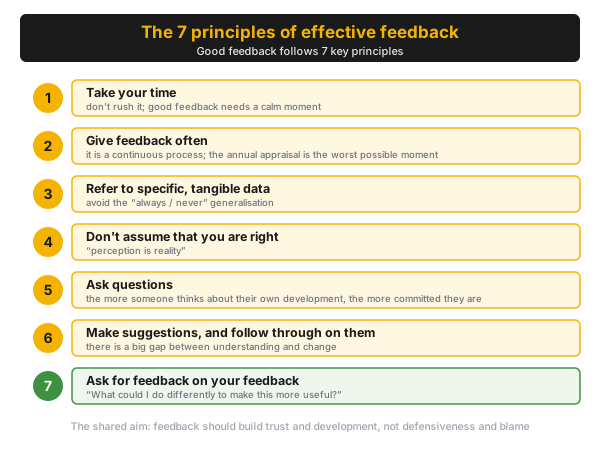
Figure 3 — the seven principles of effective feedback. The first six steer everyday practice; the seventh (ask for feedback on your own feedback) closes the loop and develops you as well.
- Take your time. Don’t rush it; if it takes longer, give it the time. Good feedback needs a calm moment.
- Give feedback often. This is a continuous process. The annual appraisal is the worst possible moment for negative feedback, because the receiver cannot correct course in time and it comes as a surprise.
- Refer to specific, tangible data. Avoid the “always…” and “never…” generalisations, because they invite argument and defence.
- Don’t assume that you are right. Don’t press your view as “the one truth”; don’t argue about “the truth,” argue for the receiver hearing your point of view. “Perception is reality.”
- Ask questions. The more someone thinks about their own development, the more committed they are to making it happen.
- Make suggestions, and follow through on them. There is a big gap between understanding and change: you have to agree on the next steps and then track them.
- Ask for feedback on your feedback. “What could I do differently to make this more useful?”
How does good feedback differ from poor feedback?
Section titled “How does good feedback differ from poor feedback?”The difference is not in the topic but in the outcome: on the very same situation, poor feedback breeds defensiveness and blame, while good feedback builds trust, skill and self-confidence and leaves the receiver able to act. The same subject, two opposite results, depending on quality.
| Poor feedback | Good feedback | |
|---|---|---|
| Climate | breeds defensiveness and confrontation | creates trust and cooperation |
| Focus | on blame | on development, on the improvement possible or achieved |
| Skill | does not develop it | raises the skill |
| Self-confidence | undermines it | strengthens belief in one’s own ability |
| Clarity | leaves the receiver guessing | makes clear “exactly where I stand” and “what to do next” |
| Feeling | judged, labelled | helped, able to act |
| Problem | generalises, makes it look too big or too vague | ties it to a specific, manageable incident |
| Ownership | “others say…”, not owned | fully owned, the giver says it as their own |
The hallmarks of good feedback (from the coaching literature, after Max Landsberg’s The Tao of Coaching):
- Contract on the topic: agree together on what you are going to talk about (create a contract).
- Acknowledge the coachee’s feelings, and focus on the skill, not the person (focus on skills, not person).
- Paint a concrete picture of the desired skill, and suggest practical steps.
- Position the feedback as something needed to build or demonstrate the skill, not as a “you haven’t got it / you have to prove yourself” label.
- Balance the negatives and the positives, and give constructive actions.
- Check with questions, and ask the receiver to recap the essentials (ask for recap).
- Get to the plan together, and offer future support.
- Let the coachee assess themselves first (invite to assess own performance first).
- Refer to a specific, jointly observed incident (“what I observed was…”), and treat it as a conversation between two people (“what I observed was… this is how it affected me…”), NOT as relaying other people’s opinions (“others say…”).
How does structured feedback run? (giving and receiving)
Section titled “How does structured feedback run? (giving and receiving)”A standardized structure helps: a separate, simple sequence of steps guides the giver and the receiver, and the two sides together form a closed dialogue that reduces defensiveness (see Figure 1).
GIVING feedback — 4 steps:
- Describe a specific observation. A neutral, observed event, not a generalisation or a judgement: “What I notice is that your team has become confused about the goals.”
- Explain the impact it has on you, without arguing and without defending: “My sense is that this reduces their willingness to take on the tasks assigned to them.” (“I” message)
- Make a specific suggestion or give recognition: “What I would suggest is that we fix the goals before the analysis.”
- Ask back and hand over the floor: “What do you think?”
RECEIVING feedback — 4 steps:
- Listen without interrupting, and ask clarifying questions.
- Acknowledge the other person’s point of view (acknowledge the point of view).
- Say thank you for the feedback.
- Weigh whether and how the feedback applies to you: the decision is yours.
The point of the structure is that it reduces defensiveness on both sides. The giver starts from a specific observation and from their own experience of the impact, not from an accusation; the receiver listens and weighs instead of defending straight away. This is where the closing image comes from: “feedback is a gift.” For the giver it is not about self-justification, and for the receiver it is their own decision what to do with it (when and how to “unwrap” the gift).
Recognition, consequences and coaching — where feedback sits in the system
Section titled “Recognition, consequences and coaching — where feedback sits in the system”Feedback connects to the wider Lean system in two directions.
Upwards: rewards and consequences. The fifth element of performance management works only if recognition and consequence are fair and visible, and, crucially, apply equally not just to subordinates but to peers and superiors as well. That is what makes the system credible. Feedback is the daily practice of this: positive recognition is just as much feedback as corrective feedback, and the two have to be kept in balance (balance negatives and positives).
Downwards: coaching and capability building. There is a big gap between understanding and change. Nobody changes from a single piece of feedback; a change of behaviour is built through repeated feedback and coaching over weeks and months. Coaching carries the same logic further: a good coach asks rather than tells (the GROW model: Goal, Reality, Opportunities, Will), lets the coachee find the solution themselves, and now and then challenges them or gives them feedback. The performance dialogue is itself a coaching opportunity: at the board the leader coaches with “what / who / when” questions, often without the coachee noticing. In this way feedback is not a punishment but the primary tool of the leader as coach for building a problem-solving culture.
Process-industry context and safety
Section titled “Process-industry context and safety”In the process industries and on a Seveso site, feedback is the daily carrier of the safety and performance culture. After the shift handover and the daily or weekly review the shift supervisor gives feedback: not in general terms (“we need to pay more attention”), but along the seven principles. They refer to a specific, observed event (for instance one particular start-up deviation, one particular near-miss report), name the impact, and close with an agreed next step.
“Always / never” generalisations and public blaming are especially destructive here: they breed a defensive, cover-up culture, which from a safety point of view is the most dangerous of all, because it kills the willingness to report near misses. Positive reinforcement matters just as much: recognizing safety-conscious behaviour, a good decision to shut down, or a hidden fault brought to light is what keeps operators willing to speak up about problems.
How can a leader introduce it? (practice)
Section titled “How can a leader introduce it? (practice)”Feedback does not start in a workshop, it starts in the next conversation. A simple, source-faithful scenario a shift supervisor can start with tomorrow:
- Pick a specific, recent observation, not a vague impression from weeks ago. An event both of you can recall.
- Frame it along the four steps of giving: what you observed, what impact it had, what you suggest, then hand over the floor with an open question.
- Avoid the words “always / never”, and say exactly what you would like done differently.
- Agree on the next step: who, what, by when. Without this, understanding will not become change.
- Close with a self-development question: “Was this useful in this form? What should I do differently next time?”
Practice exercise. Recall a recent situation in which you wanted to give feedback but it did not happen or it went badly. Write it out along the four steps of giving, the way you would say it today, and mark which principle you originally broke.
Give-and-receive pair exercise. In pairs: one gives a real, small piece of feedback along the four steps, the other responds with the four steps of receiving (listen, acknowledge, thank, weigh). Then you swap. The observer watches one single thing: did both of them avoid defensiveness.
Common mistakes
Section titled “Common mistakes”Behind every mistake sits the correct practice as well (mistake, why it hurts, what to do instead):
- Giving negative feedback only once a year, at the appraisal. Why it hurts: there is no time to correct course, and it triggers a surprised, defensive reaction. Instead: give it often, close to the specific event.
- Generalising (“always…”, “never…”). Why it hurts: it stirs up argument and defence. Instead: refer to a specific, jointly observed incident.
- Arguing about “the truth.” Why it hurts: “who is right” is a dead end. Instead: focus on the receiver hearing the point of view (“perception is reality”).
- Attacking the person rather than the behaviour or the skill. Why it hurts: it undermines self-confidence and develops nothing. Instead: talk about the skill, not the person.
- “Others say…” Why it hurts: it is not owned and cannot be checked. Instead: a conversation between two people about a shared experience, in the first person.
- They understand it, but there is no agreement on the next step. Why it hurts: understanding is not change; without follow-through it fizzles out. Instead: fix a specific action (who, what, by when).
- No balance. Why it hurts: with nothing but negatives the receiver shuts down, with nothing but praise there is no development. Instead: balance the positive and the corrective.
- A one-off event rather than a process. Why it hurts: without coaching and repetition the behaviour reverts. Instead: repeat it, and tie it to coaching.
When NOT to use it? (limits of the method)
Section titled “When NOT to use it? (limits of the method)”Developmental feedback is powerful, but it is not the right answer to every situation. Knowing the limits matters as much as the method itself:
| Situation | Why spontaneous feedback is not (primarily) the answer | What the right answer is |
|---|---|---|
| A disciplinary or legal matter (rule violation, safety offence) | this calls for a formal, documented procedure, not a developmental conversation | the HR/disciplinary process, according to the organization’s rules |
| In a state of strong emotion (anger, shock, fresh after the incident) | the receiver cannot weigh anything; the feedback lands as an accusation | first let things settle, establish the facts, and only then hold the developmental conversation |
| The root cause is a system or process failure, not human behaviour | feedback given to a person does not fix a bad process | root cause analysis (5 whys), process redesign |
| A certified safety function is missing | coaching does not substitute for a protection layer | risk analysis and the engineered solution required by the standard (LOPA/SIL) |
| In public, in front of others (negative feedback) | it humiliates, makes people defensive, kills trust | praise in public, correct in private |
Rule of thumb: developmental feedback is at its strongest on recurring, observable behaviour. For a disciplinary matter, a design fault or a certified safety function it does not replace the appropriate tool, it complements it.
Take it home (keys)
Section titled “Take it home (keys)”- It is not about the truth, it is about being heard. The goal is for the receiver to hear your point of view and to know what to do next.
- A specific observation, a specific impact, a specific suggestion, then a question. These four steps take the accusation out of feedback.
- Give it often and in good time, don’t save it up for the annual appraisal; with negative feedback this matters most.
- Avoid “always / never” and “others say.” One specific incident, two people, in the first person.
- Understanding is not change. Agree on the next step and follow it through; lasting change takes repeated coaching.
- Ask for feedback on your own feedback. It develops you and lends credibility to the whole thing.
Self-test
Section titled “Self-test”- Which three of the seven principles are broken by someone who gives negative feedback once a year, at the appraisal, with the sentence “you are always late with the reports”? Justify your answer.
- Take a real situation and put the four steps of giving feedback into words. Where is it easiest for the “I” message to slide into an accusation?
- Why do we say that “feedback is a gift”? What does this mean for the giver and for the receiver separately?
How does this show up in digital practice?
Section titled “How does this show up in digital practice?”The power of feedback rests on follow-through: on whether the action discussed actually happens. This is the point where most feedback fizzles out, and this is exactly what a well-designed digital workflow supports: it records the outcome of the conversation and makes it visible and trackable. The mechanism is different, the principle is the same.
| Feedback principle | Digital implementation | What it adds |
|---|---|---|
| Specific observation | a structured conversation/coaching template (what, impact, suggestion) | the feedback is not a vague impression but a recorded, specific case |
| Follow-through | recording the action with an owner and a deadline | the agreed step no longer depends on the leader’s memory |
| Often, in good time | reminders and a cadence built into the system | feedback does not drift towards the annual appraisal |
| Tracking | the status of the action is visible shift by shift | the “understanding → change” transition becomes measurable |
| Ask for feedback on it | logged coaching points, a reviewable pattern | it becomes visible what helps and what does not |
Connection to OPEREX (shift log)
Section titled “Connection to OPEREX (shift log)”The weakest link in feedback is the sixth principle: suggest and follow through, that is, bridging the “gap between understanding and change.” The outcome of the feedback given in a performance dialogue, the agreed next step, the owner and the deadline, can be recorded in a structured, time-stamped form in the OPEREX shift log, together with the actions from the performance dialogue. Follow-through then no longer depends on the leader’s memory: the agreed action is visible and auditable shift by shift, the recurring coaching points can be tracked, and the real effect of the feedback (the change) becomes measurable.
Terminology (HU / EN / JP)
Section titled “Terminology (HU / EN / JP)”| Hungarian | English | Japanese | Note |
|---|---|---|---|
| visszajelzés | feedback | フィードバック | the skill behind the 5th element of performance management |
| visszajelzés adása | giving feedback | — | 4 steps: observation, impact, suggestion, question |
| visszajelzés fogadása | receiving feedback | — | 4 steps: listening, acknowledgement, thanks, weighing |
| elismerés | recognition | 承認 | positive reinforcement |
| következmény | consequence | 結果 | applied fairly, to peers and superiors too |
| én-üzenet | “I” message / “I observed that…” | — | a specific, owned observation |
| „a percepció a valóság” | “perception is reality” | — | it should be about being heard, not about the truth |
| coaching | coaching (GROW) | コーチング | asks rather than tells; the long-term partner of feedback |
| kaizen-szellem / folyamatos fejlődés | kaizen | 改善 | the aim of feedback: development, not judgement |
What are the seven principles of effective feedback?
(1) Take your time; (2) give feedback often; (3) refer to specific, tangible data; (4) don’t assume that you are right; (5) ask questions; (6) make suggestions and follow through on them; (7) ask for feedback on how you give feedback. The shared aim is that feedback should build development and trust rather than defensiveness and blame.
Why is the annual appraisal a bad place for negative feedback?
Because feedback is a continuous process. If it only comes up once a year, the person has no opportunity to correct course in time, and the appraisal triggers a surprised, defensive reaction. Negative feedback is best given immediately, tied to a specific event.
How does good feedback differ from poor feedback?
In its outcome. Poor feedback breeds defensiveness and confrontation, focuses on blame, generalises and undermines self-confidence. Good feedback creates trust and cooperation, focuses on development, raises skill and self-confidence, and makes clear to the receiver “exactly where I stand” and “what to do next,” in a way that leaves them feeling able to act on it.
What steps does structured feedback consist of?
The four steps of giving: (1) describe a specific observation, (2) explain the impact on you without arguing, (3) a specific suggestion or recognition, (4) ask back (“what do you think?”). The four steps of receiving: (1) listen without interrupting, (2) acknowledge the other person’s point of view, (3) say thank you, (4) weigh how far the feedback applies.
What does "feedback is a gift" mean?
Two things. From the giver’s side: it is not about self-justification or about knowing better, it is about the receiver’s development. From the receiver’s side: it is their decision what to do with the feedback, when and how to “unwrap” the gift.
What is the difference between feedback and coaching?
Feedback is the reflecting back of a specific observation (what I saw, with what impact, what I suggest). Coaching is a longer-term, repeated process that uses questions (GROW: Goal, Reality, Opportunities, Will) to help the other person find the solution themselves. Feedback can be an element of a coaching conversation; a single piece of feedback rarely changes behaviour for good.
Related concepts
Section titled “Related concepts”performance management · performance dialogue · lean leadership · coaching · problem-solving culture · performance board · visual management · pdca
Next step
Section titled “Next step”Once you have this, it is worth going on from here, in this order:
- performance dialogue — the regular conversation that feedback makes work; this is where it becomes clear what you are giving feedback on.
- coaching — the long-term partner of feedback: how you build lasting capability through questions and repetition (the GROW model).
- performance management — the wider frame whose fifth element (rewards, consequences, recognition) gives feedback its meaning.
References / further reading
Section titled “References / further reading”- Max Landsberg: The Tao of Coaching. HarperCollins Business, 1996 — the classic source of the hallmarks of good feedback (contract, focus on skills not person, ask for recap).
- Douglas Stone – Sheila Heen: Thanks for the Feedback: The Science and Art of Receiving Feedback Well. Viking, 2014 — the authoritative treatment of the receiving side.
- John Whitmore: Coaching for Performance. Nicholas Brealey — the canonical work on the GROW model (Goal, Reality, Options, Will), on which feedback coaching is built.