Operator-Driven Reliability (ODR)
≈ 13 min read · 2,616 words
The operator stands next to the machine for eight hours: they hear the bearing, they see the leak. Then they raise a work order and wait, and by the time the technician gets there, the small anomaly has turned into a schedule-breaking repair. ODR shortens that distance. Let’s look at what ODR is, which tasks can be handed to the operator, and how this frees up maintenance capacity.
Operator-Driven Reliability (ODR) is a process in which the operator takes over the basic maintenance and condition-checking tasks of their own equipment.
ODR redirects work that used to fall on the maintenance technician to operations: minor adjustment, lubrication, condition checking and simple troubleshooting, based on pre-written “one-point lessons,” after training and qualification. ODR serves two equally ranked goals: it frees up maintenance capacity for higher-level predictive and reliability work, and it creates shorter downtime and greater uptime. The other reading of the method is early detection: the operator identifies potential equipment problems in time, fixes the smaller ones themselves, and has the more significant ones handled by maintenance in a scheduled way.
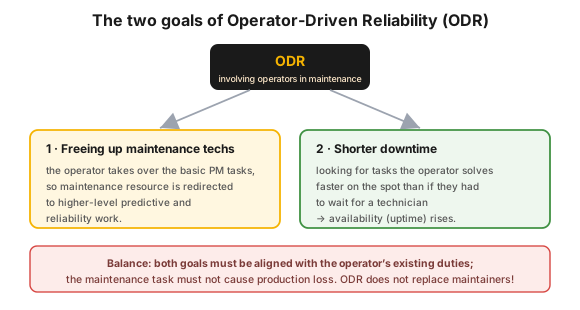 Figure 1 — the two goals of ODR, balanced against the operator’s existing operating duties.
Who is this for?
Section titled “Who is this for?”For those responsible for equipment availability and for the content of the operator’s work: plant manager · shift supervisor · maintenance manager · reliability engineer · process engineer · training lead.
Learning objectives
Section titled “Learning objectives”After this module you will be able to:
- define ODR and name its two goals;
- decide, using the four filters and the skill gate, whether a task can be handed over;
- build the training programme for one duty, from the one-point lesson to qualification;
- estimate how much maintenance capacity is freed up, and where it is worth directing it.
In brief
Section titled “In brief”- ODR = involving the operator in the maintenance of their own equipment, with early detection and scheduled escalation.
- Two equally ranked goals: freeing up maintenance capacity for higher-level work, and shorter downtime.
- A working preventive maintenance (PM) base is a prerequisite, because most ODR tasks are PM-type tasks.
- Handover gate: basic skill only, no special tool and no major disassembly, and the required skill fits within what the company is willing to train.
- Every ODR task = 1+ one-point lesson (training → qualification → signature → certification); this is how 10–40% of the PM obligations can be taken over.
Why it matters (the stakes)
Section titled “Why it matters (the stakes)”Breakdown repair costs two to four times as much as the same work done in a planned way; and reactive work also breaks the weekly schedule. ODR intervenes exactly where this extra cost arises: it does not let a small anomaly turn, after a wait, into a failure.
The two goals of ODR
Section titled “The two goals of ODR”ODR has two goals, in no particular order: it frees up a maintenance technician, and it shortens downtime. If operators carry out the simpler tasks that fall on maintenance, that frees up a resource which can be redirected to higher-level predictive and reliability work. On the other hand, we look for tasks the operator solves faster on the spot than if they had to wait for a technician, so availability (uptime) rises.
Both goals must be balanced with the duties already placed on the operator, so that performing a reliability task on the equipment does not end up causing production loss.
Which tasks can be handed to the operator?
Section titled “Which tasks can be handed to the operator?”Those that can be done with a single basic skill, without a special tool and without major disassembly, and for which the necessary knowledge fits within what the company is willing to teach the operator.
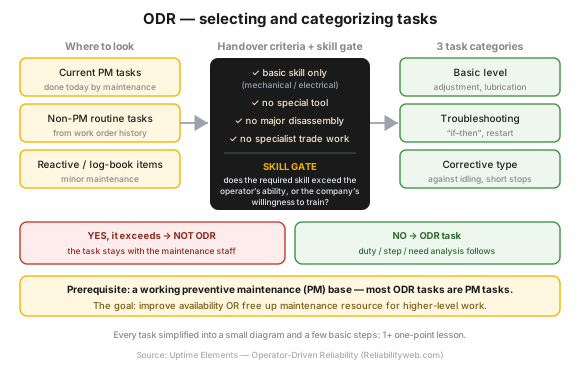 Figure 2 — where to look for the tasks, on what criteria and skill gate they are handed over, and into which three categories they are sorted.
The first of the prerequisites is preventive maintenance: most of the handed-over ODR tasks will be PM tasks. The three sources of candidates are the current PM tasks of the maintainers, the non-PM routine tasks in the work order history, and finally the reactive work orders and the smaller maintenance activities recorded in the hand-written log book.
Handover criteria and the skill gate
Section titled “Handover criteria and the skill gate”A task can be handed over from maintenance to operations if it requires only one basic skill (e.g. mechanical or electrical), and needs no special tool, no significant disassembly and no specialist trade work.
The three task categories
Section titled “The three task categories”The selected tasks must be simplified to the point where they can easily be documented in a small diagram and a few basic steps. From here three categories follow:
- Basic level: minor adjustments and tasks connected with lubrication.
- Troubleshooting: a short “if – then” type diagram; this can include electrical restart, or clearing a mechanical jam and switching back on.
- Corrective type: tasks aimed at eliminating idling and minor stoppages.
In practice (process-industry reliability workshop material, anonymized excerpt) this means the following, where it is safe and the operator is qualified for it:
| Daily–weekly round | Basic PM and preparation |
|---|---|
| oiling and greasing · clean-ups · “look, listen and feel” · gauge reading · filter cleaning · pump changeovers | process and equipment condition monitoring · basic PMs (packing, filters) · checking and tightening belts and parts · simple calibrations · routine cleaning and housekeeping · preparatory work for maintenance |
Training: one-point lessons
Section titled “Training: one-point lessons”The one-point lesson is a short training sheet tailored to one duty: a small diagram and a few basic steps, from which the operator learns the task. Why it is per duty is answered by the hierarchical job analysis:
| Level | What it means | Example |
|---|---|---|
| Duty | the task to be delegated | the routine lubrication of the pump |
| Step | the individual action needed to carry out the duty | identifying the lubrication point, dosing |
| Need | the knowledge and skill required to take the steps | knowing the lubricant type and the safety rule |
The difference between the needs and the operator’s existing skills gives the content of the one-point lesson: one person already has everything needed to perform the steps, another only partly, a third not at all. That is why every duty requires its own training programme.
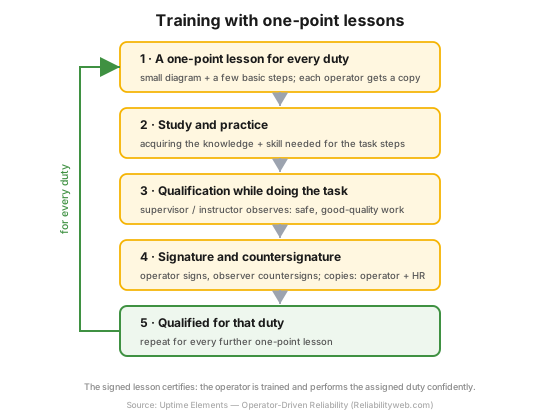 Figure 3 — the five-step cycle of the one-point lesson from drafting to qualification, repeated for every duty.
After learning and practising, the operator is qualified while performing the duty, in the presence of a supervisor, a representative of the training department, or a highly trained operator assigned to this (a job instructor). The goal is that they perform the task safely and to good quality.
The operator then signs one copy of the one-point lesson, the observer countersigns it, and one copy each goes to the operator and to HR. This must be repeated for every expected duty.
Continuous improvement in ODR
Section titled “Continuous improvement in ODR”As ODR is introduced at many companies worldwide, further opportunities come to light:
- A mixed maintainer/operator team that maintains and operates the equipment at the same time. The members with maintenance capability take the lead when maintenance is needed, and through the one-point lessons they teach the correct techniques to the others; conversely, the operators teach the maintainers correct operation.
- A blended operator-maintainer role, in which the operating position is filled by a person with helper-level maintenance skills: they know when to operate and when to maintain.
The benefits of ODR
Section titled “The benefits of ODR”The goal is for the operator to take over at least 10–40% of the preventive maintenance obligations; this frees up 10–40% of the previously PM-focused maintenance resource for predictive work (vibration analysis, thermography) and reliability work (e.g. root cause analysis). The extent of implementation varies from company to company: some entrust only the most basic tasks to the operator, others detailed tasks that require a lot of maintenance.
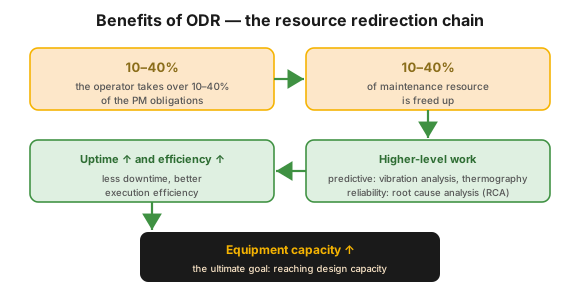 Figure 4 — the redirection chain from the PM handover to equipment capacity.
Because these resources now do higher-level work, this has a positive effect on equipment uptime and on execution efficiency, which in the end raises capacity, all the way to reaching the design capacity. The most advanced organizations also spend the freed-up capacity on reliability analysis, which increases global reliability by improving equipment design.
When NOT to use it (the limits of the method)
Section titled “When NOT to use it (the limits of the method)”- As a headcount-reduction tool. More than one company has tried to introduce ODR in order to do away with maintenance technicians. This approach has never succeeded.
- When the skill gate says no. If the required skill exceeds the willingness to train, the task stays with maintenance.
- Without a working PM base. Without preventive maintenance there is nothing to hand over, and nothing to measure the result against.
- Without strong leadership support. ODR does not require the full infrastructure of TPM; in exchange it presupposes firm leadership commitment.
- If the handover causes production loss. Then the balance has tipped over, and the programme will not be sustainable.
Common mistakes
Section titled “Common mistakes”- Handing over a task that is too complex: if a special tool, major disassembly or specialist trade work is needed, the task is not ODR-capable.
- Handover without training: without a one-point lesson, qualification and signature the operator is not certified, and that is a safety risk.
- A programme without measurement: without tracking, the 10–40% remains an intention.
Industrial and safety context
Section titled “Industrial and safety context”ODR is industry-independent, and is a relative of the TPM autonomous maintenance (Jishu Hozen) pillar; the relationship can be stated precisely: ODR is a variant of TPM, but because it does not require the infrastructure that TPM needs, it presupposes strong leadership support. The method builds on having the colleague closest to the problem take part in the basic upkeep and condition monitoring of the equipment: an operator who also watches state changes, trends and alarms handles the process with greater attention. The process-industry lean literature describes the same thing as the owner-operator: treat the machine as if it were your own. Safety is a key question: every handed-over task may be performed only by a trained and qualified operator, according to the one-point lesson. In a process-industry (e.g. Seveso) plant, well-delimited operator basic PM means faster intervention and less of the “schedule-breaking,” two-to-four-times-more-expensive maintenance, while the complex, hazardous work stays with the skilled maintainer.
Putting it into practice
Section titled “Putting it into practice”Start small, and move up in steps. Basic care (keep the equipment clean, cool and lubricated) can be started with little training, so it gives an immediate contribution; the advanced level (oil and filter changes, attentiveness) comes only where the basics already work. The goal of the advanced phase is threefold: excellent servicing, greater machine knowledge for the operator, and basic-level service from people who did not maintain anything before.
- Put the PM base in order (see preventive maintenance).
- Collect the candidate tasks from the PM plan, the work order history and the reactive and log-book items.
- Filter with the four criteria, run the skill gate on them, then sort them into the three categories.
- Break down the task by duty / step / need, write a one-point lesson, train, qualify, get it signed.
- Make ODR easier on the equipment itself: easily adjustable belts and chains, accessible oil fills and lubrication points, labelled piping and hoses.
- Measure what percentage of the PM obligations has been taken over, and where you directed the freed-up capacity.
Take it home (keys)
Section titled “Take it home (keys)”- ODR is capacity redirection, not a headcount question: an organization that introduces it as a downsizing move will fail at it.
- The skill gate is the real decision. The four filters narrow it down; the yes/no answer comes from the willingness to train.
- No task goes over without a one-point lesson and qualification. Signature, countersignature, one copy for the operator and one for HR.
- The 10–40% only comes if there is something to hand over: without a PM base there is no ODR.
- Balance is the price of sustainability: if the task taken over causes production loss, the programme backfires.
Connection to OPEREX (shift log)
Section titled “Connection to OPEREX (shift log)”The basic PM and condition checks entrusted to the operator can be assigned and signed off in the shift log (OPEREX): the round walked according to the one-point lesson, the anomaly noticed and the “handed over to maintenance” flag are recorded in one place, auditably, so the road toward the 10–40% take-over stays trackable.
Terminology (HU / EN / JP)
Section titled “Terminology (HU / EN / JP)”| Hungarian | English (canonical) | JP |
|---|---|---|
| Operátortól / üzemeltetőtől függő megbízhatóság | Operator-Driven Reliability (ODR) | — |
| Üzemeltetés bevonása | Operator Involvement | — |
| Tulajdonos-operátor | Owner-operator | — |
| Egyoldalas tanulság | One-point lesson (OPL) | — |
| Munkahelyi oktató | Job instructor | — |
| Kötelesség / lépés / igény | Duty / step / need | — |
| Üresjárat és rövid üzemszünet | Idling and minor stoppages | — |
| Autonóm karbantartás | Autonomous maintenance | Jishu Hozen |
The terminology follows the usage of Uptime Elements.
What is Operator-Driven Reliability (ODR)?
A process that involves the operating staff in the maintenance and reliability of their own equipment. Based on one-point lessons, after training and qualification, the operator performs basic maintenance and condition-checking tasks, and fixes the smaller problems themselves.
Which tasks can be handed to the operator?
Those that require only a basic skill (mechanical or electrical), need no special tool, significant disassembly or specialist trade work, and for which the required skill does not exceed what the company is willing to train. Typically lubrication, cleaning, gauge reading, basic PM and simple troubleshooting.
Is ODR a replacement for the maintainers?
No. ODR launched for the sake of headcount reduction has never succeeded. ODR is about redirecting capacity; the goal is not to fill up the operator’s day with maintenance work.
What is a one-point lesson?
A short training sheet focused on a single duty (a small diagram and a few basic steps). Every ODR task consists of at least one one-point lesson; after training and qualification the operator signs it, and the observer countersigns.
Self-test
Section titled “Self-test”Self-check questions
- A task meets all four handover criteria, but performing it correctly would need training the company does not fund. Will it become an ODR task?
- What is the difference between duty, step and need?
- How much PM take-over is the goal, and where should the freed-up capacity be directed?
Answer key: 1) No: it fails at the skill gate, the task stays with maintenance. · 2) The duty is the task to be delegated, the step is the individual action needed to carry it out, the need is the knowledge and skill required for the steps. · 3) 10–40% of the PM obligations; the capacity goes to predictive and reliability work.
Applied exercise
- Pick a real pump lubrication task and write a one-point lesson for it: break it down by duty / step / need, draw the small diagram, and name who qualifies and who countersigns.
Related concepts
Section titled “Related concepts”preventive maintenance · autonomous maintenance · tpm · maintenance planning and scheduling · vibration analysis · infrared thermography · root cause analysis (RCA) · reliability strategy · cmms
References / further reading
Section titled “References / further reading”- Uptime Elements reliability framework, © NetexpressUSA Inc. d/b/a Reliabilityweb.com: the “operator-driven reliability” element (goals, criteria, skill gate, one-point lessons, 10–40%); the “operational excellence” element (early detection, the relationship to TPM); the “reliability-centred design” element.
- Raymond C. Floyd: Liquid Lean — Developing Lean Culture in the Process Industries. Productivity Press / Taylor & Francis, 2010, chapter 9 (“Equipment Reliability and Operator Care”): basic care and the advanced phase, the owner-operator, the limit of the method.