San Gen Shugi (the three-reality principle) — Gemba, Genbutsu, Genjitsu
≈ 13 min read · 2,680 words
A good mechanic doesn’t fix your car from a “knock-knock” sound described over the phone. They have the car brought in, lift it up, look at the actual part, and work with measured data. A doctor doesn’t write a prescription from blind guesswork either: they examine the patient and order real test results. This is exactly San Gen Shugi, the Lean “three realities” principle: examine the problem where it actually happens, on the real thing and with real data, not from behind a desk. Let’s look at what the three “gen” mean, and why you won’t find the root cause in Excel.
San Gen Shugi is the Lean “three realities” principle: examine the problem where it actually happens, on the real thing and with real data, not from the office. Its three elements are Gemba (the real place, where the work and value creation happen), Genbutsu (the real thing, part, equipment) and Genjitsu (the real data and information). The guiding idea is simple: you can never find the root cause in an Excel sheet; reality must be observed on site, with your own eyes. It is complemented by the 5 Whys, which — by repeatedly asking “why?” — gets from the symptomatic fault to the actual root cause.
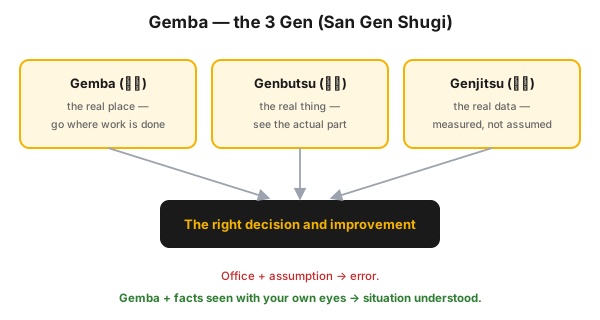 Figure 1 — the three “gen” (real place, real thing, real fact) together lead to the right decision; the office and assumption lead to error.
Who is this for?
Section titled “Who is this for?”This article is for those who make decisions about problems and deviations day in, day out: shift supervisor · plant manager · operator · maintenance technician · process engineer · process technologist · HSE specialist · Lean/CI specialist.
Learning objectives
Section titled “Learning objectives”After reading this article you will be able to:
- explain what the three “gen” mean (Gemba, Genbutsu, Genjitsu), and why all three are needed;
- recognize the classic anti-pattern where the fault code “breaks away” from reality;
- link on-site observation with root-cause analysis (5 Whys);
- distinguish San Gen Shugi from the related but different tools (Gemba walk, 5 Whys);
- decide when the on-site walk is not the fastest route to the answer.
The essence (TL;DR)
Section titled “The essence (TL;DR)”- Three realities (3 Gen): Gemba (real place) · Genbutsu (real thing) · Genjitsu (real data).
- “Never in Excel”: you find the root cause on site, with your own eyes, not from an after-the-fact report.
- Anti-pattern: fault code, board, Excel, weekly meeting where nobody understands the code and nothing gets solved.
- Complement: the 5 Whys takes you from the symptomatic cause to the root cause; San Gen Shugi adds the reliable observation.
- Process safety: incident and near-miss investigation happens on site, on the real equipment and on real DCS/PI data.
What is San Gen Shugi, and where does it come from?
Section titled “What is San Gen Shugi, and where does it come from?”San Gen Shugi (三現主義) is the Japanese “three realities” principle: the right decision comes from the real place, the real thing and the real data, not from a secondhand description. It grew up in the Toyota environment, from the same thinking that the Toyota Way also expresses in the principle of genchi genbutsu (“go and see for yourself”). The logic: whoever makes the decision should first gain direct, first-hand experience of what is actually happening.
The common opening syllable of the three “gen” is “gen” (現), which carries the meaning “real, actual.” Hence the mnemonic: go to the real place, look at the real thing, rely on the real data.
| Gen | English | What it means |
|---|---|---|
| Gemba (現場) | real place | where the work and value creation actually happen; go there |
| Genbutsu (現物) | real thing | the actual, faulty part or piece of equipment; look at it |
| Genjitsu (現実) | real fact/data | real, on-site data; not a secondhand, office report |
Guiding principle: nothing in production looks critical from the office, so the root cause cannot be found in an Excel sheet. Go out, look, gather the real data.
Why can’t we find the root cause in Excel?
Section titled “Why can’t we find the root cause in Excel?”Because the after-the-fact, office data breaks away from reality: the context of the problem, the real equipment and the location are lost by the time the number lands in the spreadsheet. A typical, cautionary chain looks like this:
- The operator writes the fault codes on a worksheet.
- The supervisor tallies them on the board.
- The administrator enters them into Excel.
- At the weekly meeting nobody understands what the “A2” fault code means, who could solve it, or what to do with it. “Let’s move on to the next item!”
The data has broken away from reality: nobody was on site, nobody saw the real thing, so 22 “A2” fault codes in the weekly report remain just a number. This is the exact opposite of San Gen Shugi.
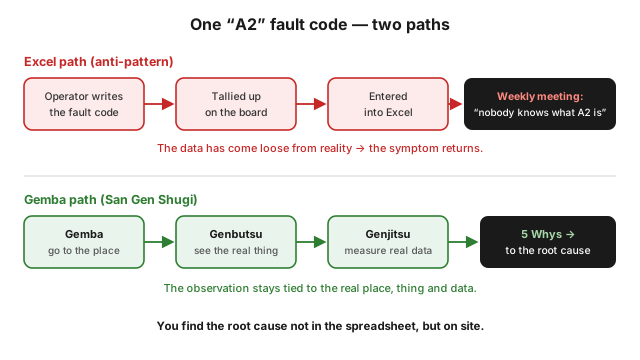 Figure 2 — the same “A2” fault code on two paths: the office Excel path breaks away from reality and the symptom returns; the Gemba path (real place, thing, data), then the 5 Whys, reaches the root cause.
Why does it matter? (the stakes)
Section titled “Why does it matter? (the stakes)”The absence of San Gen Shugi is not a spectacular failure but a silent loss: an analysis broken away from reality produces a bad decision, and the problem returns. If the weekly meeting counts fault codes instead of someone going out to the scene, the organization treats the symptom instead of the cause, again and again. In a process-industry environment the stakes are higher: a misunderstood near-miss, or a deviation “explained away” from the office, can ripen into a real incident on the next shift.
The lesson: the few minutes you spend on site are cheaper than an action built on a bad decision that does not solve the real problem.
How does San Gen Shugi connect to the 5 Whys?
Section titled “How does San Gen Shugi connect to the 5 Whys?”San Gen Shugi provides the reliable observation, while the 5 Whys provides the logical chain leading to the root cause. The two build on each other: first go out and look at reality, then ask “why?” five times.
The classic machine-stoppage example shows the difference well: behind the symptom visible on site (a tripped fuse), asking “why?” five times gets to the true root cause, the missing preventive maintenance. For the worked-out, step-by-step question chain, see the 5 Whys article.
San Gen Shugi provides the reliable starting point for this: the question chain must be started from real facts observed on site, not from assumption. The two tools together: go out (Gemba), look at the real equipment (Genbutsu), gather real data (Genjitsu), then ask “why?” five times.
How to use it in practice?
Section titled “How to use it in practice?”Short answer: don’t start at your desk. San Gen Shugi is a simple, repeatable routine that a shift supervisor can introduce tomorrow:
- Go out to the scene (Gemba) as soon as a deviation or fault comes up; don’t wait for the report.
- Look at the real thing (Genbutsu): the faulty part, the leaking fitting, the actual state of the equipment; don’t infer from a description.
- Gather real data (Genjitsu): read the on-site instrument, the DCS/historian trend, measure what you can; don’t work from a secondhand, later-typed table.
- Ask the person doing the work: the operator often knows precisely what changed and when; on-site knowledge is part of reality.
- Link it to the 5 Whys: start the root-cause analysis from the observed facts, then record the lesson.
Process-industry context and safety
Section titled “Process-industry context and safety”In a process-industry, Seveso-scope environment, San Gen Shugi is the principle of the Gemba walk and the on-site walkdown. The shift supervisor assesses the situation not from the control room or from an after-the-fact report, but on the physical plant (field walkdown, the near-miss site, the actual vessel).
The incident and near-miss investigation must be carried out on site (Gemba), on the real equipment (Genbutsu) and on real DCS/PI data (Genjitsu), not merely from after-the-fact reports. From a process-safety standpoint this is critical: the true cause of a deviation is often only visible on site, on the equipment (corrosion, a trace of a leak, a misadjusted valve), and the story comes together from the real trend, not from the rounded weekly summary (see near-miss, hazop).
Common mistakes
Section titled “Common mistakes”- Office analysis instead of the scene. They try to understand the problem from a secondhand report, from Excel. Why it’s a problem: the context is lost, the decision is based on data broken away from reality. Instead: go out to the Gemba and look at the real thing before you decide.
- Data without reality. Counted fault codes that nobody ties to a real event. Why it’s a problem: the number on its own does not tell you what and why happened. Instead: tie the on-site observation to every meaningful code.
- “I heard about it,” but didn’t see it. The leader knows the fault from a report but did not see the Genbutsu. Why it’s a problem: the description filters and distorts; the key is often precisely the detail left out. Instead: look at the actual part or equipment with your own eyes.
- Observation without root-cause analysis. You go out, you see the fault, but you stop at the symptom. Why it’s a problem: the visible fault is rarely the true cause. Instead: start the 5 Whys from the observed facts, all the way to the root cause.
When NOT to use it? (limits of the method)
Section titled “When NOT to use it? (limits of the method)”San Gen Shugi is a strong principle, but it is not the fastest answer to every situation. There are times when a different tool is the right move:
| Situation | Why the on-site walk is (primarily) not it | The right answer | ||
|---|---|---|---|---|
| Immediate danger (fire, toxic release) | entering the scene may be life-threatening | first the emergency procedure and shutdown; only enter a secured scene | ||
| The fault is a statistical pattern of many cases | a single scene does not show the trend | statistical data analysis (SPC, Pareto), then a targeted Gemba to the outlier case | ||
| A design or system-level cause | the scene shows the symptom, not the system | process redesign, [[fmea.en | FMEA]], [[vsm.en | VSM]] |
| The knowledge lives solely in documents (P&ID, HAZOP minutes) | there is nothing to “look at” on the scene | analysis of the relevant documentation |
Rule of thumb: San Gen Shugi is strongest for concrete, on-site-observable deviations. For a statistical pattern, a design fault or a life-threatening situation, another tool comes first, and the on-site walk complements it, it does not replace it.
How does it appear in digital practice?
Section titled “How does it appear in digital practice?”The principle of San Gen Shugi does not stop at the physical scene: a well-designed digital workflow ensures exactly that the observation stays tied to the real place, real thing and real data. The mechanism differs, the principle is the same.
| San Gen Shugi principle | Digital implementation | What it adds |
|---|---|---|
| Gemba (real place) | mobile field walkdown / operator round recorded on the device, on-site photo with timestamp and location | the observation stays tied to place and time, not reconstructed afterwards |
| Genbutsu (real thing) | photo attached to the equipment, QR/tag identifier, condition indicator | the specific asset is identified, not an abstract fault code |
| Genjitsu (real data) | live DCS/historian/PI trend alongside the log, not a later-typed Excel | the decision is tied to real, source-authenticated data |
| “Never in Excel” | a structured digital log instead of a free-text table | the fault code stays retrievable and in context |
Connection to OPEREX (shift diary)
Section titled “Connection to OPEREX (shift diary)”The deviations observed on site, the field walkdowns and the near-miss observations (together with the real data) can be logged in the shift diary (OPEREX). This way the root-cause analysis is documented retrievably, tied to the real data, and the “office” and the “gemba” reality do not drift apart from each other. This is the practical realization of the “never in Excel” principle: the log does not replace the scene but records what we saw there.
Terminology (HU / EN / JP)
Section titled “Terminology (HU / EN / JP)”| Hungarian | English | Japanese |
|---|---|---|
| Valós hely | Real place | Gemba (現場) |
| Valós tárgy | Real thing / real parts | Genbutsu (現物) |
| Valós tény/adat | Real fact / real data | Genjitsu (現実) |
| Három valóság elve | Three realities principle | San Gen Shugi (三現主義) |
| Menj oda és nézd meg | Go and see for yourself | Genchi Genbutsu (現地現物) |
Take it home (keys)
Section titled “Take it home (keys)”- Go out first, then decide. The right decision comes from the real place, the real thing and the real data, not from the report.
- The three “gen” are needed together: place (Gemba) + thing (Genbutsu) + data (Genjitsu). Leave one out and the picture is distorted.
- Excel is not where the root cause lives. The spreadsheet summarizes, but the scene provides reality’s context.
- Tie it to the 5 Whys: start the root-cause analysis from the observed facts, don’t stop at the symptom.
- Walk the Gemba regularly, not just when something goes wrong, so you know the normal and immediately see the deviation.
Self-test
Section titled “Self-test”- What are the three “gen,” and why is it not enough to rely on only one (e.g. the real data)?
- In the “22 A2 fault codes in the weekly report” example, exactly which “gen” is missing, and what would be the right first step?
- Complement San Gen Shugi with the 5 Whys on a fault you know: where is the Gemba, what is the Genbutsu, and where do you get from the symptomatic cause to the root cause?
What do the three "gen" of San Gen Shugi mean?
The Gemba is the real place (where the work and value creation happen), the Genbutsu is the real part or thing, and the Genjitsu is the real data and information. The principle says: examine the problem on site, based on real data and things, not from a secondhand description.
Why can't we find the root cause in Excel?
Because the after-the-fact, office data breaks away from reality: the context of the problem, the real equipment and the location are lost by the time the number lands in the spreadsheet. To understand the root cause you have to go out to the Gemba and look at the Genbutsu with your own eyes.
What is the connection between San Gen Shugi and the Gemba walk?
San Gen Shugi is the principle (three realities), while the Gemba walk is the practice: the structured on-site walkdown that realizes this principle.
Are San Gen Shugi and genchi genbutsu the same?
Related, but not identical. Genchi genbutsu (現地現物) is the “go and see for yourself” principle; San Gen Shugi (三現主義) breaks this down into three concrete requirements: real place, real thing, real data. Both come from the same Toyota thinking.
Related concepts
Section titled “Related concepts”gemba-walk · 5 Whys · jidoka · kaizen · pdca · near-miss
Next step
Section titled “Next step”If you have understood this, from here it is worth going on, in this order:
- gemba-walk — putting San Gen Shugi into practice: the routine of the structured on-site walkdown.
- 5 Whys — the root-cause analysis that gets from the facts observed on site to the actual cause.
- pdca — the improvement cycle that builds the solution to the root cause in and makes it a standard.
References / Further reading
Section titled “References / Further reading”- Taiichi Ohno: Toyota Production System: Beyond Large-Scale Production. Productivity Press, 1988 — the source of on-site, reality-based management (gemba) in the Toyota system.
- Masaaki Imai: Gemba Kaizen: A Commonsense, Low-Cost Approach to Management. McGraw-Hill, 1997 — “gemba” as the real place where value is created and where improvement must happen.
- Jeffrey K. Liker: The Toyota Way. McGraw-Hill, 2004 — Principle 12: genchi genbutsu (go and see for yourself to thoroughly understand the situation).