Lean leadership
≈ 26 min read · 5,165 words
Two plant managers face the same shutdown. One calls the person responsible into the office: “Who got it wrong, and why are we slipping again?” The other goes out to the scene, walks the process with the team, and asks: “What do we see, and where can we improve the system so this does not happen again?” The same problem, two different worlds. The second leader leads the Lean way: they do not look for someone to blame but give a vision, coach, and solve the problem for good by developing their people. Let’s look at what it is, why it works, and how it can be introduced on a shift.
Lean leadership is a philosophy in which the leader does not give orders but provides a vision, coaches, and delivers results by developing their people. In contrast to traditional, reactive, rule- and metric-based leadership, it is proactive: it asks “Why?”, empowers and challenges instead of commanding, and aligns the team toward the True North (the ultimate, ideal state). Its guiding principle is that “everyone is a leader in their own area,” and that if you develop people the right way, the results will follow. Lean leadership is the Mindsets & Behaviours element among the three lenses of Lean, but it permeates all three.
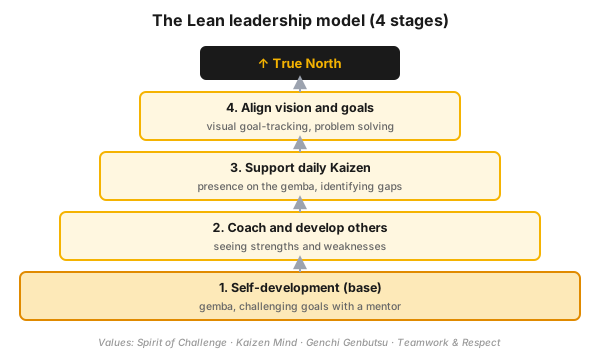 Figure 1 — the four-stage model of Lean leadership development: from self-development to vision alignment, all the way toward the True North values (Challenge, Kaizen Mind, Go-and-See, Teamwork, Respect).
Who is this for?
Section titled “Who is this for?”This article is for those who lead people and processes, or take part in the rollout: shift supervisor · plant manager · group leader · process engineer · maintenance manager · project and change leader · HSE · Lean/CI specialist · senior executive.
Learning objectives
Section titled “Learning objectives”After reading this article you will be able to:
- distinguish traditional from Lean leadership behavior along five concrete dimensions;
- explain the four-stage leadership-development model and the four core values;
- recognize the 10 practical characteristics of Lean leadership, and a “bad/good” behavior pair for each;
- understand why mindset and behavior decide the success of a transformation;
- outline how you would introduce the Lean leadership routines within a wave, from the pilot to sustainment.
The essence
Section titled “The essence”- At the heart of Lean leadership is that we achieve sustainable results by developing people (“sustainability through people development”), not the other way round.
- The traditional leader is reactive, makes rules, asks “When?”, delegates and dictates; the Lean leader is proactive, creates a vision, asks “Why?”, empowers and challenges.
- Development follows a four-stage model: 1) self-development, 2) coaching others, 3) supporting daily Kaizen, 4) aligning vision and goals, all toward the True North.
- Four core values: Spirit of Challenge, Kaizen Mind, Genchi Genbutsu (Go-and-See / Gemba), Teamwork & Respect.
- In practice, 10 characteristics describe the behavior (for example “shop flooring,” fact-based decisions, honest feedback, leading by example), each with a concrete “bad/good” behavior pair.
- The leader’s role is to support the front line: the organization serves the value stream, not the other way round (bottom-up logic).
- The key is trust and humility: satisfaction with the status quo kills the hunger to improve.
Why does it matter? (the stakes)
Section titled “Why does it matter? (the stakes)”Lean leadership is not a “soft” topic: it decides whether the tools you introduce will stick. About 70% of transformation programs fail to reach their goal, and the most common cause is not technical but human: employee resistance, leadership behavior that does not support the change, and insufficient resources. If you introduce only the tools but leadership behavior stays the same, the improvement bounces back.
This is reinforced by another, frequently cited observation: a significant part of corporate loss, around 95%, is tied to the internal barriers to change, not to process details. On a purely process level, then, no lasting result can be achieved: the culture has to change, and its engine is the leader. That is why Lean = continuous improvement = continuous change, and leading the change is the leadership work itself.
What is it, and where does it come from?
Section titled “What is it, and where does it come from?”Lean leadership is one of the load-bearing pillars of Lean. The Lean approach starts from the Voice of the Customer and rests on three, equally important lenses, all of which are needed for a successful rollout:
- Operating System: how we configure and optimize the process so that it creates value and minimizes waste.
- Management Infrastructure: the formal structures, processes and systems through which human and organizational resources are directed toward the shared goals.
- Mindsets & Behaviours: how people think, feel and behave at work, individually and collectively.
Lean leadership belongs to the third lens (Mindsets & Behaviours), but it permeates all three. The essence of leadership is well summarized by Warren Bennis: leadership is a function of knowing yourself, having a vision you can communicate well, building trust among your colleagues, and realizing your own leadership potential through effective action.
Historical root. Lean is the legacy of the Toyota Production System (TPS), which Toyota developed out of necessity after World War II. Around 1933 the company nearly went bankrupt, with an annual volume of only ~11,000 units against GM’s 3.6 million, a fraction of American productivity (roughly one ninth of it). Taiichi Ohno radically transformed the plants, and the TPS grew into a system in its own right. The essential point is that Toyota created it for itself: it was tailored to its own needs, so transplanting it to another industry requires reflection and customization. Every organization has to identify and solve its own challenges based on its own processes, place, people and other unique factors. The “let’s find a company similar to us that has already done it, and copy it” attitude is mistaken: benchmark-copying does not work, because the leader has to take their own organization through the transformation.
How does the Lean leader behave differently?
Section titled “How does the Lean leader behave differently?”Lean leadership is measured in daily behavior. Five tangible dimensions separate the traditional from the Lean style, and this is broken down further by the four-stage development model, the four core values and the 10 characteristics.
Traditional vs. Lean leadership
Section titled “Traditional vs. Lean leadership”The contrast of the two leadership styles:
| Traditional leadership | Lean leadership |
|---|---|
| Reactive | Proactive |
| Makes rules | Creates vision |
| Asks “When?” | Asks “Why?” |
| Delegates | Empowers |
| Dictates | Challenges |
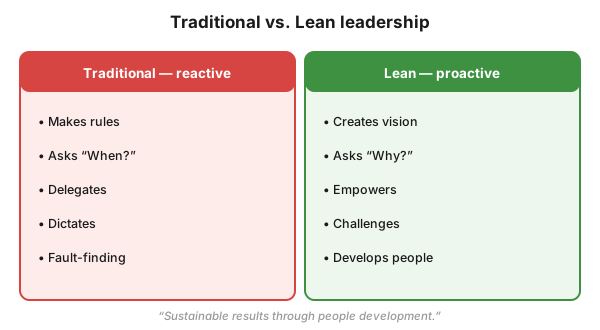 Figure 2 — contrasting traditional (reactive) and Lean (proactive) leadership behavior.
The guiding principle is that “everyone is a leader in their own area”; there is no “boss” and “subordinate.” The tools of self-development are: gemba walk, curiosity, self-respect, challenge.
The four-stage model of Lean leadership development
Section titled “The four-stage model of Lean leadership development”Leadership development consists of four stages that build on one another, centered on the True North values (Challenge, Kaizen Mind, Go-and-See, Teamwork, Respect). The table below contrasts the traditional and the Lean approach stage by stage (see Figure 1):
| Stage | Traditional | Lean |
|---|---|---|
| 1. Self-Development | Learns from a mentor and/or copies a successful style within the “old boys’ club” | Goes to the gemba to deeply understand the actual situation, and takes on increasingly challenging goals under a mentor’s guidance |
| 2. Coach and Develop Others | Picks similar successors, develops “favorites” or hires proven “heroes” from outside | Learns to see others’ strengths and weaknesses; develops people the right way, and the results will follow |
| 3. Support Daily Kaizen | Holds people accountable for metrics with a system of reward and punishment | Leadership presence on the gemba based on deviations from the True North and visual indicators; coaches the others to close the gaps themselves |
| 4. Create Vision and Align Goals | Drives goals with metrics; aggressive, bottom-up accountability; rewards the good and punishes the poor performer | Starts and sustains continuous improvement with visual goal-tracking; focuses on problem solving and developing people |
The four core values of Lean leaders
Section titled “The four core values of Lean leaders”- Spirit of Challenge: every leader is expected not only to excel in their current role but to take on challenges, with energy and enthusiasm, to achieve a bold vision.
- Kaizen Mind: the continuous improvement of performance.
- Genchi Genbutsu (Go-and-See / Gemba): go and see with your own eyes so that you understand deeply.
- Teamwork & Respect: mutual respect and trust toward people.
The 10 characteristics of Lean leadership
Section titled “The 10 characteristics of Lean leadership”This is the operationalized, “what should I actually do” level of the behavior. Each characteristic has a concrete bad/good behavior pair:
- Deploy Strategy & Objectives: we decide based on a long-term vision and goals, we develop the vision together with people, from a company-wide (not just departmental) perspective. Bad: “The most important thing is to push the volume through the unit.” Good: “We steer performance by cascading KPIs, and every colleague understands it.”
- Challenge to Support the Change Process: we take responsibility for our actions (including the uncomfortable topics), we do not accept postponement and excuses, and when we delegate we follow up regularly. Bad: “I’m so busy with my normal work and all the Lean stuff.” Good: “Lean is my normal work!”
- “Shop Flooring” (See the reality): the real work happens on the shop floor, the operators are important people, so we are there often, daily. Bad: “Let’s sit down in a meeting room and discuss it…” Good: “Let’s see it with our own eyes on the shop floor!”
- Open and Clear Communication: we are positive, we always look for improvement, we do not blame people but improve the system, the glass is half full, and we celebrate success. Bad: “Who is responsible for this mistake?” Good: “Where can we improve the process?”
- Commitment to Standards (Speak with Data): we build on facts, not rumors; in case of a problem, root-cause analysis (RCPS), often a 5 Whys and fishbone (Ishikawa) analysis together with colleagues. Bad: “I think we have a problem…” Good: “What? Where? Why? How?”
- Coaching & Team Building (Build People): coaching-style leadership and team building; we don’t need to know every answer, we lead with questions, we involve the team. Bad: “I don’t have time for performance reviews.” Good: “Developing my people is my most important task!” The concrete structure of the coaching conversation (GROW) and the OILS framework for feedback are presented in the Lean coaching and feedback article.
- Respect (We build trust): building mutual trust, honesty, informing people in time, keeping promises, listening to colleagues. Bad: “It’s confidential, but did you know that…” Good: “This is confidential, I can’t tell you.”
- Give Honest Feedback (Daily feedback): feedback when needed, praise for excellent performance, immediate handling of undesirable behavior. Bad: “Of course it went well, that’s our job.” / “I know it’s wrong, but I turn a blind eye to it.” Good: “Congratulations on the excellent performance!” / “I’ll tell them right now how their behavior affects me.”
- Positive Thinking (Can-Do Mentality): a “we can do it” mentality, action orientation; we don’t put tasks off, we do them now, action matters more than talk. Bad: “Good idea, let’s think about it and wait for X’s opinion…” Good: “Good idea, let’s do it today! I’ll take responsibility, right now!”
- Lead by Example (Role Model): we always keep our promise (an agreement is an agreement, a deadline is a deadline), “walk the talk,” we ourselves are excellent at 5S and keep our time management under control. Bad: “I didn’t finish what we agreed on, sorry, can we move the meeting?” Good: “I completed what we agreed on time, and I hold the meeting at the agreed time too, because I respect the others.”
In summary: Lean leaders realize the four-stage model through proactivity, in an empowering and challenging atmosphere, by applying the 10 characteristics.
The leader exists to support the front line
Section titled “The leader exists to support the front line”Lean organizational logic inverts the traditional pyramid: the organization serves the operating system (the value stream), not the other way round. Leaders exist to support the front line, giving the team four things: Capability, Empowerment, Involvement, Commitment. The role division of a Lean organization can be broken down into four focuses:
- PURPOSE: gives direction, sets plans and goals.
- PROCESS: helps create standards, audits, tracks and improves the standards.
- PEOPLE: sets priorities, develops people, creates a sense of urgency.
- DO IT: sets goals and tasks.
Characteristics of the front line: more responsibility on the line (problem solving), coaching the operators instead of “fire-fighting,” on-the-job training, a step-down model to cover absences. The span of control is crucial, and can be set correctly on the basis of a seven-element analysis tool.
Process-industry context and safety
Section titled “Process-industry context and safety”- Safety comes first. The base layer of Lean leadership is the “Safety – Best Quality – Lowest Cost – Shortest Lead Time” order, where safety always comes first. Leadership presence on the gemba is at the same time the presence of the safety culture.
- Process-industry relevance. The main message of a 2009 article is that in the process industry (especially oil and gas) there is a huge, untapped reserve in Lean: falling inventories, rising extraction costs, volatile prices. The real test of leadership comes not when the price is high but when it drops: the loss is there even when the price is high, it just isn’t visible. The “hiring high, firing low” model (hiring when prices are high, laying off when they are low) is questionable, while retaining workers through a recession is invaluable, because it increases loyalty and experience and reduces fear in the culture.
- Process-industry examples. Leadership “shop flooring” sees exactly the losses that are invisible from the meeting room: the stalling of flow across successive processing steps, inflexibility (for example, at flaring, avoiding soot formation by controlling the steam quantity, where a single episode can mean on the order of ~60 t of MP steam lost), or the energy loss of the distillation block, where energy makes up a large part of the total cost.
- Silos and shared responsibility. According to the Functional Support principle, every support function exists for production (that is where value is created). The practical transformation: one team (team leader + operators + maintenance staff) is jointly responsible for a reliable process with minimal downtime, measured against the same KPIs, instead of the traditional, mutually independent production/maintenance split, where poor communication and unclear responsibilities jeopardize reliability.
Introduction in practice (roadmap: pilot → rollout)
Section titled “Introduction in practice (roadmap: pilot → rollout)”The Lean transformation proceeds in waves, and each wave follows a structured roadmap. The logic of introducing the leadership:
A) Strategic commitment (senior management). The eight steps of the 2009 framework are about leadership:
- Learn – senior management and the key advisers learn what Lean means.
- Reflect / Debate / Challenge – debate and reflection: is Lean right for us.
- Build into Strategic Plan – Lean must be built into the company’s high-level plan so that everyone takes it seriously; leaders should stay committed and take part in dismantling the barriers to change (ultimately, leaders are responsible for the success of Lean).
- Identify / Remove Barriers – identifying and weighting the barriers to change (prioritized on a 0–5 scale).
- Customize – customization to the organization’s culture.
- Top-level VSM – high-level mapping of the entire value stream.
- Lower-level VSMs – mapping the sub-processes, where the problems become visible.
- Improvement Activities – quick improvements with Six Sigma / Kaizen tools or project management.
B) Roadmap of a transformation wave (at unit level). The phases and their durations:
| Phase | Content | Time |
|---|---|---|
| Preparation | Setting up teams, communication, roadmap development | ~2 weeks |
| Diagnose | Data collection, diagnosis along the Operating System / Management Infrastructure / Mindset & Behaviours | ~1 week |
| Design | Designing the future state on all three pillars | ~2 weeks |
| Plan | Tactical implementation plan (TIP) per work stream | (part of Design) |
| Implement | Introducing changes per the TIP, tracking progress | ~9 weeks |
| Sustain & CI | Standardization, transition to continuous improvement | ongoing |
Milestones: Preparation Meeting → Boot Camp → OC Meeting (Operating Committee) → SC Meeting (Steering Committee), in a repeating rhythm.
C) Handing over responsibility (Drive and Responsibility). A cycling metaphor describes how the navigator (internal Lean adviser) gradually hands over control to the business team:
- Getting started / Diagnostic: the navigator “steers and pedals,” the business team rides along.
- Design & Planning: the navigator pedals, the business team steers and pedals.
- Implementation: the navigator gradually pulls back, only gives tips, the business team takes over the handlebars.
- Post-wave: the navigator lets go, only watches, the business team stands on its own, steers and pedals.
D) Roles and responsibilities in the wave:
- Navigator: drives continuous improvement through the organization, challenges the organization, transfers knowledge.
- Local Champion: responsible for the transformation and its results.
- Pull Forward: sets challenging goals and direction, tunes people to them.
- Management Team: sets challenging goals and direction, open to new paths.
- Unit / Organisation: contributes, open to new methods.
Expectations of the Stream Leader: lead from the front, always be well prepared, be impartial, motivate and encourage, coach, challenge, keep the team on the True North.
Key success factors: the change starts from the leadership team; there should be a clear vision of how Lean fits the strategy of the process-industry plant and the units; there should be a clear transformation team; they should acquire enough Lean capability to steer; they should be open to new things; they should challenge the results and the organization.
E) The change formula (Dannemiller). Leadership change management can also be described with a simple, practical model:
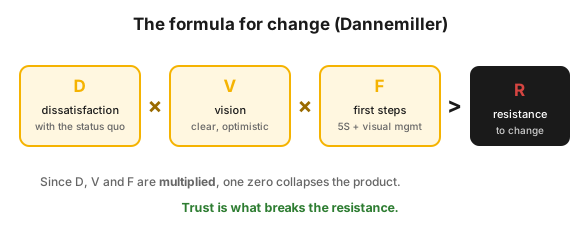 Figure 3 — the Dannemiller formula: the product of dissatisfaction with the status quo (D), the vision (V) and the first concrete steps (F) overcomes the resistance to change (R).
Because D, V and F are multiplied, if any of them is missing (zero) or low, the product will also be low and will not overcome the resistance (R). Senior management’s dissatisfaction with the status quo is indispensable, the vision is mandatory, and the first concrete steps are 5S and visual management (the base of the House of Lean). Trust is what breaks the resistance.
Measurement / audit
Section titled “Measurement / audit”The “measurement” of Lean leadership happens primarily through visual performance management and the presence of the leadership routines:
- Performance Management = the dashboard of leadership. By the car-dashboard analogy, you need a balanced, not-too-large set of indicators, clear and appropriate target values, visualization (performance tracking), and corrective/preventive actions. A KPI should be S.M.A.R.T. (Specific, Measurable, Achievable, Results-oriented, Time-bound), simple, actionable, high-impact, often “leading” in nature, and preferably not financial.
- “Own your numbers.” As soon as the leader or the team writes the number on the board by hand, it becomes their own: the handwriting prompts thinking, which is what closing the gap requires. On the boards, a color code relative to the target: blue = target, red = missed, green = achieved.
- 5S and standardization audit. Leadership’s standard-keeping can be measured with weekly 5S audits (comparing the current state with the standard), presenting the results and building them into the performance review.
- Skill matrix (competence matrix). The team’s development is tracked with a visual tool: each task is assigned a competence level according to the rubric of the skill matrix (from the lowest, where the person is still a learner, to the highest, where they work to standard cycle time, improve, and train others too). The matrix is a planning tool: it highlights training needs, increases flexibility, reduces variability.
- Performance dialogue. The cycle of performance management: 1) clear metrics, goals, responsibility; 2) realistic plans and budget; 3) effective performance tracking; 4) robust performance dialogues; 5) rewards, consequences, actions.
Hands-on / case studies
Section titled “Hands-on / case studies”Lean transformation of a complaint-handling team (case study) — the impact of leadership tools. The leadership Lean journey of a bank’s complaint-handling team clearly shows the combined effect of the three leadership tools:
- October 2013: introduction of capacity-management tools.
- December 2013: use of sit-in and coaching (the leader sits down next to the colleague, observes and coaches).
- January 2014: defining individual and team KPI targets, and regularly tracking the individual KPIs.
- Result: about a 10% increase in efficiency (best-practice sharing + process improvement), the share of handled complaints dropped below the target, and since May there has been no need for overtime. Reorganizing the work: instead of distribution by task type (many handovers), a “case owner” model where everyone is responsible for seeing through the case that comes to them, with back-up pairs and a daily meeting.
This case shows three characteristics of Lean leadership together: presence (sit-in), coaching, and visual/KPI-based performance tracking.
A simple kaizen example (the result of leadership “shop flooring”). A short before/after measurement: the lead time dropped from 1:25 to 0:38 (a 0:47 improvement), the distance walked per day from 18 meters to 1.8 meters (a 16.2-meter saving), the distance walked per year from 6,552 meters to 655.2 meters. The lesson: the leader sees the unnecessary Motion on the gemba, which cannot be seen from the meeting room.
A personal Lean journey (the power of trust). A leadership experience from a plant where trust was the key: by redesigning the process and the layout, they achieved a significant annual revenue increase and cost reduction, and freed up production floor space too. The lesson: where trust is present and the vision is clear, resistance is low and change is easy.
Common mistakes
Section titled “Common mistakes”The anti-patterns are best read paired with the correct practice:
- Benchmark-copying. “Give me a benchmark from a company similar to us.” Why it’s a problem: Lean cannot be copied from another organization; every organization has its own processes, people and challenges. Instead: take your own organization through the transformation, solve your own challenges.
- Focusing only on the tools, without the culture. Why it’s a problem: isolated improvements cannot be sustained without a fundamental culture change; around 95% of the loss is tied to the barriers to change. Instead: change leadership behavior and mindset, don’t just put up the boards.
- Fire-fighting. Why it’s a problem: with a non-routine issue we tend to “put out the fire” immediately, we don’t understand the current situation, we barely plan, we barely check the direction, and there is no end to the problems. Instead: PDCA and root-cause analysis instead of treating the symptom.
- Treating the symptom instead of the root cause. Why it’s a problem: after the symptom is cleared, the problem returns. Instead: eliminate the root cause (5 Whys, RCPS), and treat the problem as an opportunity for improvement.
- Scapegoating. “Who is responsible for the mistake?” Why it’s a problem: knowing who made the mistake will neither solve nor prevent the problem. Instead: ask where the system can be improved, and the person can help find the root cause.
- “I don’t have time for it / this is extra on top of my normal work.” Why it’s a problem: this way Lean stays a “project” that comes and goes. Instead: Lean is part of the normal work; developing people and the performance review are the leader’s most important task, not a burden.
- Complacency with success. Why it’s a problem: profitability does not mean the business model works; as Deming warns, we should not mistake success for success. Instead: keep a deep humility, because the moment you believe you are “better” than others, you lose the hunger to improve.
When NOT to use it? (limits of the method)
Section titled “When NOT to use it? (limits of the method)”Lean leadership is strong in the context of continuous improvement, but it is not the best answer for every situation. Knowing its limits is just as important as the style itself:
| Situation | Why Lean coaching is not primarily the answer | The right answer |
|---|---|---|
| An acute safety situation or emergency | there is no time here for coaching and consensus; an immediate, unambiguous instruction is needed | direct, authoritative intervention; the coaching comes after the event, in processing the lessons |
| A certified safety function / protection layer is needed | leadership presence and culture do not replace technical protection | risk analysis and design to standard (LOPA/SIL, IEC 61511) |
| No senior-management commitment | Lean leadership starts from the leadership team; forced from below, it wears off | first establish senior-management commitment and vision alignment |
| A one-off, non-recurring problem | there is nothing to “build into the culture” durably for a single case | a one-off root-cause analysis, recording the lesson |
| A fundamental lack of capability or resources | coaching cannot make up for missing expertise or capacity | targeted training (capability building), resource allocation, and only then coaching |
Rule of thumb: Lean leadership is the engine of lasting, repeated performance. In an emergency, for a certified safety function, or in the absence of senior-management commitment, a different tool is the right primary one; Lean coaching complements these, it does not replace them.
Take it home (keys)
Section titled “Take it home (keys)”- People first: the source of sustainable results is developing people, not the other way round. A good leader does not look for someone to blame but improves the system.
- “Why?”, not “When?”: proactively give a vision, empower and challenge, instead of making rules and dictating.
- Go to the gemba: you see the real work on the shop floor, not in the meeting room; the daily presence is your best “measuring instrument.”
- Culture decides: most transformations fail on behavior, not on technology; leadership behavior is the key variable.
- D × V × F > R: dissatisfaction, vision and first concrete steps together overcome the resistance, and trust is what breaks it.
- Stay humble: the moment you are satisfied, development stops; the best organizations stay hungry.
Self-test
Section titled “Self-test”- Name the five behavioral differences between the traditional and the Lean leader, and explain why the Lean style is “proactive.”
- List the steps of the four-stage leadership-development model, and say in which stage presence on the gemba is most important, and why.
- About 70% of transformations fail to reach their goal. What are the three most common causes, and which leadership behavior reduces these risks?
How does it appear in digital practice?
Section titled “How does it appear in digital practice?”The essence of Lean leadership is the daily, repeated leadership routine: presence, coaching, handling deviations, tracking commitments. The same logic is realized in software too: instead of the physical board and the paper log, a structured, searchable digital system records the leadership work — the mechanism is different, the principle is the same.
| Leadership principle | Digital implementation | What value it delivers |
|---|---|---|
| Gemba presence, “shop flooring” | mobile observation entry, with photo and location | the observed deviation is not lost, it is searchable |
| Visual performance management | digital KPI board with target value, color code (target/below/above) | everyone sees the same real state |
| “Own your numbers” | the owner records the number and the explanation themselves | responsibility and commitment, an auditable trail |
| Coaching and handling deviations | recording an action with owner and deadline, follow-up | closing the gap does not stay a verbal promise |
| Root-cause analysis (5 Whys, RCPS) | a structured problem-solving template with attached evidence | the lesson is retained across shifts |
| Daily meeting / handover | a structured agenda and decision log | the leadership presence is documented and consistent |
Connection to OPEREX (shift diary)
Section titled “Connection to OPEREX (shift diary)”Many elements of Lean leadership are a routine that repeats daily, at shift level, and this is exactly what the OPEREX shift diary makes recordable and searchable in a structured way:
- Gemba walk / “shop flooring” observations and the deviations found (gaps relative to the True North) can be documented as entries.
- The agenda and decisions of the daily meeting / shift handover (who committed to what, what they concluded) can be logged, so leadership presence leaves an auditable trail.
- KPI deviations and corrective actions (the “performance board” logic) can be tracked item by item, with owner and deadline.
- Root-cause analysis (5 Whys, RCPS) and the related actions can be recorded, so problem solving is not lost across shifts.
- Shared production–maintenance responsibility: the commitments of the team measured against a shared KPI are visible in one place, which supports dismantling the silos.
This way the leadership routines serve as documented, searchable evidence for continuous improvement and reliable operation.
Terminology (HU / EN / JP)
Section titled “Terminology (HU / EN / JP)”| Hungarian | English | Japanese / original |
|---|---|---|
| Menj és nézd meg | Go and See | Genchi Genbutsu (現地現物) |
| Műhelyszint / üzemtér | Shop floor / Gemba | Gemba (現場) |
| Folyamatos fejlesztés | Continuous Improvement | Kaizen (改善) |
| Végső / ideális cél | True North / Ideal State | — |
| Vizuális jelzőlámpa | Visual signal | Andon (アンドン) |
| Kihívó szellem | Spirit of Challenge | — |
| Felhatalmazás | Empowerment | — |
| Gyökérok-elemzés | Root Cause Problem Solving (RCPS) | — |
What is Lean leadership?
A leadership approach in which the leader creates a vision, aligns the team toward the True North as a role model and coach, and develops their people, out of the conviction that “if you develop people the right way, the results will follow.”
How does it differ from traditional leadership?
The traditional leader is reactive, makes rules, asks “When?”, delegates and dictates. The Lean leader is proactive, creates a vision, asks “Why?”, empowers and challenges. Its guiding principle is that “everyone is a leader in their own area.”
What are the four stages of Lean leadership development?
- Self-Development (self-development on the gemba, alongside a mentor), 2) Coach and Develop Others, 3) Support Daily Kaizen (presence and coaching the closing of gaps), 4) Create Vision and Align Goals (vision and visual goal-tracking), all organized around the True North values (Challenge, Kaizen Mind, Go-and-See, Teamwork, Respect).
Why do about 70% of transformations fail?
Most often because of people’s mindset and behavior: employee resistance, leadership behavior that does not support the change, and insufficient resources. A significant part of the loss, around 95%, is tied to the internal barriers to change, so the culture has to change; working with process tools alone is not enough.
What is the leader's role in a Lean organization?
Supporting the front line. The organization serves the value stream (operating system), not the other way round: the leader gives direction (Purpose), helps with and audits standards (Process), develops people and sets priorities (People), and coaches instead of fire-fighting.
Related concepts
Section titled “Related concepts”5s · kaizen · gemba-walk · true-north · vsm · A3 report · performance management · standard work · visual management · muda-mura-muri · training and onboarding · lopa-sil
Next step
Section titled “Next step”If you have understood this, from here it is worth going on, in this order:
- true-north — the goal toward which the Lean leader aligns at every stage; without it the coaching has no direction.
- gemba-walk — the concrete practice of “shop flooring”: how to be present on site in a way that develops rather than inspects.
- performance management — the “dashboard” of leadership: the visual performance tracking and the performance dialogue with which you handle the daily deviations.
References / Further reading
Section titled “References / Further reading”- Warren Bennis: On Becoming a Leader. Addison-Wesley, 1989 — leadership as self-knowledge, vision and trust; the source of the leadership definition quoted in the article.
- James P. Womack – Daniel T. Jones: Lean Thinking. Simon & Schuster, 1996 — the canonical exposition of the five Lean principles and the True North (perfection).
- Taiichi Ohno: Toyota Production System: Beyond Large-Scale Production. Productivity Press, 1988 — the foundational work on the TPS and the gemba mindset.
- W. Edwards Deming: Out of the Crisis. MIT Press, 1986 — the classic of leadership responsibility and systems thinking (“94% belongs to the system”).
- Kathleen Dannemiller’s change formula (D × V × F > R) — a practical model of organizational change.