Functional support in the Lean organization
≈ 15 min read · 3,057 words
The plant is down because a pump has failed, and the shift is waiting on maintenance. Maintenance is working through its own list, the critical spare part is “in progress” at procurement, and the lab is overloaded just now with another sample. Everyone is watching their own board, while production simply stands still. This is the classic silo operation, and it is exactly what functional support sets out to eliminate: the simple yet often missing recognition that every support function exists to serve production, because that is where value is created. Let’s look at what this means, why it works, and how you can turn silos into a service system.
Functional support is the principle that every support function serves production as its internal customer, since that is where value is created. The support functions (maintenance, finance, procurement, HR, quality, production planning) are not self-serving “kingdoms” but service providers: the company makes its money in production. It is the fifth element of the Management Infrastructure (MI); it hinges on three concrete behaviors: breaking down the silos, adopting the customer’s perspective, and effective communication. It is not a hierarchy of superior and subordinate but a service logic: the support function, keeping its professional autonomy, makes production’s need the measure of its service.
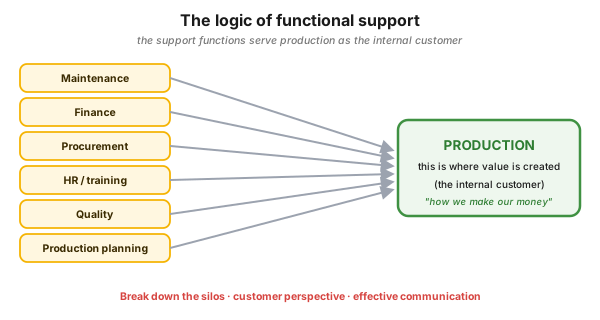
Figure 1 — the support functions serve production as the internal customer. Good functional support breaks down the silos, adopts the customer’s perspective, and is built on effective communication.
Who is this for?
Section titled “Who is this for?”This article is for those who work at the boundary of the support and production functions, or who lead it: plant and shift manager · maintenance manager and planner · buyer · lab manager · process and reliability engineer · HR / training partner · Lean/CI specialist · HSE.
Learning objectives
Section titled “Learning objectives”After reading this article you will be able to:
- explain why production is the “internal customer,” and what this means for the support functions;
- recognize the symptoms of silo operation, and name the three corrective behaviors (breaking down the silos, the customer’s perspective, effective communication);
- formulate a service standard for a concrete support handoff (e.g. a maintenance request, a lab sample);
- draw the line: where the customer’s perspective does NOT override the professional or safety veto.
The essence
Section titled “The essence”- The fifth element of the MI. Of the five elements of the Management Infrastructure, this one is responsible for making the support functions work not for their own sake but for production.
- Production is the internal customer. Value is created in production; every other function serves this, not the other way round (a bottom-up logic, in line with the inverted pyramid of the Lean organization).
- Break down the silos. The walls between functions slow the value flow; support has to reach across them.
- The customer’s perspective. The support function should look at production as an internal customer whose need it has to satisfy.
- Effective communication. Fast, clear, documented information exchange is the foundation of functional support.
- The professional veto stays. The “customer” measures the quality of the service; it does not ask for professional or safety limits to be given up.
Why does it matter? What do you risk with silos?
Section titled “Why does it matter? What do you risk with silos?”The price of silos is not abstract: it lands directly in downtime, conflict and forgone value. When every support function drives its own KPI (maintenance the budget optimum, procurement the unit price, the lab the turnaround time), production’s request gets stuck between the walls, and the unplanned downtime drags on.
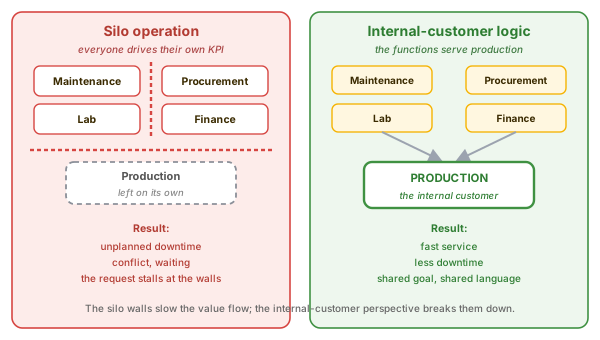
Figure 2 — the same four functions in two kinds of logic. On the left, the silo: separate KPIs, walls, production left on its own. On the right, the internal-customer logic: the functions serve production, along a shared goal and a shared language.
The stake is simple: the silo is not the fault of the support function but of the system that gives them a separate goal and does not tie them to production’s need. Whoever restores this connection gains not more people or a bigger budget, but faster service and less conflict, out of the same resources.
What is it, and where does it come from?
Section titled “What is it, and where does it come from?”Functional support is an extension of the inverted pyramid of the Lean organization. In the Lean organization the organization serves the value-creating process, not the other way round (a bottom-up logic): the structure, the leadership and the support all exist so that the front line, where value arises, can do its job well. Functional support carries this principle further, to the support functions: every support function exists to serve the production unit, because that is where value is created, and that is how the company makes its money.
This is a shift in mindset. Maintenance, finance, procurement, HR, quality assurance and production planning are typically the most common support functions, but the list varies from plant to plant. The point is not which ones they are, but that they are not separate “kingdoms” with their own goals, but service providers whose internal customer is production. The goal is three concrete behaviors: breaking down the silos, adopting the customer’s perspective, and effective communication.
The idea of the “internal customer” is not a Lean invention: it comes from the tradition of Total Quality Management (TQM), where every process step is the “customer” of the next. Lean applies this to the organization as a whole: the entire chain serves the value of the final, external customer, and within this the customer of the support functions is production.
How can functional support be improved? The three behaviors
Section titled “How can functional support be improved? The three behaviors”Functional support is not an org chart but three observable behaviors. If these are in place, support is fast and accountable; if they are missing, silos form.
1. Break down the silos
Section titled “1. Break down the silos”A silo is a wall between functions: a separate goal, a separate language, a separate priority. Breaking down the silos means that the support function and production see a shared goal (the stable, safe, economical operation of the plant), and that requests do not get stuck at the organizational boundary. Its practical tools are shared daily/weekly forums (e.g. the review around the performance board), cross-functional problem solving, and a clear who-does-what-by-when order of responsibility.
2. Take the customer’s perspective
Section titled “2. Take the customer’s perspective”The customer’s perspective is the most important mental switch: the support function looks at production as an internal customer whose need it has to satisfy. This is not servility but a service standard: the success of support is decided not by its own internal metric, but by whether production received what it needed, on time and at the right quality. In the “customer’s” language this means: what is being requested, by when, at what quality, and whether it was received.
3. Communicate effectively
Section titled “3. Communicate effectively”Fast, clear and documented information exchange ties the other two together. A request handed over late or inaccurately causes downtime or an error; and a handoff left without a trace is not accountable. Effective communication here means something concrete: a clear request, a confirmed receipt, a visible status, a closure.
Process-industry context and safety
Section titled “Process-industry context and safety”In a process-industry plant, functional support is tangible: maintenance serves production’s availability need (not just its own budget optimum), the lab delivers the quality result for a decision on time, procurement delivers the critical spare part to avoid a shutdown, and production planning aligns the capacity and material demand with production’s rhythm. Where there are silos, maintenance and production drive separate KPIs, competing with each other, and unplanned downtime and conflict grow. The common language is the need of production as the internal customer.
Introduction in practice: how to set it up tomorrow
Section titled “Introduction in practice: how to set it up tomorrow”Functional support is not a project but a daily practice. A shift supervisor or plant manager can start tomorrow by putting a single support handoff in order:
- Choose a painful, recurring handoff between production and a support function (e.g. a maintenance request, a lab sample, an urgent purchase).
- Describe it through the customer’s eyes: what production wants — what it requests, by when, at what quality, and how it knows it is done.
- Make the request and its status visible on a shared surface (a board or a log), with an owner and a deadline.
- Take it to a shared forum (a daily/weekly review): production and the support function should look at the same open list, in the same place.
- Close it and measure it: did production receive it on time; if not, where did it get stuck, and what is the next improvement.
The goal is not a big reorganization, but that one handoff moves from the silo logic into the customer logic, and then that this pattern spreads.
Measurement and audit
Section titled “Measurement and audit”The quality of functional support is measured not by the internal metrics of the support function but by the metrics of the service:
- Lead time: from production’s request to fulfilment (e.g. a maintenance request, a lab sample, a spare part).
- On-time and on-quality conformance: what percentage of requests are fulfilled on time and at the right quality (the internal customer’s satisfaction).
- The effect on downtime avoidance: the relationship between the speed of support and unplanned downtime.
- Traceability: what percentage of requests have a documented trail (who requested what, by when, and what became of it).
Target-value logic: the goal is not the activity of the support function, but that production, as the internal customer, receives what it needs on time and at the right quality.
Common mistakes: anti-pattern and correction
Section titled “Common mistakes: anti-pattern and correction”- Functions operating in silos. Why it’s a problem: everyone drives their own KPI, production is left on its own. Instead: a shared goal, with production’s need as the measure; let the open requests come together on a shared forum.
- “Support is what matters, production will adapt.” Why it’s a problem: it reverses the value logic, when in fact value arises in production. Instead: production is the internal customer, support serves.
- Slow, vague, traceless communication. Why it’s a problem: information handed over late or badly causes downtime or an error, and a traceless handoff is not accountable. Instead: a clear request, a confirmed receipt, a visible status, a closure.
- The customer’s perspective as helplessness. Why it’s a problem: support gives up its professional autonomy and, even on a safety question, yields to the urging. Instead: the customer measures the quality of the service; the professional and safety veto stays.
- The success of support is measured by its own metric. Why it’s a problem: the function “performs well” on its own board while production is waiting. Instead: the measure of service is the internal customer’s satisfaction (whether it received it on time and at the right quality).
When NOT to use it? (limits of the method)
Section titled “When NOT to use it? (limits of the method)”The principle of functional support is strong, but it is not the answer to everything. There are times when misunderstanding it does more harm than good:
| Situation | Why not this way | The right answer |
|---|---|---|
| A safety-critical decision (interlock, MOC, a HAZOP finding) | “the customer is pushing” must not override the professional veto | professional/HSE autonomy decides; MOC and LOPA/SIL are authoritative |
| The professional standard of the support function (e.g. a sampling protocol, a maintenance specification) | the customer’s need is not a lowering of professional quality | the standard stays; the speed/transparency of the service improves, not the professional level |
| A genuine capacity shortage (not enough people/equipment) | “be customer-oriented” does not make up for a missing resource | a resource and priority decision at leadership level, not inside support |
| The competing needs of several internal customers | not every request is equally urgent | a transparent priority order and escalation, not “whoever is louder” |
Rule of thumb: the customer’s perspective improves the quality of the service; it does not move the professional or safety limits. Where a certified safety function or a professional standard is at stake, the discipline decides.
Take it home (keys)
Section titled “Take it home (keys)”- Production is the internal customer — every support function measures itself against this, not against its own internal metric.
- Service instead of silos: the walls between functions slow value down; a shared forum and a shared goal break them down.
- The customer’s perspective is measurable: the quality of support is shown by lead time, on-time-and-on-quality fulfilment, and downtime avoidance.
- Let communication be documented: a traceless handoff is not accountable; a clear request, a confirmation, a status, a closure.
- The professional veto stays: the customer logic concerns the service; it does not override the safety limits.
Self-test
Section titled “Self-test”- Why is production the “internal customer,” and what follows from this for the daily work of maintenance, procurement or the lab?
- Name the three behaviors of functional support, and give a concrete plant example for each.
- A pressing shift supervisor puts pressure on the lab to skip a sampling step for a faster result. Based on the “production is the internal customer” principle, is it right to give in? Justify your answer from the standpoint of the professional veto.
How does it appear in digital practice?
Section titled “How does it appear in digital practice?”The principle of functional support does not stop at the org chart: the same logic is realized in a well-designed digital workflow too. Instead of the word in the corridor and the promise kept in someone’s head, here a recorded request, a visible status and a measurable lead time tie production to the support function; the mechanism differs, the principle is the same.
| Principle of functional support | Digital implementation | What it achieves |
|---|---|---|
| The customer’s perspective | the request (need, sample, spare part) is a recorded item with an owner and a deadline | production’s need becomes accountable |
| Breaking down the silos | a shared, searchable surface: production and support see the same open list | “I have no record of it” disappears |
| Effective communication | status tracking: open / in progress / done, with a timestamp | the request does not stall invisibly |
| Measurement | automatic collection of lead time and fulfilment rate | the quality of service becomes measurable |
| Traceability | a logged handoff: who requested what, by when, and what became of it | the support delivery is auditable |
Connection to OPEREX (shift diary)
Section titled “Connection to OPEREX (shift diary)”Functional support is fast and accountable when the trail of the requests and handoffs between production and the support functions is preserved. Requests opened toward support and recorded in the OPEREX shift diary (a maintenance request, a lab sample, a procurement chase) can be tracked with a timestamp and an owner, so the handoff between silos becomes transparent, and the “who requested what, when, and what became of it” question can be answered shift by shift. The open-request list built into the shift handover ensures that a support need is not lost at the shift boundary.
Terminology (HU / EN)
Section titled “Terminology (HU / EN)”| Hungarian | English | Note |
|---|---|---|
| funkcionális támogatás | functional support (system) | the 5th element of the MI |
| támogató funkciók | support functions | maintenance, finance, procurement, HR, quality, production planning… |
| belső vevő | internal customer | production; from the TQM tradition |
| siló | silo | a wall between functions |
| vevői nézőpont | customer perspective | the measure of service |
| értékteremtő folyamat | value creation process | where production takes place |
What is functional support in the Lean organization?
It is the element of the Management Infrastructure that is about how effectively the support functions (maintenance, finance, procurement, HR, quality, production planning) serve production. The founding principle is that every support function serves production as the internal customer, because that is where value is created.
Why is production the "internal customer"?
Because the company produces value in production, and that is where it makes its money. The task of the support functions is to serve this value creation: in the Lean inverted pyramid the organization serves the operational process, not the other way round.
How can functional support be improved?
With three concrete behaviors: breaking down the silos (eliminating the walls between functions), adopting the customer’s perspective (production’s need as the measure), and fast, documented, effective communication.
Does the "customer's perspective" mean that support always gives in to production?
No. The customer’s perspective concerns the quality of the service (on time, at the right quality, transparently), not the giving up of professional or safety limits. On a safety-critical question, the veto of maintenance, HSE or process-safety expertise stays.
How do I know we are operating in silos?
The symptoms: every function drives its own KPI, production’s request stalls at the organizational boundary, the handoffs leave no trace, and during unplanned downtime there are “whose job is it” arguments. The fix is a shared goal, a shared forum, and a traceable handoff.
Related concepts
Section titled “Related concepts”management infrastructure · organizational empowerment · vertical vs. horizontal · performance management · performance board · shift handover · mos
Next step
Section titled “Next step”If you have understood this, from here it is worth going on, in this order:
- management infrastructure — the full frame: functional support is the fifth of the MI’s five elements; here you see how it fits with the other four.
- organizational empowerment — the inverted pyramid, of which functional support is the extension: why the whole organization serves the front line.
- performance board — the shared forum where the open requests of production and the support functions become visible and accountable.
References / Further reading
Section titled “References / Further reading”- James P. Womack – Daniel T. Jones: Lean Thinking. Simon & Schuster, 1996 — value is defined from the standpoint of the (final) customer; the internal counterpart of this is the internal-customer logic.
- Raymond C. Floyd: Liquid Lean: Developing Lean Culture in the Process Industries. CRC Press, 2010 — the application of Lean management systems in the process industries.
- The concept of the “internal customer” comes from the tradition of Total Quality Management (TQM), where every process step is the “customer” of the next; Lean applies this to the organization as a whole.