The maintenance role in asset teams
≈ 20 min read · 3,957 words
A pump breaks down in the night. Who do you call? And in the morning meeting, who is the one expected to say when it will run again? In most plants the question is not “is there maintenance,” but whether there is a single, nameable person who is accountable for the maintenance work on that unit and who sits at the decision-making table, not in another building. The asset team model answers this: maintenance has a dedicated representative in the team, the asset team maintenance leader. Let’s look at what this role is, why it works, and how it connects to the daily work.
Maintenance is represented in the asset team by the asset team maintenance leader, who is accountable for the unit’s maintenance work.
In the matrix organisation they are a peer of the operations and technology leaders, while in the official hierarchy they report to work execution management. They are the single point of contact toward the maintenance organisation; alongside them work lead planners, whose number depends on the size and complexity of the asset team. Between maintenance and operations the work order is the formal connection point.
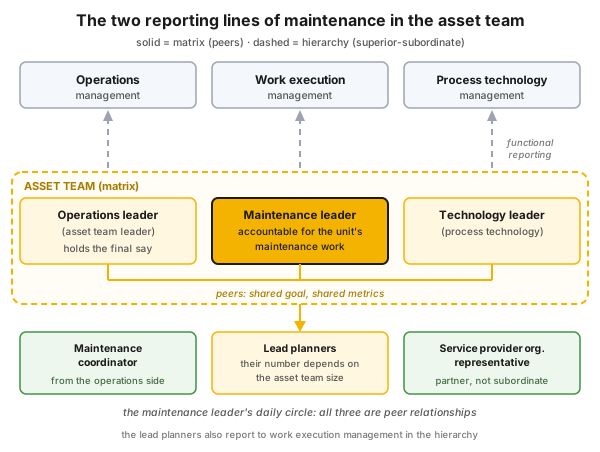 Figure 1 — the two reporting lines of the maintenance leader. In the matrix they are a peer of the operations and technology leaders; in the official organisational structure they report to work execution management; below is the daily collaboration circle, in which every relationship is a partnership.
Who is this for?
Section titled “Who is this for?”This article is for those who work at the boundary of maintenance and operations in the daily running of a plant: maintenance leader · plant manager and asset team leader · maintenance planner · operational maintenance coordinator · shift supervisor · process engineer · reliability engineer · HSE · the work supervisor of a service partner.
Learning objectives
Section titled “Learning objectives”After reading this article you will be able to:
- name who is accountable for the maintenance work in an asset team, and what “single point of contact” means;
- explain the difference between the matrix and the hierarchy for this role, and say which line decides what;
- estimate how many planners are needed for a given asset team, and on what basis;
- recognize which players are partners and not subordinates, and why this difference matters;
- follow the path of a work order from the need to closure.
In brief
Section titled “In brief”- Maintenance’s dedicated representative in the asset team is the asset team maintenance leader, the leader accountable for the unit’s maintenance work.
- They have two lines: in the matrix they are a peer of the operations and technology leaders, while in the official organisational structure their boss is work execution management.
- They are the single point of contact toward the rest of the maintenance organisation, from daily work to complex multi-craft tasks.
- Alongside them, lead planners handle the clear, directly issuable work; their number depends on the size, scope and complexity of the asset team.
- The daily collaboration circle (operational maintenance coordinator, planners, the service provider representative) is a peer relationship, not a superior-subordinate one.
- Their authority is largely informal: it rests on professional experience and standing, not on a right to command.
- The formal connection point between operations and maintenance is the work order.
Why does it matter? (the stakes)
Section titled “Why does it matter? (the stakes)”If maintenance has no single, nameable owner at the plant level, the gap is not signalled by one big failure but by many small frictions. Requests arrive through several channels, everyone asks someone different for priorities, operations and maintenance keep separate lists, and the shutdown windows slip because the isolation is not ready in time. The end of this is not “bad maintenance,” but lost availability: the equipment stands idle while the work waits to be organized.
The other extreme is just as expensive. If the maintenance representative sits in the team but reports only upward, into their own function, and does not treat the asset team’s decisions as their own, then the matrix exists on paper while in practice two mutually watchful silos remain. This is exactly the stake of the model: one asset, one team, shared metrics, as the rope analogy in the asset team concept article also illustrates.
Who represents maintenance in the asset team, and what is their responsibility?
Section titled “Who represents maintenance in the asset team, and what is their responsibility?”Maintenance is represented by the asset team maintenance leader: the leader accountable for the maintenance work carried out in the plants the asset team is responsible for. The role is not a liaison and not a messenger, but a decision-maker who, in their own area, speaks at the asset team table about the scope, sequence and conditions of the maintenance work.
Their responsibility has three layers:
| Layer | What it means in practice |
|---|---|
| Professional responsibility | The quality and craftsmanship of the unit’s maintenance work, from daily tasks to complex multi-craft jobs. |
| Point-of-contact responsibility | They are the single point of contact toward the rest of the maintenance organisation and the service provider; operations does not go directly to the executors. |
| Team responsibility | They are jointly accountable with the other members for the asset team’s shared metrics (availability, reliability, maintenance cost), not only for the performance of their own function. |
This model also reshapes the maintenance organisation itself: for every asset team to have a dedicated maintenance leader, maintenance must be set up along a geographic logic, not purely by craft.
Why two reporting lines?
Section titled “Why two reporting lines?”Because the matrix and the hierarchy answer two different questions: one tells you who you decide with, the other who develops and appraises you. This duality is not a flaw in the model but its essence.
| Question | The matrix (asset team) answer | The hierarchy (functional organisation) answer |
|---|---|---|
| Who are they a peer of? | The operations and technology leaders | The same-level professional leaders |
| Who is their boss? | The asset team has no commanding boss over the members | Work execution management |
| What does this line decide? | The daily operating questions for the given asset | Professional standard, methodology, load balancing, development |
| Where do they report? | The asset team reports the shared metrics to the business team | The maintenance leader to their functional manager |
There is an important exception to the peer status. The operations leader is the asset team’s leader, because the primary owner of the asset is operations, and the legal responsibility also rests with them. In decisions, therefore, they hold the final say. This is not a superior-subordinate relationship, though: the final say serves to close disputed cases, not to direct the daily work.
What does the planner do, and how many are needed?
Section titled “What does the planner do, and how many are needed?”Every asset team has one maintenance leader, and alongside them as many lead planners as the size, scope and complexity of the asset team warrants. The planners carry through the clear, well-defined jobs that the designated maintenance craftspeople can perform directly: static and rotating equipment, instrumentation, electrical, analyzer or civil tasks.
The sizing logic is simple, and it is not a headcount norm but a judgement call:
- Small, homogeneous asset team: alongside the maintenance leader one planner is enough, covering every craft.
- Large or craft-diverse asset team: several dedicated planners, typically split by discipline.
- Complex unit with many pieces of equipment: planner capacity is the bottleneck, because unprepared work stalls in the field.
The planner, too, follows the two-line logic: in the matrix they belong to the maintenance leader, while in the official organisation their boss is likewise work execution management. The professional depth of planning and scheduling is covered by a separate article: maintenance planning and scheduling.
Who do they work with day to day?
Section titled “Who do they work with day to day?”The maintenance leader’s daily collaboration circle consists of three players, and all three relationships are partnerships, not superior-subordinate ones. This is one of the easiest points in the model to get wrong, because the old reflex is that “maintenance serves the plant,” or the reverse.
- Operational maintenance coordinator. From the operations side, they support the maintenance activity: they create the operational conditions for safe and efficient work (shutdown, isolation, permitting, time window). They work with the maintenance leader and the planners in a collaborative way, as a peer.
- Planners. Under the maintenance leader’s professional direction, but with independent responsibility, they carry the jobs assigned to them.
- The service (support) provider organisation’s representative. They are accountable for the actual execution of the maintenance work, and are an integral member of the asset team even if organisationally they are not part of the production organisation. They share the status of work in progress (deadlines, extra work, cost), the parameters of planned work (resources, start and deadline, supplier strategy, preparation difficulties), and the other activities running in their own area.
How is the work connected? The work order
Section titled “How is the work connected? The work order”Between operations and maintenance the work order is the formal connection point: it translates an operational need into executable, schedulable and measurable maintenance work. Without the order the request stays verbal, so it cannot be prioritized, planned or retrieved.
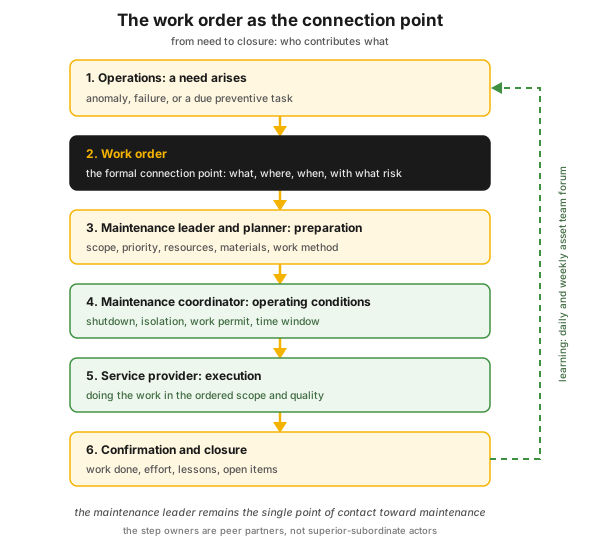 Figure 2 — the path of the work order from the operational need to closure, with feedback at the end to the asset team’s daily and weekly forum. The maintenance leader is the single point of contact toward maintenance throughout.
Every element of the chain has an owner, and this is exactly what makes the work order the shared language of the asset team: operations frames the need, maintenance prepares it, operations creates the conditions, the service provider executes, and the closure leads back to the team’s forums. The systematic depth of managing the work order is covered by the CMMS article.
Where does the role appear in the operating rhythm?
Section titled “Where does the role appear in the operating rhythm?”The maintenance leader is not an occasional player at the asset team’s forums but has a named input at every level. In the rhythm of the management operating system it looks like this:
| Forum | What maintenance contributes |
|---|---|
| Daily asset team meeting | The maintenance leader (or the planner) comments on the past 24 hours’ maintenance events, the open jobs and the daily tasks. |
| Weekly asset team meeting | The maintenance aspects of the weekly plan, new risks and obstacles, the maintenance cost against target, actions to close the gaps. |
| Weekly risk review | The operating risks arising from the maintenance state, the status of recommendations from inspections. |
| Monthly asset team review | The actual-vs-plan comparison of the reliability and maintenance-cost metrics, the status of improvement plans, escalation if needed. |
This rhythm is the real test of the role: if the maintenance leader shows up only at the daily meeting with a report, but not in the weekly planning and the monthly review, then the model is again tamed down into mere information transfer.
Process-industry and safety context
Section titled “Process-industry and safety context”In process-industry plants, often under the Seveso regime, this role is directly a safety matter. Maintenance work almost always means energy isolation, opening, a temporary state, so the work itself is a risk source. The dedicated maintenance leader is important because it is with them that it comes together what is open, what is bypassed, and when the original state is restored.
A few boundaries worth stating explicitly:
- The part of the maintenance work that alters the technical solution cannot be handled with a work order: it falls under management of change (MOC) if we are not doing an identical replacement.
- The work permit and the isolation remain operations’ responsibility; the maintenance leader cannot take these over.
- The technical integrity of the equipment and its associated inspection regime is a separate discipline, not part of the asset team’s daily decision scope.
Introduction in practice
Section titled “Introduction in practice”- Assign a named maintenance leader to every asset team, and make clear which plants they are responsible for.
- Reshape the maintenance organisation along a geographic logic, so that this assignment is actually sustainable.
- Record the two lines in writing: who they are a peer of in the matrix, and who is their functional manager.
- Size the planner capacity based on the asset team’s size, scope and complexity, then name the discipline coverage.
- Close down all parallel request channels: from now on, an operational need enters as a work order.
- Seat the asset team’s maintenance and technology leaders near the operations leader.
- Build the maintenance input into the standing agenda of the daily, weekly and monthly forums.
- Appraise the operation at regular intervals, and fix the gaps you find.
Measurement / audit
Section titled “Measurement / audit”The working of the role is proven not by the org chart but by a few simple, observable signs:
| What we look at | Good sign | Bad sign |
|---|---|---|
| Request channels | Requests essentially all arrive as work orders | Parallel verbal and email channels |
| Point of contact | Operations goes to the maintenance leader | Everyone goes to their own contact in maintenance |
| Forum presence | Named maintenance input at the daily, weekly and monthly forum | Only the daily report |
| Escalation | Rare, and really about matters outside the remit | Frequent, about daily priorities |
| Continuity | The key positions are stable for years | Frequent turnover, lost local knowledge |
It is worth reviewing the effectiveness of the model as a whole at regular intervals, with a small, outside pair of eyes, because the structure is often fine on paper while the practice still deviates from it.
Common mistakes
Section titled “Common mistakes”| Anti-pattern | Why it’s a problem | Good practice |
|---|---|---|
| The maintenance leader becomes a messenger. They only forward the requests to the professional organisation. | The decision at the asset level is lost, every matter escalates. | Be an accountable leader: on scope, sequence and conditions, they speak in the asset team. |
| Several parallel points of contact. Operations goes directly to the executors. | Conflicting priorities, invisible load, slipping time windows. | A single point of contact, every request on a work order. |
| Treating the service provider as a subordinate. | Withholding information and formal contact slow execution down. | A peer relationship, full membership in the asset team. |
| A maintenance leader without a planner. | Unprepared work stalls in the field; the leader drowns in daily fires. | Planner capacity must be sized to the asset team’s size and complexity. |
| Matrix on the org chart, silo in reality. The maintenance leader answers only to their function. | The shared metrics become no one’s, local optimization returns. | Shared goals and shared appraisal for the asset team’s result. |
| Frequent turnover in the key positions. | The local knowledge and the trust capital that informal leadership rests on are lost. | Deliberate continuity: key roles stable for several years. |
When NOT to use this model?
Section titled “When NOT to use this model?”The asset team maintenance role is a strong frame, but not for every situation:
- During a turnaround or a major project a dedicated, own-organisation shutdown management takes over most of the work; the daily asset team logic is too little for this.
- In a very small or simple unit a separate maintenance leader and planner role may be over-organisation; here one role can cover several functions.
- In questions of professional depth (reliability strategy, inspection technology, failure analysis) the decision is not the asset team’s but the discipline’s.
- If leadership role-modeling is missing from the higher level, the matrix stays formal; then the leadership system must be fixed first, not the org chart.
What this article does NOT cover
Section titled “What this article does NOT cover”This article describes the role of maintenance in the asset team: who is accountable, who they are a peer of, who they collaborate with, and where the work connects. The professional depth of maintenance excellence is covered by a separate chapter, Maintenance Excellence:
- preventive maintenance — the logic of preventive and condition-based maintenance strategies.
- maintenance planning and scheduling — the standalone craft of planning and scheduling, the content of the planner’s work.
- CMMS — the systematics of work-order management and the asset register.
- asset condition management — the tools of condition assessment and condition-based decision.
Also outside this article’s scope are the organisation of turnarounds, the details of maintenance cost management, and the commercial side of contractor partnership models.
Take it home (keys)
Section titled “Take it home (keys)”- Name the owner. One asset team, one maintenance leader, with a clear plant remit.
- Know which line decides what. The matrix decides the daily operation, the hierarchy the professional standard and the development.
- Close the need into a single channel. No work order, no priority, no measurement.
- Treat the service provider as a partner. The executor is not a supplier at the end of the corridor, but a member of the team.
- Size the planner capacity. Unprepared work stalls in the field, and that is the most expensive standstill.
- Build continuity. This role stands on informal authority, which only time and presence build.
Self-test
Section titled “Self-test”- In the matrix, who is the asset team maintenance leader a peer of, and who is their boss in the official organisational structure?
- What determines how many planners are needed in an asset team?
- Why is it important that the service provider’s representative be a partner and not a subordinate?
Answer key
- In the matrix they are a peer of the operations leader (who is also the asset team’s leader and holds the final say) and the technology leader. In the official organisational structure their boss is work execution management, which professionally coordinates the work of the maintenance leaders and the planners.
- The size, scope and complexity of the asset team. Every asset team has one maintenance leader, while the number and discipline split of the planners is shaped by the unit’s needs.
- Because they are accountable for the actual execution of the maintenance work, and the team needs real-time, honest information about the work in progress and the planned work (deadlines, extra work, resources, preparation obstacles). In a subordinate role this information arrives filtered and late.
How does it show up in digital practice?
Section titled “How does it show up in digital practice?”The essence of the role is the co-location of information and responsibility, and today this is largely realized in software. The mechanism is different from a wall board, but the principle is the same: one need, one owner, one retrievable trail.
| Element of the role | Digital implementation | Value |
|---|---|---|
| Single point of contact | The work order is a mandatory entry gate, with a named owner | The parallel, invisible request channels disappear |
| Work-order life cycle | A state-managed process from the need to closure, with mandatory fields | The readiness and the bottleneck are visible in real time |
| Planner preparation | Resource, material and work-method data linked to the order | Fewer field standstills due to lack of preparation |
| Operating conditions | Permit and isolation process linked to the work | The work can start only with valid conditions |
| Daily and weekly input | Automatically collected status for the team’s forums | The meeting is spent on deciding, not on collecting data |
| Closure and learning | Recorded effort, experience, open items | The asset history becomes analyzable, not a matter of memory |
Connection to OPEREX (shift log)
Section titled “Connection to OPEREX (shift log)”The maintenance leader’s daily input is exactly the content the shift log exists for: the maintenance events of the past 24 hours, the open jobs, the next day’s time windows and the isolation requests. In the OPEREX shift log these are recorded shift by shift, in one place, and are visible not only to maintenance but also to operations, technology and HSE. This way the daily meeting does not start with collecting what happened, but with deciding what to do.
Terminology (HU / EN / JP)
Section titled “Terminology (HU / EN / JP)”| Hungarian | English | 日本語 (romaji) |
|---|---|---|
| Üzemeltetés (az asset team egésze mint ernyő) | Operations (as the integrated unit) | 操業 (sōgyō) |
| Üzemvitel (a szűk funkció, operátorok) | Operations (function) | 運転 (unten) |
| Eszköz-csapat | Asset team | — |
| Asset team karbantartási vezetője | Asset team maintenance leader | — |
| Munkavégrehajtás vezetése | Work execution management | — |
| Tervező | Lead planner | 計画者 (keikakusha) |
| Üzemviteli karbantartási koordinátor | Operational maintenance coordinator | — |
| Kiszolgáló (támogató) szervezet | Maintenance service provider organisation | — |
| Munkamegrendelés | Work order | 作業指示 (sagyō shiji) |
| Mátrixszervezet | Matrix organisation | — |
| Egyenrangú fél | Peer | — |
| Működtetési ritmus | Operating rhythm | — |
Who represents maintenance in the asset team?
The asset team maintenance leader, the leader accountable for the maintenance work carried out in the plants the asset team is responsible for. They are also the single point of contact toward the rest of the maintenance organisation, from daily work to complex multi-craft tasks.
Who is the asset team maintenance leader subordinate to?
They have two lines. In the matrix they are a peer of the operations and technology leaders, so there is no commanding relationship over them. In the official organisational structure their boss is work execution management, which professionally coordinates the work of the maintenance leaders and the planners.
How many planners are needed in an asset team?
There is one maintenance leader per asset team, while the number of lead planners depends on the size, scope and complexity of the asset team. The planners carry the clear, directly issuable work, split by discipline (static, rotating, instrumentation, electrical, analyzer, civil).
What is the role of the work order between operations and maintenance?
The work order is the formal connection point: it translates an operational need into executable, schedulable and measurable maintenance work. Without it the request stays verbal, so it cannot be prioritized or retrieved.
Is the service provider part of the asset team?
Yes. The representative of the service (support) provider organisation accountable for executing the maintenance work is an integral member of the asset team even if organisationally they are not part of the production organisation. They are a partner, not a subordinate, and regularly share the status of the work in progress and the planned work.
Related concepts
Section titled “Related concepts”the asset team concept | operational excellence | management operating system | OGSM | performance dialogue | KPI cascade | shift handover | operator-maintainer | autonomous maintenance | production reliability program | management of change (MOC) | maintenance planning and scheduling | CMMS | preventive maintenance | asset condition management
Next step
Section titled “Next step”- the asset team concept — if you haven’t read it yet, start here: what the asset team is, and why alignment is what decides.
- management operating system — the operating rhythm, in which the maintenance input appears at the daily, weekly and monthly level.
- maintenance planning and scheduling — the maintenance professional depth starts here, if after the role you also want the content.
References / further reading
Section titled “References / further reading”- ISO 55000 / 55001 — the asset management standard family: the framework for responsibilities, roles and asset-life-cycle decisions (see asset management (ISO 55000)).
- ISO 45001 — the occupational health and safety management standard: the requirements for documented control of work and traceability.
- Seveso III Directive (2012/18/EU) — the European framework for the safety management system of major-accident-hazard establishments, including the expectation of a clear recording of the organisation and the responsibilities.