Standardized work (Standard Work)
≈ 19 min read · 3,870 words
Imagine three shifts starting up the same equipment in three different ways — and no one can tell you which is the right method. One operator does it this way, another that way, the third the way they once learned it. If you wanted to improve the process now, what would you measure the improvement against? This problem is exactly what standardized work (in English standard work or standardised work) solves: it records the currently known best way, so there is a common starting point to measure against and to improve. Let’s look at what it is, what it consists of, and how you introduce it.
Standardized work is the clear, visual record of the currently known best, safest and most efficient way of carrying out an activity. It is the common base that everyone follows the same way until we develop something better — at a given moment the “benchmark,” not an eternal rule. Its main goal is to reduce variability: we can only measure and improve what is stable and uniform. It is not the performance ceiling but the starting point of continuous improvement: at the end of the PDCA we always record the new, better process as a standard, then improve further from there.
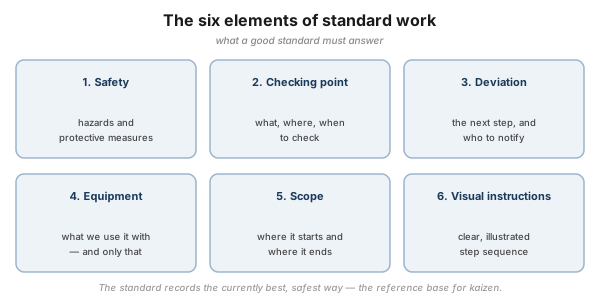 Figure 1 — the six elements of standard work that a good standard must answer.
Who is this for?
Section titled “Who is this for?”This article is for those who deal in practice with unifying how work is done: operator · shift supervisor · production and plant manager · process engineer · technologist · maintenance technician · Lean/CI specialist · team leader leading the training · HSE.
Learning objectives
Section titled “Learning objectives”After reading this article you will be able to:
- explain why you can only improve on a stable, uniform process, and what the standard gives you;
- list the six elements of standardized work, and write a standard for a concrete task from them;
- distinguish the standard’s training role from its development role (the Level 0–4 knowledge levels);
- place the standard in the PDCA cycle as the “locking wedge”;
- draw the boundary: when the standard is NOT the right answer (emergency, design flaw).
In brief
Section titled “In brief”- Standardized work is the uniform, visual record of the currently best way of an activity — at a given moment the “benchmark,” not an eternal rule.
- Its main goal is to reduce variability: we know where we stand, we can compare the state with the previous one, and there is something to measure improvement against.
- Its six typical elements: safety, checking points, what to do in case of deviation, equipment to use, the scope of the activity, and clear, visual instructions.
- The standard is the base of continuous improvement: at the end of PDCA we always record the new, better process as a standard, then improve further from there.
- Process-industry application: unified shift-handover information transfer, unified inspection routes, visual operating instructions.
- It is not “rate-setting” and not stopwatching — a few minutes’ variation is not the point; the point is to eliminate needless and dangerous variability.
Why does it matter? (the stakes)
Section titled “Why does it matter? (the stakes)”If there is no common standard, a single small thing is missing — the reference base — but because of it a whole chain reaction starts. As long as three shifts work three different ways, there is nothing to measure improvement against, the deviation stays hidden, and the most critical knowledge sticks to individual people. And information lost at the shift handover can lead directly to a fault in a continuously operating plant.
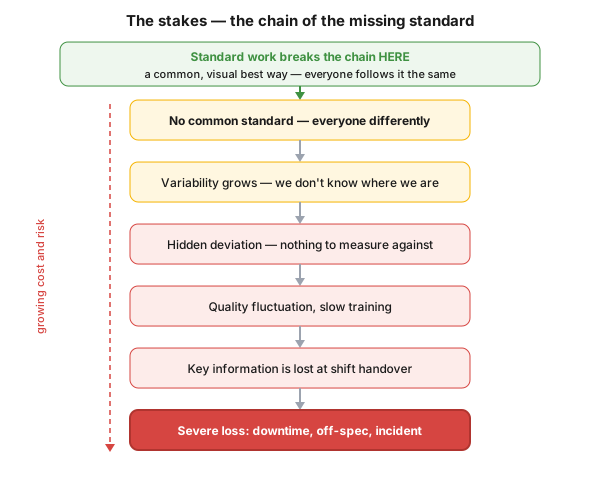 Figure 2 — the escalation of the missing standard: the longer we leave it, the more expensive and riskier it gets. Standardized work breaks it at the very start of the chain — by recording the common, visual best way.
What is standardized work, and where does it come from?
Section titled “What is standardized work, and where does it come from?”Standardized work is a lean principle originating from the Toyota Production System (TPS), starting from the realization that you can only improve on a stable process. If the same task is done three ways by three shifts, there is no common starting point: we don’t know which method is good, we can’t measure improvement, and every deviation stays hidden.
Four simple reasons show why it is needed:
- It reduces variability — eliminating the needless, risky variation in the process.
- We know where we are — there is a reference state.
- We can improve and compare with the previous state.
- It provides a base for future improvements.
An important clarification: standardized work does not mean working faster or doing more, but differently and different things — we drop the needless, non-value-adding activities, and do the necessary ones in a paced way with a uniform mindset. The standard is not forced on people “from above”: the essence of the method is that the working methods of the different shifts and operators are collected, compared, the best practice is selected or developed, and then everyone follows it. The solutions come from those who know the work best.
Standardized work forms part of the foundation of the Lean Operating System “temple,” alongside 5S. Without stable, repeatable processes the elements above it (flow, just-in-time, jidoka, problem solving) do not work reliably either.
What makes a good standard? — the six elements
Section titled “What makes a good standard? — the six elements”A standard usable in practice must answer six questions (see Figure 1). Together they make the standard both a training aid and a safety tool at once:
- Safety — what hazards and protective measures relate to the task; what to wear/avoid. In a process-industry plant this is always the first element.
- Checking point(s) — what, where and when to check during the activity (parameter, state, signal).
- What to do in case of deviation? — if the process leaves the normal range, what the next step is and who must be notified. This links the standard to deviation management and the Andon logic.
- Equipment to use — with what tool, instrument or aid we perform the task (and only with that).
- The scope — exactly where the activity starts and ends, what the standard applies to.
- Clear, visual instructions — the step sequence is unambiguous, preferably in pictorial/diagrammatic form, so it can be followed at a glance without a wall of text.
What is the standard’s training role and what is its development role?
Section titled “What is the standard’s training role and what is its development role?”The standard is a dual tool: at once a training reference and a development starting point. This duality is made measurable by the Level 0–4 five-level scale of the skill matrix, which measures how well a given skill / task / work instruction (SOP) has been mastered:
| Level | What the operator can do | Role |
|---|---|---|
| Level 0 | does not know the SOP; has not yet started the task, does not possess the technical skill | before training |
| Level 1 | knows the SOP, but can only do the task with senior help / support | training |
| Level 2 | applies the process well, and recognizes deviations without help | independent work |
| Level 3 | able to identify the root cause of deviations, solve them, update the SOP, and can train the team | deviation management + trainer |
| Level 4 | substantively improves the standard / the methods | standard developer |
Level 0–2 is the domain of training (against what someone is “ready”), while Level 3–4 is the deviation-handling, training and standard-improving level. This shows that the standard is not the end of development but its starting point.
How does the standard connect to PDCA?
Section titled “How does the standard connect to PDCA?”The standard is embedded in the cycle of continuous improvement (Kaizen, PDCA) — the last step of the cycle is exactly recording the new standard. The full chain:
- Defining goals, area, team and the tracking KPI.
- Documenting the current state.
- Defining the future state and improvement idea(s) (TIP).
- Carrying out the improvement, introducing the ideas.
- Measuring the improved process with the defined KPI and analyzing it.
- On a fault → root-cause analysis.
- Documenting the new process as a standard, then restarting the PDCA cycle.
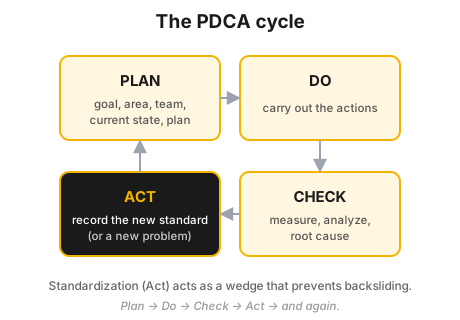 Figure 3 — the PDCA cycle; the closing Act step records the new, better process as a standard, and the next round starts from here.
That is, the standard is not an obstacle to change but the “locking wedge”: we solidify every improvement as a standard so we do not slide back, and the next round starts from here.
Process-industry context + safety
Section titled “Process-industry context + safety”Standardized work in the process industry is not an option but a condition — precisely because of safety. In the first months of a lean program at a process-industry plant, typically the ideas built around standardized work bring the first tangible results:
- Unified shift-handover information transfer — standardizing the exchange of information between shifts, so that a fault does not occur due to the loss of important information. This is the most safety-critical standard in a continuously operating plant.
- Unified inspection routes — optimizing and unifying the “plant walk” route, so that time is not wasted on random route choice, and no important piece of equipment is left out of the inspection.
- Visual operating instructions — easy-to-understand, visual descriptions and diagrams for the proper and safe operation of machines and equipment.
- Structured training and rotation — where operators previously knew only a part of the main technological areas, there standardized training and in-plant rotation can broaden their knowledge, increasing flexibility.
At a continuously operating technological unit, unified start-up/shutdown, sampling and inspection directly reduce the risk arising from human error. The standard’s “what to do in case of deviation?” element connects directly to upset management and the hazop / moc logic.
How do you introduce a standard? (roadmap)
Section titled “How do you introduce a standard? (roadmap)”The introduction of standardized work rests on PDCA and on observation. A practical, step-by-step route — each step a concrete action:
- Designate a pilot area and team. Choose a well-bounded task/area (e.g. a specific plant walk, a sampling, a product changeover). The team should consist of those who do the work (operators, team leader) — not external “experts” prescribing it.
- Observe and collect the current state (San Gen Shugi: Gemba, real data, real object). Go out to the site, observe how the different shifts and operators do the task. Talk with them: what they do, why, and why that way. Determine the approximate time requirement of the activity (not a strict norm, but you need to know roughly how long it takes, for scheduling).
- Select or develop the best practice. Compare the methods, and select (or combine) the safest and most efficient one.
- Write the standard along the six elements. Record: safety, checking points, what to do in case of deviation, equipment, scope, visual step sequence. Make it visual (photos, diagrams, colors, markings) — do not let it be a wall of text.
- Train and roll out. Train everyone on the standard; use the Level 0–4 levels of the skill matrix to track progress (Level 0–2 is training, Level 3–4 is deviation handling and standard improvement).
- Extend and sustain. Extend the standard to similar tasks/areas, build it into performance management and the audit system, and connect it with 5S: a tidy, standardized workplace is a precondition for standardized work.
Hands-on / workshop
Section titled “Hands-on / workshop”In practice, standardized work is easiest to learn through a simple workshop (“Let’s do it!”), where the participants themselves create the standard for a concrete task along the six elements. The logic is the same as the roadmap above, in miniature:
- Choose a simple task known to everyone (typically a plant activity, e.g. cleaning a piece of equipment, an inspection).
- Fill in the six elements: what the scope is, what safety rule, what equipment, which checking points, what to do on deviation, and draw/photograph the steps.
- The 3S (Shine) cleaning plan is exactly such a standard: daily / weekly / monthly / yearly cleaning tasks arranged in a table, who, what, when — with the required equipment listed (e.g. broom, dustpan, cloth) and fields to be filled in by the person doing the task. This is the meeting point of standardized work and 5S.
Homework. Choose a task that recurs in your own area, observe it with at least two operators, and write the standard for it along the six elements. Mark where the methods differ from each other, and justify which you chose as the “best practice.”
Measurement / audit — how do you sustain the standard?
Section titled “Measurement / audit — how do you sustain the standard?”Standardized work is hard to “measure with a number” on its own, but its effect and its sustainment can be well audited. The handholds:
| What we measure | Logic | Target direction | |
|---|---|---|---|
| Compliance with the standard | regular review of the Work Instructions, a “gap” analysis against the procedures, uncovering deviations (abnormalities) | scheduled re-evaluation; a decreasing number of deviations | |
| Knowledge level (skill matrix) | the goal of training is for operators to move up the Level 0–4 scale | Level 2 is independent work; Level 3–4 the developer level | |
| Variability | reducing the spread where it is measurable (e.g. cycle time, lead time) | narrowing variation (not necessarily a lower mean) | |
| Connection to OEE | root-cause-based, standardized operation leads to higher [[oee.en | OEE]], productivity and a more motivated team | improving Availability / Performance |
The established color convention of performance boards makes the result readable at a glance: blue = target, green = the actual data reached the target, red = did not reach it. The result of a standard audit can also be displayed in this form and built into performance appraisal. The essence of a good standard audit is exactly this: at a glance you can see whether the standard is being followed.
When NOT to use it? (limits of the method)
Section titled “When NOT to use it? (limits of the method)”Standardized work is strong but not the answer to every situation. Knowing where it ends is just as important as the method itself:
| Situation | Why (primarily) not the standard | The right answer | ||
|---|---|---|---|---|
| Emergency, disaster, upset | the standard is for normal, routine operation | safe intervention according to the given situation; recording the lesson afterwards | ||
| The process is actually bad or wasteful | standardizing a wasteful process solidifies the waste | first improve the process ([[kaizen.en | kaizen]], [[vsm.en | VSM]]), then record it as a standard |
| One-off, non-recurring activity | there is nothing to durably “build in” for a single case | a one-off work instruction / briefing, not a full standard | ||
| The work requires real engineering judgment, decision step by step | a rigid step sequence hinders the needed flexibility | a framework and principle-level guide + a competent expert, not a strict step standard |
Rule of thumb: standardized work is strongest for recurring, stabilizable, routine activities. First let the process be good, only then record it — and the emergency is always overridden by safety, not by the standard.
Common mistakes
Section titled “Common mistakes”The pitfalls of the standard almost all stem from the same thing: the standard is treated either as coercion or as an eternal rule. In anti-pattern ↔ correction pairs:
- Misunderstanding “norm time” and stopwatching. The standard is not made to time the worker with a stopwatch; a few minutes’ deviation has no significance. Instead: the goal is to eliminate needless and risky variation, not a speed chase.
- A standard forced from above. If the best practice is not shaped by those who do the work, the standard will not be followed. Instead: the standard must be born from observing the Gemba and involving the operators.
- A wall of text instead of visuals. A long, text instruction does not get read. Instead: give a clear, visual instruction — with a diagram, a photo, color.
- A missing “what to do on deviation” element. If the standard describes only the normal course, it leaves you alone at the most critical moment. Instead: always write down what to do and whom to notify on deviation (point 3 of the six elements).
- A frozen standard. The standard is the best way at a given moment, not an eternal rule. Instead: scheduled review and Kaizen — the last step of PDCA (recording the new standard) must not be left out.
- A standard without 5S. In a messy, non-standardized workplace the standard cannot be held (“they don’t have 20 minutes to find the right tool”). Instead: first 5S, then the standard — a tidy workplace is the precondition of the standard.
Key takeaways
Section titled “Key takeaways”- Stabilize first, then improve — improvement can only be measured against a common, uniform process.
- The standard is the currently best way, not an eternal rule — it is refreshed at the end of PDCA, and the next round starts from there.
- Six elements make a standard usable: safety, checking point, what to do on deviation, equipment, scope, visual instruction.
- Visually, not as a wall of text — the standard must be followable at a glance and the deviation noticeable immediately.
- Those who do the work write it, don’t force it from outside — the best practice comes from the Gemba.
- The emergency overrides the standard — the rule of the normal routine is not a shackle in a disaster.
Self-check
Section titled “Self-check”- Why is it true that “you can only improve on a stable process”? What does the standard give that three different working methods cannot?
- List the six elements of standardized work. Which one connects the standard to deviation management, and why is that the most critical?
- On the Level 0–4 scale of the skill matrix, where does “training” end and “development” begin? From which level can someone work independently, without help?
How does this show up in digital practice?
Section titled “How does this show up in digital practice?”The principle of standardized work does not end at the paper-based instruction: the same logic is realized in software too, in any well-designed digital workflow. Instead of the printed step sequence, here a digital template, an enforced order and mandatory fields ensure that everyone follows the same best way — the mechanism differs, the principle is the same.
| Standard principle | Digital implementation | What it delivers |
|---|---|---|
| Recording the best way | a digital template / workflow that prescribes the correct course | ad-hoc, person-by-person execution disappears |
| Visual instruction | a pictorial/diagrammatic step sequence on screen, with check questions | a process followable at a glance, faster to train |
| Checking points | mandatory, acknowledgeable fields at the critical steps | not a single check is left out |
| What to do on deviation | built-in escalation: on deviation a mandatory action + notification | the deviation gets on the agenda immediately, at its place |
| Unified shift handover | a structured, fixed-field digital handover | important information is not lost at the change |
| Review (PDCA) | a versioned standard, with a dated update | the standard does not freeze — you can see when it was updated |
Connection to OPEREX (shift log)
Section titled “Connection to OPEREX (shift log)”A real connection. One of the most safety-critical elements of standardized work in a process-industry plant is the unification of shift-handover information transfer — typically this is one of the first introduced proposals, so that a fault does not occur due to the loss of important information. The OPEREX shift log digitizes exactly this standardized, structured, non-skippable handover: fixed fields, mandatory points, a retrievable history — that is, the handover itself becomes standardized work, rather than an ad-hoc, from-memory briefing.
Terminology (HU / EN / JP)
Section titled “Terminology (HU / EN / JP)”| Hungarian | English | Note |
|---|---|---|
| Standardizált munka | Standard(ised) Work | Recording the currently best method |
| Szabványos munkautasítás | SOP (Standard Operating Procedure) / Work Instruction | The written form of the standard |
| Ciklusidő | Cycle time | The time of one cycle of the task |
| Eltérés / abnormalitás | Deviation / abnormality | Deviation from the standard |
| Vizuális menedzsment | Visual management | Immediate recognition of the standard and any deviation |
| Gemba | Gemba (現場) | The real place where the work happens |
| San Gen Shugi | San Gen Shugi (三現主義) | Real place, real data, real object |
| Kaizen | Kaizen (改善) | Continuous, small-step improvement |
What is standardized work in one sentence?
The clear, visual record of the currently known best, safest and most efficient way of carrying out an activity, which everyone follows the same way until a better one is developed — and which is the starting point of continuous improvement.
Why is it needed if it "was fine this way" until now?
Because you can only improve on a stable, uniform process. The standard reduces variability, shows where we stand, allows comparison with the previous state, and provides a base for every future improvement. With different, by-hand practices there is nothing to measure improvement against.
What should a good standard contain?
Six elements: safety, checking point(s), what to do in case of deviation, equipment to use, the scope of the activity, and clear, visual instructions.
Does it mean you have to work faster, and get timed with a stopwatch?
No. Standardized work does not mean faster or more work, but work done differently: we drop the needless, non-value-adding steps. A few minutes’ deviation has no significance; there is no stopwatching.
Can the standard be overridden in an emergency?
Yes. The standard applies to normal, routine operation. In an upset, plant shutdown or disaster, one must deviate from the scheduled activities and do the work needed in the given situation.
What is the difference between standardized work and the SOP?
Standardized work is the lean principle — the uniform, visual record of the currently best way and its continuous improvement. The SOP (standard operating procedure / work instruction) is one concrete, written manifestation of it. The standard is thus broader: it also includes training, visuality and continuous refreshing via PDCA.
Related concepts
Section titled “Related concepts”5s | kaizen | pdca | visual management | skill-matrix | san-gen-shugi | jidoka | oee | lean-operating-system | smed
Next step
Section titled “Next step”If you have understood this, from here it is worth going on — in this order:
- 5s — the standard’s “twin” in the foundation of the Lean temple: a tidy, standardized workplace is the precondition of standardized work. Start with this.
- pdca — the cycle whose closing step is recording the new standard; here you see how the standard becomes the engine of continuous improvement.
- jidoka — the “don’t pass the defect on” principle, for which the standard provides the reference base: a deviation can only be measured against a standard.
References / further reading
Section titled “References / further reading”- Taiichi Ohno: Toyota Production System: Beyond Large-Scale Production. Productivity Press, 1988. — standardized work as the base of continuous improvement in the TPS.
- “Where there is no standard, there can be no kaizen.” — in the lean canon a formulation attributed to Masaaki Imai (Kaizen, 1986), often also cited to Ohno, on the relationship between standardized work and continuous improvement.
- Masaaki Imai: Kaizen: The Key to Japan’s Competitive Success. McGraw-Hill, 1986. — the linking of standardization and continuous, small-step improvement.
- Mike Rother – John Shook: Learning to See. Lean Enterprise Institute, 1999. — observing and recording the current state as the starting point of improvement.