Support functions in the asset team
≈ 22 min read · 4,391 words
Half past seven in the morning, the daily meeting on the unit. The three chairs everyone knows are taken: the head of operations, the maintenance leader and the technologist. On the fourth chair, though, sits someone who on paper does not even belong to the production organization: the company or unit that actually does the work on the equipment. They tell you where the pump repair stands, how much extra work came out after opening it up, and whether the end-of-week tie-in will slip. If this chair is empty, the team talks about its own asset without knowing what is happening on it.
Beyond the asset team core (operations, maintenance, technology), service and support organizations also take part in the team’s work. The representative of the service provider responsible for maintenance work execution belongs neither to the core nor to the production organization, yet is an integral member of the asset team: they share and comment on the status of the work in progress and the planned work. Depending on the topic, the team also invites experts on an ad hoc basis (HSE and process safety expert, production and energy controller, business excellence expert, inspection), and by local need additional daily positions may form under the team leader (training, HSE/process safety, project and energy coordinators). The same principle applies to all of them: the support functions serve production as the internal customer.
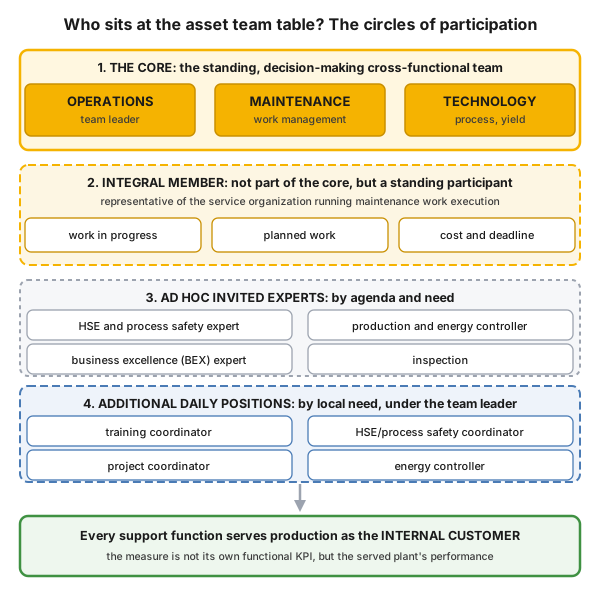 Figure 1 — the circles of participation. The decision-making core, the service organization representative present as an integral member, the experts invited by the agenda, and the additional daily positions created by local need, all of whom serve production as the internal customer.
Who is this for?
Section titled “Who is this for?”For those who lead a daily or weekly asset team forum, take part in one, or serve the unit from the support side: plant manager · shift supervisor · maintenance leader and work supervisor · technologist · work supervisor of the contracted service provider · process safety and HSE specialist · training lead · project engineer · energy and production controller · business excellence (BEX) expert · inspection specialist.
Learning objectives
Section titled “Learning objectives”After this article you will be able to:
- distinguish the asset team core, the integral member, the ad hoc invited experts and the additional daily positions;
- state what the work-execution representative must bring to the forum;
- decide which support roles should appear as a standing position and which topic by topic, on invitation;
- apply the internal customer principle to measuring the support functions.
In brief
Section titled “In brief”- The asset team core is three functions (operations, maintenance, technology), but the team is broader than that.
- The representative of the service provider organization responsible for maintenance work execution is an integral member of the team, even if organizationally they sit outside production.
- Their role is not reporting but participation: they share and comment on the status of the work so the team can decide together.
- On an ad hoc basis, following the agenda, invited experts complete the team: HSE and process safety expert, production and energy controller, business excellence (BEX) expert, inspection.
- Separate from this is the circle of additional daily positions (training, HSE/process safety, project and energy coordinators): these arise by local culture and need under the team leader, sometimes as a standalone position, sometimes as the task of an existing coordinator.
- The guiding principle: the support function is an internal service, production is the internal customer, and the yardstick is the performance of the served unit.
- The degree of participation follows the agenda, not the organizational chart.
Why it matters — what do you risk by leaving them out?
Section titled “Why it matters — what do you risk by leaving them out?”If the team narrows to the core alone, its decisions are built on an incomplete picture. The typical chain is well known: the unit decides when the equipment goes down, but the capacity and material supply of the organization doing the work are not on the table. Because of this the shutdown begins without the work being ready to start, the equipment sits idle, the extra work that emerges after opening up finds no one prepared, the deadline slips, and in the end the unit pays as lost production for what a ten-minute morning sentence could have prevented.
The same is true for the other support areas. Without a training lead, the competency gap only surfaces once someone has already made a mistake. Without a process safety specialist, the team makes a risk decision without risk expertise. Without controlling, the energy cost shows up only months later, in the report, when there is nothing left to do.
Who takes part in the asset team’s work beyond the core?
Section titled “Who takes part in the asset team’s work beyond the core?”Beyond the core (operations, maintenance, technology), two further circles take part: the representative of the service provider organization responsible for maintenance work execution as a standing, integral member, and the experts invited by the agenda: the representatives of HSE and process safety, production and energy controlling, business excellence (BEX) and inspection.
A fourth category must be separated from this, the additional daily positions. These are not invited guests but standing daily roles working under the team leader, which arise by the culture and need of the local site: training coordinator, HSE/process safety coordinator, project coordinator, energy controller.
The mode of participation differs by circle, and that difference is deliberate:
- The core is present every time, and the decision stays with it.
- The integral member sits at every forum where the topic of work execution comes up, so in practice at every daily and weekly occasion. Not a guest, but part of the table.
- The invited experts come when the agenda has a point requiring their expertise. If it does not, written input is enough.
- The additional daily positions, where they exist, are part of the daily operation, not ad hoc. Where no standalone position is created, the task lands on an existing coordinator.
The detailed role of the three asset team branches is described in separate articles: operations, maintenance and technology. And who appears when and at which forum is set by the operating rhythm.
What is the difference between the core, the integral member and the invited expert?
Section titled “What is the difference between the core, the integral member and the invited expert?”The circles do not mean a ranking, but a distinction by the mode of participation.
| Circle | Who belongs here | Participation | Decision weight |
|---|---|---|---|
| Core | operations (team leader), maintenance, technology | standing, at every forum | full right, joint decision |
| Integral member | representative of the service provider organization responsible for maintenance work execution | standing, on work-execution topics | opinion and commitment within their own scope |
| Invited expert | HSE and process safety, production and energy controller, business excellence (BEX), inspection | ad hoc, by agenda and need | expert input to the team’s decision |
| Additional daily position | training, HSE/process safety, project and energy coordinators | standing daily role where local need creates it | part of the daily operation, under the team leader |
The point of the distinction is that the team stays capable of deciding. If everyone always sits there, the forum swells into a conference and the decision slows down. But if only the core sits there, the decision becomes information-poor. The right answer is participation fitted to the agenda.
The same one level up: the business team
Section titled “The same one level up: the business team”The same logic repeats at the level above the asset teams, in the business team, which is the parent forum of the asset teams. Its standing composition is the site production manager and the discipline leaders: operations, maintenance, technology, production and energy management, process safety management, business excellence.
Two patterns repeat literally:
- The representative of the service provider organization is an integral member here too, despite standing outside the production organization. What is true at the asset team table for daily work execution is true at the parent level for the service relationship as a whole.
- The representatives of the further organizations (HSE, HR, quality control, controlling) can be invited here too on an ad hoc basis, by the need arising in the given area.
The lesson is independent of organizational level: at both levels the standing, decision-making core is complemented by the integral presence of the provider actually doing the work, and by expert invitation fitted to the need. The escalation and reporting path between the two levels is described by the operating rhythm.
Why is the work-execution representative an integral member?
Section titled “Why is the work-execution representative an integral member?”Because doing the maintenance work and managing the maintenance work are not the same thing. As a core member, the asset team’s maintenance leader is responsible for the what and the when, while the service provider organization stands on the how and the with-what side: the people, the trades, the supply chain and the actual execution are in their scope.
 Figure 2 — the representative does not report, but takes part. The status of the work in progress and the planned work is an input to the team’s joint decision.
What they bring to the forum:
- Work in progress: deadlines, completion, the extra work emerging after opening up and its cost impact.
- Planned work: resource, start time and deadline, supplier strategy, planned cost, and the most valuable of all, the obstacles of the preparation phase.
- Other activities on the provider’s side that affect the unit’s plans.
Beyond sharing, the commenting is at least as important: the representative not only puts data on the table but also gives an opinion on what can and cannot be delivered. This is what turns the daily forum from a status report into a decision-making event.
What additional daily positions appear?
Section titled “What additional daily positions appear?”Alongside the core and the integral member, further roles support the asset team’s daily operation. These are not standalone positions in every organization: the culture and need of the local site decides whether a separate person fills them, or they land among the tasks of an existing coordinator.
| Support area | What it gives the asset team | Typical solution |
|---|---|---|
| Safety engineering, process safety | risk assessment, incident and near miss investigation, bringing the process safety viewpoint into the daily decision | often the task of the general operative coordinator |
| Training, competency development | the training plan of the daily members and the shift crew, tracking the competency gap | standalone training coordinator or a shared role |
| Projects | channeling the smaller investments and improvements into the daily operation | standalone project coordinator where local need justifies it |
| Energy controlling | energy efficiency, the deviation of plan from actual | typically the technology coordinator also handles the energy efficiency activity, elsewhere a separate controller position |
The two combinations that can be called typical, then, are that the general operative coordinator also handles the HSE and process safety tasks, and the technology coordinator the energy efficiency activity. Placing the other roles is a local decision.
The principle is the same for all of them: the support role does not supervise the team but serves it.
What does it mean that the support functions serve production as the internal customer?
Section titled “What does it mean that the support functions serve production as the internal customer?”It means that the success of the support function is measured not by the volume of its own activity, but by whether the served unit works better because of it. The value is created in the unit; the support function contributes to it.
This view changes two concrete things:
- The yardstick. The question is not how many audits or how many work orders the support area closed, but whether the unit got to a decision, a permit, a spare part, or knowledge faster.
- The tone. The support function’s question is not “do you comply with my rule,” but “what do you need in order to produce safely and reliably.”
This is the internal customer logic, which Lean management infrastructure describes in detail as functional support (see functional support).
Process-industry and safety context
Section titled “Process-industry and safety context”In the process industry, involving the support circles is not a matter of organizational convenience but a process safety question: the work of a team organizationally on the outside but working on the plant equipment takes place in the same hazardous process environment where production runs. Whoever does the work must know the plant’s current state, and vice versa: the plant must know who is working on its equipment and with what.
Three practical consequences follow from this:
- The daily forum is also a joint refresh of the risk picture. Listing the work in progress also shows where there is open equipment, where there is a temporary state, and where several are working side by side at once. The interaction of simultaneous work is one of the classic sources of risk in the process industry.
- Extra work brings risk too, not just cost. The deviation emerging after opening up shifts not only the deadline and the cost: it often changes the nature of the work too, so the permitting and risk-assessment loop must be re-run on it (see operational risk assessment).
- The daily consensus does not replace the formal procedure. If the work touches the design basis, the equipment or the parameter limits, the change goes through change management (see management of change), and hazard identification happens in the professional process (see HAZOP), not at the morning meeting.
That is why the process safety support role carries a different weight even within the invited circle than the others: risk assessment, incident and near miss investigation (see near miss) is not an optional agenda color, but the very expertise without which the team would make a risk decision with no risk expertise.
What this article does NOT cover
Section titled “What this article does NOT cover”This article writes in broad strokes: its topic is what role a given function has in the asset team, not the depth of that discipline. You will not find contractual models, maintenance-planning methodology, risk-analysis technique or controlling methodology in it.
- Functional support as a system (silos, internal customer, the three improving behaviors) is elaborated here as the fifth element of management infrastructure: functional support.
- The concept, structure and leadership of the asset team (the core, the team leader, alignment and the performance dialogue) is here: operations of the asset team.
- For the disciplinary depth, see the articles of the relevant chapters, for example HAZOP, management of change, wrench time, shift handover.
Introduction in practice
Section titled “Introduction in practice”- Go through the daily forum’s agenda and mark which points need knowledge beyond the core.
- Seat the maintenance work-execution representative in a standing place, don’t invite them as a guest.
- Record what they bring with them: work in progress, planned work, extra work, preparation obstacles.
- Separate the two categories: assign the invited expert to the agenda, but create the additional daily position by local need or make it the task of an existing coordinator.
- Close every agenda point with an action: owner and deadline, even if the owner belongs to another organization.
- Measure the service from the internal customer’s viewpoint, and ask the unit regularly what the support could help with.
Measurement and audit
Section titled “Measurement and audit”| Question | What to look at |
|---|---|
| Is the work-execution representative there? | attendance rate at the daily and weekly forum |
| Do they really take part? | how many decisions their input was the triggering factor for |
| Do they speak up in time? | the average lead time of announcing preparation obstacles |
| Are the actions alive? | the closing rate of actions assigned to an owner in another organization |
| Is there an internal-customer view? | the unit’s feedback on the support functions’ service |
Common mistakes: anti-pattern and correction
Section titled “Common mistakes: anti-pattern and correction”- The representative only reports. Why it’s a problem: the forum degrades into a status report. Instead: ask about the risk and the feasibility, and ask for an opinion, not just a percentage.
- “Not our person, they shouldn’t see everything.” Why it’s a problem: whoever does not see the picture cannot support a good decision. Instead: share the information needed for work execution with them in full.
- Everyone sits at every forum. Why it’s a problem: the decision slows down, participation becomes formal. Instead: participation fitted to the agenda, a separate risk circle.
- The support function drives its own KPI. Why it’s a problem: the function “performs well” while the unit stands still. Instead: the yardstick is the performance of the served unit.
- Every support role is treated as “invited.” Why it’s a problem: coordinating training or projects is a daily task, not an occasional expert opinion. If it only comes up when it is put on the agenda, it becomes ownerless. Instead: decide role by role whether it should be a standing daily position (even as the task of an existing coordinator), or truly an ad hoc invitation.
- The action owner is always in the core. Why it’s a problem: the task reaching across the organizational boundary stays ownerless. Instead: the owner can be on the provider’s side too, only let it be named.
When NOT to use it (don’t force it)
Section titled “When NOT to use it (don’t force it)”- If there is no real agenda connection. Inviting a support role for its own sake causes forum bloat. In that case written input is enough.
- If the decision belongs solely to the discipline. Reviewing a certified safety function or a risk analysis is not the genre of the daily forum; there the professional process is the right path (see management of change, HAZOP).
- If the participation blurs the responsibility. The final responsibility and “last word” of the head of operations remain even if many sit at the table. The support is not co-decision.
- In a very small organization, where the roles fall on one or two people, the formal circle-based model can be needless bureaucracy; a conscious invitation rule is enough.
Take it home (keys)
Section titled “Take it home (keys)”- Beyond the core there are three further circles: the integral member, the ad hoc invited expert and the additional daily position. Separate them consciously, because the mode of participation is different for each.
- The work-execution representative has a standing place at the table, regardless of their organizational affiliation.
- The goal is not the reporting but the sharing and commenting that leads to a joint decision.
- The support roles take shape by local need, sometimes as a standalone position, sometimes attached to an existing task.
- The yardstick of the support function is the performance of the internal customer, not its own activity.
Self-test
Section titled “Self-test”- How does the integral member differ from the ad hoc invited expert in the asset team, and why is this distinction important?
- List three things the work-execution representative must bring to the daily or weekly forum.
- Is the training coordinator and the project coordinator an invited expert or an additional daily position? What decides it?
- A support function proudly reports that it completed every audit it undertook, while the unit has been waiting on a spare part for weeks. What does the internal customer principle say about this?
Answer key
Section titled “Answer key”- The integral member (the service provider organization’s representative) is a standing participant who also makes commitments within their own scope; the invited expert is ad hoc, giving expert input assigned to the agenda. The distinction matters because this keeps the forum at once capable of deciding and well informed.
- Any three: the status and deadline of the work in progress, the extra work emerging after opening up and its cost impact, the resource and time need of the planned work, the supplier strategy, and the obstacles of the preparation phase.
- Additional daily position. These are not guests invited by the agenda but standing daily roles working under the team leader, which arise by the culture and need of the local site. Where there is no standalone person for them, the task lands with an existing coordinator.
- That the support function is not qualified by its own activity. The value is created in the unit, so the yardstick is the performance of the served unit, not the number of closed audits.
Applied exercise
Section titled “Applied exercise”Take out the last week’s agenda of your own daily forum. Next to each agenda point write a letter for whose knowledge it needed: C (core), I (integral member), E (invited expert), D (additional daily position). Then look at who was actually present. Where E or D appears but no one represented it, either a decision was made with incomplete information, or the point did not even belong there. In a single sentence, decide which of the two it is.
How does it appear in digital practice?
Section titled “How does it appear in digital practice?”Cross-boundary cooperation fails in the paper world because the information is spoken and leaves no trace. The same principle can be enforced and documented in software.
| Element | Digital implementation | Value |
|---|---|---|
| The status of work execution | jointly seen work-order status, completion and deadline | everyone sees the same picture at the forum |
| Extra work and cost impact | a deviation entry attached to the work order | the surprise does not surface on the month-end invoice |
| Preparation obstacle | an obstacle flag with an owner, before the work starts | early escalation, less wasted downtime |
| Request toward a support function | a timestamped request, owner, deadline | the handover across the organizational boundary is measurable |
| Forum action | a logged decision and action, regardless of whose organization is responsible | closing rate, audit trail |
Connection to OPEREX (shift log)
Section titled “Connection to OPEREX (shift log)”In the OPEREX shift log the output of the daily forum is recorded: the remark made on the status of work execution, the extra work, the obstacle and the action triggered from it, with owner and deadline. Because the log is built around the unit and not around the organizational units, the request opened toward the service organization shows up in the same thread as the operations and technology entries, so cooperation across the organizational boundary becomes retrievable.
Terminology (HU / EN / JP)
Section titled “Terminology (HU / EN / JP)”| Hungarian | English | Japanese (romaji) |
|---|---|---|
| Üzemeltetés (az ernyő, az asset team egésze) | Operations (as an integrated unit) | 操業 (sōgyō) |
| Üzemvitel (a szűk funkció, az operátorok) | Operations (function) | 運転 (unten) |
| Eszköz-csapat | Asset team | — |
| Üzleti csapat (az asset teamek felettes fóruma) | Business team | — |
| Üzleti kiválóság | Business Excellence (BEX) | — |
| Ellenőrzés (berendezés-állapot) | Inspection | 検査 (kensa) |
| Kiszolgáló (szolgáltató) szervezet | Service provider organisation | — |
| Karbantartási munkavégrehajtás | Maintenance work execution | 保全実行 (hozen jikkō) |
| Támogató funkció | Support function | — |
| Belső vevő | Internal customer | 内部顧客 (naibu kokyaku) |
| Pótmunka | Extra work | — |
| Kompetenciafejlesztés | Competency development | — |
| Eszkaláció | Escalation | — |
Who takes part in the asset team's work beyond the core?
The representative of the service provider organization responsible for maintenance work execution as a standing, integral member, and experts invited on an ad hoc basis by the agenda and need: HSE and process safety expert, production and energy controller, business excellence (BEX) expert and the inspection representative. Separate from this is the circle of additional daily positions (training, HSE/process safety, project and energy coordinators), which arise by local need as standing roles under the team leader.
Why is someone who does not belong to the production organization a member of the asset team?
Because they are the one who actually does the maintenance work. The asset team is responsible for the asset’s performance, and for this it must know the real status, obstacles and cost impact of the work. Organizational affiliation is secondary; the knowledge needed for the decision is what decides.
What is the difference between the asset team's maintenance leader and the service organization's representative?
The maintenance leader in the core is responsible for the what and the when; they are the single connection point toward the maintenance organization. The service organization’s representative stands on the how and the with-what side: resource, trades, supply chain, execution.
What does it mean that the support functions serve an internal customer?
That the value is created in production, and the support function contributes to it. That is why the support function is not qualified by its own activity, but by whether the served unit can work faster and more safely because of it.
Is every support role a standalone position?
No. In many organizations these land among the tasks of an existing coordinator: typically the general operative coordinator also handles the HSE and process safety tasks, and the technology coordinator the energy efficiency activity. The solution is decided by the need and culture of the local site.
Does the same structure apply at the level above the asset team too?
Yes. In the business team the service provider organization’s representative is an integral member too, though standing outside the production organization, and the representatives of further organizations (HSE, HR, quality control, controlling) can be invited here as well on an ad hoc basis, by the need arising in the given area.
Related concepts
Section titled “Related concepts”operations (the asset team) | operations branch | maintenance branch | technology branch | operating rhythm | functional support | operational excellence | MOS | performance management | shift handover | operator-maintainer | wrench time | the production reliability program | operational risk assessment | near miss | management of change | HAZOP
Next step
Section titled “Next step”- operations of the asset team — first understand the asset team concept and the core; this article builds on it.
- operating rhythm — then the daily, weekly and monthly forum order that sets who sits at the table when.
- functional support — finally the system-level elaboration of functional support (silos, internal customer, improving behaviors).
References / further reading
Section titled “References / further reading”- ISO 55000 / ISO 55001 — the asset management standard family: the framework of asset-centered, cross-functional responsibility and the involvement of stakeholders.
- CCPS (Center for Chemical Process Safety): Guidelines for Risk Based Process Safety — the risk-based process safety framework, which treats the handling of contractual partners (contractor management) and the safe management of work as a standalone element.
- ISO 45001 — occupational health and safety management system, including the requirements for involving external service providers and the supply chain.
- ISO 9001 — the generally cited, public frame of the process approach and the internal customer / internal service logic.