CMMS (maintenance management system)
≈ 15 min read · 3,036 words
The fitter is standing next to the pump, but the sheet of paper does not say which seal goes into it, who approved the job, or when it was last replaced. In a well-used system these three questions never even come up, because everything is organized around the work order. Let’s look at what a CMMS is, why the work order is at its centre, and what the three phases are that make an implementation succeed.
A CMMS (computerized maintenance management system) is software that organizes and records maintenance work around its core: the work order (WO).
It also keeps the preventive maintenance schedules and master data, the materials and spare parts, the job plans and the asset history. Its success does not depend on the software but on carrying three phases through properly: selection, implementation, use. Many companies reach only ~50% utilization, which prevents the full return on the investment.
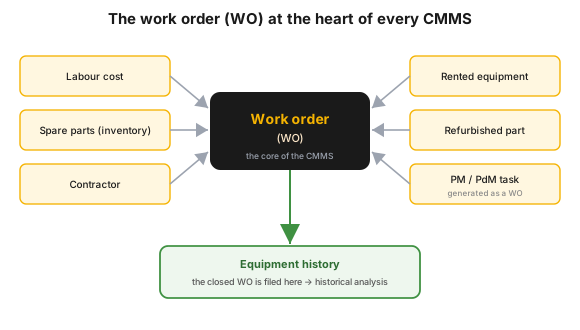 Figure 1 — the work order is the core of the CMMS, the module data flow inward, and the closed WO goes into the equipment history.
Who is this for?
Section titled “Who is this for?”This article is for those responsible for recording, planning and the data quality of maintenance work: maintenance manager and planner · reliability engineer · plant manager · shift supervisor · stores and purchasing staff · HSE specialist.
Learning objectives
Section titled “Learning objectives”After completing this module you will be able to:
- define the CMMS and name the basic elements of its master data
- follow the life cycle of the work order from the work request to technical and financial closing
- list the four goals of the implementation and the three phases of the project
- recognize the three lessons on which most CMMS projects fail
In brief
Section titled “In brief”- The core of the CMMS is the work order (WO): it is raised against a piece of equipment or a location (building, floor, room).
- After closing, the WO goes into the equipment history, so it stays available for historical analysis.
- The module data flow to the WO (labour, spare part, contractor, rental), and the PM/PdM tasks are also generated as WOs.
- Four goals: enforcing the processes · easier documentation · better documentation (reports) · integration with other corporate systems.
- Three phases: selection → implementation → use; the implementation starts with the master data, which can take several man-years of work.
- Three lessons: do not drop the training; involve the users already at selection; secure the resources for continuous use.
What is a CMMS, and why is the work order at its centre?
Section titled “What is a CMMS, and why is the work order at its centre?”The work order is normally raised against a piece of equipment, or against a building, floor or room within a facility. When it is finished, it is filed in the history of that equipment or location, so it stays available for historical analysis.
As the planning, scheduling and execution of the work order proceed (see maintenance planning and scheduling), the other modules of the CMMS send data to the WO: the labour cost, the spare parts used, the contractors, the rented equipment, the refurbished parts and every other cost. Even the preventive and predictive tasks are generated as WOs, and after execution they go into the appropriate history file.
The CMMS is the Work Execution Management (WEM) element of the Uptime Elements framework, one of its five knowledge domains (REM, ACM, WEM, LER, AM).
The life cycle of the work order
Section titled “The life cycle of the work order”The work order is not a data sheet but an end-to-end process, whose purpose is to maintain the condition of the equipment at the minimum life-cycle cost, together with knowledge capture and cost control at the deepest possible asset level.
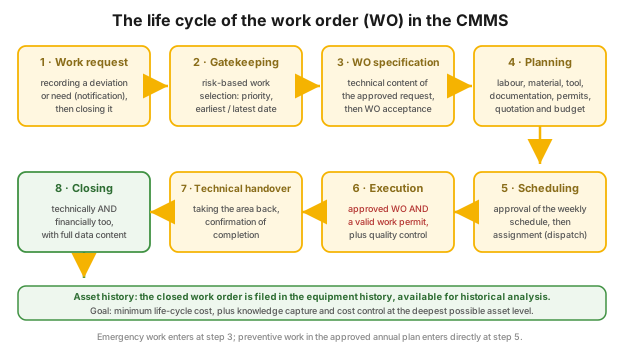 Figure 2 — the path of the work order from the work request to the double closing.
- Recording the work request on the basis of a deviation or a smaller modification need, then completing and closing the notification.
- Gatekeeping with risk-based work selection: the organization approves or rejects the request, and assigns a priority, an earliest start and a latest finish.
- WO specification and acceptance: the approved request becomes technical content, which is taken over before planning.
- Planning: labour, material, tools, documentation and permits, with a quotation and its acceptance.
- Scheduling and assignment: weekly schedule, approval, dispatching.
- Execution with quality control, followed by technical handover and confirmation of completion.
- Closing from both a technical and a financial standpoint, with the full data content.
The double closing is not a formality: work orders that are technically closed but financially open do not add up to the real asset cost.
Why does an organization introduce a CMMS?
Section titled “Why does an organization introduce a CMMS?”For four reasons: to enforce its maintenance processes, to make documentation easier and better, and to connect the maintenance data with the rest of the corporate systems.
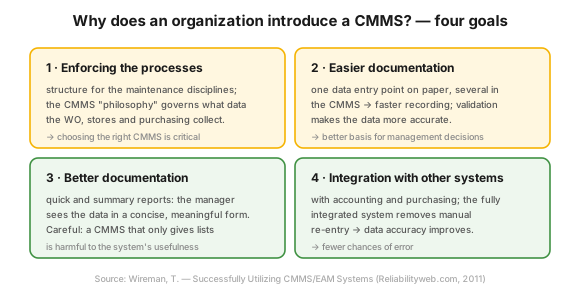 Figure 3 — the four main reasons an organization selects, implements and uses a CMMS.
- Enforcing the maintenance processes. The CMMS gives structure for enforcing the maintenance disciplines. Every CMMS (whether purchased or developed in house) has its own philosophy about how maintenance should work; this governs what information the work order, the stores, purchasing and reporting collect. Hence the “chicken or egg” question: do you first need a good paper-based system, or does computerization itself provide the guidance? If the CMMS is selected first and used for the processes needed for success, that saves considerable time and money.
- Easier documentation. A paper-based system typically has one data entry point, a CMMS has several, so recording is faster. Because the system validates the entered data, they are more accurate and more complete, which gives better information for management decisions.
- Better documentation. The CMMS produces quick and summary reports, so the manager sees the data in a concise, meaningful form against a trend. Reporting capability differs from CMMS to CMMS: some give only a list, which is harmful to the usefulness of the system.
- Integration with other corporate systems. The data of a standalone CMMS have to be carried over to other systems (accounting, purchasing) by hand. A fully integrated system eliminates this and improves data accuracy, because there is no scope for manual data-manipulation error.
The three phases of a CMMS project
Section titled “The three phases of a CMMS project”A CMMS project consists of three phases, and all three have to be carried through: selection decides what you get, implementation decides whether it works, and use decides whether it still works two years later.
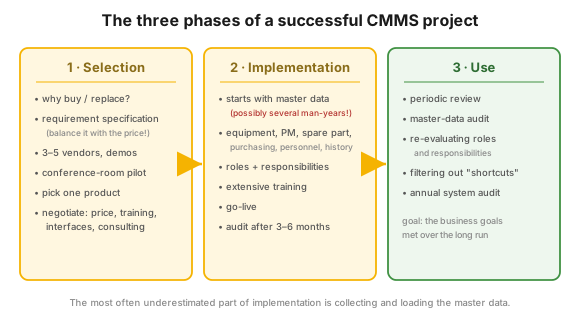 Figure 4 — the three phases of every successful CMMS project.
1 · Selection
Section titled “1 · Selection”First you have to understand clearly why the organization is selecting (or replacing) a CMMS: perhaps the manual system is overloaded, or the existing CMMS does not meet the requirements. You have to identify what the system must do: this needs a detailed description of the maintenance processes, a list of the processes that are wanted but not performed today, a list of the desired system characteristics, and a third list of the desirable but not mandatory functions. These make up the requirement specification, which has to be balanced against the price, because the more extensive the specification, the more expensive the system.
The finished specification is sent out to the vendors. If at least 3–5 vendors respond positively, the demonstrations and product evaluations can follow, and even a conference-room pilot on a limited database. After the right product has been selected, negotiation follows on price, training, the necessary interfaces and consulting.
2 · Implementation
Section titled “2 · Implementation”Implementation always starts with the master data, all of which are needed together for the CMMS to work correctly: equipment number, functional location (asset hierarchy), PM inspections, spare part data, bill of materials (BOM), purchasing and personnel data, existing asset history. Most parts used on an asset must appear on a bill of materials, and must be identifiable on the individual work orders. It sounds simple, but a company may have thousands of pieces of equipment, thousands of PM inspections and many thousands of spare parts, which makes this the most frequently underestimated area: collecting and loading the master data can be literally several man-years of effort.
After the data load, the system is rolled out to the organization, and the role and responsibility of every user is defined (at minimum the planners, supervisors and technicians; and the clerical support, if there is any). Everyone has to understand the effect of their own role on data accuracy, and this requires extensive training. The system then goes live, and a review checks whether the data were entered correctly and everyone has been trained. After 3–6 months the use has to be audited against the business goals; the gaps typically gather around data accuracy, and in that case the roles and responsibilities need to be reviewed. If the use is correct, annual reviews maintain the level.
3 · Use
Section titled “3 · Use”Use has to be reviewed periodically, to check that the original goals are still being met. This means an audit of the master data and of the actual use. Since the system has not changed since implementation, if there is a problem it is typically because someone is using it incorrectly: over time many organizations look for shortcuts in recording. In that case the organizational roles and responsibilities have to be examined again.
Three lessons from earlier CMMS projects
Section titled “Three lessons from earlier CMMS projects”The experience of earlier projects concentrates on three areas, and all three are human, not technical, questions.
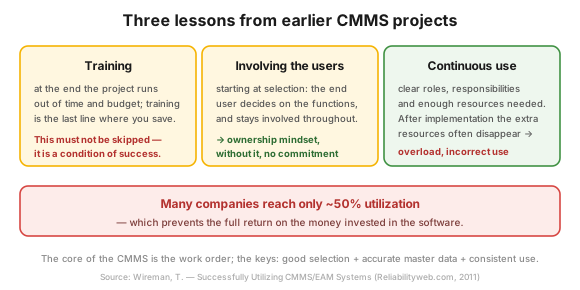 Figure 5 — the three most important lessons, and the utilization warning.
- Training. A CMMS implementation, like every project, runs out of time and budget towards the end, and training is the last line where money can still be “saved”. The multi-day training is shortened to hours or dropped, which prevents optimal use. Training the end users is an unavoidable condition of success, and it is not a one-off event: it has to be run again at organizational transitions.
- Involving the users. This starts already at selection: the end users have to be asked when it is being decided what functions the system must perform, and they have to be kept involved throughout. This is how the ownership mindset develops that makes the project a success; without it there is no commitment.
- Continuous use. Correct, lasting use is determined by well-chosen roles, responsibilities and sufficient resources. Often the extra resources brought in for the implementation disappear afterwards, the remaining employees become overloaded, and this leads to incorrect use.
Warning: many companies reach only ~50% utilization with their CMMS, which prevents the full return on the money invested in the software.
Common mistakes
Section titled “Common mistakes”- Building a paper-based system first, before selecting the CMMS: if the right system is chosen from the outset, this is a waste of time.
- An oversized requirement specification: it drives up the price, and has to be balanced.
- Underestimating the master data: the load takes several man-years, and without it the CMMS does not deliver the results.
- Dropping the training at the end of the project: the most common and most expensive mistake.
When NOT to use it? (the limits of the method)
Section titled “When NOT to use it? (the limits of the method)”The CMMS is a tool, not a strategy. It misses the target wherever an organization expects the software to supply the discipline it lacks.
- Do not expect it to replace the roles. If it is not clear who has to use it, how and when, the master data are damaged, and no real value comes out of the information you get.
- Do not treat it as an automatic basis for analysis. Used badly, the CMMS is merely a heap of unconnected information that has to be picked through by hand; ideally the work history should be structured by failure mode (asset condition management).
- Do not let the system become the obstacle in an emergency. Immediate intervention skips the front end of the WO process, and the notification is recorded afterwards; this is an exception, not a practice.
- Do not buy without business requirements. In the absence of a specification, the selection imposes the vendor’s philosophy on the organization.
Industrial and safety context
Section titled “Industrial and safety context”The CMMS is industry-independent; the system is often also sold under the name EAM (Enterprise Asset Management), with a broader asset management scope. In the process industry the work order carries the safety layer alongside the maintenance work: the HSE risks and the special rules have to be recorded at WO level already, and then when the work permit is prepared.
Accurate asset history is what allows the reliability strategy and the criticality analysis to work on a data basis, and makes it possible to run a root cause analysis or a regulatory audit.
Introduction in practice
Section titled “Introduction in practice”This is how you would implement it tomorrow, if you were handed the task today:
- Write down the business requirements in a half-day workshop with the planners, supervisors and technicians: what we do today, what we would like to do, what is a mandatory function and what is only a wish.
- Balance the specification against the price before you send it out; every extra line costs money.
- Ask for at least 3–5 quotations, watch demos, and run a conference-room pilot on a limited database.
- Plan man-years for the master data (equipment, functional location, PM, spare part, BOM, asset history).
- Assign the roles (planner, supervisor, technician, stores), and train by role, not with a uniform curriculum.
- Audit the use 3–6 months after go-live, and annually after that; the faults typically gather around data accuracy.
- Measure utilization, and set a target value for it.
Take it home (keys)
Section titled “Take it home (keys)”- The key element of any CMMS is the work order. If the WO is weak, all the other data will be weak too.
- The key to selecting the system is defining the business requirements properly, not the length of the function list.
- The key to implementation is training by job role. Nobody learns their own responsibility from a uniform curriculum.
- The key to full utilization is accurate master data and consistent use, according to the defined business tasks.
- Training is not a one-off event: it has to be run again at organizational transitions.
Connection to OPEREX (shift log)
Section titled “Connection to OPEREX (shift log)”The CMMS is the system of record for the work order; the OPEREX shift log is the operational layer where the actual shift event (the PM round completed, the abnormality observed, the “schedule-breaking” reactive work) is captured with low friction and confirmed. Reducing the friction of recording, alongside training and clarified roles, improves the quality of the data flowing on toward the WO history.
Terminology (HU / EN)
Section titled “Terminology (HU / EN)”| Hungarian | English (canonical) | Note |
|---|---|---|
| Számítógépes karbantartás-irányítási rendszer | Computerized Maintenance Management System (CMMS) | an element of the framework |
| Eszközgazdálkodás | Enterprise Asset Management (EAM) | a near-synonymous name, with a broader scope |
| Megrendelés | Work order (WO) | the core of the CMMS |
| Törzsadat | Master data | the basis of correct operation |
| Funkcionális hely | Functional location | the reference point of the asset hierarchy |
| Anyagjegyzék | Bill of materials (BOM) | the part reference of the WO |
| Kihasználtság | Utilization | often only half of what is possible |
| Tárgyalótermi pilot | Conference-room pilot | a trial run |
The terminology follows the usage of Uptime Elements and Wireman.
What is a CMMS?
A software system that computerizes most of the maintenance processes: recording and keeping work orders, PM schedules and master data, materials and spare parts, job plans and asset history data. Its core is the work order.
Why is the work order at the centre of the CMMS?
Because all the data are built around the WO: the labour, inventory, contractor and other modules send their data to the WO, the PM and PdM tasks are generated as WOs, and the closed WO goes into the equipment’s history, which is what makes it suitable for historical analysis.
When can a work order be regarded as closed?
When it has been closed from both a technical and a financial standpoint, and all the correct information has been entered into the system. Work orders that are closed only technically do not add up to the real asset cost.
Why do many companies reach only \~50% utilization?
Typically because of skipped end-user training, unclear roles and responsibilities, and the resources missing for continuous use. Without these the master data are damaged, and the system does not deliver the return.
Self-test
Section titled “Self-test”Self-check questions
- What is the difference between a technically closed work order and a genuinely closed one?
- On an urgent repair requiring immediate intervention, the WO is not created. What is the correct procedure?
- Why is buying the CMMS not enough for a reliability analysis to be made from the work history?
Answer key: 1) A genuinely closed WO is closed both technically and financially, with the full data content; without this there is no real asset cost. · 2) The work may be carried out, but the notification has to be recorded in the system afterwards, and the scope is limited to dealing with the emergency. · 3) Because used badly the CMMS is a heap of unconnected data; the analysis needs accurate master data and a work history structured by failure mode.
Applied task
- Pick ten work orders closed last month, and check on each of them: is there a functional location, is there a part reference, and was it also closed financially?
Related concepts
Section titled “Related concepts”maintenance planning and scheduling | preventive maintenance | operator-driven reliability | reliability strategy | criticality analysis | root cause analysis | reliability KPIs | asset condition management | asset management (ISO 55000)
References / further reading
Section titled “References / further reading”- Terry Wireman: Successfully Utilizing CMMS/EAM Systems. Maintenance Strategy Series 4. Reliabilityweb.com, 2011.
- Uptime Elements reliability framework, © NetexpressUSA Inc. d/b/a Reliabilityweb.com: the “computerized maintenance management system” element in the Work Execution Management (WEM) knowledge domain.
- ISO 55000 (asset management), ISO 31000 (risk management) and API 691: the modern CMMS gives the holistic picture of asset condition in line with these standards (asset management (ISO 55000)).
- Process industry maintenance work order policy, 2022 (anonymized extract): the end-to-end process of the work order, risk-based work selection and the work permit gate.