Poka-yoke — mistake-proofing
≈ 18 min read · 3,671 words
Imagine trying to plug in a USB connector — the wrong way round it simply won’t go. The microwave won’t start with the door open, you can’t pull the ignition key out of a car in D, the fuel-pump nozzle shuts off by itself when the tank is full. These are all examples of the same lean principle: poka-yoke, in English mistake-proofing. The meaning of poka-yoke is simple: we shape the process or the product so that the error cannot be made at all — or if it does happen, it surfaces immediately, before it turns into trouble. Let’s look at what it is, why it works, and where it is used.
Poka-yoke (mistake-proofing) is a simple, often physical solution that makes the error impossible from the outset, or catches it immediately before it becomes scrap. In Japanese ポカヨケ, “avoiding inadvertent mistakes”; its core idea is that an error consists of two parts — first the mistake happens, and only then does it turn into scrap or an accident — and poka-yoke wedges itself precisely between the two. Its aim is built-in quality: instead of relying on human attention, it shapes the process so that the incorrect action is not even possible, or cannot move on. Poka-yoke is the tool-level implementation of jidoka (“don’t pass the defect on”).
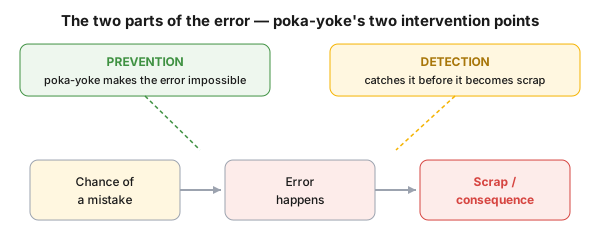 Figure 1 — the two parts of the error and the two intervention points of poka-yoke: prevention (the error does not happen at all) and detection (the error surfaces before it becomes scrap).
Who is this for?
Section titled “Who is this for?”This article is for those who deal with mistake prevention in practice: operator · production and plant manager · process engineer · quality engineer · maintenance technician · Lean/CI specialist · product designer.
Learning objectives
Section titled “Learning objectives”After reading this article you will be able to:
- explain what the “two parts” of an error are, and where poka-yoke fits in;
- distinguish the preventive and the detective, as well as the control and the warning poka-yoke, and justify which is stronger;
- recognize the three classic sensing methods (contact / fixed-value / motion-step);
- devise a cheap, simple poka-yoke for one concrete work step;
- draw the boundary: when poka-yoke is NOT enough in a process plant (a certified safety system is needed).
The essence
Section titled “The essence”- Poka-yoke = mistake-proofing: it shapes the process so that the error is not even possible, or surfaces immediately.
- An error consists of two parts: the mistake happens → then (if we do not intervene) it turns into scrap/an accident. Poka-yoke wedges itself between the two.
- Two timings: prevention (the error does not happen at all — the best) and detection (the error surfaces before it moves on).
- Two regulating functions: control (stops / rules out — strong) and warning (signals — weaker, because it requires a human reaction).
- A good poka-yoke is cheap and simple — not expensive automation, but a pin, a hole, a template, a metered part count or an enforced sequence.
- It does not blame the worker: it fixes the system, does not shame the person (this is why the earlier “baka-yoke” name became, out of respect, “poka-yoke”).
- It is the tool-level implementation of jidoka’s “don’t pass the defect on” principle; it complements, does not replace root-cause analysis (5 Whys).
Everyday poka-yoke examples (you have definitely met them)
Section titled “Everyday poka-yoke examples (you have definitely met them)”Poka-yoke is not an abstract factory concept — you use it day in, day out, you just don’t call it that:
| Everyday example | What mistake it prevents | Type |
|---|---|---|
| USB-A connector | plugging in the wrong way round | preventive · contact (shape) |
| The cut corner of a SIM and SD card | inserting in the wrong orientation | preventive · contact |
Car: the ignition key won’t come out in D |
driving off with the gear unlocked | control |
| Microwave won’t start with the door open | radiation with the door open | preventive · control |
| Automatic shut-off of the fuel-pump nozzle | overfilling, spillage | detective · control |
| Child-proof medicine cap (push + twist) | a child opening it | preventive · motion-step |
| The shape of an earthed plug / socket | a reversed or wrong connection | preventive · contact |
| The separately bagged screws of flat-pack furniture | wrong screw in the wrong place | preventive · fixed-value |
What they all share: they do not leave correct use to your attention, but make the error difficult or impossible from the outset. This is exactly what we bring into industry too.
Why does it matter? (the stakes)
Section titled “Why does it matter? (the stakes)”A tiny mistake born of a moment’s inattention is cheap in itself — the trouble is the chain reaction it sets off if nothing stops it. The same uncaught error is still pennies at the operation level, but at the customer or in an incident it is orders of magnitude more expensive and dangerous.
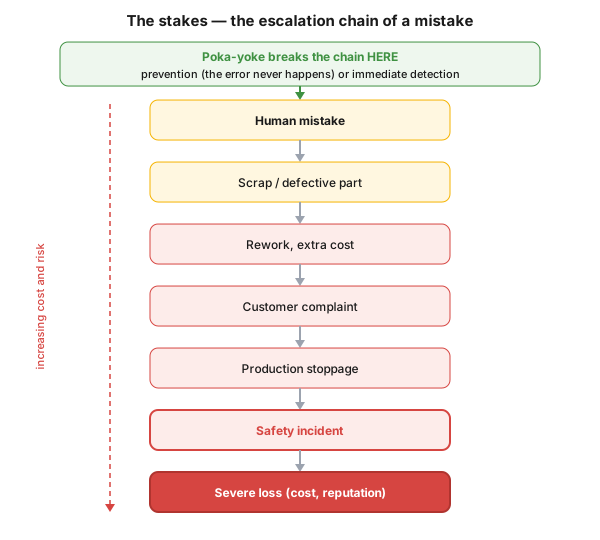 Figure 2 — the escalation of a mistake: the further down the chain you catch it, the more expensive and risky it is. Poka-yoke breaks it at the very start of the chain — at prevention or at immediate detection.
The lesson is simple: the cheapest error is the one that never happened. That is why it pays to invest attention at the start of the chain — in prevention — rather than repairing expensively at the end.
What is poka-yoke, and where does it come from?
Section titled “What is poka-yoke, and where does it come from?”Poka-yoke is one of the oldest and most easily understood pieces of the Lean quality toolkit. The method was developed and documented by Shigeo Shingo in the Toyota environment; its classic description is in his work Zero Quality Control: Source Inspection and the Poka-Yoke System (by the same author who also systematized SMED). The name was originally baka-yoke (“fool-proofing”), but because that sounds insulting to the worker, it was changed to poka-yoke: poka is the inadvertent mistake made from inattention, and yoke is avoidance. The shift of emphasis matters: the worker is not at fault, it is the system that allows the error — poka-yoke fixes the system.
One of the method’s greatest virtues is that it does not change the course of the work or the product — it simply reduces the chance of the error to something far smaller. Moreover, it is so simple that with a few minutes of theory and a few examples anyone understands it; this is why it is often the first improvement skill front-line teams are given.
Poka-yoke is the tool-level relative of jidoka: jidoka is the principle that the defect must be recognized and stopped where it arises; poka-yoke is the concrete solution that ensures this, built into the machine or the workplace, without human vigilance. The Lean quality philosophy puts source inspection first: it is the cause of the error that must be checked, not its result — and poka-yoke is exactly what makes this possible at the operation level.
How does poka-yoke work?
Section titled “How does poka-yoke work?”Poka-yoke wedges itself between the two parts of the error — the mistake and the scrap or accident it produces: it either prevents the mistake from the outset, or detects it immediately before it moves on. It can be characterized on two axes — when it intervenes (prevention vs. detection) and with what force (control vs. warning) — plus three classic sensing methods determine how it “catches” the error.
The two parts of the error — prevention vs. detection
Section titled “The two parts of the error — prevention vs. detection”The founding insight of poka-yoke is that an error consists of two parts: first the mistake happens (e.g. the operator would insert a part the wrong way round), and only after that, if nothing stops it, does it turn into scrap or an accident. Poka-yoke intervenes between these two events, in two timings (see Figure 1):
- Prevention: the mistake cannot even happen — the part that cannot be inserted the wrong way round, the connector that fits only one way. This is the strongest: there is nothing to get wrong.
- Detection: the mistake happens, but the system catches it immediately, before it moves on — the scale stops the line if a part is missing.
The ranking is clear: where you can, prevent; where you can’t, detect immediately. The weakest — but often still necessary — solution is mere after-the-fact inspection.
Two regulating functions: control vs. warning
Section titled “Two regulating functions: control vs. warning”Poka-yoke can also be of two kinds according to the strength of the intervention:
| Function | What it does | Strength | Example |
|---|---|---|---|
| Control | physically prevents or stops the process | strong — leaves no choice | a connector that cannot be plugged in the wrong way; the machine won’t start until every part is in place |
| Warning | signals (light, sound), but does not stop | weaker — requires a human reaction | a light/sound flashes on a deviation; a confirming click at correct fastening |
The control solution is stronger because it does not rely on human attention — a person’s attention is finite and tires. The warning is justified when the process cannot or must not be stopped automatically.
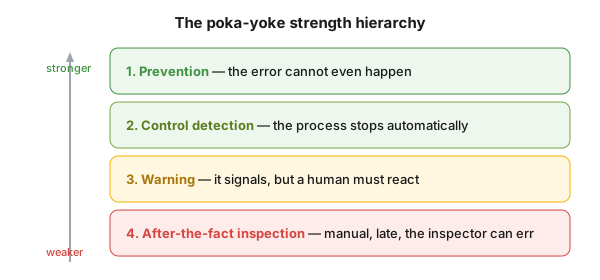 Figure 3 — the strength hierarchy of poka-yoke: always strive toward the strongest feasible level.
Three classic sensing methods
Section titled “Three classic sensing methods”Poka-yoke devices “catch” the error on three kinds of principle (Shingo’s established classification):
| Method | Its principle | Example |
|---|---|---|
| Contact | sensing physical shape, size, presence | a pin/hole/template that fits only correctly; a limit switch |
| Fixed-value | checking the correct count/quantity | a pre-metered set of screws: if any are left over, a step was missed |
| Motion-step | checking that the correct sequence/movement happened | the next step is allowed only after the previous one is done |
The four ways of practical implementation
Section titled “The four ways of practical implementation”Four recurring poka-yoke practices cover most situations:
| # | Practice | Essence |
|---|---|---|
| 1 | Physical separation | physically rule out the possibility of the mistake (e.g. different, non-interchangeable connectors) |
| 2 | Visual signals | make the correct state and the deviation visible at a glance |
| 3 | Pattern recognition | let the deviation appear as a conspicuous pattern (e.g. in an orderly layout the place of a missing part gapes empty) |
| 4 | Simple physical devices and small changes | cheap, small modifications that rule out or catch the error |
How is poka-yoke different from a checklist, an SOP or training?
Section titled “How is poka-yoke different from a checklist, an SOP or training?”All are useful tools, but their mechanism differs. The common weak point — human attention — is missing only from poka-yoke:
| Tool | What it builds on | Its strength | Its weakness vs. poka-yoke |
|---|---|---|---|
| Poka-yoke | makes the error impossible / catches it immediately | does not depend on human attention | — |
| Checklist | reminds of the steps | cheap, quick to introduce | can be ticked off without actual execution |
| SOP / work instruction | describes the correct method | standardizes, trains | protects only if read and followed |
| Training | gives knowledge and skill | builds competence | attention tires, skill fades |
| Inspection | screens out the error afterwards | catches the scrap | expensive, late, and the inspector can err too |
So poka-yoke does not replace the others, but takes the weakest link — human attention — out of the equation. The best system combines them, but the critical error is ruled out by poka-yoke.
Process-industry context + safety
Section titled “Process-industry context + safety”Poka-yoke originates in discrete manufacturing, but in process industries — precisely because of safety — it is at least as strong a tool:
- Enforced, unique connectors (keying). Hose ends and couplings of different sizes/shapes physically prevent the wrong chemical from being connected to the wrong line or tank — this is the classic, safety-critical application of physical separation (preventing cross-contamination and reaction hazards).
- Enforced sequence in the permit to work (PTW). The steps of the permit to work and of the start-up/shutdown procedure can be acknowledged in an enforced sequence — a motion-step poka-yoke: the next step opens only after the previous one is confirmed.
- Fixed-value for accounting for interlocks and blinds. A pre-recorded list and count-back of the number of interlocks bypassed and blinds (blinding) inserted during a shutdown is a fixed-value poka-yoke: if not everything is restored before start-up, it surfaces immediately.
- Safety boundary — MANDATORY. In process industries poka-yoke does not replace certified functional safety systems. The emergency-shutdown and protection logic must always be designed according to risk analysis and the relevant standards (LOPA, SIL / IEC 61511). Poka-yoke is the cheap, broad tool for ruling out everyday, human mistakes — together with jidoka it reinforces the “don’t pass the defect on” culture, but it does not take the place of the safety-critical protection layers.
Putting it into practice (roadmap)
Section titled “Putting it into practice (roadmap)”Poka-yoke is such a rewarding beginner’s tool precisely because it starts from a concrete, recurring error:
- Choose a painful, recurring mistake (the Andon signals, the scrap or near-miss log, the gemba will show it). Define it precisely: what is correct, and what is the mistake.
- Ask: can it be prevented? Always look for prevention first (make the error impossible). Only if that is not possible, design detection.
- Choose a method (contact / fixed-value / motion-step) and a function (control if possible; warning if you must).
- Build a cheap, simple solution, and try it out on the gemba. A good poka-yoke is rarely expensive — if it turns out complicated, think again.
- Standardize and spread it (standard work): write the proven solution into the work instruction, and look for the same error pattern at other stations. Refine it with the pdca cycle.
Hands-on part / mini-scenario
Section titled “Hands-on part / mini-scenario”Discrete example (fixed-value). In a manual assembly a washer often gets left out. Poka-yoke: meter out per shift exactly as many washers as there are products to be made. If any are left over at the end of the shift, one product is missing one; if they run out earlier, two were put somewhere. The error surfaces when it arises, not at the customer — with a cheap tool, without human vigilance.
Process-industry example (physical separation). At an additive or chemical feed, connecting the wrong material to the wrong line can cause cross-contamination and a reaction hazard. Poka-yoke: unique, non-interchangeable couplings — the incorrect connection is physically impossible. This is a preventive, control poka-yoke: the strongest category.
Homework. Choose a recurring mistake in your own area, and design a preventive poka-yoke for it (if that’s not possible, a detective one). Write down: which method (contact/fixed-value/motion-step), control or warning, and how much it costs.
Measurement / audit
Section titled “Measurement / audit”The effect of poka-yoke lands in quality, which is the third factor of OEE (Q):
- The occurrence of the given error before/after introducing the poka-yoke (the goal: it falls to zero or near zero).
- The proportion of errors that reached the customer / the next operation compared to those caught during the process (the effectiveness of built-in quality).
- Coverage: for how many identified error possibilities there is already a poka-yoke — an auditable list of the critical operations.
Target-value logic: the goal is not the number of poka-yokes, but that the critical, safety- or quality-critical mistakes be prevented, preferably with a control, preventive solution.
Common mistakes
Section titled “Common mistakes”- We ask for more attention instead of preventing the error. “Be more careful!” — a person’s attention tires. Instead: make the error impossible (preventive, control poka-yoke).
- We only detect, instead of preventing. We catch the error at the end of the line. Instead: wherever possible, prevent it — prevention > detection.
- An expensive, complicated “poka-yoke.” We inflate it into an automation project. Instead: a good poka-yoke is cheap and simple; if it is expensive, you are going the wrong way.
- Poka-yoke instead of the root cause. We catch the symptom, but the cause remains. Instead: poka-yoke complements, does not replace root-cause analysis (jidoka step 4).
- A “baka-yoke” mindset. We blame the worker. Instead: the error is a system problem — poka-yoke fixes the system, it does not shame the person.
- Poka-yoke at a safety-critical point instead of the certified system. Instead: in process industries poka-yoke complements, but does not replace, the SIL/LOPA protection layers.
When NOT to use it? (the limits of the method)
Section titled “When NOT to use it? (the limits of the method)”Poka-yoke is strong, but not universal. There are times when a different tool is the right answer — knowing this is just as important as the method itself:
| Situation | Why (primarily) not poka-yoke | The right answer | ||
|---|---|---|---|---|
| The error is non-recurring, a one-off case | there is nothing to “build in” durably for a single case | one-off root-cause analysis, recording the lesson | ||
| The root cause is unknown | poka-yoke catches the symptom, not the cause | first cause investigation ([[5-miert.en | 5 Whys]]), then poka-yoke | |
| A certified safety function is needed | poka-yoke is not a certified, audited protection layer | design per [[lopa-sil.en | SIL/LOPA]], IEC 61511 | |
| The problem is really a process- or product-design fault | the error possibility should not be caught but eliminated | process redesign ([[vsm.en | VSM]], [[kaizen.en | kaizen]]) |
Rule of thumb: poka-yoke is strongest for recurring, known human mistakes. For safety-critical protection and an unknown root cause it does not replace the appropriate tool — it complements it.
Take it home (keys)
Section titled “Take it home (keys)”- An error is not yet scrap — there is time to step in. Poka-yoke wedges itself between the mistake and the consequence.
- Prevention > detection: where you can, make the error impossible; where you can’t, catch it immediately.
- Control > warning: physical exclusion is stronger than a signal — human attention is finite.
- Cheap and simple is the good poka-yoke: a pin, a hole, a template, a metered count, an enforced sequence.
- Fix the system, don’t blame the person (poka-yoke, not baka-yoke).
- In process industries it is a safety tool, but it does not replace certified SIL/LOPA.
Self-test
Section titled “Self-test”- What are the “two parts” of an error, and where exactly do poka-yoke’s two timings (prevention, detection) fit between them?
- Give a control and a warning poka-yoke example for the same mistake — which is stronger and why?
- Name a process-industry physical separation (contact/keying) example, and justify why this is the strongest category (preventive + control).
How does it appear in digital practice?
Section titled “How does it appear in digital practice?”The principle of poka-yoke does not end on the production line: the same logic is realized in software too, in any well-designed digital workflow. Instead of the physical pin, hole or template, here field validation, enforced sequence and automatic alerting prevent the mistake — the mechanism differs, the principle is the same.
| Poka-yoke principle | Digital implementation | What it prevents |
|---|---|---|
| Prevention | a mandatory field; the operation cannot be started with incomplete data | incomplete or faulty entry |
| Control function | the process cannot move on / cannot be closed | skipping the critical step |
| Motion-step (enforced sequence) | the workflow only lets you proceed in the correct order | swapping or skipping steps |
| Fixed-value (completeness) | a completeness check: every item acknowledged | the missed item or check |
| Detection | immediate, automatic alert on a deviation | that the error moves on unnoticed |
| Standard work | a digital template / workflow fixes the correct course | ad-hoc execution that differs from person to person |
Connection to OPEREX (shift diary)
Section titled “Connection to OPEREX (shift diary)”The principle of poka-yoke can be built directly into a digital shift diary. In the OPEREX shift diary the critical shift-handover and authorization points can be made into mandatory, acknowledgeable fields: the log cannot be closed until the operator confirms the key checks (fixed-value), and certain steps can only be opened in sequence (motion-step). This way a skipped step surfaces at the end of the shift, within the system — not at the next shift or in an incident. This poka-yoke built into the log also provides an ISO 45001 audit trail that the critical checks were carried out.
Terminology (HU / EN / JP)
Section titled “Terminology (HU / EN / JP)”| Hungarian | English | Japanese / note |
|---|---|---|
| Hibabiztos megoldás | mistake-proofing / poka-yoke | ポカヨケ — poka (inadvertent mistake) + yoke (avoidance) |
| Bolondbiztos (early, discarded name) | fool-proofing / baka-yoke | バカヨケ — replaced because of its insulting connotation |
| Forrás-ellenőrzés | source inspection | checking the cause, not the result (Shingo) |
| Vezérlő funkció | control function | stops / rules out |
| Figyelmeztető funkció | warning function | signals (light/sound) |
| Zéró hibás minőség | Zero Quality Control (ZQC) | Shingo’s system |
The technical terms are validated from the source material (Liquid Lean, Floyd 2010) and the established Lean canon (Shingo).
What is poka-yoke, simply put?
A simple, often physical solution that prevents the error from the outset, or catches it immediately, before it becomes scrap or an accident — without relying on human vigilance.
What is the difference between a preventive and a detective poka-yoke?
The preventive one ensures the error cannot even happen (e.g. a part that can’t be inserted the wrong way round) — this is the strongest. The detective one allows the mistake, but signals/stops it immediately, before it moves on. Where you can, prevent; where you can’t, detect.
Why "poka-yoke" and not "baka-yoke"?
The original “baka-yoke” (“fool-proofing”) is insulting to the worker. Poka-yoke refers to the inadvertent mistake, and its message is: the person is not at fault, it is the system that allows the error — the solution is to fix the system.
How is poka-yoke related to jidoka?
jidoka is the principle (“don’t pass the defect on”; stop the error where it arises); poka-yoke is its tool-level implementation at the operation level. Jidoka’s Andon signal is human or machine; poka-yoke often makes the error impossible from the outset.
Does poka-yoke replace safety systems?
No. In process industries poka-yoke is the cheap, broad exclusion of everyday human mistakes, but the safety-critical protection layers must be designed according to risk analysis and standards (SIL/LOPA, IEC 61511) — poka-yoke complements these, it does not replace them.
Related concepts
Section titled “Related concepts”jidoka | standard work | 5 Whys | 5s | oee | san-gen-shugi | A3 report | kaizen | lopa-sil
Next step
Section titled “Next step”If you have understood this, from here it is worth going on — in this order:
- jidoka — the principle of which poka-yoke is the tool-level implementation. Start with this: you will understand why the error must be stopped where it arises.
- standard work — how you fix and spread the proven poka-yoke, so it does not remain a one-off idea.
- 5 Whys — the root-cause analysis that poka-yoke complements but does not replace: together they give the durable solution.
References / Further reading
Section titled “References / Further reading”- Shigeo Shingo: Zero Quality Control: Source Inspection and the Poka-Yoke System. Productivity Press, 1986. — the canonical foundational work on poka-yoke and source inspection.
- Raymond C. Floyd: Liquid Lean: Developing Lean Culture in the Process Industries. CRC Press, 2010 — Chapter 8 (Mistake Proofing or Poka-Yoke): the application of the method in process industries.