Muda, Mura, Muri — the three inhibitors of flow (Waste, Variability, Inflexibility)
≈ 13 min read · 2,609 words
You set off for work in the morning. Some days the drive takes 45 minutes, some days 74 — on average 56. What do you do? You leave earlier so you get in even on the worst day — that is, you keep a time buffer that on the average day is simply lost. This is variability (Mura). If the shop has only a single narrow checkout, running is pointless — that is inflexibility (Muri). And if they then hand you the wrong item and you have to take it back, that is waste (Muda). These same three things slow production down and make it more expensive too. Lean calls them together the three inhibitors of flow — in Japanese the “3 Mu”: Muda, Mura, Muri. Let’s look at what these three are, how they connect, and why all three must be attacked at once.
The three inhibitors of flow in Lean are waste (Muda), inflexibility (Muri) and variability (Mura) — all three add cost but no value. In English, the “three inhibitors of flow”: Waste, Inflexibility and Variability. The goal of Lean is uninterrupted flow: getting the right-quality product to the customer in the right quantity and at the right time. Durable improvement requires tackling all three at once, because inflexibility and variability always create waste (muda). This article is the overview, showing the three inhibitors together; for the in-depth treatment see the muda, mura and muri articles.
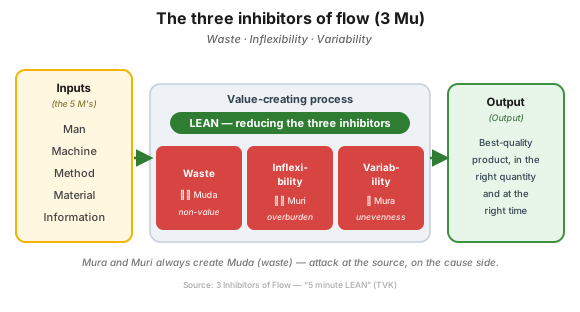 Figure 1 — from the inputs (Man, Machine, Method, Material, Information) the value-creating process produces output; three inhibitors block the flow — waste (Waste / Muda), inflexibility (Inflexibility / Muri) and variability (Variability / Mura) — all of which Lean reduces.
Who is this for?
Section titled “Who is this for?”This article is for those who wrestle with the obstacles to flow day to day: operator · shift and plant manager · process engineer · production and logistics planner · quality engineer · Lean/CI specialist · controlling.
Learning objectives
Section titled “Learning objectives”After reading this article you will be able to:
- name and distinguish the three inhibitors of flow (Muda, Mura, Muri), and give their English equivalents (Waste, Variability, Inflexibility);
- explain why the three are not independent, and why Mura and Muri always produce Muda;
- recognize the four types of inflexibility (capability, configuration, capacity, changeover);
- understand why variability is insidious when “the average is fine”;
- decide when to start on the cause side (Mura, Muri), and when treating the symptom (Muda) is enough.
In brief (TL;DR)
Section titled “In brief (TL;DR)”- The three inhibitors of flow: Muda (waste / Waste), Muri (inflexibility / Inflexibility), Mura (variability / Variability).
- All three add cost but no value — which is exactly why they are Lean’s targets.
- From the inputs (Man, Machine, Method, Material, Information) the value-creating process produces output: the best-quality product, in the right quantity and at the right time. The three inhibitors degrade this transformation.
- Cause and effect: Mura and Muri always result in Muda (buffer inventory, overtime, idleness), so anyone who only chases waste is treating the symptom — durable improvement begins with Mura and Muri.
- The “3 Mu” = the 3 inhibitors: the Japanese Muda / Mura / Muri triad corresponds exactly to the Waste / Variability / Inflexibility framework.
Why the three inhibitors matter (the stakes)
Section titled “Why the three inhibitors matter (the stakes)”The stakes of the three inhibitors are competitiveness and safety. Variability and inflexibility build forced buffers — inventory, overtime, idleness; these add up to waste (muda); and waste in turn means longer lead time, higher cost, and more abnormal, hence riskier, plant states. A single fluctuation on its own is cheap — the trouble is the chain reaction it starts if you do not address the cause side.
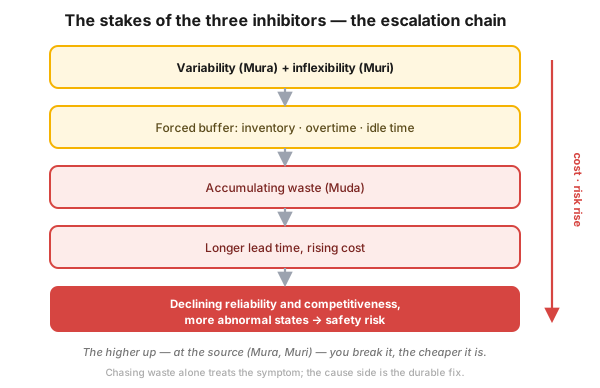 Figure 2 — the escalation of the three inhibitors: the unstable, inflexible process breeds a forced buffer, and that breeds accumulating waste, longer lead time and greater risk. The higher up — at the source — you break it, the cheaper it is.
The lesson: the cheapest waste is the waste never produced. That is why it pays to put attention at the start of the chain — on reducing variability and inflexibility — rather than compensating expensively at the end.
What are the three inhibitors of flow (Muda, Mura, Muri)?
Section titled “What are the three inhibitors of flow (Muda, Mura, Muri)?”The three inhibitors of flow are waste (Muda), inflexibility (Muri) and variability (Mura) — together the “three inhibitors of flow”. Lean draws the process as an input–transformation–output model: the inputs (Man, Machine, Method, Material, Information) are transformed through the value-creating process into output — the goal being “the best-quality product, in the right quantity and at the right time”. Three factors inhibit this flow (Wastes – Inflexibility – Variability):
| Inhibitor (EN / JP) | What it means | In-depth article | |
|---|---|---|---|
| Waste (Waste / Muda) | non-value-creating activity: the 8 waste types (TIMWOODI) | [[muda.en | muda]] |
| Inflexibility (Inflexibility / Muri) | the system’s inability to adapt quickly to customer demand — adds cost, not value | [[muri.en | muri]] |
| Variability (Variability / Mura) | the scatter of process outputs (quality, quantity, time) from the target state | [[mura.en | mura]] |
1. Waste (Muda)
Section titled “1. Waste (Muda)”Waste is the non-value-creating activity the customer does not pay for. The classic eight waste types (TIMWOODI): overproduction, transport, waiting, inventory, over-processing, motion, defects/rework, and unused human knowledge (Intellect). Detailed treatment, process-industry examples and metrics: muda.
2. Inflexibility (Muri)
Section titled “2. Inflexibility (Muri)”Inflexibility is the inability to adapt quickly to customer demand — the “inability to meet customer requirements”. It adds cost but does not add value. It has four types:
| Type | What it means |
|---|---|
| Capability | the inability of people and the organization to adapt to customer demand; we cannot deliver the desired product/service |
| Configuration | the inability of the product, process or network to satisfy customer demand |
| Capacity | the inability of volume to follow customer demand |
| Changeover | the lack of quick changeover of processes to shifts in customer demand |
The consequence of inflexibility is either capacity idling or overtime / capacity increase — both cost without value. Typical sources: large production lots, long changeover times (a SMED target), a rigid shift regime, a bottleneck, high WIP. Details and the diagnosis: muri.
3. Variability (Mura)
Section titled “3. Variability (Mura)”Variability is the scatter of process outputs due to any deviation from the target operating conditions. Its sources: People, Materials, Process, Information, Quality, Energy, Environment. It is insidious because a good average hides the scatter — an unacceptably wide min–max range makes the process unreliable and demands forced reserves (inventory, overtime). Detailed treatment, the damage chain and the heijunka antidote: mura.
Why one framework? — the cause-and-effect chain
Section titled “Why one framework? — the cause-and-effect chain”The three inhibitors are not independent. Mura (variability) and Muri (inflexibility) always create Muda (waste): to counter them we build reserves out of necessity — buffer inventory, overtime, idle capacity — which is itself muda.
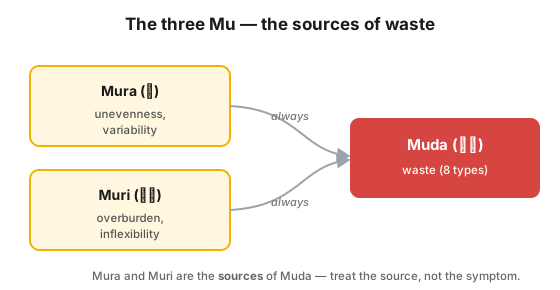 Figure 3 — Mura (unevenness) and Muri (overburden) always create Muda (waste); this is why durable improvement begins at the source, on the cause side, not just at the symptom.
That is why anyone who only chases waste is treating the symptom while the cause keeps re-creating the waste. Durable flow improvement begins on the cause side (Mura, Muri). This is also the explanation for why the main metric of flow, lead time, degrades in the presence of the three inhibitors: variability and inflexibility build buffers, and buffers mean waiting and inventory (muda) in the value stream.
How do the three inhibitors show up in the process industry?
Section titled “How do the three inhibitors show up in the process industry?”In the process industry the three inhibitors are directly tangible — and they touch safety too:
- Variability — the load curve. A vivid process-industry example of variability is the fluctuation of energy consumption, made visible by the load curve: the process’s energy use scatters as a function of load, and every “Why did it deviate?” question kicks off a root-cause analysis.
- Inflexibility — flaring and steam. When the customer or the regulator expects flaring to be minimized, the plant must avoid soot formation at the flare: at the start and end of flaring the steam quantity must be finely raised/lowered. If this quick, fine control is missing, inflexibility turns into a direct monetary loss — to convey the order of magnitude: ~60 t of MP steam ≈ €2,000 / event.
- Stability is a safety foundation. A low-scatter, leveled, standardized plant means fewer transient and abnormal states, fewer manual interventions and fewer near-miss situations. Reducing the three inhibitors is at once an OEE and a safety gain — especially in a Seveso plant, where a Mura→Muri chain (a load peak → strain beyond the equipment’s capability) can escalate into a process safety event (see muri).
When NOT to use it? (the limits of the framework)
Section titled “When NOT to use it? (the limits of the framework)”The “3 Mu” is a powerful way of thinking, but not the right answer to every problem. Knowing where its boundary lies is just as important as the framework itself:
| Situation | Why (primarily) not the 3 Mu framework | The right answer | ||
|---|---|---|---|---|
| A certified safety function is needed | stabilization is not an audited protection layer | design per [[lopa-sil.en | SIL/LOPA]], IEC 61511 | |
| The root cause is unknown | the framework categorizes, but does not uncover a cause | first cause investigation ([[5-miert.en | 5 Whys]]), then action | |
| A one-off, non-recurring deviation | there is no system-level Mura/Muri to reduce | one-off root-cause analysis, recording the lesson | ||
| The problem is a product- or process-design flaw | the flow does not need smoothing but redesigning | [[vsm.en | VSM]], [[kaizen.en | kaizen]], process redesign |
Rule of thumb: the three-inhibitors framework is strongest for recurring, system-level flow problems. It does not replace certified safety and the analysis of one-off cases — it complements them.
Common mistakes
Section titled “Common mistakes”The pitfalls almost all stem from treating the symptom (Muda) instead of the cause (Mura, Muri). In anti-pattern ↔ correction pairs:
- Chasing only the waste. We cut the buffer inventory, but not the variability and inflexibility — so the buffer builds back up. Instead: start at the source (Mura, Muri), and the Muda drops on its own.
- The “average” as a yardstick. A good average masks the intolerable scatter (45–74 minutes is still “average 56”). Instead: look at the scatter (min–max, range), not just the average.
- Changeover blindness. We take the long changeover as “a given”. Instead: with SMED the changeover-Muri can be reduced dramatically.
- Overtime as a durable solution. We paper over capacity inflexibility with constant overtime. Instead: capacity flexibility (heijunka, cross-training), not burnout.
- Blurring the three inhibitors together. “It’s all just waste.” Instead: separate the three — you diagnose and treat Muda, Mura and Muri differently.
Key takeaways
Section titled “Key takeaways”- Attack at the source, not at the symptom: reducing Mura and Muri automatically carries the Muda along too.
- Look at the scatter, not just the average — behind a “good average” an unreliable process may hide.
- Changeover is the most tangible Muri — start here, with SMED for a quickly measurable gain.
- Level before you automate: the other Lean tools are built on a stable, low-scatter process.
- A stable process is also safer — fewer abnormal states, fewer near-misses.
Self-check
Section titled “Self-check”- Name the three inhibitors of flow in English and in Japanese, and say which is the Japanese 3 Mu equivalent of each.
- Why is it not enough to reduce only the waste (Muda)? Tie your answer to the cause-and-effect chain.
- A process’s lead time is good on average, yet a buffer still has to be kept. Which inhibitor causes this, and why is it “insidious”?
How does this show up in digital practice?
Section titled “How does this show up in digital practice?”The three inhibitors do not stay at the level of a shop-floor mindset: a well-designed digital operation supports the same logic. There, the inhibitors become measurable, trendable data, so the cause side (Mura, Muri) can be improved in a targeted way — the mechanism differs, the principle is the same.
| Inhibitor / principle | Digital implementation | What it delivers |
|---|---|---|
| Making variability (Mura) visible | automatic data capture, trend and control chart (min–max, scatter) | the scatter behind the “good average” comes to light |
| Measuring inflexibility (Muri) | automatic logging of changeover time and capacity utilization | the changeover / capacity bottleneck becomes quantified |
| Recording waste (Muda) | downtime and rework event log with cause codes | waste becomes measured data, not anecdote |
| Separating cause vs. symptom | linking event → root-cause action (owner, deadline) | the Mura/Muri source can be improved in a targeted way |
| Leveling (heijunka) | digital schedule / heijunka board | load smoothing becomes traceable |
Connection to OPEREX (shift log)
Section titled “Connection to OPEREX (shift log)”The events of the three cause types that inhibit flow are by their nature shift-level and time-series: waste (downtime, waiting, rework), variability (fluctuating output, feed scatter, off-spec) and inflexibility (long changeover, capacity limit, flaring) are all events that can be logged in the shift log. In the OPEREX shift-log SaaS, from this data the three inhibitors of flow become a measured, trendable metric — not an anecdote (“the afternoon shift slipped again”), but a re-measurable fact for which a targeted stabilizing action (standard work, SMED, leveling) can be planned, and whose effect can be checked against the data from the following shifts.
Terminology (HU / EN / JP)
Section titled “Terminology (HU / EN / JP)”| Hungarian | English | 日本語 / romaji |
|---|---|---|
| az áramlás három gátja | three inhibitors of flow | — |
| veszteség / pazarlás | waste | 無駄 / muda |
| változékonyság / egyenetlenség | variability / unevenness, inconsistency | 斑 / mura |
| rugalmatlanság / túlterhelés | inflexibility / overburden, unreasonableness | 無理 / muri |
| áramlás | flow | 流れ |
| a rugalmatlanság 4 típusa | the 4 types of inflexibility: capability · configuration · capacity · changeover | — |
| a három Mu | the three Ms (3 Mu) | — |
What are the three inhibitors of flow in Lean?
Waste (Muda / Waste), inflexibility (Muri / Inflexibility) and variability (Mura / Variability). All three add cost without value, and all three must be tackled at once to achieve uninterrupted flow.
What is the connection between the 3 inhibitors and the Japanese 3 Mu?
They are the same: the Waste / Variability / Inflexibility triad corresponds exactly to the Japanese concepts Muda / Mura / Muri (in English, “the three Ms”).
Why is it not enough to reduce only the waste (muda)?
Because variability (Mura) and inflexibility (Muri) re-create the waste: to counter them we build reserves out of necessity (inventory, overtime), which is itself muda. Durable improvement begins on the cause side, with Mura and Muri.
What are the four types of inflexibility?
Capability (the lack of delivering the desired product/service), Configuration (the product/process/network cannot satisfy demand), Capacity (we cannot match volume to demand) and Changeover (the lack of quick changeover of processes).
Related concepts
Section titled “Related concepts”muda · mura · muri · flow · the three types of activity · heijunka · standard work · smed · load-curve analysis · Lean basics
Next step
Section titled “Next step”Once you have grasped the overview, from here it is worth going on — in this order:
- muda — the most tangible inhibitor: the 8 waste types (TIMWOODI), with plant examples. Start with this, because it is the first thing you spot on the gemba.
- mura — variability and the heijunka antidote: why scatter is “insidious”, and how you smooth it out.
- muri — the four types of inflexibility and the SMED-target changeover: the cause side, where durable improvement begins.
References / further reading
Section titled “References / further reading”- Taiichi Ohno: Toyota Production System: Beyond Large-Scale Production. Productivity Press, 1988. — the canonical foundational work on muda/mura/muri and waste-centered improvement.
- James P. Womack – Daniel T. Jones: Lean Thinking: Banish Waste and Create Wealth in Your Corporation. Free Press, 1996 (exp. 2003). — flow and waste organized into five principles.
- Mike Rother – John Shook: Learning to See: Value-Stream Mapping to Add Value and Eliminate Muda. Lean Enterprise Institute, 1999. — making waste visible in the value stream.