Preventive maintenance (PM)
≈ 11 min read · 2,219 words
We take the car in for a service every ten thousand kilometres even when it is running perfectly. The trigger is the odometer or the calendar, not a symptom of failure: this is exactly the logic of preventive maintenance, on an industrial scale. Let us look at what PM is, what its goals are, and how you develop a good PM program.
Preventive maintenance (PM) is a scheduled strategy: regular inspection, part replacement and periodic overhaul, regardless of the current condition.
The goal of preventive maintenance is to prevent failures, and with that to reduce maintenance downtime, extend the useful life of the assets and cut back expensive reactive work. Proactive work typically costs only a quarter to half of reactive, breakdown-repair work, so PM pays off on a purely cost basis as well. PM is the foundation of every maintenance and reliability process: the reliability-critical programs (condition monitoring, RCM, RCA) are built on this foundation.
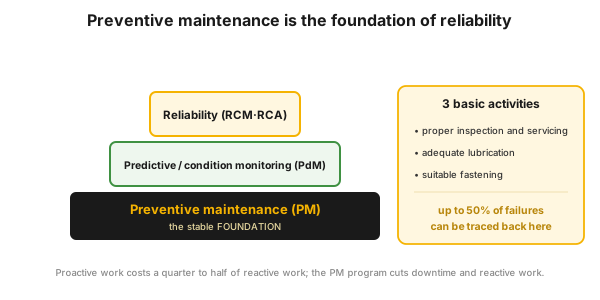 Figure 1 — PM is the stable foundation on which the predictive and reliability programs are built; up to 50% of failures can be traced back to the 3 basic activities.
Who is this for?
Section titled “Who is this for?”For those who are responsible for equipment availability and for planning maintenance work: maintenance manager and planner · reliability engineer · plant manager · shift supervisor · process engineer · HSE specialist.
Learning objectives
Section titled “Learning objectives”After completing this module you will be able to:
- define PM, and name its three basic activities
- place PM within the family of maintenance strategies (PdM, corrective, deliberate RTF)
- work through the eight steps of a PM program, and choose the right scheduling trigger
- measure the program with the four key performance indicators
In brief
Section titled “In brief”- PM = scheduled prevention independent of the current condition (inspection, replacement, overhaul).
- Proactive work costs a quarter to half of reactive work, so PM pays off on a cost basis too.
- 3 basic activities (proper inspection and servicing, adequate lubrication, suitable fastening): up to 50% of failures can be traced back here.
- Goals: less downtime, up to 40% longer useful life, less reactive work and cost.
- The program is built in 8 steps from the goal to execution, and it lives in a CMMS.
- The task is activated by a trigger: calendar, usage or condition.
- 4 KPIs: schedule compliance (≥ 95%), planning accuracy (≥ 95%), overdue PM, PM effectiveness (reactive work < 20%).
- PM is for wear-out failures; it does not prevent random failures (see the bathtub curve).
What is preventive maintenance, and why is it the foundation of reliability?
Section titled “What is preventive maintenance, and why is it the foundation of reliability?”It is the foundation because it is cheaper than reactive repair, and because it covers the most frequent failure causes. According to an industry study, repairing failures costs roughly 17–18 dollars per horsepower per year, whereas with a good PM program it is 11–13 dollars. PM rests on three basic activities (Figure 1), and according to numerous studies up to 50% of equipment failures can be traced back to one of these three areas. Whoever focuses on these fundamentals reduces event-driven work and increases equipment uptime.
The goals of PM
Section titled “The goals of PM”The business value of PM arrives from several directions, and each of them is measurable.
- Reducing downtime, and with it capacity: cutting the maintenance downtime of capacity-limiting machines frees up extra capacity, up to the point of making a redundant machine unnecessary.
- Extending useful life: at times by as much as 40%.
- Reducing reactive, breakdown-repair work: higher maintenance productivity, lower cost.
- Energy saving: clean heat exchangers and coolers, and good shaft alignment waste less energy.
- Regulatory and safety compliance: the PM requirements of process safety management and of the standards.
How do you develop a good PM program?
Section titled “How do you develop a good PM program?”In eight steps, from the goal to execution; the order matters, because every step is the input of the next.
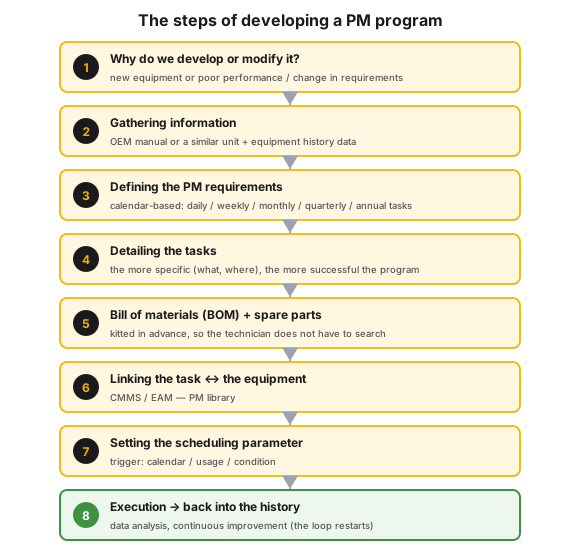 Figure 2 — the eight steps of the program.
- Why do we develop or modify it? (New equipment, poor performance, a reliability recommendation or a change in requirements, with the support of senior management.)
- Gathering information: for a new machine the manufacturer’s manual or a similar unit as a reference; for an existing one all current PM tasks and the equipment history data.
- Defining the PM requirements: most companies use a calendar-based program (daily, weekly, monthly, quarterly, semi-annual, annual).
- Detailing the tasks: the more specific it is (what, exactly where), the more successful it is; the detailed check sheet also serves the training of new technicians (on-the-job training).
- Specifying the bill of materials (BOM) and spare parts, kitted in advance, so that the technician does not have to search.
- Linking the task and the equipment, typically in the PM library of the CMMS / EAM.
- Setting the scheduling parameter: this is the trigger that activates the task.
- Execution, then feeding the result back into the history data: good data analysis is what makes age-based scheduling cost-effective.
The scheduling triggers
Section titled “The scheduling triggers”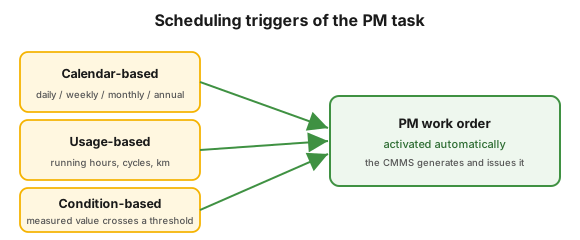 Figure 3 — the three bases that trigger the task: calendar, usage, condition.
The scheduled call-off happens when the measured value of calendar time, of usage (running hours, cycles) or of condition crosses a prescribed limit; the CMMS then automatically generates and issues the PM work order.
The key performance indicators of preventive maintenance
Section titled “The key performance indicators of preventive maintenance”A starting PM program can be steered with four metrics: two measure the discipline of execution, one the backlog, one the end result.
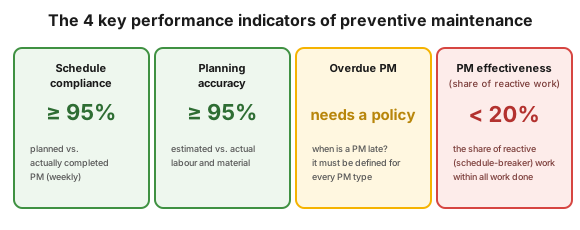 Figure 4 — the four recommended starting KPIs.
- Schedule compliance: the ratio of planned to actually completed PM (weekly); in a proven program ≥ 95%.
- Planning accuracy: the match between the estimated and the actual labour and material demand, ≥ 95%.
- Overdue PM tasks: useful, but you have to set a policy for it (when is a PM late?).
- PM effectiveness (the share of reactive work): the percentage share of reactive, breakdown-repair work within all maintenance work completed, target < 20%. Its usual definition: any work that is not scheduled a week in advance; in many organizations this is “schedule-breaker” work, because it has to be squeezed into the weekly schedule.
When NOT to use it? (the limits of the method)
Section titled “When NOT to use it? (the limits of the method)”PM is the right tool when the failure is age-related and there is an identifiable wear-out age, or when assessing the condition would cost more than time-based replacement, and the latter is still reasonably effective. In every other case another member of the strategy family is the answer.
| Maintenance work type | When it is the right choice | When it is wrong |
|---|---|---|
| PM (predetermined): calendar- or usage-based replacement, overhaul | a wearing part with a predictable life; a mandatory periodic check | on a failure mode that is not age-related it burns money, and introduces “infant mortality” failures |
| PdM (condition-based): continuous online monitoring or periodic offline inspection | there is a measurable degradation signal, and the P–F interval is long enough | if the failure process is too fast, or there is no measurable signal |
| Corrective: deferred (planned, scheduled) | there is time for technical preparation and scheduling | if the loss of function has a safety or environmental impact |
| Corrective: immediate (unplanned) | there is no time for preparation, the function must be restored | if it becomes routine: the organization stays in the reactive trap |
| Deliberate run-to-failure (RTF) | the failure is acceptable (no significant safety or environmental impact), prevention is not economical or not possible | never on a critical or safety function |
So the choice is decided not by the age or the price of the asset, but by the nature of the failure mode (see the bathtub curve and the 6 patterns).
Common mistakes
Section titled “Common mistakes”PM programs tend to go wrong in two opposite directions: either they do too little, or they do a lot to no avail.
- Targeting the wrong failure type: PM has a hard time eliminating random, early or misuse-induced failures, because it is meant for wear-out failures.
- PM running without benefit: the task gets done, but it prevents nothing, because it was badly chosen. The correct practice is reverse RCM, that is, reviewing the added value of the existing PM tasks, and an 80/20 focus by criticality (criticality analysis, reliability strategy).
- Too generic a task description: without the details, execution and training are both weak.
- Scheduling without spare parts: the technician goes searching, productivity drops.
- No data analysis from the history: the scheduling does not improve.
- A high reactive share: if reactive work is above 20%, the PM program is not reaching its goal.
Industrial and safety context
Section titled “Industrial and safety context”PM is industry-independent, but in the process industry it is also a direct safety tool: process safety management (PSM) requirements prescribe mandatory PM tasks (periodic testing of safety valves, gas detectors, fire protection systems). In a hazardous (Seveso) plant a missed PM is not only a reliability risk but a safety integrity risk; for hidden failures the failure-finding (FF) tasks are the right answer. PM must be weighted by criticality (criticality analysis).
Putting it into practice
Section titled “Putting it into practice”The order matters: first the discipline of the fundamentals, then the fine-tuning.
- Start with the basics: inspection and servicing, lubrication, fastening, because this covers half of the failures.
- Weight from the FMEA/RCM: tie the PM to the failure mode and to criticality (reliability strategy).
- Detail it (what, where), give a BOM, and link it to the CMMS.
- Measure the 4 KPIs, and push reactive work below 20%.
- Extend it towards the operators: PM is also the backbone of TPM; the basic tasks (cleaning, lubrication, inspection) can be handed over to the operators (autonomous maintenance, operator-driven reliability).
Take it home (keys)
Section titled “Take it home (keys)”- The value of PM has to be recognized by the whole organization, not only by maintenance: without that, the schedule is always overridden by today’s firefighting.
- Without an effective PM program the organization stays trapped in the reactive way of working. PM provides the stability without which the other work management requirements cannot be met either.
- Start with the three basic activities: up to half of failures are covered by inspection, lubrication and fastening.
- For every PM task, ask what it prevents. If there is no answer, the task does not generate benefit, it burns capacity.
- Define the reactive share first, then measure it: whatever is not scheduled a week in advance is reactive.
Connection to OPEREX (shift log)
Section titled “Connection to OPEREX (shift log)”The PM tasks and the round-walk inspections/lubrication are items that can be ticked off shift by shift in the shift log (OPEREX), so schedule compliance and “overdue PM” become auditable, and the share of reactive work can be calculated from the log data. This way PM does not exist on paper only: shift by shift it is visible whether it was completed.
Terminology (HU / EN)
Section titled “Terminology (HU / EN)”| Hungarian | English (canonical) | Abbreviation |
|---|---|---|
| Megelőző karbantartás | Preventive Maintenance | PM |
| Prediktív karbantartás | Predictive Maintenance | PdM |
| Reaktív / hibajavító munka | Reactive / corrective work | — |
| Meghibásodásig üzemeltetés | Run to Failure | RTF |
| Ütemtörő munka | Schedule-breaker | — |
| Anyagjegyzék | Bill of Materials | BOM |
| Ütemező kiváltó | Scheduling trigger | — |
| Munkahelyi oktatás | On-the-job training | OJT |
| Üzemkész idő | Uptime | — |
The terminology follows the usage of the Uptime Elements.
What is preventive maintenance (PM)?
A scheduled maintenance strategy: regular inspection, part replacement and periodic overhaul regardless of the current condition, in order to prevent failures and reduce downtime.
Why does PM pay off on a cost basis?
Because proactive work typically costs a quarter to half of reactive, breakdown-repair work. According to an industry estimate, breakdown repair costs about 17–18 USD/hp/year, and with good PM about 11–13 USD/hp/year.
What are the 3 basic activities?
Proper inspection and servicing, adequate lubrication, suitable fastening. Up to 50% of failures can be traced back to one of these three areas.
What does PM not solve?
Random, early (“infant mortality”) and misuse-induced failures, because PM is meant for wear-out failures; on top of that, an unnecessary overhaul introduces a new early failure into the system.
What should the share of reactive work be?
In a good PM program the unscheduled, “schedule-breaker” reactive work should be below 20% of maintenance activities.
Self-test
Section titled “Self-test”Self-check questions
- Which three basic activities can up to half of equipment failures be traced back to?
- The failure mode of a pump is not age-related, but it has a measurable vibration signal. Is PM or PdM the right answer, and why?
- Does an urgent repair squeezed into the weekly schedule on Monday morning count as reactive work?
Answer key: 1) Proper inspection and servicing, adequate lubrication, suitable fastening. · 2) PdM: for a failure that is not age-related, periodic replacement does not help, whereas the measurable signal makes a condition-based intervention possible. · 3) Yes, because it was not scheduled a week in advance; this is the classic “schedule-breaker” work.
Applied exercise
- Pick five PM tasks from your own schedule, and write down for each which failure mode it prevents, and what its trigger is.
Related concepts
Section titled “Related concepts”reliability strategy | the bathtub curve | CMMS | maintenance planning and scheduling | operator-driven reliability | TPM | autonomous maintenance | criticality analysis | asset condition management
References / further reading
Section titled “References / further reading”- Terry Wireman: Maintenance Strategy Series Volume 1 – Preventive Maintenance. Reliabilityweb.com, Fort Myers, 2011.
- Terry Wireman: Zero Breakdown Strategies. Reliabilityweb.com, Fort Myers, 2012.
- Uptime Elements reliability framework, © NetexpressUSA Inc. d/b/a Reliabilityweb.com: the »preventive maintenance« element.
- MSZ EN 13306 Maintenance terminology: the standard concept set of the calendar-, usage- and condition-based split.
- The specific cost figure (17–18 and 11–13 USD/hp/year respectively) comes from a study published in Preventive and Predictive Maintenance Technology magazine.