Muda — the 8 wastes (TIMWOODI)
≈ 24 min read · 4,813 words
Stop for a moment at any office process and count how long something actually “happens” to the work item — and how long it just waits, travels, queues or sits in storage. In most processes the real value-adding work is only a few percent of the lead time; the rest is muda, that is, waste. You see the same thing when a parcel is “in transit” for days even though the actual shipping is a matter of hours, or when a technician spends half an hour looking for a tool for a ten-minute repair. The meaning of muda is simple — anything the customer would not pay for — and Lean teaches us to actually see it. Let’s look at what it is, how many kinds there are, and how it can be eliminated.
Muda (Japanese for waste) is any activity that, from the customer’s point of view, creates no value — the customer is not willing to pay for it. The classic list is Taiichi Ohno’s (Toyota) seven types of waste (with the acronym TIMWOOD: transport, inventory, motion, waiting, overprocessing, overproduction, defects), which today is complemented by an eighth — unused human creativity (Intellect) — making the acronym TIMWOODI. The goal of Lean is to recognize and eliminate muda, so that the share of value-adding work grows.
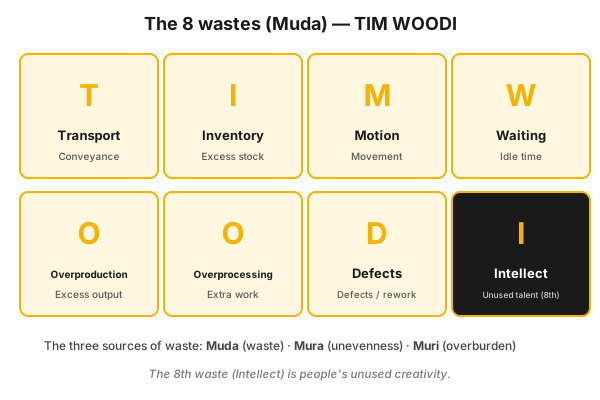 Figure 1 — the eight types of waste with the acronym TIMWOODI. The first seven are Ohno’s classic list; the eighth (Intellect) is unused human knowledge and creativity.
Who is this for?
Section titled “Who is this for?”This article is for those who see waste in their daily work — or want to learn to see it: operator · shift and plant manager · maintenance technician · process and production engineer · technologist · logistics specialist · Lean/CI specialist · HSE.
Learning objectives
Section titled “Learning objectives”After reading this article you will be able to:
- say what muda is, and how it differs from mura and muri (the 3 Mu);
- list the 8 types of waste with the acronym TIMWOODI, and give a plant example for each;
- separate work into value-adding / necessary-but-non-VA / pure waste categories;
- justify why overproduction is the worst waste;
- recognize where waste-hunting ends and the certified safety system begins.
In brief
Section titled “In brief”- Muda = waste: anything that consumes resources but delivers no value to the customer.
- The 3 Mu are the three sources of waste: muda (waste), mura (unevenness/variability), muri (overburden). Mura and muri always result in muda.
- The classic 7 wastes are Taiichi Ohno’s (Toyota) list; the TIMWOOD acronym helps you remember them.
- The 8th waste is the workforce’s unused creativity/knowledge (Intellect / Talent) — the acronym then becomes TIMWOODI.
- Work breaks down into three parts: value-adding (VA), necessary but non-value-adding (incidental), and waste (muda). The goal is to maximize the share of VA.
- Overproduction is the worst waste, because it drags every other waste along with it and hides the problems.
- Lean attacks the combination of waste (muda) – variability – inflexibility in order to restore flow.
- To recognize waste you need “muda glasses”: once you learn to see waste, you spot it in more and more places.
Why it matters (the stakes)
Section titled “Why it matters (the stakes)”Muda on its own is rarely spectacular — one extra transfer, an hour of waiting, an item sitting in storage. The trouble is the chain reaction triggered by the worst waste, overproduction: whoever produces more or earlier than the customer needs thereby breeds excess inventory, extra movement and tied-up capital — and, in the meantime, hides the real problems.
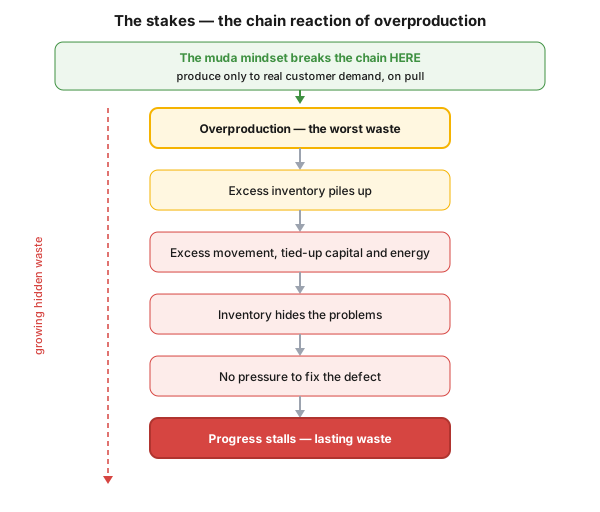 Figure 2 — the chain reaction of overproduction: it breeds excess inventory and extra movement, hides the problems, removes the pressure to fix, and finally progress stalls. The muda mindset breaks the chain at the very start — at pull production.
The lesson is simple: the cheapest waste is the surplus never produced. That is why it pays to look at the start of the chain — to hold back overproduction and excess inventory — rather than expensively managing the consequences at the end. In a typical process, value-adding work is only a fraction of the lead time; the rest is the room to hunt for waste.
What is muda, and where does it come from?
Section titled “What is muda, and where does it come from?”Muda is a Japanese word meaning waste. Lean / the Toyota Production System (TPS) uses it to name every element of production that requires resources but creates no value. The customer, after all, is willing to pay only for the value-adding steps — everything else merely raises the cost without adding anything to the product’s customer-perceived value.
Taiichi Ohno himself summed up the essence of the Lean mindset this way: “All we are doing is looking at the time line, from the moment the customer gives us an order to the point when we collect the cash — and we are reducing that time line by removing the non-value-adding wastes.” Identifying waste is therefore the foundation of the entire Lean edifice: after defining customer value (VOC), every Lean principle rests on filtering out and eliminating, within the value stream, whatever the customer would not pay for.
The concept is part of the 3 Mu framework, which summarizes three kinds of waste:
- muda — waste (non-value-adding activity),
- mura — unevenness, variability (fluctuation in load/pace),
- muri — overburden (straining a person or machine beyond capacity).
Of the three, mura and muri always result in muda, which is why in practice the concept of muda and the activity of eliminating muda have spread the most widely.
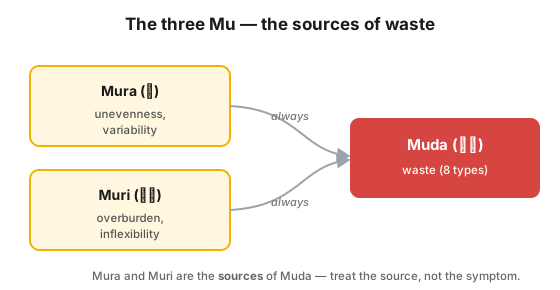 Figure 3 — the three Mu: Mura (unevenness) and Muri (overburden) always generate Muda. The durable solution starts at the source (mura, muri), not at the symptom.
The fight against waste is organized around two names in the history of the TPS: Taiichi Ohno (the father of the TPS) placed the elimination of muda at the center of the Toyota Production System, while Shigeo Shingo identified and systematized the seven types of waste as part of the TPS. The two viewpoints do not contradict each other: Ohno is the creator and practical implementer of waste-focused thinking, Shingo is the systematic categorizer of the seven types. The usual order of the list spells out the name TIM WOOD from the English initials, which makes the types easier to remember. Over time, further types of waste emerged — most of them, however, do not fit among the original seven, and are often the effect of the existing base wastes. The most popular eighth waste is the workforce’s unused creativity/knowledge (Intellect, Talent). The practical advice: it is worth focusing on the original wastes — or, better still, not aiming for categorization at all, but learning to recognize and eliminate them.
What are Lean’s 8 types of waste (TIMWOODI)?
Section titled “What are Lean’s 8 types of waste (TIMWOODI)?”Lean’s eight types of waste with the acronym TIMWOODI: Transport, Inventory, Motion, Waiting, Overproduction, Overprocessing, Defects, and Intellect (unused human knowledge). The first seven are Ohno’s classic list, the eighth is the modern addition.
Before we take the types, Lean sorts work into three categories — this is the basis of the “muda glasses”:
| Category | Definition | What we do with it |
|---|---|---|
| Value-adding (VA) | Work that directly increases the product’s customer-perceived value (e.g. assembling parts). “What the customer pays for.” | Maximize |
| Necessary but non-value-adding (incidental) | Adds no direct value, but is currently needed to keep operations running (e.g. a small reach for the material during assembly). | Reduce |
| Waste (muda) | Adds no customer value and is not strictly necessary to keep operations running either. | Eliminate |
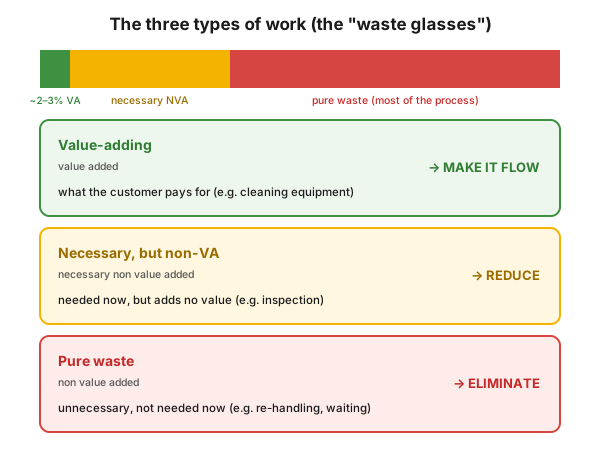 Figure 4 — the three types of work. The value-adding part is typically only a small fraction of the whole; the goal is to grow the share of VA at the expense of waste and incidental activity.
The goal: maximize the share of value-adding work by eliminating/reducing waste and incidental activity. Now let’s take the eight types one by one.
1. Overproduction — Overproduction Producing more or earlier than the customer demands. By JIT principles, producing more than necessary is at least as big a mistake as producing less. This is the worst waste, because in the form of excess inventory it drags every other waste along with it, and on top of that it hides the problems: if we have produced ahead, we don’t even notice that a machine has stopped — or if we do, we have no reason to fix it immediately and permanently. Overproduction makes things comfortable, and thereby prevents the continuous improvement of the production system.
2. Waiting — Waiting When we should be working but for some reason are forced to wait: waiting for the machine because of a badly defined workflow, operators waiting for each other because the line is unbalanced, or work standing still because of a machine fault or material shortage. In services this is the most common waste.
3. Transport / material handling — Transportation Material handling within the plant is an important part of serving production, but from the customer’s viewpoint it is waste, because it adds no value. We consider as waste the movement that is more than the strict minimum. First we should not think about how to handle a material transfer more efficiently, but about whether it is needed at all — movement between separate workstations can often be eliminated by relocating the workstations.
4. Unnecessary/poor-quality processing — Overprocessing Unnecessary work stemming from poor process or machine design (e.g. shaping that the finished product does not need; packing something that is unpacked at another point in the plant). It includes doing the work “better” than what the customer asks for (higher quality than necessary), because they will not pay more for that either. Its typical office variant is unnecessary paperwork: creating documents that no one uses.
5. Inventory — Inventory A quantity larger than the minimum inventory needed to run the processes safely. Inventory is comfortable (in case of a problem you don’t have to intervene immediately), but storage and inventory management not only add no value, they carry significant cost (space, heating/cooling, extra equipment, extra staff), and take up room from valuable production capacity. Put vividly: inventory hides all the problems while tying up money and energy.
6. Unnecessary motion — Motion Every motion that adds no value to the product, and every value-adding but non-optimal sequence of motions. Motions beyond the strict minimum count as waste (e.g. walking from one machine to another; moving material from one hand to the other; holding a part in your hand instead of setting it down so you could work with both hands). All of this must be reduced while complying with the safety, occupational-health and technological requirements.
7. Defects — Defects / Rework If we don’t do something right the first time, it has to be done again — with extra time and cost. Defective products hinder JIT operation. Worse still, the defect may surface only at the customer, which comes with a loss of trust and a much higher cost.
8. Unused human knowledge/creativity — Intellect / Talent (the 8th, supplementary waste) The under-use of the workforce’s creativity, knowledge and abilities — for example, when qualified engineers do administration. This is the most popular eighth waste, and bringing it in makes the acronym TIMWOODI.
Eliminate → Reduce → Flow (the guiding thread)
Section titled “Eliminate → Reduce → Flow (the guiding thread)”The three activity categories and waste management can be strung onto a single guiding thread whose goal is to reduce lead time:
- Eliminate: the unnecessary, abnormal, non-value-adding (NVA) steps — these must be phased out immediately.
- Reduce: the necessary but non-value-adding (incidental / necessary NVA) steps — e.g. in a process-industry maintenance job, the blinding and the cooling down.
- Flow: the value-adding (VA) activity — e.g. the cleaning itself — which must be made continuous.
In other words: we eliminate the unnecessary NVA, reduce the necessary NVA, and make the value-adding work flow — and along with it, the time line from order to cash shrinks.
How does muda show up in the process industry? (context + safety)
Section titled “How does muda show up in the process industry? (context + safety)”Muda is not only meaningful in discrete manufacturing — it applies just as much in process-industry and maintenance practice. In a continuous-operation environment, the material typically travels along a long value stream (e.g. atmospheric distillation → desulfurization → blending), and the intermediate tanks (inventory) hide the problems while tying up money and energy.
Maintenance and operations examples for the 8 wastes:
| Waste | Process-industry / maintenance example |
|---|---|
| Overproduction | Maintenance activity performed more often than necessary |
| Inventory | Many tools kept in stock |
| Motion | The field crew doesn’t take out all the tools needed for a job |
| Defects | Going back to the same fault because it wasn’t fixed the first time |
| Waiting | Morning wait before going out to the area |
| Transport | Carrying material for a repair not by the shortest route |
| Overprocessing | Over-complicated administration before starting a maintenance task |
| Intellect | Qualified engineers doing administration |
Quality giveaway (the process-industry case of overprocessing) — a worked example. In continuous operation, the typical form of overprocessing is quality giveaway: if we “boil off” or overheat a product above spec, we add a needless quality margin the customer won’t pay for — while also wasting energy. In one yield-improvement action, lowering the outlet temperature of the boil-off tube furnace raised the gas-oil yield from ~92.6% to ~97.6%, because there was a needless margin in the flash point — and on top of that the measure also brought energy savings. (See the gas-oil yield case study.)
Wrench time / OPE benchmark (waiting and transport waste). A significant share of the time of outside operators and maintenance workers is non-value-adding. According to OPE measurements (Overall Performance Effectiveness), maintenance “wrench time” — the time actually spent on the tool, value-adding — was often only 25–30% of the total working time, whereas international good practice is 50–60%. The main sources of waste are waiting and transport (and the fact that the worker often shouldn’t even need to be on site). (See wrench time.)
How do you introduce it in practice? (roadmap)
Section titled “How do you introduce it in practice? (roadmap)”Muda is not in itself a “tool to be introduced,” but a way of seeing: the organization learns to recognize and eliminate waste. A practical roadmap:
1. Preparation and shaping the mindset. Clarify that the goal is not more or faster work, but working differently and on different things — dropping the unnecessary (non-value-adding) activities. This is the key message toward the shift colleagues as well.
2. Teach the 3 categories and the 8 wastes. Everyone learns to distinguish value-adding (VA), necessary-but-non-VA (incidental) and waste (muda) activities, and to recognize TIMWOODI.
3. Pilot in a bounded area (Mini-T). The transformation typically starts on part of a specific value stream (e.g. a distillation block + local workshops). The pilot examines three main operating areas: (a) energy use and technological process (yield, quality), (b) the maintenance process, (c) operation itself (shift work, plant management).
4. Observation and data collection at the Gemba. The essence of the method is collecting data and observing the actual activities — not scapegoating, but understanding and improving the existing practices. Good proposals are based on precise, thorough observation. (See gemba.)
5. Establishing best practice and standardizing. We gather and compare the working methods of the different shifts/operators, and select/develop the best practice, which everyone then follows. (See standard work, 5s.)
6. Rolling out in waves. We extend the proven solutions to the other units, plants and countries, building internal capabilities wave by wave — so that the organization can lead the Lean transformations itself.
Who does what:
- Top management: clear expectations, frequent communication, go out and look at the shop floor, demand understanding of the root cause, reward improvement ideas.
- Line leaders / experts: take ownership of the introduction, be role models, “hunt for waste” and identify improvement opportunities.
- Navigators / internal champions: challenge the status quo, teach the methodology, spread the new way of thinking. They do not dictate “how to work” — the solutions come from those who know their own work best.
Measurement / audit
Section titled “Measurement / audit”Muda can be measured directly through the proportions of the work composition and through value-stream metrics. Established metrics:
- Value-adding ratio (VA ratio) = value-adding time / total lead time. In a typical VSM example the VA ratio is a mere 2.3% — this is how low the starting value tends to be, which shows the magnitude of the waste. (Goal: raise the ratio; see vsm.)
- Lead time reduction — by phasing out excess inventory and waiting.
- Wrench time (the share of actual, hands-on repair time) — worth re-measuring to uncover further opportunities. Benchmark: typically 25–30% at the start, international good practice 50–60% (detailed breakdown: wrench time).
- Activity distribution (OPE): breaking down the time of a shift/observation into value-adding / supporting / non-value-adding shares (e.g. ~30–40% value-adding, the rest waste and supporting).
- Total Team Effectiveness (TTE): a stepwise metric that leads from the gross available hours down to the effective hours — with a separate improvement action at each step: absence → non-availability → productivity loss → effectiveness loss.
- Operational metrics move together: transformations typically improve floor-space needs, lead time, defects/part and the “right first time” ratio all at once.
- Inventory value / WIP — measuring the capital tied up by excess inventory.
Audit logic: the “audit” of muda is really Gemba observation and continuous waste-hunting. Visual performance boards, the daily morning meetings and the cascaded KPI structure make visible where waste arises — sustainability comes from these leadership routines. (See mos, 5s.)
Hands-on / example
Section titled “Hands-on / example”Steam generator (E22) cleaning example — separating the 3 activity types. On a specific maintenance task the Eliminate → Reduce → Flow logic is clearly visible:
- Cleaning = value-adding → FLOW (must be made to flow).
- Blinding + cooling down = necessary, but non-value-adding → REDUCE (must be minimized).
- Waiting = unnecessary, non-value-adding → ELIMINATE (must be eliminated).
After classifying the observed wastes, a faster new process was designed from the old one — the same logic as in the textbook process activity mapping petrol-station example, where it turned out that out of the steps of a “simple” task, only 1 was a true value-adding operation, the rest being transport, inspection and waiting.
Waste-reduction measures actually implemented in a process-industry environment (with the corresponding waste type):
- Standardized shift handover — unifying the information exchange between successive shifts, so that no defect arises from the loss of important information. (Reducing defects, waiting.)
- Optimized, unified inspection routes — so no time is lost on random route choice, and no important unit is left out of the inspection. (Motion, transport, defects.)
- Multifunctional training and rotation of operators — the operators had previously often known only two of the complex plant’s four main technological areas; with regular training, coached by experienced operators, greater work flexibility can be achieved. (Using Intellect.)
- Visual, easy-to-understand operating descriptions for the correct and safe handling of the machines. (Reducing overprocessing, defects.)
- Improving cooperation between operators and maintenance workers — greater transparency, less waiting time. (Reducing waiting.)
At a sister company’s process-industry plant, most of the proposals developed in the first few months were actually implemented, realizing significant annual savings. The process-industry Lean program itself, incidentally, originated from a visit to a Lufthansa Technik maintenance plant — a good illustration that the methodology of waste-hunting reaches across industries.
Common mistakes
Section titled “Common mistakes”The pitfalls of waste-hunting typically stem from treating the symptom instead of the cause, or from noticing only the most conspicuous waste. In anti-pattern ↔ correction pairs:
- Underestimating overproduction. The “let’s produce ahead to be safe” mentality is comfortable, but it drags every other waste along with it and hides the problems. Instead: produce on pull, only to real customer demand — overproduction is the worst waste.
- Treating inventory as safety. The buffer is reassuring, but it covers up the real root problems (machine faults, variability) and ties up real cost (money, energy, space). Instead: reduce inventory, and solve the surfacing problems at the root.
- Optimizing only for more efficient execution. We try to speed up a transfer/step instead of eliminating it. Instead: first ask: is it needed at all? — and only then how it can be sped up.
- Treating waste-hunting as scapegoating. If observation is a raking-up of past mistakes, people close off. Instead: the goal is to improve the process, not to blame people — the solution comes from those who know the work best.
- Focusing only on muda, without mura and muri. Symptomatic waste, without the root cause (variability, overburden), comes back. Instead: start at the source — smooth the variability (mura) and relieve the overburden (muri), otherwise muda regenerates.
- Manufacturing too many new waste types. Most of the ever-new “waste categories” are the effect of the original 7+1. Instead: focus on the basics — or, better still, work not on classification but on recognition and elimination.
- Neglecting the eighth (Intellect) waste. Unused human knowledge is the hardest to see. Instead: ask those who do the work — this is often the biggest, untapped reserve.
When NOT to use it (the limits of the method)
Section titled “When NOT to use it (the limits of the method)”Waste-focused thinking is strong, but not the right answer on its own for every situation. Knowing where its limit is matters just as much as the method itself:
| Situation | Why (primarily) not waste-hunting | The right answer | ||
|---|---|---|---|---|
| The waste is caused by variability or overburden | you cut out the muda, but the mura/muri regenerates it | first treat the source of mura (leveling, [[mura.en | heijunka]]) and muri | |
| A certified safety function is needed | a “needless” step may be a mandatory protective layer | the safety function is set by risk analysis and standards ([[lopa-sil.en | SIL/LOPA]]) | |
| The “waste” is actually necessary incidental | a blindly cut step makes the process unstable | first reduce, don’t eliminate blindly | ||
| An unstable, standardless process | there is nothing against which to measure waste | first [[5s.en | 5s]] + [[standard-munka.en | standard work]], then waste-hunting |
Rule of thumb: muda elimination is strongest when you apply it to a stable, standardized process, and also treat the mura–muri root. It does not replace a safety function or a planned protective layer — it complements them.
Key takeaways
Section titled “Key takeaways”- Waste is money and time the customer does not pay for — the goal is to raise the VA ratio, not to push harder.
- Look at the start of the chain: overproduction is the worst waste, because it breeds all the others and hides them.
- Eliminate → Reduce → Flow: eliminate the unnecessary NVA, reduce the necessary NVA, make the value-adding flow.
- Inventory is not safety but a blanket — tied-up capital that hides the real problem.
- Start at the source: mura and muri always generate muda; treating the symptom on its own comes back.
- The muda glasses are the most important tool — teach the team to see the waste.
Self-check
Section titled “Self-check”- List the eight types of waste with the acronym TIMWOODI, and give a plant example for each.
- Why is overproduction the worst waste? Walk through the chain reaction from the excess inventory to the stalled progress.
- In a process, one step adds no direct customer value, but is needed today for safe operation. Which category does it fall into, and what do you do with it (eliminate / reduce / flow)?
How does this show up in digital practice?
Section titled “How does this show up in digital practice?”Recognizing muda does not stop on the production line: the same logic is realized digitally too. Instead of Gemba observation done with the eyes, here automatic data collection, process and inventory data, and alarms make the waste visible — the mechanism differs, the principle is the same.
| Muda principle | Digital implementation | What it delivers |
|---|---|---|
| Measuring waiting | automatic timestamp at every step; surfacing the idle times | hidden waiting becomes quantifiable |
| Inventory | real-time WIP and tank tracking, an alarm on accumulation | tied-up capital becomes visible |
| Overproduction | pull signal / demand-based scheduling in the system | we produce only to real demand |
| Motion / transport | the digital trace of activities → route and movement analysis | extra movement can be uncovered |
| Defects | deviation log, automatic tracking of the first-time-right ratio | the rework trend becomes measurable |
| Standard work | a digital template / workflow captures the best practice | the person-to-person, wasteful variation of execution disappears |
Connection to OPEREX (shift log)
Section titled “Connection to OPEREX (shift log)”One of the most tangible process-industry grounds for muda reduction is operation: the standardized shift handover, the recorded, scheduled plant inspection rounds and the observation of shift activities. The OPEREX shift-log SaaS makes exactly these documentable and retrievable: structured recording of the handover reduces the defect and waiting waste that stems from information loss, and the trace of activities gives a data basis for uncovering motion and overprocessing waste — precisely the kind of observation and data collection on which good proposals are built.
Terminology (HU / EN / JP / DE)
Section titled “Terminology (HU / EN / JP / DE)”| Hungarian | English | 日本語 / other |
|---|---|---|
| veszteség, pazarlás | waste | muda (無駄), Verschwendung |
| 3 Mu / a három veszteség | the 3 Ms | muda · mura · muri |
| 7 / 8 veszteség | 7 / 8 wastes | 7 muda; acronym: TIMWOOD(I) |
| túltermelésből adódó veszteség | overproduction | Überproduktion |
| várakozásból fakadó veszteség | waiting | Warten |
| szállítási / anyagmozgatási veszteség | transportation / conveyance | Transport |
| felesleges feldolgozás | overprocessing / processing | unnötige Prozesse |
| készletben rejlő veszteség | inventory | Bestände |
| mozdulatokban rejlő veszteség | motion(s) | Bewegung |
| javításból eredő veszteség | defect / correction (rework) | Fehler, Nacharbeit |
| kihasználatlan emberi tudás | intellect / talent | (8th waste) |
| egyenetlenség | unevenness | mura (斑) |
| túlterhelés | overburden | muri (無理) |
The subtypes of mura and muri. The “three flow barriers” are often used under the names Waste / Variability / Inflexibility, which corresponds to the classic Muda / Mura / Muri triad. Mura is the deviation from plan. Muri is the inability to meet demands flexibly, with subtypes: Capability, Capacity, Changeover and Configuration.
What is muda?
Muda is a Japanese word meaning waste. In Lean it denotes any activity or use of resources that, from the customer’s point of view, creates no value — that is, the customer is not willing to pay for it.
What are Lean's 8 (originally 7) types of waste?
Overproduction, Waiting, Transport, Unnecessary processing (overprocessing), Inventory, Motion and Defects (Taiichi Ohno’s original seven types, TIMWOOD), complemented by unused human knowledge/creativity (Intellect) — together: TIMWOODI.
What does the TIMWOOD (TIMWOODI) acronym mean?
The English initials help you remember: Transportation, Inventory, Motion, Waiting, Overprocessing, Overproduction, Defects — and with the eighth: Intellect.
What is the difference between muda, mura and muri?
Muda is waste (non-value-adding activity), mura is unevenness/variability, muri is overburden. The three together are the 3 Mu; mura and muri always result in muda.
Which is the worst waste?
Overproduction: in the form of excess inventory it drags every other waste along with it, and on top of that it hides the problems, thereby preventing the continuous improvement of the system.
Does muda reduction mean you have to work faster?
No. The goal is not more or faster work, but working differently and on different things: dropping the unnecessary, non-value-adding activities so that the share of value-adding work grows.
What does "quality giveaway" mean in a process-industry plant?
It is the process-industry case of overprocessing: we produce higher quality than the customer expects (e.g. a product boiled off above spec). This is an energy and yield loss — the customer does not pay for the surplus. In one example, lowering the tube furnace’s outlet temperature raised the gas-oil yield from ~92.6% to ~97.6%, because there was a needless margin in the flash point.
Related concepts
Section titled “Related concepts”lean | mura | muri | vsm | gemba | 5s | kaizen | standard work | jit | oee | mos | the 5 lean principles | muda-mura-muri | flow & pull | the three types of activity | wrench time
Next step
Section titled “Next step”If you have understood this, from here it is worth going on — in this order:
- muda-mura-muri — the full picture: how waste (muda) connects to its sources, variability (mura) and overburden (muri). Start with this, because the durable solution is decided here.
- vsm — the value-stream map: the concrete tool with which you measure waste and make it visible (VA ratio, lead time).
- standard work — the stable base against which “waste” can be measured at all; without it, waste-hunting runs empty.
References / further reading
Section titled “References / further reading”- Taiichi Ohno: Toyota Production System: Beyond Large-Scale Production. Productivity Press, 1988. — the canonical foundational work on muda and the seven types of waste.
- Shigeo Shingo: A Study of the Toyota Production System from an Industrial Engineering Viewpoint. Productivity Press, 1989. — the systematic organization of the seven types of waste.
- James P. Womack – Daniel T. Jones: Lean Thinking: Banish Waste and Create Wealth in Your Corporation. Simon & Schuster, 1996. — the canonical treatment of the value / waste (VA/NVA) principle and of flow.