The OPEREX house — what OE covers
≈ 18 min read · 3,622 words
No one starts building a house at the roof. First comes the foundation, then the walls, and only at the end does the roof go on, the part that ties the whole thing together and protects it. If the foundation is weak, a beautiful roof does not help: the house cracks. But if only the foundation is poured and the walls are never built, there is nothing to protect. With operational excellence the situation is exactly this. Operational Excellence is not one discipline among the others, but the roof: the frame that ties the excellence of process safety, production, technology and maintenance into a single, coordinated system. This article shows what falls under it, what holds it up, and where to find all of it in the knowledge base.
The OPEREX house is a model of what falls under Operational Excellence: an umbrella, four legs and two enablers.
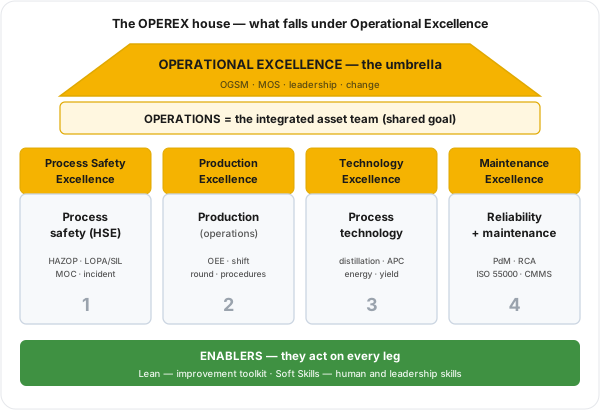 Figure 1 — the OPEREX house: the OE umbrella above integrated operations (the asset team), below it the four functional legs each with its own Excellence cap, and the two enablers in the foundation (own figure).
Who is this for?
Section titled “Who is this for?”This article is for those whose responsibility is not a single discipline but the working of a whole plant or organization: plant and site manager · asset manager · shift supervisor · process technologist · maintenance manager · reliability engineer · HSE manager · Lean/CI program manager · senior executive.
Learning objectives
Section titled “Learning objectives”After reading this article you will be able to:
- draw the OPEREX house, and name the four legs and the two enablers;
- justify why Operational Excellence is an umbrella, and not one leg among the others;
- explain why you must work with all three Lean lenses at once, and what happens if you work with only one;
- classify a specific improvement topic to the right leg and the right lens;
- say where the model’s usefulness ends, and when the house metaphor is misleading.
In brief
Section titled “In brief”- Operational Excellence is the umbrella, not a leg: it integrates the excellence of the four functional areas into a single system.
- The house’s four legs: process safety (Process Safety Excellence), production (Production Excellence), process technology (Technology Excellence), maintenance and reliability (Maintenance Excellence).
- Above the legs stands integrated operations, the asset team: operations, technology and maintenance organized around a shared goal, together with HSE.
- The house’s two enablers in the foundation: Lean as an improvement toolkit and philosophy, and soft skills as a human and leadership skill set. Both act on every leg.
- The three lenses (OS, MI, M&B) are not an option but a condition: if you introduce only the tools, the improvement slides back.
- The model is also the map of the knowledge base: the legs are chapters
20,30,40,50, the enablers are11and12, and the umbrella is10.
Why does it matter? (the stakes)
Section titled “Why does it matter? (the stakes)”The stake of the house model is where you look for the fault when an improvement brings no result. Without a shared frame, every function optimizes within its own leg: maintenance for its own cost, technology for its own yield, operations for its own production number, safety for its own metric. Individually each one “works well,” yet the asset’s performance still does not improve, because the efforts cancel each other out. The rope analogy of the asset team shows the same thing with numbers: with unaligned goals, the resultant force of four people is 1+1+1−1 = 2, i.e. half; with aligned goals it is 1+1+1+1 = 4, i.e. the whole.
The second, even more common stake is durability. Most improvement programs fail not because of a wrong tool choice, but because they introduce only the tools and leave the management routine and the mindset untouched. The improvement shows for a while, then the old state quietly returns. In the language of the house: the walls were raised, but no foundation was poured beneath them.
What falls under Operational Excellence?
Section titled “What falls under Operational Excellence?”Under Operational Excellence fall the four functional excellences, with integrated operations standing above them, and the two enablers beneath. The model condensed into a single sentence:
Operational Excellence = Process Safety Excellence + Production Excellence + Technology Excellence + Maintenance Excellence. The OE frame (strategy deployment, operating rhythm, leadership) integrates it, and the Lean and soft-skills enablers feed it.
The roof: the OE umbrella
Section titled “The roof: the OE umbrella”The roof is the frame that integrates the excellence of the four areas into a single, coherent system. This includes strategy deployment (OGSM, Hoshin), the daily operating rhythm (MOS), and the human side of leadership and change (Lean leadership and coaching, Lean change management). This is what makes OE not a tool and not a program, but the way the organization works.
The beam of the house: integrated operations
Section titled “The beam of the house: integrated operations”Between the roof and the legs sits operations, that is, the integrated asset team. This is one of the most easily misunderstood points of the model, so it is worth separating the two words sharply:
| Concept | What it means | Where it is in the house |
|---|---|---|
| operations (the whole) | the whole integrated unit: operations + process technology + maintenance, together with HSE | the beam above the legs, the asset team |
| operations (the function) | the narrow function: the daily running of the process from the control room and in the field | the core of the Production leg |
Value is not created in the separate performance of the functions, but in their overlap: in the shared work, the shared goal and the shared responsibility.
The four legs (in safety-first order)
Section titled “The four legs (in safety-first order)”- Process safety (Process Safety Excellence). Identifying and managing risk before it becomes an event: HAZOP, LOPA/SIL, management of change, incident and near-miss handling. This is the first leg, because the performance of the rest is meaningless if the plant is not safe.
- Production (Production Excellence). The excellence of operations: OEE, shift handover, the standard operator round, operational risk management, plant housekeeping and operating procedures.
- Process technology (Technology Excellence). The excellence of the process and the technology: the units and process control, the optimization of energy and yield.
- Maintenance and reliability (Maintenance Excellence). Managing the condition and lifetime of the asset: reliability engineering, condition monitoring, work management, asset management.
The foundation: the two enablers
Section titled “The foundation: the two enablers”The enablers stand in the foundation because they do not belong to any one leg separately, but act on all of them:
- Lean (
11): the improvement toolkit and philosophy, from reducing waste through problem solving to performance management. Lean is not “the fifth leg,” but the layer with which you improve any leg. - Soft skills (
12): personal and leadership effectiveness, from self-awareness through communication to team leadership. Without this, the coordination that is the essence of the model does not come about.
Why must you work with all three lenses?
Section titled “Why must you work with all three lenses?”Because on its own no single lens holds a change. The three lenses are three simultaneous viewpoints on the same organization: the operating system (OS) is what we do (the technical configuration of the process); the management infrastructure (MI) is how we steer it (the formal structures, performance management, the daily routine); and mindsets and behaviours (M&B) is how people think, feel and behave. For a durable result all three must be moved at once, not in sequence.
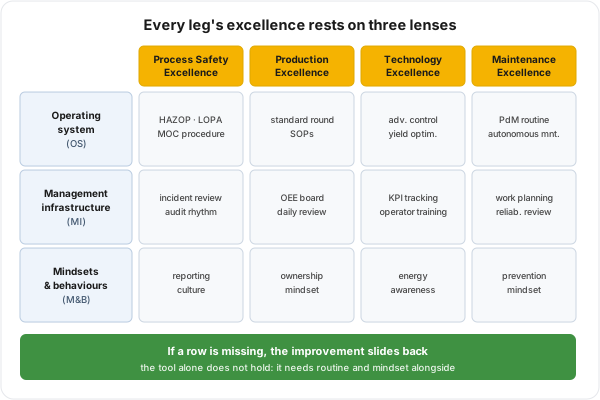 Figure 2 — the matrix of the four legs and the three lenses: the excellence of every leg rests on all three lenses. If a row is missing, the improvement slides back (own figure).
This is the most important message of the model, so it is worth looking at it on a concrete example. In an improvement aimed at energy efficiency, all three lenses move at once on the Technology leg:
- OS: switching on and tuning the advanced control (APC, soft sensor), standardizing the proven practice.
- MI: the operator-training system and the tracking of the performance metric, that is, the routine that measures and holds the use to account.
- M&B: the panel operators’ energy awareness, that is, that they understand that with their own parameters they too influence consumption.
If the control is switched on, but no one measures its use and the operators do not understand why it matters, the technical improvement does not last: the system does not stay in use. The same logic holds on any other leg: the HAZOP report (OS) is worth nothing if there is no one to hold the actions to account (MI), and there is no reporting culture in which people dare to speak up about the deviation (M&B).
How does the house connect to the other chapters?
Section titled “How does the house connect to the other chapters?”The structure of the house is also the structure of the knowledge base: every element of the house has its own chapter, so you can move from the model to the concrete topic in one step.
| House element | Chapter | What you find there |
|---|---|---|
| Umbrella (roof) | OPEREX — Operational Excellence | what OE is, integrated operations and the operating rhythm, strategy deployment and leadership |
| Leg 1: process safety | Process Safety | risk analysis, management of change, incident handling, reliability and resilience |
| Leg 2: production | Production Excellence | performance measurement and yield, shift management, plant housekeeping, operating procedures |
| Leg 3: process technology | Technology Excellence | units and process control, energy and yield, the technological application of Lean |
| Leg 4: maintenance | Maintenance Excellence | reliability engineering, asset condition, work management, asset management |
| Enabler: Lean | Lean and process improvement | arranged by the three lenses: operating system, management infrastructure, mindsets and behaviours |
| Enabler: soft skills | Soft skills | self-awareness, personal effectiveness, communication, team and project leadership |
It is worth noticing that the internal structure of the Lean chapter is the three lenses themselves. This is no accident: if in an improvement you pick a tool from only one sub-chapter, you commit exactly the mistake the section above is about.
Process-industry context and safety
Section titled “Process-industry context and safety”The order of the house is not an aesthetic decision in a process-industry environment. Process safety is the first leg because in a Seveso-classified plant the excellence of the other three will not save the organization from a serious event either, and because safety performance and reliability performance draw on the same discipline: maintained equipment, followed procedures, deviations noticed and reported.
Two boundaries are worth keeping clear:
- The house is a model, not a protection layer. The OE frame and the Lean tools do not replace the safety functions built on risk analysis and the relevant standards (LOPA/SIL, IEC 61511). The model tells you where a topic belongs, not what SIL level is required.
- The owner of reliability is not a single leg. By the principle of “operations-driven reliability,” operations (the shift) is also responsible for the asset’s reliability, and maintenance is an equal partner. That is precisely why the Maintenance leg cannot be developed in isolation from the others.
Introduction in practice (roadmap)
Section titled “Introduction in practice (roadmap)”The house is not a diagram to hang on the wall but a working tool. Use it like this in your own area:
- Draw your own house. Name who is responsible for the four legs in your organization, and who fills the role of the roof (the integration). If there is no name for the integration, that in itself is the diagnosis.
- Classify your running improvements. Write up the current initiatives, and place each one against a leg. Both the clustering and the empty legs are telling.
- Place them on the three lenses too. For each initiative, decide whether it develops the operating system (OS), the management routine (MI) or the mindset (M&B). The matrix of Figure 2 is a ready template for this.
- Look for the empty rows. If every initiative of a leg falls into the OS row, a slide-back is foreseeable there. Complete it with an MI and an M&B element before you go on.
- Tie the goals into a single cascade. The alignment of the legs comes from strategy deployment (OGSM, Hoshin) and the operating rhythm (MOS), not from good intentions.
- Review it again quarterly. The state of the house changes: what was the weakest leg last year may be the strongest today.
Practical exercise. Take the three most recent, died-out improvements in your own area. Classify each one to a leg and a lens, then answer: which lens was missing? It is worth examining separately whether it was really the tool (OS) that was missing, or rather the management routine and the mindset behind it.
Measurement / audit
Section titled “Measurement / audit”The house is not a KPI but a structuring frame, so you do not measure it itself, but what it makes visible:
- Coverage. Of the fields spanned by the four legs and the three lenses, in how many is there a live initiative with an owner and a deadline? The empty fields are the gap.
- Balance. How are resources distributed across the legs, and across the lenses? A strong OS overweight is a forewarning of the slide-back.
- Alignment. Do the goals of the legs come from one cascade, or were they born separately by function? Checkable by tracing the goals back to the shared strategic goal.
- Durability. Of the closed improvements, how many hold their result half a year later? This directly measures the joint presence of the three lenses.
Common mistakes
Section titled “Common mistakes”- Treating OE as a fifth leg. If Operational Excellence is a separate function with a separate team, it becomes a parallel system and dies. Instead: OE is the roof, that is, the way the existing functions work together.
- Seeing the enabler as a leg. Launching a “Lean project” alongside the others is the same mistake. Instead: Lean always works on the concrete problem of one of the legs, not for its own sake.
- Filling only the OS row. Introducing tools without a management routine and a mindset. Instead: assign an MI and an M&B element to every initiative too (Figure 2).
- Narrowing operations down to the operating function. If by “operations” you mean only the operators’ work, the asset-team logic falls apart. Instead: use the operating function for the narrow function, and operations for the integrated unit.
- Putting safety last. Improving process safety “later” is the reverse order. Instead: safety-first, the order of the model is deliberate.
- Drawing the house once. The model is a diagnostic tool; drawn once at a single workshop it remains decoration. Instead: regular review, as in point 6 of the roadmap above.
When NOT to use it? (the limits of the model)
Section titled “When NOT to use it? (the limits of the model)”The house is a strong frame, but not for everything. Knowing where it ends is part of using it correctly:
| Situation | Why the house is not the answer | The right tool |
|---|---|---|
| Solving a specific technical problem | the model classifies, it does not solve | root-cause analysis (the 5 whys), FMEA, DMAIC |
| Designing a safety function | the model is not a certified protection layer | risk analysis, LOPA/SIL, IEC 61511 |
| Replacing an org chart | the house is a logical model, not a hierarchy | the actual organizational and responsibility order (RACI) |
| Internal optimization of a single function | there the integration is not the bottleneck | that leg’s own professional toolkit |
| A very small organization | four separate legs do not exist there | a simplified frame: what we do, how we steer it, how we think |
Rule of thumb: the house is most useful when the problem is between functions, and it is misleading when you need to go deep within a single function.
Take it home (keys)
Section titled “Take it home (keys)”- OE is the roof, not a leg. If you treat it as a fifth function, you build a parallel system that dies.
- Four legs, two enablers. The legs are the disciplines, the enablers (Lean, soft skills) act on all of them.
- Operations is the whole, the operating function is the part. The two words are not interchangeable.
- All three lenses, at once. If you cannot name an MI and an M&B element for one of your improvements, you know in advance that it will slide back.
- The house is also a map. From any element of the house you reach the right chapter in one step.
Self-test
Section titled “Self-test”- Why do we say Operational Excellence is an umbrella, and not a function alongside the four legs? What happens if it is nonetheless treated as a leg?
- In a plant they introduced a new shift-handover template, yet three months later everyone works the old way. Which lenses were missing, and what would you have done differently?
- Where is the difference between “operations (the whole)” and “the operating function,” and in which leg does the second sit?
How does it appear in digital practice?
Section titled “How does it appear in digital practice?”The house model is static on paper, but digitally it becomes a working structure: moving between the legs and tracking the presence of the lenses is exactly what is hard to sustain by hand.
| House element | Digital implementation | What it delivers |
|---|---|---|
| Integrated operations (the beam) | a shared shift record seen by all three functions | the overlap is truly shared, not three parallel logs |
| Four legs | classifying entries as safety, operations, technology and maintenance topics | it becomes visible which leg generates the load |
| Management infrastructure (MI) | a deviation → action → owner → deadline chain, with automatic reminders | the routine does not depend on memory |
| Mindsets and behaviours (M&B) | low-friction reporting, feedback to the reporter | the barrier to reporting decreases |
| Umbrella (the OE frame) | feeding the daily data back to the goal cascade | the path between the strategic goal and the shift becomes closed |
Connection to OPEREX (shift log)
Section titled “Connection to OPEREX (shift log)”The most critical point of the house is the beam where the four legs meet, and in practice this meeting happens shift by shift: operations notices a deviation, technology proposes an intervention, maintenance takes up work, and the safety viewpoint frames all three. If this lives in four separate notebooks or four separate email threads, integration remains intent. The OPEREX shift log makes this meeting a single, shared, retrievable record: the deviation, the triggered action, the owner and the deadline are recorded in one place, visible to every function. This way the coordination of the asset team is measurable not once a year at a workshop, but shift by shift.
Terminology (HU / EN / JP)
Section titled “Terminology (HU / EN / JP)”| Hungarian | English | 日本語 (romaji) |
|---|---|---|
| Működési kiválóság | Operational Excellence (OE) | オペレーショナル・エクセレンス |
| Üzemeltetés (the whole asset team) | Operations (as an organisation) | — |
| Üzemvitel (the narrow function) | Operations (as a function) | 運転 (unten) |
| Eszköz-csapat | asset team | — |
| Folyamatbiztonsági kiválóság | Process Safety Excellence | — |
| Termelési kiválóság | Production Excellence | — |
| Technológiai kiválóság | Technology Excellence | — |
| Karbantartási kiválóság | Maintenance Excellence | — |
| Képessé tevő (enabler) | enabler | — |
| Operatív rendszer | Operating System (OS) | — |
| Vezetési infrastruktúra | Management Infrastructure (MI) | — |
| Gondolkodás és viselkedés | Mindsets & Behaviours (M&B) | 現場 (genba) |
What is the OPEREX house?
A model of what falls under Operational Excellence: under the OE umbrella stand four functional legs (process safety, production, process technology, maintenance), above the legs is integrated operations (the asset team), and in the foundation are two enablers, Lean and soft skills.
Why is Operational Excellence an umbrella, and not a discipline?
Because it does not have its own content but an integrating role: it ties the excellence of the four areas into a single, coordinated system through strategy deployment, the operating rhythm and leadership. If it is treated as a separate function, it becomes a parallel system and dies.
Why is Lean an enabler, and why not a fifth leg?
Because it does not solve the problems of a single discipline but, as a toolkit, acts on every leg: with the same problem-solving, standardizing and performance-management set you can improve safety, production, technology and maintenance alike.
Why is it not enough to work with only one lens?
Because no single lens holds a change on its own. If you introduce only the tools (OS) but the management routine (MI) and the mindset (M&B) stay unchanged, the initial improvement slides back: there is nothing to hold it.
What is the difference between operations (the whole) and the operating function?
Operations (the whole) is the integrated whole, that is, the operating function, process technology and maintenance jointly, together with HSE. The operating function is one of its functions: the daily running of the process from the control room and in the field.
Where should I start introducing the house?
By drawing your own house: name who is responsible for the four legs, and who fills the integrating role. Then classify your running improvements by legs and lenses, and look for the empty fields.
Related concepts
Section titled “Related concepts”Operational Excellence · integrated operations · the three lenses · OGSM · MOS · Hoshin · Lean leadership and coaching · the operating rhythm · HAZOP · OEE · the production reliability program
Next step
Section titled “Next step”Once you have understood the model, from here it is worth going on, in this order:
- Operational Excellence — the concept itself: what operational excellence means, and what management system carries it. The house is the model, this is the content.
- the three lenses — the three lenses in detail: why the improvement slides back if you work with only one.
- the integrated asset team — the integrated asset team: who make it up, how they are led, and why coordination decides.
References / Further reading
Section titled “References / Further reading”- James P. Womack – Daniel T. Jones: Lean Thinking. Simon & Schuster, 1996. — the foundational work on Lean as a framework for organizational improvement.
- Taiichi Ohno: Toyota Production System: Beyond Large-Scale Production. Productivity Press, 1988. — the canonical source of the operating-system (OS) layer.
- ISO 55000 (Asset management) — the international standard frame of the asset-management leg.
- IEC 61511 (Functional safety: Safety instrumented systems for the process industry sector) — the standard for the certified protection layers of the process-safety leg.