Gemba walk
≈ 26 min read · 5,174 words
The defect sheet on the shop floor is full of “A2” codes, the spreadsheet says 22 of them, and at the weekly meeting somebody asks: “What is an A2? Who can fix it?” The answer is silence, then “let’s move on to the next item.” The problem has been there for years and still never gets solved, because everyone is looking at the report rather than at the place where the problem is created. The Gemba walk turns that around: you get up from your desk, go out to where value is actually made, look at the process and the real thing with your own eyes, and work from facts measured on site. Let’s look at what it is, how it differs from an ordinary walk-around, and how to introduce it.
A Gemba walk is a structured visit to the place where value is actually created, so the leader can see the process and the real facts with their own eyes. “Gemba” is Japanese for “the place where things happen”; the walk builds its understanding on that real place, on the real thing and on real data (the 3 Gen principle), not on reports or assumptions. A Gemba walk is neither an inspection nor “management by walking around”: its purpose is learning, respect, and the development of process thinking. The leader’s job is to ask questions (5 Whys, not 1 Who), to answer rarely, and to delegate the responsibility for finding the answers.
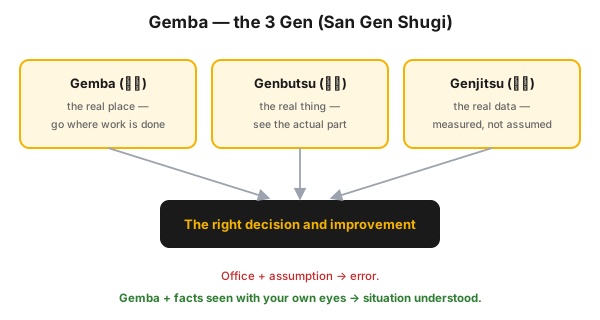 Figure 1 — the backbone of the Gemba walk is the 3 Gen (San Gen Shugi): the real place (gemba), the real thing (genbutsu) and the real data (genjitsu) together lead to the right decision. An assumption made in the office leads to a wrong call; a fact seen with your own eyes leads to a situation understood.
Who is this for?
Section titled “Who is this for?”This article is for people who lead, improve or work in day-to-day operations: shift supervisor and plant manager · process engineer · process and reliability engineer · Lean/CI specialist · HSE · senior manager · team leader and operator.
Learning objectives
Section titled “Learning objectives”After reading this article you will be able to:
- explain what gemba and the 3 Gen (San Gen Shugi) are, and why the decision belongs where the work happens;
- distinguish a Gemba walk from the ad-hoc walk-around of “management by walking around”;
- run a walk end to end using Womack’s question set (every step, flow, 4M, front line, business metrics);
- recognize the three levels of the walk (operational, cross-functional, senior management) and “Gemba phobia”;
- introduce a weekly walk rhythm on one value stream that leads to PDCA actions and an audit trail.
In brief
Section titled “In brief”- Gemba is Japanese for “the place where things happen”: in a factory it is the production area, more generally the place where value is created.
Genbaandgembaare the same word (old-style Hepburn romanization wrote m before b/m/p). - The Gemba walk turns the principle of genchi genbutsu (“go and see”) into a routine: the decision is made at the real place, on the real thing, based on real data (3 Gen / San Gen Shugi).
- The walk runs from one end of a value stream to the other, together with the people involved. Its aim is to understand the situation and prompt action, not to hunt for faults.
- The leader’s role: ask questions (5 Whys, not 1 Who), answer rarely, show respect, and delegate the responsibility for finding the answers.
- The walk cuts across the vertical (functional) grain of the organization in the service of the customer’s horizontal, cross-process need.
- The biggest obstacle is “Gemba phobia”: leaders believe they have to know every answer. They need to be retrained into the questioning, coaching role.
- In the process industry the walk is also a safety tool: a leak, a blocked escape route, a deviation is visible on site but not in a report.
Why does it matter? (the stakes)
Section titled “Why does it matter? (the stakes)”An unsolved problem does not persist because there is no data on it; it persists because the data has come loose from reality. The classic sequence: an operator writes down a fault code, the team leader tallies it on the board, someone types it into a spreadsheet, and by the weekly meeting all that is left is a number. “There were 22 A2 defects last week.” What is an A2? We don’t know. Who will fix it? He’s not in today. What do we do about it? Nothing. Let’s move on. The problem stays reliably with us, because the decision is made at a desk rather than where the defect arises.
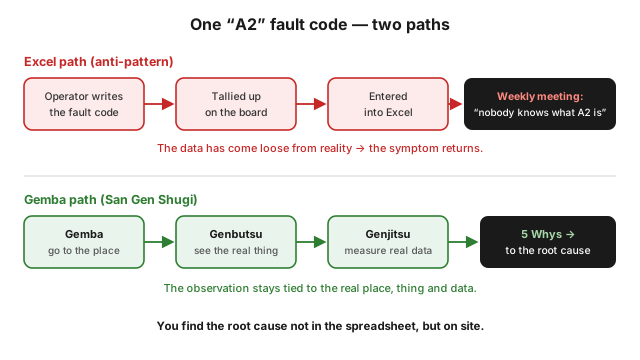 Figure 2 — the same fault code on two paths. On the Excel path the information moves one step further from reality at every hand-off and hits a dead end at the weekly meeting. On the Gemba path the observation stays tied to the real place, the real thing and the real data, so it leads to the root cause.
This is the warning of San Gen Shugi in a single sentence: “Nothing in production is critical when you look at it from the office, and you will never find the root cause in a spreadsheet.” So the stakes are not abstract: whoever leads from reports is treating symptoms while the real cause stays untouched. The price of the walk is a few hours a week; the price of not walking is recurring scrap, the problem that is never solved, and, in the process industry, risk you have never physically seen.
What is a Gemba walk, and how does it differ from management by walking around?
Section titled “What is a Gemba walk, and how does it differ from management by walking around?”A Gemba walk is a structured visit along a value stream, together with the people who work there, using a fixed question set, with the aim of learning and of teaching process thinking. “Management by walking around”, by contrast, is an occasional walk-around, often accompanied by orders. What sets the Gemba walk apart is precisely that it does not look for faults and does not issue commands: it asks questions and looks at the real place, the real thing and the real data.
The Japanese word gemba (or genba) means “the place where things happen”. A Japanese detective uses it for a crime scene; in a factory it is the usual name for the production area. Since the goal is creating value for the customer, we call gemba the place where that value is produced. Genba and gemba are the same word: in traditional Hepburn romanization an n standing before b, m and p was written as m (hence genba → gemba). The modified romanization appeared in the 1950s, but many people still use the traditional form.
The Gemba walk puts the Toyota principle of genchi genbutsu into practice. Loosely translated, genchi genbutsu means “go and see”. The road to understanding does not run through data supplied by others, through reports, or through our own assumptions; we have to satisfy ourselves about the situation with our own eyes, at the place where it happens. This does not mean we should stop asking the people involved or stop discussing the problem with others; it only means that when someone asks us about the situation, we should not say “I heard that” or “I was told that”, but be able to say confidently: “This is what I saw.”
Closely related is 3 Gen / 3G, in Japanese San Gen Shugi (the principle of the three reals):
| Japanese | Meaning | What it means on the walk |
|---|---|---|
| Gemba / genba | the real place | go to where the work happens |
| Genbutsu | the real thing / part | look at the actual product, machine, material |
| Genjitsu | the real fact / data | work from real data measured on site |
How does the walk work in practice?
Section titled “How does the walk work in practice?”A Gemba walk is not a random stroll but literally a walk along a value stream, with the people involved, using a fixed question set. In this formulation the walk means three things at once:
- A walk — literally, one foot in front of the other (though on a large value stream you may need a car or a plane to get between sites);
- it runs from one end of a value stream to the other;
- together with the people who work in the value stream and/or manage it.
The purpose: to understand the situation and assess what needs improving (including collaboration across departments and organizations), and then, armed with that knowledge, to prompt action across the company’s vertical, functional grain. Every organization looks upwards, towards the CEO, while customer value flows horizontally, across several departments. The walk sets itself against that vertical grain in the service of the customer’s horizontal need.
What do we ask during the walk?
Section titled “What do we ask during the walk?”The backbone of the walk is a set of check points worked through in order. At every step (station) we stop and look:
1. Preparing the process
- Which value stream are we focusing on?
- How far are we walking (where does the process start and end)?
- Where do we start, and from which direction? (It doesn’t matter much, but starting from the end, from the customer side, is often best.)
2. For each individual step
- Valuable (or waste)?
- Capable (does it give a good result, every time)?
- Available (does it work when it is needed)?
- Adequate (no bottleneck and no excess capacity)?
- Flexible (fast changeovers)?
3. For the flow
- Does value flow? What is the ratio of lead time to value-creating time?
- What is the share of value-creating steps among all steps?
- Can the customer pull on demand (how large is the work-in-process inventory)?
- Is demand levelled (at one point, planned proactively, so that
muraandmuridisappear)?
4. The result of the whole process
- What are the results of the whole process?
- What does the customer feel and experience, and what does the supplier, with regard to the whole process?
- What is the cost of the whole process?
5. From the 4M perspective
- Man: are they present, trained, multi-skilled?
- Machine: is there proactive maintenance (TPM)?
- Material: does exactly what is needed arrive when it is needed?
- Method: is there standard work within takt time?
6. Front-line management
- How are the value creators supported (relief team leaders, Andon)?
- How are problems acted on: reactively, or proactively as well?
- Is there visual control (status indicators, posted, up-to-date standard work)?
- How are the value creators trained (TWI)?
7. Business metrics and the direction of improvement
- Cost (including rework), quality, customer satisfaction, on-time delivery, responsiveness?
- What needs to be stabilized before improvement is even possible?
- Which steps do we improve, in what order, and who takes responsibility?
What levels and types of walk are there?
Section titled “What levels and types of walk are there?”Not every walk is the same: the operational manager’s daily routine, the cross-functional visit and the rare but high-impact senior management walk are all different.
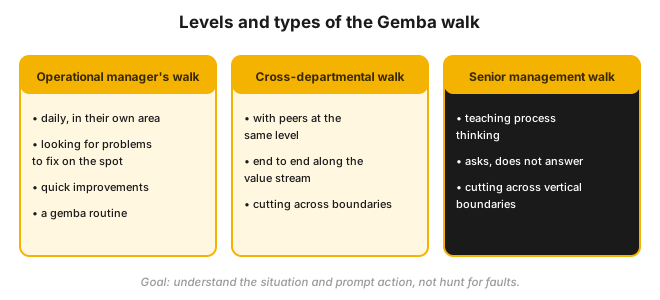 Figure 3 — the three levels of the Gemba walk. The operational manager walks their own area daily; the cross-departmental walk goes end to end along the value stream with peers; the senior management walk teaches process thinking and cuts across vertical boundaries.
- Operational manager: probably already walks their area every day, looking for problems to fix immediately and for quick improvements, and perhaps joins peers daily for a cross-departmental walk.
- Senior manager: in practice usually does not walk, and when they do, they often do more harm than good, because they lack the process and gemba perspective (“the lights are on but nobody’s home”). The value of the senior management walk is precisely that it gives process-minded employees a tool for teaching senior managers to think in processes.
What is the leader’s role on the walk?
Section titled “What is the leader’s role on the walk?”On the walk the leader asks rather than answers: they look for the root cause, not the culprit, and treat everyone involved with respect.
- Ask 5 Whys, not 1 Who (we are looking for the root cause, not a scapegoat).
- Rarely, preferably never, give the answer.
- Show respect towards everyone involved.
- Make it clear that managing the whole process is critical, and that visibility, accuracy, accountability and PDCA are the essence of every value stream.
Useful senior management questions: Which value stream should we choose? Who owns this value stream? (The most common answer: “nobody”.) What is current performance, and is it visible to everyone, do they agree it is correct? How big is the gap to target? What PDCA-based experiments are running to close that gap?
The “strong Genba”: the six building blocks of leadership presence
Section titled “The “strong Genba”: the six building blocks of leadership presence”The Gemba walk is an event; the “strong Genba” is its lasting, systemic version: the state in which leadership is regularly present where value is added, and leads from there too. A 2013 Lean Summit case study (see success factors of a production system) breaks it down into six simple building blocks:
- Genba time — the leader spends planned, calendarized time on the shop floor rather than in the office.
- Simple checklists on the Genba — short, on-site checklists, not complicated systems.
- Meetings on the Genba — hold the meeting where the problem is, not in a meeting room.
- Short, focused audits on the Genba — quick on-site checks that the standards are being followed.
- Visualization and standards — the board and the standard are what make a deviation immediately visible.
- Involving the workforce and cost-effective solutions — at every level, with simple, cheap fixes.
The guiding principle: “Create a Kaizen culture, work consistently, use simple methods, and make your Genba strong.” Weak Genba management leads directly to a lot of muda, an unstable process and high cost; a strong Genba is therefore a precondition for a Kaizen culture and for stable production.
Process-industry context + safety
Section titled “Process-industry context + safety”In continuous process industries (oil processing, chemicals) the control room screen and the daily report give a powerful but deceptive picture of reality. The warning of San Gen Shugi applies here with particular force: you will not find the root cause in a spreadsheet. From the control desk everything may look “green”, while out on site:
- a valve or flanged joint is leaking, evaporating, dripping;
- an escape route or fire-fighting access is blocked;
- a lockout/tagout (LOTO) tag is missing or out of date;
- an operator is using a workaround, because the standard is not realistic;
- there is clutter and a slip hazard around a sampling point.
These are visible on site but not in a report. That is why, in the process industry, the Gemba walk is both an improvement and a safety tool.
The walk is intertwined with other on-site elements: with visual management (status boards, takt displays), with Andon (the problem signals the responsible person immediately), with the standard of 5s (making clutter and hidden risk visible) and with the current-state and future-state maps of vsm (the walk is in fact a “live” VSM snapshot). No specific internal KPI figure or internal designation goes into the public part of the knowledge base, only the methodology.
Putting it into practice (roadmap: pilot → rollout)
Section titled “Putting it into practice (roadmap: pilot → rollout)”The walk is simple but not magic: it is not a one-shot miracle cure but a routine repeated regularly. Changing adult behaviour takes time and requires constant feedback; anyone who promises rapid change is not telling the truth. So the introduction is gradual too.
- Clarify the purpose and the ground rule (about 1 week). Put it on record: the walk is about learning and respect, not auditing or fault-hunting. Announce the ground rule “5 Whys instead of 1 Who”. Pick one value stream as the pilot (preferably a stretch that hurts the customer or is safety-critical).
- Walk the pilot value stream (2–4 weeks). Mark the start and end of the process, and walk backwards from the customer. Take the process owner and the people working there with you. Use the question set above as a checklist, and record every deviation on the spot (what you saw, where, when). The walk should end with 3–5 actions: what, who, by when, with an owner and a deadline.
- Establish a rhythm (a weekly walk). Make the walk a calendar routine (e.g. a fixed time of day, a fixed route rotation). The adult brain learns from the frequency of repetition, not from the intensity of the stimulus: weekly repetition is what builds the habit.
- Add a coaching layer. Learn to hold back your answers and to lead with coaching questions. The most common pitfall here is “Gemba phobia”: the leader was trained to know every answer; they need to be retrained so that their role becomes asking the good question (respectfully) and delegating the search for the answer.
- Spread it vertically. Bring in the higher management levels: process-minded employees use the senior management walk as a “teaching tool” aimed at leaders. Schedule cross-functional walks too, so that the walk cuts across the organization’s vertical boundaries.
- Build it into the management operating system (MOS). Tie the walk to a PDCA cycle: the deviations found trigger experiments, and the next walk verifies them. That way the walk becomes a permanent element of the Lean operating system rather than a separate campaign.
Hands-on / mini-scenario
Section titled “Hands-on / mini-scenario”This is how you would introduce it tomorrow. Pick a 30–45 minute stretch of a value stream where the customer (or the next shift) is complaining. In the morning, after the shift starts, go out there with the process owner and an operator. Start from the end, and at every station ask three questions: “Does this step create value, or is it waste? Is the work flowing here, or standing still? If there is a deviation right now, what on site would show it to me?” Don’t propose a solution; if something doesn’t add up, ask why five times. At the end of the walk write down at most five actions in “what / who / by when” form, and go back at the same time next week to see whether they were closed. That’s all there is to it: one route, one question set, one weekly repetition.
Measurement / audit
Section titled “Measurement / audit”The Gemba walk is a qualitative tool in itself, but its discipline can be measured. A few meaningful indicators (with target-setting logic, without specific internal figures):
| Indicator | Formula / definition | Target logic |
|---|---|---|
| Walk adherence | walks held / walks planned | → 100% (the rhythm is the point, don’t skip) |
| Action closure rate | actions closed on time / open actions | high and stable (the walk leads to action, not to a list) |
| Deviation lead time | average time from finding a deviation to closing it | falling trend (faster response) |
| Leadership participation | share of walks held by senior managers | rising (“Gemba phobia” is easing) |
| 5 Whys ratio | share of deviations taken through to root cause analysis | rising (problem solving is going deeper) |
The quality of the walk is audited by an observation question list tailored to the value stream (the 4M, flow and front-line points above): what matters is not the score but whether at every step we really looked at the real place, the real thing and the real data (3 Gen). The lead time to value-creating time ratio and the share of value-creating steps are the “quantitative output” of the walk, shared with vsm.
Two case studies from the corpus
Section titled “Two case studies from the corpus”The walk is in fact a live VSM snapshot: as a leader or an improvement specialist you already have to walk in order to draw the current state of the value stream and to imagine a better future state.
1. The hidden waste (VSM walk). A VSM-style snapshot of a fuels value stream (from the corpus, for demonstration): crude storage → distillation → intermediate storage → blending → finished product, with OEE, energy consumption, headcount and inventory tracked at each station. A snapshot like this reveals that the share of value-creating time in the total lead time is only a few percent (in the example, out of some 96 days only about 2.3 days were actual value creation, i.e. roughly a 2.3% VA ratio). In such a case the question on the walk is not “who is to blame for all those days of waiting”, but which step is waste, where the flow stops, and what has to be stabilized first before it can be improved.
2. What the average hides (tanker loading). At a tanker loading terminal the “average” hid the real picture: at first sight the solution would have been an investment (a new loading station). On-site observation, however, showed that half the capacity was free, and that simply by scheduling the tankers (levelling, i.e. production levelling) about 20% more tankers and roughly 14% greater loaded volume could be achieved without any investment. That is exactly the point of the walk: the real cause seen on site leads to a different solution than the assumption made behind a desk.
Common mistakes
Section titled “Common mistakes”Each mistake captures an anti-pattern, with the correct practice beside it, tied back to the article’s claims.
- “Management by walking around.” Why it’s a problem: ad-hoc order-giving freezes the shop floor. Instead: the leader asks and learns rather than instructs; the walk is structured and covers one value stream.
- Fault-hunting and looking for a scapegoat. Why it’s a problem: whoever walks with a “1 Who?” question takes away people’s openness. Instead: respect and “5 Whys”, looking for the root cause, not the culprit.
- The walk as a one-off miracle cure. Why it’s a problem: a single walk produces no “magic” result. Instead: the effect comes from the repeated weekly rhythm, because the adult brain learns from the frequency of repetition.
- Gemba phobia in senior management. Why it’s a problem: someone who believes they must know every answer either does not go out, or goes out and “does more harm than good”. Instead: retrain them into the questioning, coaching role, and delegate the search for the answer.
- Walking only vertically. Why it’s a problem: if everyone walks inside their own silo, the customer’s horizontal, cross-departmental need stays invisible. Instead: cross-functional walks that cut across the vertical boundaries.
- Observation without action. Why it’s a problem: if the walk does not produce “what / who / by when” actions and PDCA follow-up, it stays an empty ritual. Instead: 3–5 recorded actions, with owner and deadline, verified on the next walk.
- Working from data instead of the site. Why it’s a problem: “looking for the root cause in Excel” is the negation of San Gen Shugi. Instead: without the 3 Gen (real place, real thing, real data) a walk is not a walk.
When NOT to use it? (limits of the method)
Section titled “When NOT to use it? (limits of the method)”The Gemba walk is a powerful leadership and improvement tool, but it is not the right answer to every problem. Knowing the limits matters as much as the method itself:
| Situation | Why the walk is not the (primary) answer | The right answer | |
|---|---|---|---|
| A certified safety function is required | the walk is not a designed, audited protection layer | design to LOPA/SIL, IEC 61511, HAZOP | |
| The process is not stable, there is no standard | there is nothing to see a deviation against; the walk measures “noise” | standard work and [[5s.en | 5s]] first, then the walk |
| Deep, data-intensive cause analysis is needed (variability, correlation) | on-site inspection is not enough for a statistical cause | [[pdca.en | pdca]] + Six Sigma / data analysis, then on-site verification |
| The purpose is accountability or discipline | the walk is built on learning and trust; used as punishment it destroys trust | HR / management tools, kept separate from improvement | |
| A remote or distributed process (no physical gemba) | there is no single site you can walk | digital gemba: historian, video, remote data + less frequent physical visits |
Rule of thumb: the Gemba walk is at its strongest where there is a repeating, on-site visible process and a stable standard against which the deviation shows up. It does not replace the certified safety system and deep data analysis; it complements them.
Take it home (keys)
Section titled “Take it home (keys)”- Go to where value is made. Make the decision at the real place, on the real thing, from real data (3 Gen), not from a report or an assumption.
- Ask, don’t answer. “5 Whys, not 1 Who”, respectfully, and delegate the responsibility for finding the answer.
- The rhythm is the point. One walk is not magic; the weekly, calendarized repetition is what builds the habit and the culture.
- The walk must produce action. At the end of every visit, 3–5 “what / who / by when” actions, verified with PDCA, otherwise it stays an empty ritual.
- Cut across the silos. You need cross-functional walks, because customer value flows horizontally, across several departments.
- In the process industry it is also a safety tool, but it does not replace the certified HAZOP/LOPA/SIL layers.
Self-test
Section titled “Self-test”- What are the three elements of the 3 Gen (San Gen Shugi), and why is just one of them (e.g. the data alone) not enough for making a decision?
- Name one concrete difference between a Gemba walk and “management by walking around” in the leader’s behaviour.
- A senior manager introduces a weekly walk, but three months later nothing has changed. Based on the article, what are the two most likely causes, and what would you do differently?
How does this show up in digital practice?
Section titled “How does this show up in digital practice?”The principle of the Gemba walk does not stop at the physical visit: the same logic (work from the real place, the real thing and real data, and turn the observation into a traceable action) is also realized in a digital management operating system. The mechanism is different, the principle is the same.
| Gemba principle | Digital implementation | What it adds |
|---|---|---|
| Real data from the site | mobile capture on the gemba (photo, measurement, note taken on site) | the data does not come loose from reality, as it does on the Excel path |
| Observation → action | a “what / who / by when” action tied to the visit, with owner and deadline | the walk is not forgotten but can be tracked |
| PDCA loop | the next walk sees the open actions from the previous one, with status | closure can be verified and measured |
| Rhythm and adherence | a calendarized walk cadence with reminders; held/planned ratio | the weekly rhythm is sustainable and auditable |
| Visual deviation | digital status board, trend, alert on the deviation | the deviation is immediately visible, like a physical Andon |
| Audit trail | a time-stamped, searchable log of who saw what and what they did | it gives authority and evidence for the review |
Connection to OPEREX (shift log)
Section titled “Connection to OPEREX (shift log)”The weakest link in the Gemba walk is follow-up: the deviation you spotted on site and the action you assigned are often lost by the time you get back to the office. The OPEREX shift log SaaS closes exactly this gap: the observation, deviation and action (what / who / by when) uncovered on the walk can be recorded on site, tied to the shift, and retrieved later, so the next walk or the next shift can verify closure. That is what gives the walk its PDCA loop and its audit trail: the walk is not forgotten but becomes a measurable routine.
Terminology (HU / EN / JP)
Section titled “Terminology (HU / EN / JP)”| Hungarian | English | Japanese | Note |
|---|---|---|---|
| a hely, ahol a dolgok történnek | the real place / shop floor | gemba / genba (現場) | genba and gemba are the same |
| menj, nézd meg! | go and see | genchi genbutsu (現地現物) | the founding principle of the walk |
| a három valóság | three reals / actuals | 3 Gen / 3G — San Gen Shugi (三現主義) | gemba + genbutsu + genjitsu |
| a valós tárgy / alkatrész | the real thing / part | genbutsu (現物) | |
| a valós tény / adat | the real fact / data | genjitsu (現実) | |
| Gemba-séta | Gemba Walk | — | a structured on-site visit |
| veszteség / egyenetlenség / túlterhelés | waste / unevenness / overburden | muda / mura / muri | what the walk looks for |
What is the difference between a Gemba walk and "management by walking around"?
“Walking around” is an occasional walk-around, often accompanied by orders. A Gemba walk is structured: it covers one value stream with the people involved, using a fixed question set; the aim is learning and teaching process thinking, not directing or fault-finding.
What does 3 Gen / San Gen Shugi mean?
The principle of the three reals: gemba (the real place), genbutsu (the real thing) and genjitsu (the real data). Its message: nothing in production is critical when you look at it from the office, and you will not find the root cause in a spreadsheet.
Who should do a Gemba walk, and how often?
Everyone, from the front-line supervisor to the senior manager. Operational managers ideally walk their own area daily; cross-functional and senior management walks are less frequent, but they are the ones most missing at senior level, even though that is where their impact is greatest.
How does a Gemba walk help in a process-industry plant?
From the control room every indicator may look “green”, while out on site there is a leak, a blocked escape route or an unrealistic standard. The walk makes these physically visible, which is why it is both an improvement and a safety tool, though it does not replace the certified HAZOP/LOPA/SIL layers.
What is the leader's most important rule on the walk?
Ask, don’t answer. “5 Whys, not 1 Who”, respectfully, and delegate the responsibility for finding the answers. The biggest obstacle is “Gemba phobia”, the belief that the leader has to know every answer.
Related concepts
Section titled “Related concepts”san-gen-shugi | vsm | 5s | kaizen | pdca | andon | standard work | muda-mura-muri | visual management | 5 Whys
Next step
Section titled “Next step”Once you have understood this, it is worth going on from here, in this order:
- san-gen-shugi — the methodological core of the walk (real place, real thing, real data). Start here: you will understand why the good decision is made on site.
- vsm — the value stream map, of which the walk is the “live” snapshot: the current-state and future-state drawings give the walk its direction.
- pdca — the loop that turns a deviation found on the walk into an experiment and a closure, so that the walk does not remain observation without action.
References / further reading
Section titled “References / further reading”- James P. Womack: Gemba Walks. Lean Enterprise Institute, 2011 (expanded edition 2013). — the canonical source for the concept of the Gemba walk and the leader’s role in it; this article also draws on Womack’s 2013 Lean Summit talk in Budapest.
- Lean Enterprise Institute — lean.org — the established, public definitions of genchi genbutsu, gemba and lean leadership.
- Taiichi Ohno: Toyota Production System: Beyond Large-Scale Production. Productivity Press, 1988. — the original Toyota source for genchi genbutsu and the “go and see” mindset.