Mura (unevenness / variability)
≈ 19 min read · 3,711 words
You’re stuck in traffic where the flow now crawls, now surges, now stops — even though no one is braking without reason. Or at the store one checkout has a snaking queue while the one next to it stands empty. Both are the same phenomenon: unevenness. The system does not move steadily and predictably, but in fits and starts — and that is exactly what makes it slow, expensive and irritating. In manufacturing this is called mura (in Japanese ムラ). The idea is simple: wherever the pace of work or the load fluctuates, waste arises — even when the average is fine. Let’s look at what it is, where it comes from, and how it can be eliminated.
Mura is the unevenness of work, load or output — variability that arises from any deviation from the target state. It is one of the three sources of waste (the 3 Mu) in Lean and the Toyota Production System (TPS), alongside muda (waste) and muri (overburden): the process now races, now stands still, or one station is overburdened while another waits. Mura is not a goal in itself but a cause: every mura and every muri ultimately produces muda, so eliminating variability is one of the root-level tools of waste reduction.
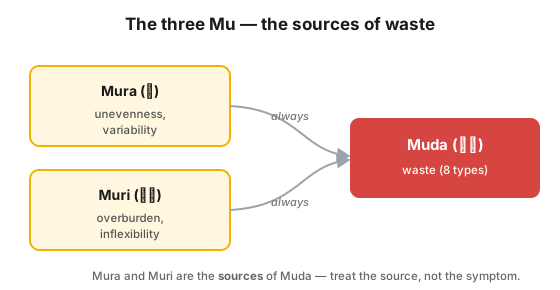 Figure 1 — the three Mu: mura (unevenness) and muri (overburden) are the sources of muda; it is worth attacking waste at its root, at the variability.
Who is this for?
Section titled “Who is this for?”This article is for those who meet production unevenness in practice: operator · shift supervisor · production and plant manager · process engineer · production planner · logistics specialist · Lean/CI specialist.
Learning objectives
Section titled “Learning objectives”After reading this article you will be able to:
- distinguish mura from muda and muri, and explain why it is a cause, not a symptom;
- recognize the two forms of mura (temporal and station-to-station unevenness);
- identify the common sources of variability (from a missing standard to supplier quality);
- choose the right remedy — standard work, line balancing, heijunka — in the correct order;
- justify why heijunka cannot be applied without quick changeover.
In brief
Section titled “In brief”- Mura = unevenness / imbalance / variability; one member of the 3 Mu (muda, mura, muri).
- Mura is a cause, not a consequence: mura and muri always produce muda waste — so it is worth attacking at the root, at the variability.
- Variability arises from any deviation from the target state: a missing or unobserved standard, machine failure, variable supplier quality, process instability, unleveled production, uneven operator load.
- Mura’s chain reaction: variability → quality and delivery problems → forced contingency (inventory, overtime, capacity) → rising cost and a dissatisfied customer.
- Three main remedies: standard work (the internal variability of the work), line balancing (the load across stations) and heijunka (leveling the incoming load) — in this order.
- The prerequisite for heijunka is quick changeover — the leveled product mix requires many changeovers, which a short changeover time makes possible.
Why it matters (the stakes)
Section titled “Why it matters (the stakes)”Unevenness does not seem expensive on its own — the trouble is the chain reaction it sets off. Variability leads to a quality defect or a delivery slip toward the customer; whoever wants to avoid that is forced to build contingency (inventory, overtime, spare capacity) — which is itself muda and costs money. So mura punishes twice: if you do not defend against it, your customer suffers; if you defend against it with contingency, you pay for it.
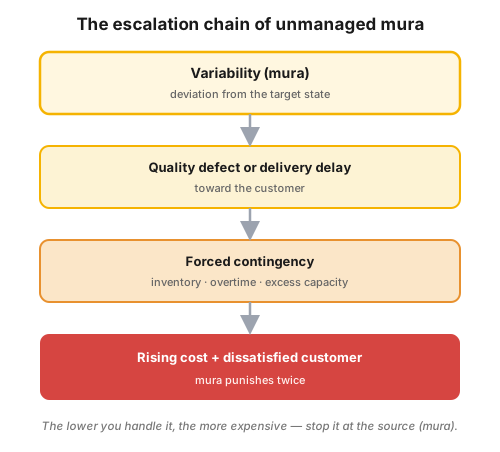 Figure 2 — the escalation of unmanaged mura: the lower down the chain you handle it, the more expensive. Best of all is to stop it at the source — at variability itself.
The lesson is the same as with built-in quality: the cheapest unevenness is the one you eliminate at its source. That is why it pays to invest in stability, rather than papering over its consequences at the end with contingency.
What is mura, and how is it different from muda and muri?
Section titled “What is mura, and how is it different from muda and muri?”Mura is the unevenness; muda is the waste that arises from it, and muri is the overburden — together the three are the Toyota Production System’s three “Mu”. They are often regarded as “the three kinds of waste,” but this is imprecise: since it is the word muda that we translate as waste (and that has seven or eight kinds — see muda), it is better to keep the name 3 Mu and treat mura and muri as a separate category of causes.
| Mu | Hungarian | English | Meaning |
|---|---|---|---|
| Muda | veszteség / pazarlás | waste | activity that consumes resources but creates no value |
| Mura | egyenetlenség / kiegyensúlyozatlanság | unevenness, inconsistency, variation | fluctuation of load / output / work |
| Muri | túlterheltség | overburden, unreasonableness | an unreasonable demand beyond the capability of a person or machine |
The key connection: mura and muri always produce muda. This is why the concept of muda, and the activity aimed at eliminating waste, became the most widespread — but whoever chases only muda treats the symptom. Mura and muri are the cause side that produces the symptoms.
Another frequently used Lean framework looks at the process through three lenses: waste, variability and inflexibility. This grouping is independent of the 3 Mu — here inflexibility is not muri but the rigidity of the process (the inability to switch mix or volume) — yet variability is a distinct, prominent target in this framework too. Variability is defined here precisely as any deviation from the target operating conditions, which degrades quality and delivery.
How does mura show up in practice?
Section titled “How does mura show up in practice?”Mura takes on two faces — in time and in space — and feeds on the most varied sources. First the two forms it takes, then the list of sources, and finally how it runs through the system.
The two forms of mura
Section titled “The two forms of mura”- Temporal unevenness — the same process now races, now stands still. Its typical cause is fluctuating or bursty production scheduling (e.g. end-of-month rush production, the characteristic “hockey-stick” curve).
- Spatial / station-to-station unevenness — the load on workstations or operators is not equal; some are overburdened (muri), others wait (muda). This is caused by imbalance of the production line, and it is the classic source of waiting among the seven wastes: because the line is unbalanced, operators wait on one another.
The sources of variability
Section titled “The sources of variability”Variability arises from any deviation from the target state. The practical list of sources:
- No standard exists (no work instruction, machine setting, process description)
- Not following the standard (deviation from the work instruction, machine setting, process)
- Process instability (process instabilities)
- Machine failure and slowing machine (machine breakdown, machine runs slower)
- Variable supplier quality (bad or inconsistent supplier quality) → rising scrap rate
- A product characteristic that leaves the specification (e.g. weight exceeds the upper specification limit, USL)
- Unleveled production (unleveled production)
- Low operator engagement in the task (lack of operator engagement)
- Long internal distances (between departments, workstations)
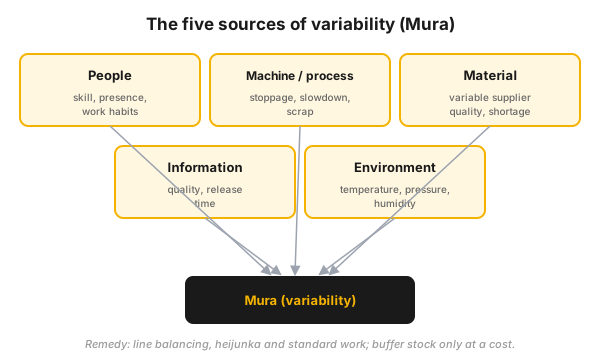 Figure 3 — the five source families of variability (an Ishikawa-style grouping of sources): people, machine/process, material, information and environment all feed mura; the remedy is leveling and standard work, not the buffer.
How does mura become expensive? The damage chain
Section titled “How does mura become expensive? The damage chain”Variability does not stay local — it runs through the whole system (Figure 2). Mura leads to a quality or delivery problem toward the customer, and adds cost to the system. Whoever does not want to fail toward the customer builds contingency — inventory or spare capacity — which is itself muda. This is how the double punishment comes together: the lack of defense burdens the customer, defending with contingency burdens the manufacturer.
How can mura be eliminated?
Section titled “How can mura be eliminated?”With three main tools that attack variability at three different levels. The correct order of introduction goes from the inside out: first the internal fluctuation of a single operation, then the unevenness between stations, and finally the smoothing of the incoming load.
| Tool | What it levels | Mechanism | |
|---|---|---|---|
| **[[standard-munka.en | standard work]]** | the variability of the work activities | a fixed, repeatable best method in every cycle |
| Line balancing | the load on operators across stations | the work elements are distributed so that every load falls close to the takt time | |
| Heijunka (leveled production) | the daily production quantities and types | in the smallest possible time unit we produce the quantity and mix that match average customer demand |
The three tools act on three levels: standard work eliminates the internal (cycle-to-cycle) variability of a single operation; line balancing the unevenness between stations; heijunka the temporal unevenness of the incoming load.
Process-industry context + safety
Section titled “Process-industry context + safety”In a continuous-operation, process-industry environment mura appears with a different face than in discrete manufacturing, but the logic is the same:
- Load fluctuation (feed rate swing): the fluctuating load on the feed of a continuous-operation unit (distillation column, reactor, heat-exchanger train) is mura. Deviation from the target state (stable load, temperature, pressure) degrades yield and quality — exactly per the “deviation from target operating conditions” definition.
- Variable feedstock quality: the quality spread of the feed is the process-industry equivalent of “inconsistent supplier quality” — left unmanaged it causes recipe and quality fluctuation, off-spec product.
- Stability as a safety foundation: Lean stability logic and process safety pull in the same direction — a leveled, standardized, predictable operation means fewer transient states, fewer manual interventions and fewer near-miss situations. Reducing variability is at once an OEE and a safety gain.
Putting it into practice (roadmap)
Section titled “Putting it into practice (roadmap)”Mura reduction is not a one-step action but a stabilization journey. Suggested order (who / what / in what order):
- Make mura visible (pilot area, 1–2 weeks). Who: the area’s team leader + a Lean supporter. What: measure output or cycle time per time unit (shift / hour) and plot the curve. The goal is not the average but showing the spread — variability often becomes visible only at a fine temporal resolution; a weekly average hides it.
- Stabilize with standard work (the cause side first). What: the most common source of variability is a missing or unobserved standard. Introduce or update standard work and check its observance before reaching for a more complex tool. This is the cheapest mura reduction.
- Level the load across stations (line balancing). What: create an operator-balance chart of the current state, determine the efficiency of the work distribution, then redesign the allocation of operations so that every load falls below and close to the takt time. Try it and correct.
- Smooth the incoming load with heijunka. What: introduce leveled production — leveling of quantity and type according to average customer demand. Prerequisite: quick changeover, because the leveled product mix requires many changeovers.
- Roll out and sustain. What: standardize the lessons of the pilot, carry them to the next area, and build monitoring of the mura metric into daily visual management / the gemba walk so it does not slip back.
Hands-on / example — the heijunka smoothing
Section titled “Hands-on / example — the heijunka smoothing”The classic worked example shows well how heijunka eliminates temporal mura. Monthly demand (20 working days):
| Type | Monthly demand | Daily demand |
|---|---|---|
| A | 18,000 pcs | 900 pcs/day |
| B | 14,000 pcs | 700 pcs/day |
| C | 10,000 pcs | 500 pcs/day |
Without heijunka (assuming a batch of 100) the production sequence runs in large, consolidated blocks:
AAAAAAAAABBBBBBBCCCCCHere only 2–3 changeovers per day are needed — but production is uneven: while A runs, B and C stand still, whereas customer demand is continuous. This is mura (and overproduction / inventory of one type, shortage of another).
With heijunka, if we truly produce in leveled batches of 100, the sequence is smoothed:
ABCABACBACABABCABACBANow production, in any short period, delivers the mix of average customer demand — the temporal unevenness disappears. The price: 20 changeovers a day instead of 2–3, meaning the time required for a type change must be cut to one tenth.
Homework. Choose a recurring, uneven output in your own area. Measure it hourly/per shift over a week, plot the curve, and mark: which source (a missing standard, unbalanced load, variable material) causes the greatest spread — and which remedy (standard work / line balancing / heijunka) you would start with.
Measurement / audit
Section titled “Measurement / audit”Mura is by its nature spread-like, so the focus of measurement is not the average but the fluctuation:
-
Output stability: the deviation of actual hourly / per-shift output from plan. Where the output rate (end-of-line rate) differs from the takt time, there is mura: if the rate is faster than takt and we do not stop the line when the plan is reached, overproduction (muda) arises; if it is slower, the line underperforms.
-
Operator balance: the operator-balance chart shows how even the load is across stations. The goal: every column close to takt time, with minimal spread.
A useful formula for line balancing:
required workforce = total net time required [TU]─────────────────────────────takt time -
Changeover time / batch size: since heijunka only works with quick changeover, a reduction in changeover time and batch size is an indirect mura metric.
Target logic: the goal is not an absolute number but a trend-like reduction of the spread at an unchanged average. If average output is the same but the hourly spread decreases, mura has decreased — less forced contingency (inventory, overtime) will be needed.
Common mistakes
Section titled “Common mistakes”- You chase only muda, not mura. You treat the symptom (waiting, inventory, scrap) while the cause — variability — reproduces it. Instead: mura and muri are the cause side; attack there, at the source.
- You “manage” mura with contingency. You cover the unevenness with buffer stock or overtime. Instead: this is not elimination but mura made more expensive — contingency is itself muda; eliminate the cause.
- Heijunka without quick changeover. You want a leveled product mix, but changeover is long, so either the many changeovers do not fit or every changeover is waste. Instead: first SMED, then heijunka.
- You measure with the average. The weekly/monthly average hides the essence of mura. Instead: measure the spread at a fine temporal resolution (hour/shift) — only this reveals the fluctuation.
- Line balancing on an unstable process. If there is no standard work, the operation times themselves scatter. Instead: first stabilize the operation with standard work, only then balance the line.
- You do not address the lack of a standard. You ignore the most cheaply remediable source of variability. Instead: start here — without an introduced and observed standard you chase the same problem with more expensive tools.
- You ignore the mura → muri chain. A load peak can push a person or a machine beyond their capability. Instead: stabilize, because the consequence is injury, illness or equipment failure — in a process plant, a safety event.
When NOT to use it (the limits)
Section titled “When NOT to use it (the limits)”The mura tools are strong but not the right answer to every problem. Knowing when a different tool is needed is just as important as the method itself:
| Situation | Why (primarily) not a mura tool | The right answer | |||
|---|---|---|---|---|---|
| The problem is pure waste, not fluctuation (e.g. a superfluous step) | there is nothing to “level” here | direct [[muda.en | muda]] removal ([[vsm.en | VSM]], [[kaizen.en | kaizen]]) |
| The root is overburden (person/machine beyond capability) | smoothing eases the symptom, not the cause | relieving [[muri.en | muri]]: ergonomics, capacity, sizing | ||
| A one-off, non-recurring fluctuation | there is nothing to build durably into the process | a one-off root-cause analysis, recording the lesson | |||
| Demand itself is extremely scattered and cannot be smoothed | heijunka cannot “invent” customer demand | demand management, flexible capacity, deliberate buffer planning |
Rule of thumb: the mura tools are strongest for recurring fluctuation measurable against a standard. For pure waste, overburden or a one-off deviation they do not replace the appropriate tool — they complement it.
Key takeaways
Section titled “Key takeaways”- The average lies — mura lives in the spread. If you measure only the average, you do not see the unevenness.
- A cause, not a symptom: waiting, inventory and scrap are produced by mura. Fix there, do not cover up the consequence.
- From the inside out: first standard work (internal), then line balancing (between stations), finally heijunka (incoming load).
- Contingency = hidden mura. Buffer and overtime are not a solution but unevenness paid for in money.
- Heijunka does not work without SMED — the leveled mix requires many changeovers, which only quick changeover makes cheap.
- In the process industry, stability is also safety — reducing mura means fewer transients and near-misses.
Self-check
Section titled “Self-check”- What is the difference between mura, muda and muri, and why do we say that “mura and muri always produce muda”?
- A line’s average hourly output is on plan, but the individual hours scatter strongly. Is there mura, and if so, why is it expensive even when the average is fine?
- Why must standard work be introduced before line balancing and heijunka — what would happen in the reverse order?
How does this show up in digital practice?
Section titled “How does this show up in digital practice?”Managing mura does not end on the production line: variability is most dangerous where it is invisible — and that is exactly what a well-designed digital operation makes visible. Instead of the physical stopwatch and the paper curve, here time-series data, a load dashboard and deviation alerts reveal the fluctuation — the mechanism differs, the principle is the same.
| Mura principle | Digital implementation | What it delivers |
|---|---|---|
| Making temporal unevenness visible | time-series output/cycle-time trend, shift-level breakdown | the spread becomes visible; the average does not hide it |
| Station-to-station unevenness | operator/machine-load dashboard | the overburdened and the waiting station can be identified |
| Recording standard work | digital work instruction / template | cycle-to-cycle variability decreases |
| Leveled scheduling | leveling / heijunka scheduler module | the incoming load can be smoothed to average customer demand |
| Deviation alert | threshold-based alert on planned vs. actual rate | mura surfaces as it arises, not after the fact |
Connection to OPEREX (shift log)
Section titled “Connection to OPEREX (shift log)”Mura is by its nature a time-series, shift-level phenomenon — exactly the resolution a shift log records. In the OPEREX shift-log SaaS, from the time series of output, cycle time, stoppages and events recorded per shift, mura can be made visible: the variation between shifts and within a shift appears, whereas a consolidated daily/weekly average KPI would hide it. This way variability is not an anecdote (“the afternoon shift fell behind again”) but a measured, trendable metric for which a stabilizing measure (standard work, leveling) can be planned and whose effect can be re-measured from the data of the following shifts.
Terminology (HU / EN / JP)
Section titled “Terminology (HU / EN / JP)”| Hungarian | English | 日本語 / romaji | Note |
|---|---|---|---|
| egyenetlenség, kiegyensúlyozatlanság, változékonyság | unevenness, inconsistency, variation, variability | ムラ / mura | one of the 3 Mu |
| veszteség, pazarlás | waste | ムダ / muda | the consequence of mura |
| túlterheltség | overburden, unreasonableness | ムリ / muri | a frequent companion of mura |
| kiegyenlített termelés | level(ed) production, production smoothing | 平準化 / heijunka | the main remedy for mura |
| gyártósor-kiegyenlítés | line balancing | Austaktung (DE) | leveling the load across stations |
| standard munka | standard work / standardized work | 標準作業 / hyojun sagyo | eliminating cycle variability |
What is mura, simply put?
The unevenness — when the pace of work, load or output fluctuates because of any deviation from the target state. The process now races, now stands still; or one station is overburdened while another waits.
What is the difference between muda, mura and muri?
Muda is waste (activity that creates no value), mura is unevenness (load fluctuation), muri is overburden (a demand beyond capability). Mura and muri are causes that in every case produce muda (waste) — which is why the 3 Mu must be handled together.
Why is mura bad if average production is fine?
Because variability leads to a quality or delivery problem toward the customer, and whoever wants to avoid it is forced to build contingency (inventory, overtime, excess capacity) — which is itself cost and waste. Mura punishes even when the average is good.
How can mura be eliminated?
With three main tools, in this order: standard work (eliminating the cycle-to-cycle variability of the work), line balancing (balancing the load on operators) and heijunka (leveling the daily quantity and product mix).
Why does heijunka not work without SMED?
Because the leveled product mix multiplies the number of daily changeovers (in the classic example 20 instead of 2–3). This only fits without waste if you cut the changeover time to a fraction — which quick changeover provides.
Related concepts
Section titled “Related concepts”muda | muri | muda-mura-muri | the three types of activity | standard work | smed | pull system | jidoka | oee | TPS origins
Next step
Section titled “Next step”If you have understood this, from here it is worth going on — in this order:
- standard work — the first and cheapest remedy for mura: how you eliminate the internal variability of the work before reaching for a more complex tool.
- smed — quick changeover, the hard prerequisite of heijunka: without it the leveled mix turns into waste.
- pull system — heijunka as a full leveling mechanism in the pull system: here the smoothing of the incoming load comes together at the system level.
References / further reading
Section titled “References / further reading”- Taiichi Ohno: Toyota Production System: Beyond Large-Scale Production. Productivity Press, 1988. — the canonical foundational work on the muda–mura–muri triad and production leveling.
- James P. Womack – Daniel T. Jones: Lean Thinking. Simon & Schuster, 1996. — waste and variability as the targets of Lean, with practical case studies.
- Jeffrey K. Liker: The Toyota Way. McGraw-Hill, 2004. — heijunka (leveling) as Principle 4, with a detailed treatment of the mura–muri–muda connection.
- Lean Enterprise Institute: Lean Lexicon (Marchwinski – Shook, eds.). — the established definitions of mura, heijunka, line balancing.